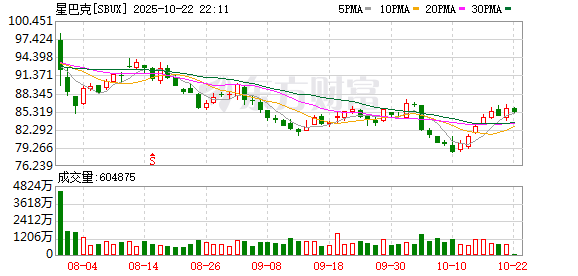
STARBUCKS(04337)

Search documents
星巴克(SBUX.US)复苏迹象初现!Q4营收超预期 同店销售重回正增长
Zhi Tong Cai Jing· 2025-10-29 23:47
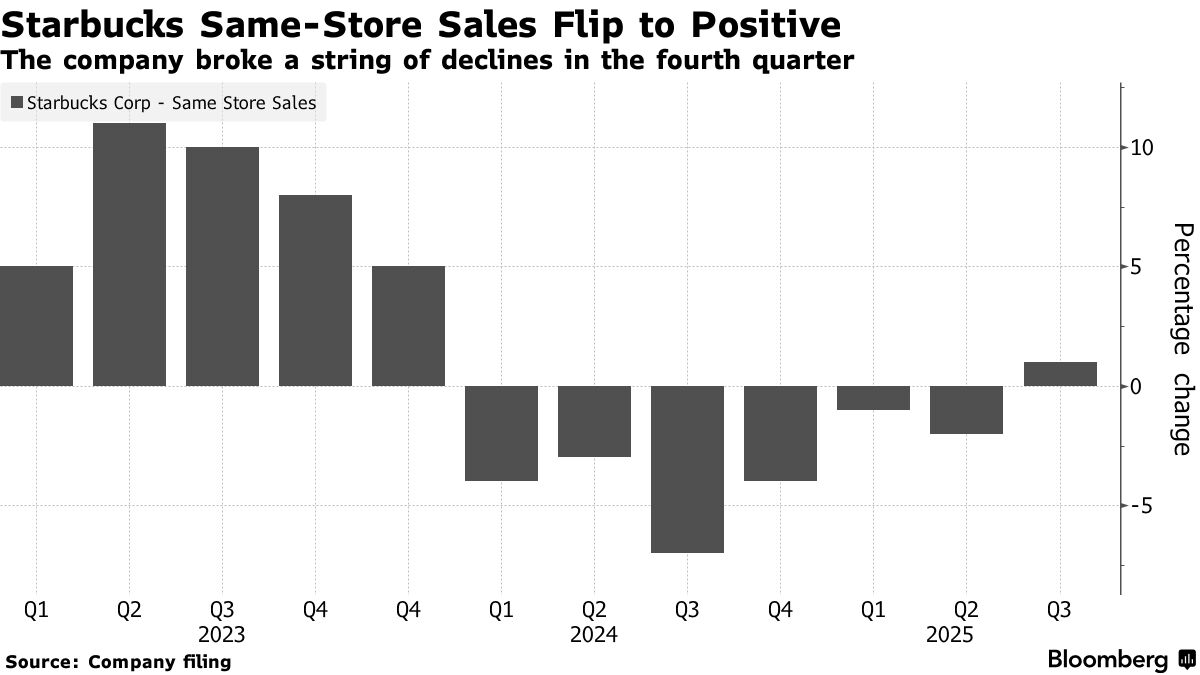
Core Insights - Starbucks has achieved positive same-store sales growth for the first time in over a year, indicating that the company's efforts to turn around its performance are beginning to show results [1] - The company's net revenue for Q4 of fiscal year 2025 increased by 5.5% year-over-year to $9.57 billion, surpassing market expectations of $9.34 billion [1] - Same-store sales rose by 1%, better than the anticipated decline of 0.48%, ending a six-quarter streak of declines, primarily driven by strong international market performance [1] Financial Performance - Adjusted earnings per share were $0.52, falling short of market expectations of $0.55 [3] - The adjusted operating margin decreased by 900 basis points year-over-year to 9.4%, mainly due to coffee prices, tariffs, and investments in labor during the transformation process [3] Strategic Initiatives - Starbucks is streamlining its menu by eliminating unpopular drinks and replacing them with products that better align with consumer preferences [3] - In Q4, the company closed 627 stores, with over 90% located in the U.S., resulting in a net decrease of 107 stores despite new openings [3] - The company has renovated only 70 stores, primarily in New York and Southern California, but plans to accelerate this process, aiming to complete renovations on over 1,000 stores by the end of the current fiscal year [3] Leadership and Future Outlook - CEO Brian Niccol expressed optimism about the current improvements in sales and transaction volumes, indicating that the revival plan is showing initial success [3] - Starbucks has not provided performance guidance but plans to present its outlook for fiscal year 2026 and beyond at an investor day in late January [4] - The CFO anticipates that higher coffee costs will continue to be a negative factor in the first half of fiscal year 2026 [4]

星巴克第四季度净营收96亿美元 高于市场预期
Xin Lang Cai Jing· 2025-10-29 20:24
Core Insights - Starbucks reported fourth-quarter net revenue of 9.6 billion USD, exceeding market expectations of 9.34 billion USD [1] - Same-store sales growth was 1%, while a decline of 0.48% was anticipated [1] - Adjusted earnings per share were 0.52 USD, slightly below the forecast of 0.55 USD [1]
瑞穗首予星巴克84美元目标价

Ge Long Hui· 2025-10-29 03:55
Core Viewpoint - Mizuho initiates coverage of Starbucks with a "Neutral" rating and sets a target price of $84 [1] Company Summary - Mizuho's analysis indicates a cautious outlook on Starbucks, reflected in the "Neutral" rating [1] - The target price of $84 suggests a moderate expectation for the company's stock performance in the near term [1]
据报博裕出价击败凯雷,成为收购星巴克中国业务控股权的领跑竞标者
Ge Long Hui A P P· 2025-10-29 02:25
Core Viewpoint - Starbucks is in the process of seeking a partner for its China business, with private equity firm Boyu Capital emerging as the leading bidder, potentially valuing the business at over $4 billion [1] Group 1: Bidding Process - Boyu Capital's bid has outperformed other private equity firms, including Carlyle Group, in the competition to acquire a controlling stake in Starbucks' China operations [1] - The valuation of Starbucks' China business in this transaction could exceed $4 billion [1] Group 2: Negotiation Timeline - Starbucks and Boyu may require several months to negotiate terms and finalize the agreement, although a definitive agreement is not guaranteed [1] Group 3: Participation of Other Firms - Other companies, including internet firms, may participate as limited partners to help co-finance the transaction [1] - Starbucks has received strong interest from multiple high-quality partners who recognize the long-term growth potential of the brand in the Chinese market [1] Group 4: Current Status - Starbucks is currently evaluating five bidding proposals but has not confirmed whether Boyu is in a leading position [1]
传博裕资本领跑星巴克(SBUX.US)中国业务竞购 估值或超40亿美元
Zhi Tong Cai Jing· 2025-10-28 13:25
Core Insights - Boyu Capital has emerged as the preferred partner for Starbucks' (SBUX.US) China business acquisition, with a potential valuation exceeding $4 billion [1][2] - The deal is part of Starbucks' efforts to revitalize its operations in its second-largest market, China [1] - Negotiations between Starbucks and Boyu Capital may take several months, and there is no guarantee that a deal will be finalized [1] Company Overview - Starbucks opened its first store in mainland China in 1999 and currently operates approximately 7,800 stores across over 250 cities [2] - The company aims to increase its store count in China to 20,000, despite facing intense competition from local brands, particularly Luckin Coffee (LKNCY.US) [2] - Starbucks' CEO Brian Niccol indicated that the process of bringing in new investors has attracted over 20 potential investment parties [2] Investment Landscape - Other private equity firms involved in the bidding for Starbucks' China business include Carlyle, Yintai Group, FountainVest Partners, KKR, Hillhouse Capital, and Primavera Capital [2] - Boyu Capital, founded in 2011 and headquartered in the Cayman Islands, focuses on private equity, public market equities, real estate, and infrastructure investments, with a primary focus on technology, consumer retail, and healthcare sectors [2]
博裕资本寻求收购星巴克中国的控股权
Ge Long Hui A P P· 2025-10-28 11:55
Core Viewpoint - Starbucks (SBUX.US) considers Boyu Capital as the leading bidder for its China operations, with a potential valuation exceeding $4 billion for Starbucks China [1] Group 1 - Boyu Capital is seeking to acquire a controlling stake in Starbucks China [1] - Boyu's bid for Starbucks China reportedly exceeds that of other bidders, including Carlyle [1]
探索“咖啡+文旅” 星巴克云南咖啡主题航班完成首航
Bei Jing Shang Bao· 2025-10-27 06:12
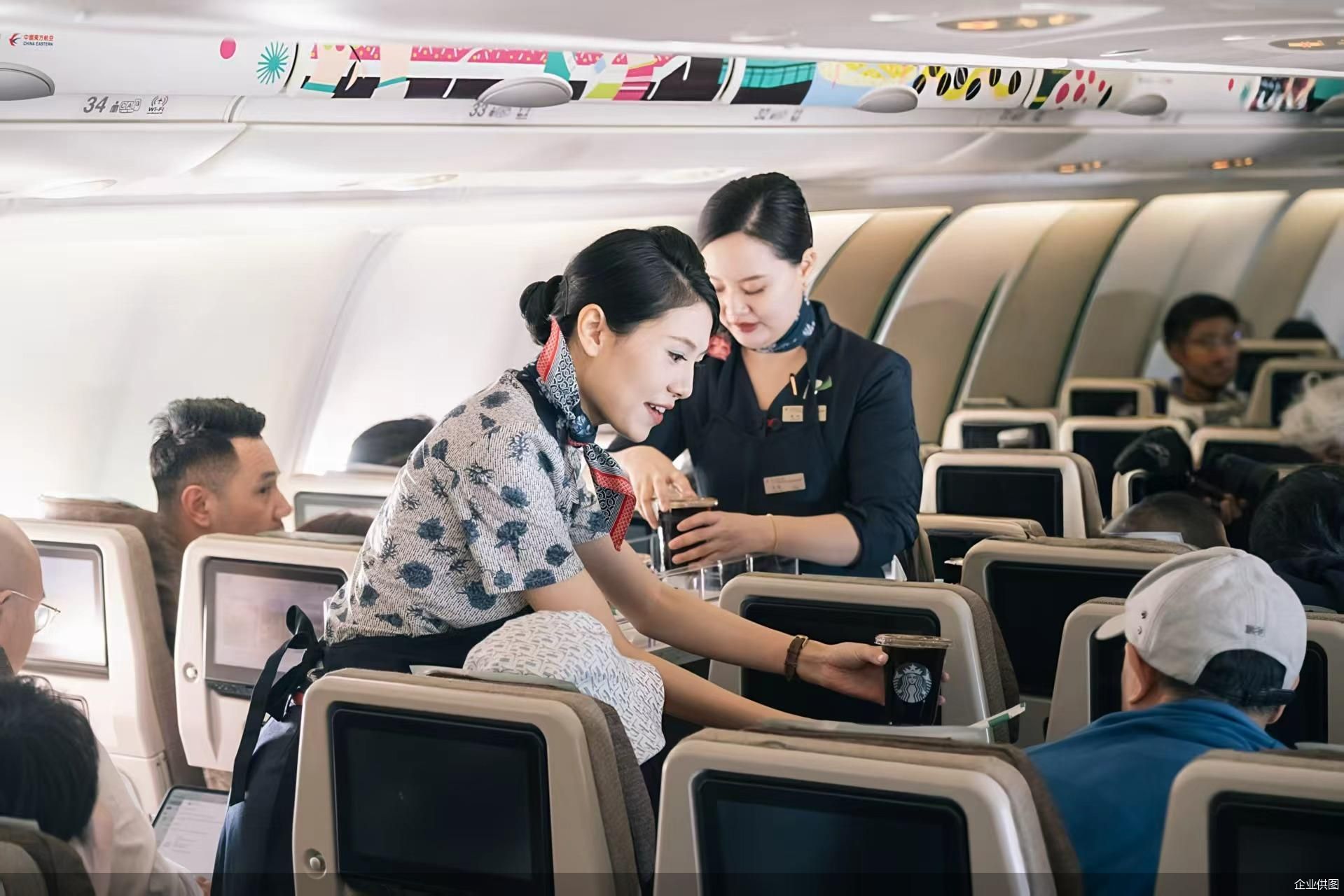
Core Insights - Starbucks China and China Eastern Airlines have launched the "Yunnan Coffee Themed Flight," marking a new collaboration in the "coffee + travel" sector [1][3] - The inaugural flight features a cabin theme of "Every Cup, From Yunnan," showcasing the journey of Yunnan coffee from bean to cup [1] - Passengers on the inaugural flight received exclusive gifts and enjoyed cold brew coffee made from Starbucks' selected Yunnan Menglian sun-dried Bourbon coffee beans [1] Group 1 - The partnership between Starbucks China and China Eastern Airlines aims to leverage complementary resources, focusing on co-creation in the Yunnan coffee sector [3] - The Yunnan coffee themed flight is a significant part of this collaboration, which was officially announced in July [3] - Starbucks has been exploring the integration of "coffee + cultural tourism," with initiatives such as the "Shared Value Beautiful Star Village" project in Yunnan, which received over 17 million yuan in donations [3] Group 2 - In August 2024, Starbucks plans to launch the "Shared Value Seeking Beans Yunnan" project to support ten coffee-growing villages in the Pu'er region, focusing on talent and cultural revitalization [3] - The company has also opened several intangible cultural heritage concept stores in cities like Hangzhou, Nanjing, and Suzhou, and established themed stores in popular tourist destinations such as Dunhuang and Jiuzhaigou [3]

星巴克开启咖啡原产地文旅体验 “云南咖啡主题航班”顺利首航
Jing Ji Wang· 2025-10-24 01:20
Group 1 - Starbucks China has launched a new collaboration with China Eastern Airlines, introducing a Yunnan coffee-themed flight, MU5814, which successfully completed its inaugural journey [1] - Over 200 passengers on the inaugural flight enjoyed cold brew coffee made from Starbucks' selected Yunnan Menglian sun-dried Bourbon coffee beans in a specially designed cabin [1] - The partnership aims to leverage complementary resources, focusing on co-creation in the Yunnan coffee sector and exploring the integration of coffee and travel industries [1] Group 2 - In recent years, Starbucks China has been exploring the "coffee + cultural tourism" concept, investing over 17 million yuan in the "Shared Value Beautiful Star Village" project in Yunnan, aimed at rural revitalization through coffee-themed integration of agriculture, culture, and tourism [2] - In August 2024, Starbucks plans to launch the "Shared Value Seeking Beans in Yunnan" project, committing 4 million yuan to support 10 coffee-growing villages in Pu'er, focusing on talent and cultural revitalization [2] - In September, Starbucks announced a collaboration with Xiaohongshu to create an "Interest Community Space" project [2]
消息称星巴克员工联合组织将于本周五启动罢工授权投票
Xin Lang Cai Jing· 2025-10-23 10:19
Core Viewpoint - Starbucks employees' union plans to initiate a strike authorization vote this Friday, indicating rising labor tensions within the company [1] Labor Relations - Over 100 labor complaints, store protests, and strikes have been reported this year, reflecting significant unrest among Starbucks employees [1]
星巴克中国与东方航空合作后进行全新跨界 打造云南咖啡主题航班
Xin Jing Bao· 2025-10-22 14:10
Core Insights - Starbucks China has announced a comprehensive partnership with China Eastern Airlines, focusing on the integration of coffee and travel industries, particularly through the creation of Yunnan coffee-themed flights [1][2]. Group 1: Partnership Details - The collaboration aims to leverage complementary resources, with a significant focus on co-creating Yunnan coffee experiences [1]. - The inaugural flight, MU5814, successfully took off, featuring a specially decorated cabin where over 200 passengers enjoyed cold brew coffee made from Starbucks' selected Yunnan Menglian sun-dried Bourbon coffee beans [2]. Group 2: Thematic Flight Experience - Passengers on the inaugural flight received exclusive gifts, including themed neck pillows, earplugs, Starbucks and Eastern Airlines co-branded badges, themed refrigerator magnets, and a Yunnan coffee manual [3]. - The Yunnan coffee-themed flights will operate for a month, expanding to more routes following the successful first flight [3]. Group 3: Community and Cultural Initiatives - Starbucks China has been actively exploring the "coffee + cultural tourism" model, having invested over 17 million yuan in the "Shared Value Beautiful Star Village" project in Yunnan, aimed at rural revitalization through coffee-themed integration of agriculture, culture, and tourism [3]. - In August 2024, Starbucks plans to launch the "Shared Value Seeking Beans Yunnan" project, committing 4 million yuan to support 10 coffee-growing villages in Pu'er, focusing on talent and cultural revitalization [3]. - In September, Starbucks also announced a collaboration with Xiaohongshu to create an "interest community space" project [3].