
STARBUCKS(04337)

Search documents
瑞幸二次上市遭围剿,星巴克被资本拿下,29亿配送费 咖啡圈生死局
Sou Hu Cai Jing· 2025-12-03 11:48
Core Viewpoint - Luckin Coffee is facing significant challenges ahead of its potential re-listing, with a notable discrepancy between its impressive revenue growth and stagnant profits, raising concerns about its underlying business model and operational efficiency [1][9]. Financial Performance - Luckin Coffee's recent quarterly report shows a substantial increase in revenue and a rapid rise in store count, nearing competitors like Heytea. However, net profit remains unchanged, indicating deeper issues within its cost structure [3]. - The company spent nearly 2.9 billion on delivery services in just three months, more than doubling from the previous year, which highlights the financial strain from its delivery model [3][14]. Competitive Landscape - Intense price competition is evident, with competitors like Kudi Coffee drastically lowering prices, forcing Luckin to reduce its own prices from 9.9 yuan to 6.9 yuan, which has not resulted in a proportional increase in customer loyalty [5]. - The competitive pressure is compounded by Starbucks' aggressive expansion strategy in China and the emergence of Kudi Coffee, which closely mimics Luckin's business model [7]. Market Perception and Capital Concerns - Luckin's eagerness to re-list is driven by a desire to restore its image post-2019 financial scandal. However, the market remains skeptical, as the current financial performance does not convincingly demonstrate a sustainable profit model [9]. - The stock price increase in the pink sheet market appears speculative, with long-term investors scrutinizing the company's fundamentals for potential weaknesses [9]. Supply Chain and Operational Efficiency - The company recognizes that relying on subsidies is not a viable long-term strategy, as competitors are enhancing their supply chain capabilities to reduce costs and improve efficiency [11]. - Luckin must address its supply chain and store management issues to avoid superficial growth and ensure long-term viability in a competitive market [13][14].



娃哈哈集团“老臣”潘家杰跳槽古茗;星巴克中国首席增长官杨振谈外卖大战丨消费早参
Mei Ri Jing Ji Xin Wen· 2025-12-02 23:28
Group 1: Starbucks China - Starbucks China emphasizes that the competition in the delivery sector is not a price war but an experience war, aiming to enhance the delivery experience for customers [1] - The strategy aligns with the company's focus on optimizing delivery through membership integration and delivery assurance, moving the coffee sector's competition from price battles to value enhancement [1] Group 2: Wahaha Group and Gu Ming - Former Wahaha Group executive Pan Jiajie has joined Gu Ming as Senior Vice President of Supply Chain, overseeing new business incubation and supply chain management [2] - This transition is expected to inject mature supply chain management experience into Gu Ming, strengthening its cost control and digital capabilities, which will support the company's fundamentals [2] - The movement of high-level executives highlights a shift in the new tea beverage sector from scale expansion to deepening supply chain competition, prompting companies to prioritize core talent retention [2] Group 3: Russia's Visa Policy Impact - Russia's implementation of a temporary visa-free policy for Chinese citizens has led to a significant increase in flight searches and hotel bookings to Russia, with searches surging over 800% within an hour of the announcement [3] - This policy is expected to provide direct business growth for travel platforms, airlines, and cross-border accommodation companies, enhancing their performance outlook and fundamental support [3] - The policy's benefits will drive innovation in cross-border travel products and service upgrades, fostering collaboration across the aviation, cultural tourism, and duty-free industries [3] Group 4: Movie Ticket Resale Market - The high demand for 4D movie tickets for "Zootopia 2" has led to significant price inflation in the resale market, with tickets being sold at nearly double their original price [4] - This phenomenon indicates strong box office appeal and a surge in demand for immersive viewing experiences, which is expected to enhance the performance outlook for distributors, cinemas, and 4D equipment suppliers [4] - The success of such films is pushing the industry to focus on content quality and technological upgrades, accelerating the industrialization of quality intellectual properties [4]
星巴克同意向纽约市支付3890万美元结束员工排班问题指控
Ge Long Hui A P P· 2025-12-02 06:17
Core Points - Starbucks has agreed to pay $38.9 million to settle allegations of over 500,000 violations related to not providing employees with stable work hours over the past three years [1] - The settlement includes $35.5 million to be distributed to over 15,000 employees, along with $3.4 million in fines and legal fees [1] - The agreement, reached on November 26, acknowledges that Starbucks frequently failed to provide fixed work schedules and made changes to employee shifts without written consent, violating legal requirements [1]

星巴克、汉堡王接连卖身,用控股权换生存?
Sou Hu Cai Jing· 2025-11-29 15:06
Group 1 - McDonald's sold most of its stake in its mainland China and Hong Kong operations in 2017, leading to a name change to "Golden Arches (China) Co., Ltd," which sparked widespread discussion online [1] - The initial perception was that this represented a retreat of an international giant, but over the years, other global brands like Starbucks, Burger King, and COSTA have followed similar paths, indicating a broader trend [1] - This trend suggests a fundamental change in the rules of the game within the Chinese market [1] Group 2 - International brands have historically leveraged strong brand power, standardized operations, and advanced concepts like the "third space" to successfully educate and develop the Chinese market and consumers [2]

退市5年还敢杀回美股?瑞幸CEO放话,门店超星巴克,底气在哪?
Sou Hu Cai Jing· 2025-11-29 10:06
Core Viewpoint - Luckin Coffee aims to return to the US stock market after being delisted due to a $310 million fraud scandal five years ago, despite the challenges posed by its historical issues and the need for compliance [1][10]. Group 1: Company Background - Luckin Coffee was delisted from NASDAQ in June 2020 after a fraud scandal that emerged shortly after its IPO in May 2019, resulting in a $180 million fine [4]. - The company has shown remarkable recovery, with Q2 2025 financial results reporting total net revenue of 12.359 billion yuan, a year-on-year increase of 47.1%, and operating profit of 1.7 billion yuan, up 61.8% [4]. Group 2: Business Strategy - The company underwent significant operational changes post-scandal, including a strategic reduction of underperforming stores while opening new locations in high-demand areas, leading to improved store density and profitability [6][8]. - A new management team was established, emphasizing transparency and employee engagement through stock incentives, which has enhanced operational efficiency [8]. Group 3: Challenges to Return - Returning to the US market is complicated by stringent regulations from the SEC regarding companies with a history of fraud, requiring Luckin to demonstrate compliance and present clean financial reports for at least three years [10]. - The company faces ongoing challenges related to US-China audit regulations, which could impact its ability to regain investor trust [10]. Group 4: Future Prospects - Luckin Coffee's motivation to return to the US market is driven by the need for capital to support expansion into lower-tier cities and global initiatives, as US markets offer higher financing efficiency and valuations [10].
卖身后的星巴克,欲为“二流”而不可得?
3 6 Ke· 2025-11-27 09:35
Core Viewpoint - Starbucks has announced a strategic partnership with Boyu Capital to establish a joint venture for its retail operations in China, retaining 40% ownership while Boyu will hold 60% and manage major operational decisions. The plan includes expanding the current 8,000 stores to 20,000, indicating a shift towards lower-tier markets, which may lead to a decline in brand perception and customer base [1] Group 1: Market Position and Strategy - Starbucks aims to compete with lower-priced coffee brands like Luckin Coffee and Kudi, which have seen rapid growth and market share gains [3][4] - The partnership with Boyu Capital is seen as a move to penetrate deeper into the Chinese market, particularly targeting lower-tier cities [1][21] - Despite the expansion plans, Starbucks faces significant challenges in cost management compared to its competitors, making it difficult to compete on price [9][7] Group 2: Financial Performance - Starbucks China reported a 14% decline in net revenue for the fiscal year 2022, with same-store sales dropping 23% and transaction volume down 20% [6] - In Q4 of fiscal year 2023, same-store sales further declined by 16%, indicating ongoing struggles in the market [6] - The company has initiated a price reduction strategy for the first time in 25 years, but this has not significantly improved its competitive position against lower-cost rivals [6][22] Group 3: Product Innovation and Consumer Preferences - Starbucks has lagged behind competitors like Luckin in product innovation, launching only 78 new products in its most prolific year compared to Luckin's over 100 [10][12] - The lack of popular new offerings has contributed to a decline in consumer interest, as younger consumers prioritize social value and innovative products [13][14] - The traditional approach of Starbucks contrasts sharply with the data-driven, rapid iteration model employed by Luckin, which has successfully created popular products that resonate with consumers [12][19] Group 4: Operational Challenges - Starbucks' operational costs are significantly higher than those of its competitors, with raw material costs at 26% and total costs exceeding 26 yuan per cup, compared to competitors' costs around 9-10 yuan [8][7] - The company's attempt to introduce smaller, more cost-effective store formats has not yielded the expected results, as operational costs remain high and consumer engagement has declined [21][22] - The challenge lies in balancing the brand's premium image with the need to appeal to price-sensitive consumers in lower-tier markets [19][21]
外资品牌集体 “改姓中”:星巴克、汉堡王易主背后,中国资本手术刀如何改写全球规则
Sou Hu Cai Jing· 2025-11-25 11:19
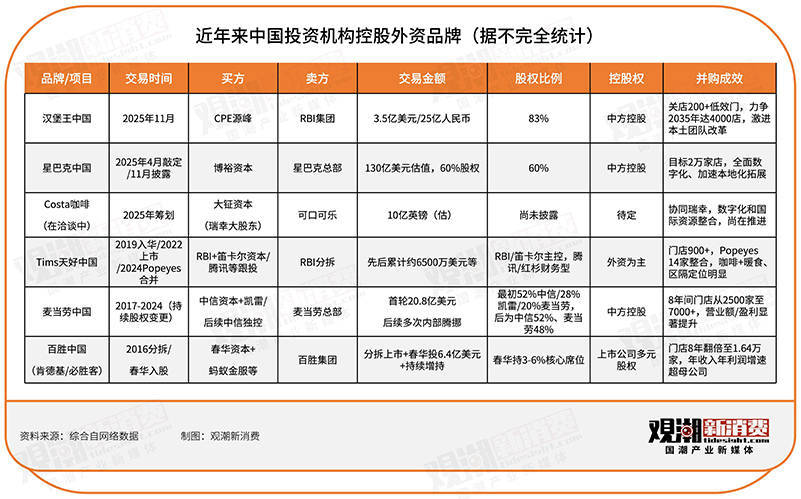
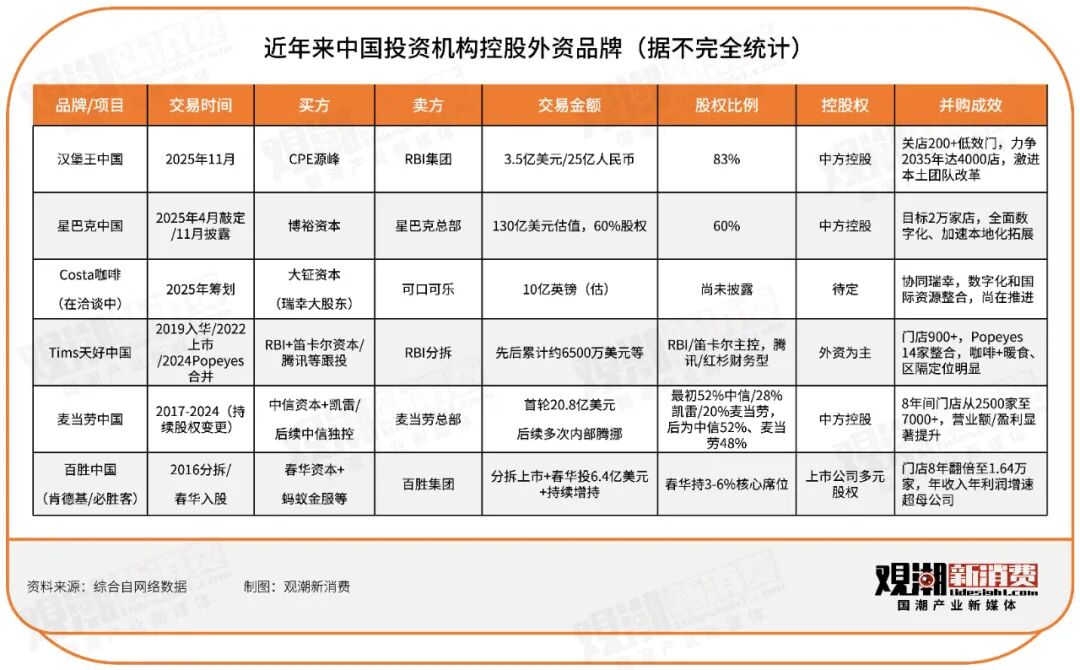
Core Insights - The ownership transfer of international brands in China, such as Starbucks and Burger King, signifies a critical shift in market dynamics, emphasizing the need for localization and adaptation to survive in a competitive landscape [1][3][17] - The decline of international brands in China is attributed to decision-making inefficiencies, digital lag, and a reversal of latecomer advantages, necessitating a reevaluation of their operational strategies [4][5][6][7] Ownership Changes - Starbucks China has transferred 60% of its equity to Boyu Capital, valuing the company at $13 billion, while Burger King China was acquired by CPE Yuanfeng for $350 million, gaining 83% control [2][4] - The trend of Chinese investment in foreign brands reflects a broader strategy to enhance competitiveness through local management and operational restructuring [1][3] Market Challenges - International brands are facing systemic failures in the Chinese market, with Starbucks' market share dropping to 14% in 2024, less than half of its peak [2][4] - The operational models of these brands, which were successful globally, are failing in China due to a lack of adaptability to local consumer preferences and market conditions [4][5][6] Strategic Solutions - The introduction of Chinese capital is seen as a solution to the operational challenges faced by international brands, focusing on local management, digital transformation, and supply chain localization [3][4][11] - Control restructuring is crucial, allowing local teams to make faster decisions and respond to market changes effectively [7][8][12] Digital Transformation - The digitalization of operations is a key strategy, with companies like McDonald's achieving over 90% of orders through digital channels after implementing localized systems [9][10][11] - This transformation is not merely a technological upgrade but a comprehensive overhaul of operational frameworks to enhance efficiency and customer engagement [10][11] Supply Chain Localization - Localizing supply chains is essential for improving cost competitiveness and operational agility, enabling brands to respond swiftly to market demands [11][12] - The establishment of long-term partnerships with local suppliers enhances the overall supply chain ecosystem, crucial for success in the Chinese market [11][12] Future Outlook - The next five years are expected to witness more international brands undergoing transformation under Chinese capital, with the potential for either revival or failure [17][18] - The ultimate success of these brands will depend on their ability to understand Chinese consumers, create genuine value, and balance brand identity with local adaptation [17][18]

外资品牌集体 “改姓中”:星巴克、汉堡王易主背后,中国资本的本土化手术刀
Sou Hu Cai Jing· 2025-11-25 00:11
Core Insights - The ownership transfer of Starbucks China and Burger King China signifies a significant shift in market dynamics, where international brands are increasingly relying on local capital to regain competitiveness in the Chinese market [4][7][8] - The era of easy profitability through brand prestige is over, as international brands face systemic challenges and must adapt to local market conditions to survive [4][8][9] Ownership Changes - Starbucks China has transferred 60% of its equity to Hillhouse Capital, valuing the joint venture at $13 billion [6] - Burger King China was acquired by CPE Yuanfeng for $350 million, gaining 83% control [6] - McDonald's China has seen its stake increase to 52% under CITIC Capital, reflecting a trend of local capital taking control of international brands [6][8] Market Challenges - International brands are experiencing a decline in market share, with Starbucks' share dropping to 14% in 2024, less than half of its peak [6][8] - The competitive landscape has shifted, with local brands like Luckin Coffee surpassing international giants, highlighting the failure of traditional business models [8][9] Structural Issues - Decision-making inefficiencies in multinational corporations hinder their ability to respond quickly to market changes, leading to missed opportunities [11] - A digital capability gap exists, as international brands struggle to adapt their global IT systems to the unique Chinese market, resulting in operational inefficiencies [12] - Local teams possess a better understanding of the market and are more willing to innovate, reversing the advantages once held by international brands [13] Strategic Solutions - Local capital is restructuring control by acquiring stakes in international brands, allowing for more agile decision-making and operational autonomy [14][17] - Digital transformation is being prioritized, with companies like McDonald's leveraging partnerships to enhance their digital capabilities and customer engagement [14][16] - Supply chain localization is being implemented to improve cost efficiency and responsiveness, crucial for competing in the Chinese market [15] Case Studies - CITIC Capital's acquisition of McDonald's China exemplifies a successful model of value creation through phased control and operational restructuring, resulting in significant growth in store numbers and digital engagement [16][17] Strategic Implications - Investors should identify brands with strong potential for operational improvement despite current challenges, as these may offer significant upside [18] - Emphasizing local management teams and operational strategies is essential for navigating the complexities of the Chinese market [18][19]

外资品牌集体 “改姓中”:星巴克、汉堡王易主背后,中国资本的本土化手术刀如何改写全球规则?
3 6 Ke· 2025-11-24 11:09
Core Insights - The ownership transfer of international brands in China, such as Starbucks and Burger King, signifies a profound market rule restructuring, driven by the need for localization and survival strategies [3][5][6] - The era where international brands could thrive solely on their legacy is over, as they face significant challenges in the Chinese market [5][6][8] Ownership Changes - Starbucks China has transferred 60% of its equity to Hillhouse Capital, with a valuation of $13 billion, aiming for 20,000 stores and accelerated localization [4][5] - Burger King China was acquired by CPE Yuanfeng for $350 million, gaining 83% control, with plans to close over 200 underperforming stores and target 4,000 stores by 2035 [4][5] - Other brands like Costa Coffee and Tims are also undergoing similar transitions, indicating a broader trend of international brands seeking local capital for revitalization [4][5] Market Challenges - Starbucks' market share in China has dropped to 14% in 2024, less than half of its peak, with local competitor Luckin Coffee surpassing it [4][5] - International brands are experiencing systemic failures in the Chinese market, with their traditional centralized operational models proving ineffective [6][10][11] Structural Issues - Decision-making inefficiencies due to centralized control hinder international brands' ability to respond quickly to market changes [10] - A significant digital capability gap exists, with local brands like Luckin leveraging advanced digital systems for operational efficiency [11] - The reversal of latecomer advantages means local teams are now more adept at innovation and market understanding than their international counterparts [12] Strategic Solutions - The restructuring of control through local capital acquisition allows for more agile decision-making and operational autonomy [12][17] - Digital transformation is essential, as seen in McDonald's China, where digital orders surged from under 20% to over 90% post-acquisition [13][14] - Localizing supply chains enhances price competitiveness and operational flexibility, crucial for success in the Chinese market [15] Case Study: McDonald's China - The acquisition by CITIC Capital exemplifies effective value creation, with store numbers increasing from 2,000 to over 7,200 and a robust digital membership system established [16][17] - The transition to a localized decision-making structure has significantly improved operational efficiency [17] Strategic Implications - Investors should identify international brands with strong potential for value enhancement despite operational challenges [18] - Emphasizing the importance of building capable local management teams is critical for successful acquisitions [18] - A deep commitment to localization across all operational aspects is necessary for international brands to thrive in China [19] Market Opportunities - The underdeveloped lower-tier markets present significant growth potential, with retail sales in rural areas exceeding 6 trillion yuan in 2023 and 2024 [20]
下沉市场翻车?星巴克万店冲刺遇阻,甩卖60%股权,中国品牌逆袭
Sou Hu Cai Jing· 2025-11-22 07:55
Core Insights - Recent actions by foreign brands like Starbucks and Burger King indicate a strategic shift rather than a retreat from the Chinese market, as they adapt to changing consumer dynamics and market conditions [1][27] Group 1: Foreign Brands' Strategies - Starbucks sold 60% of its China stake to Boyu Capital for $4 billion, while Burger King divested 83% of its equity for $2.5 billion, reflecting a trend of foreign brands restructuring their investments in China [1][27] - The historical success of foreign brands in China was driven by high demand, favorable tax policies, and a lack of local competition, which has since changed [6][7][27] - Starbucks has expanded its store count from 8,000 to 12,000 in China, with 35% of new stores located in lower-tier markets, showcasing a shift towards localization and market penetration [9][11] Group 2: Changing Consumer Landscape - The demographic shift in China, with a declining birth rate and the rise of younger consumers (post-95 and post-00 generations), has altered consumption patterns, making brand loyalty less significant [13][15] - Younger consumers prioritize taste, health, and value for money over brand prestige, leading to a decline in traditional brand appeal [15][19] - Competitors like Luckin Coffee and KFC have successfully adapted to local tastes and preferences, with KFC's introduction of localized menu items like "Sichuan Hot Pot Fried Chicken" achieving significant sales [17][23] Group 3: Market Dynamics and Competition - The coffee market in China has become segmented, with low-cost brands capturing the budget-conscious segment while premium brands focus on emotional value [19][27] - Local brands leverage digitalization and efficient service models, allowing them to outperform traditional foreign brands in terms of customer engagement and operational efficiency [21][23] - Starbucks is now adopting strategies such as health-focused product lines and partnerships to enhance customer loyalty and adapt to local market demands [25][27]
