
BeiGene(06160)

Search documents
产业经济周报:BD出海加速,AI应用竞赛升级
Tebon Securities· 2026-01-28 07:25
Market Performance - The market showed mixed performance from January 19 to January 23, with the Shanghai Composite Index rising by 0.84% and the Shenzhen Component Index increasing by 1.11%[5] - The average daily trading volume was 2.80 trillion yuan, a decrease compared to the previous week[5] Healthcare Sector - At the JPM 2026 conference, over 20 Chinese innovative pharmaceutical companies showcased their products, with significant business development (BD) transactions announced[16] - In 2025, the value of China's innovative drug patent licensing transactions reached approximately $135.7 billion, a 143% increase year-on-year, with 157 total transactions[20] Consumer Sector - The Qianwen APP integrated with Alibaba's ecosystem, achieving over 100 million monthly active users within two months of launch, marking its entry into the "billion-level club"[25] - This integration allows for a seamless process from search to decision-making and payment, establishing a comprehensive AI application ecosystem[26] Hard Technology Sector - The supply of storage and logic chips remains tight, leading to widespread price increases across the industry[32] - The price of enterprise SSDs continues to rise, with a projected increase of 33-38% for NAND Flash products due to supply constraints[36] High-end Manufacturing - The State Grid announced a total fixed asset investment of 4 trillion yuan for the 14th Five-Year Plan period (2026-2030), a 40% increase from the previous period, averaging 800 billion yuan annually[42] - The goal is to achieve a 30% share of renewable energy in total power generation by 2030, indicating significant growth potential for the solar and wind energy sectors[46]



产业经济周报:BD出海加速,AI应用竞赛升级-20260128
Tebon Securities· 2026-01-28 06:49
Market Performance - The market showed mixed performance from January 19 to January 23, with the Shanghai Composite Index rising by 0.84% and the Shenzhen Component Index increasing by 1.11%[5] - The average daily trading volume was 2.80 trillion yuan, a decrease compared to the previous week[5] Healthcare Sector - At the JPM 2026 conference, over 20 Chinese innovative pharmaceutical companies showcased their advancements, with significant business development (BD) transactions reported[16] - In 2025, the value of China's innovative drug patent licensing transactions reached approximately $135.7 billion, a 143% year-on-year increase, with 157 total transactions[20] Consumer Sector - The Qianwen APP integrated with Alibaba's ecosystem, achieving over 100 million monthly active users within two months of launch, marking its entry into the "billion-level club"[25] - This integration allows for a seamless process from search to decision-making and payment, establishing a comprehensive AI application ecosystem[26] Hard Technology Sector - The supply of storage and logic chips remains tight, leading to widespread price increases across the industry[32] - The price of enterprise SSDs continues to rise due to increased demand from AI servers, with NAND Flash supply expected to decrease by 41.7% in 2026[35] High-end Manufacturing - The State Grid announced a total fixed asset investment of 4 trillion yuan for the 14th Five-Year Plan period (2026-2030), a 40% increase from the previous period, averaging 800 billion yuan annually[42] - By 2030, renewable energy generation is expected to account for approximately 30% of total power generation, indicating significant growth potential in the solar and wind sectors[46]

华福证券:医药生物业新技术全面突破 战略看多中国创新出海
智通财经网· 2026-01-27 03:02
Core Viewpoint - By 2025, China's innovative pharmaceuticals are expected to demonstrate significant global competitiveness, with record overseas transactions and many companies turning profitable [1][2]. Domestic Review - The global competitiveness of Chinese innovative drugs is highlighted, with a record-breaking overseas transaction total exceeding $135 billion in 2025, and upfront payments reaching $7 billion. The average deal size has increased from $600 million to $900 million [2]. - A comprehensive support system from policy, including review and approval processes to medical insurance payments, is being established, leading to a rapid increase in market share for innovative drugs, particularly in oncology and immunology, which now exceeds 32% [2]. - Companies like BeiGene and Innovent Biologics have already turned profitable, with others like CanSino Biologics and Zai Lab expected to follow suit in the next three years, indicating a positive cycle of capital influx, R&D iteration, and value realization [2]. Overseas Review - The S&P Biotechnology Index has risen over 50% from its bottom in the second half of 2025, driven by interest rate cuts that have shifted funds from tech stocks to biotech [3]. - Major pharmaceutical companies (MNCs) are actively pursuing mergers and acquisitions to supplement their pipelines, particularly in oncology and immunology, as they face a "patent cliff" with key drugs like Keytruda and Opdivo losing patent protection by 2027-2028 [3]. Assessment - Chinese companies are becoming significant partners for the top 20 MNCs, with Chinese transaction amounts accounting for 40% of the global innovative drug market. China is transitioning from a "fast-follower" to a "smart-innovator" in fields like PD-1 bispecific antibodies, ADCs, and small nucleic acids, leading in pipeline numbers and clinical progress [4]. - The speed and cost advantages of Chinese innovative drug companies are notable, with patient recruitment occurring at 2-5 times the speed of international counterparts and costs being half that of Western companies [4]. Key Tracks and Investment Opportunities - Bispecific antibodies are expected to surpass $120 billion in global sales, with Chinese companies leading the development of second-generation IO products [5]. - ADCs are seeing significant contributions from China, with over half of the global pipeline, and are expected to achieve proof of concept (POC) validation by 2026 [5]. - Combination therapies in oncology are showing synergistic effects, with key clinical data expected in 2026 [5]. - The market for iRAS inhibitors is projected to exceed $8 billion in the U.S., with critical breakthroughs anticipated in 2026 [5]. - Small nucleic acids are expanding into broader applications, with key products expected to commercialize and deliver critical data in 2026 [5]. - Protein degradation technologies are advancing rapidly, with numerous autoimmune disease targets expected to yield data in 2026 [5]. - The metabolic and cardiovascular fields are also poised for breakthroughs, with new targets addressing issues like muscle loss associated with GLP-1 therapies [5]. Main Lines and Recommended Focus - Recommended companies in the bispecific antibody space include CanSino Biologics, Innovent Biologics, and others [7]. - ADC-focused companies include I-Mab, Kelun-Biotech, and others [7]. - Small nucleic acid companies to watch include Ribobio, BIBO, and others [7]. - Strategic combinations to consider include CanSino Biologics, BeiGene, and others [8]. - Flexible combinations include BIBO, Eifang Biologics, and others [8]. - Stable combinations include Hengrui Medicine, China National Pharmaceutical Group, and others [8].


智通ADR统计 | 1月27日
智通财经网· 2026-01-26 22:46
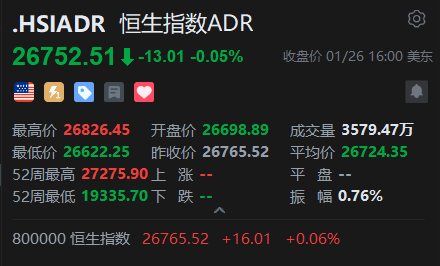
Market Overview - The Hang Seng Index (HSI) closed at 26,752.51, down by 13.01 points or 0.05% as of January 26, 16:00 Eastern Time [1] - The index reached a high of 26,826.45 and a low of 26,622.25 during the trading session, with a trading volume of 35.7947 million [1] - The 52-week high for the index is 27,275.90, while the 52-week low is 19,335.70, indicating a trading range of 0.76% [1] Blue-Chip Stocks Performance - HSBC Holdings closed at HKD 132.695, up by 1.29% compared to the Hong Kong market close [2] - Tencent Holdings closed at HKD 600.708, reflecting a slight increase of 0.2% from the Hong Kong market close [2] - Alibaba Group (BABA) saw a decline of 1.96%, closing at HKD 165.200 [3] - Xiaomi Group (01810) decreased by 2.81%, closing at HKD 35.220 [3] - AIA Group (01299) remained unchanged at HKD 83.050 [3] Notable Stock Movements - New World Development (00016) experienced a significant increase of 3.93%, closing at HKD 119.000 [3] - Kuaishou Technology (01024) fell by 3.26%, closing at HKD 78.600 [3] - JD.com (09618) rose by 1.05%, closing at HKD 116.000 [3] - Ctrip Group (09961) increased by 1.40%, closing at HKD 492.200 [3]



行业景气度回暖叠加政策利好 逾50家生物医药A股公司2025年业绩预盈
Shang Hai Zheng Quan Bao· 2026-01-26 19:16
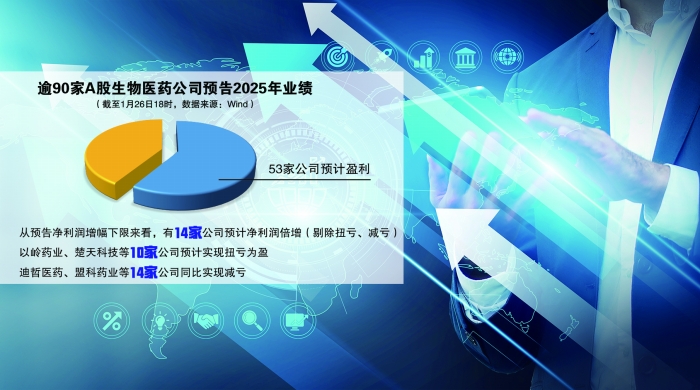
Core Insights - The A-share biopharmaceutical companies are expected to deliver innovative results in 2025, benefiting from industry recovery, overseas market expansion, and favorable pharmaceutical policies [2] - Over 90 A-share biopharmaceutical companies have released performance forecasts for 2025, with 53 companies expected to be profitable [2] - Among the profit forecasts, 14 companies anticipate a net profit increase of over 100%, while 10 companies expect to turn losses into profits [3][2] Group 1: Performance Growth Drivers - Sales volume growth and internal cost reduction are key factors for the significant profit increases among the companies [4] - Shanghai Yizhong leads with a projected net profit increase of 760.18% to 903.54%, expecting a net profit of 60 million to 70 million yuan in 2025 due to its core product being included in the national medical insurance directory [4] - Yuheng Pharmaceutical anticipates a net profit of 350 million to 420 million yuan, a year-on-year increase of 50.37% to 80.44%, driven by steady sales growth of its products [4] - Nawei Technology expects a net profit of 128 million to 145 million yuan, a year-on-year increase of 54.51% to 75.03%, focusing on market strategies in key sectors [4][5] Group 2: International Market Expansion - International business is a significant growth driver for biopharmaceutical companies [6] - WuXi AppTec, a leading CXO company, forecasts a revenue of 45.456 billion yuan, a year-on-year increase of approximately 15.84%, and a net profit of 19.151 billion yuan, a 102.65% increase [6] - Ganli Pharmaceutical expects a net profit of 1.1 billion to 1.2 billion yuan, a year-on-year increase of 78.96% to 95.23%, attributed to steady growth in domestic and international revenues [6] Group 3: Innovation and Recovery - Several innovative drug companies are entering a recovery phase, with many turning losses into profits or significantly reducing losses [8] - BeiGene expects a full-year operating profit for 2025, with revenue projections between 36.2 billion and 38.1 billion yuan, reflecting an upward adjustment from previous estimates [8] - DiZhe Pharmaceutical anticipates a revenue of 800 million yuan, a year-on-year increase of 122.28%, with a reduced net loss of 770 million yuan [9]


107只个股获机构控盘超10%,科技医药板块成资金“蓄水池”
Huan Qiu Wang· 2026-01-26 07:16
Core Insights - The report highlights the significant presence of public funds in the stock market, with 2,977 stocks appearing in fund heavy positions as of the end of Q4 last year, indicating a clear trend in institutional investment strategies [1] - A total of 107 stocks have a fund holding ratio exceeding 10%, showcasing the high influence and control of institutional funds over these stocks [1] Group 1: Fund Holdings and Stock Performance - Among the 107 stocks with over 10% fund holdings, 56 saw increased investments in Q4, with notable increases in holdings for ShenGong Co., Tianhua New Energy, and Maiwei Co., with increases of 59,020.96%, 15,808.35%, and 959.13% respectively, indicating strong institutional confidence in their fundamentals [2] - Conversely, 48 stocks experienced reductions in fund holdings, with notable decreases for Nuocheng Jianhua-U, Kaiter Co., and Keda Li, with reductions of 43.91%, 41.04%, and 39.95% respectively [2] - Three new stocks entered the heavy holding category, with Baiao Saitu, Litong Technology, and Xingtou Measurement Control having fund holding ratios of 21.55%, 12.60%, and 10.03% respectively [2] Group 2: Institutional Investment Trends - The phenomenon of institutional clustering remains significant, with over 100 funds holding 42 of the 107 stocks, and 29 stocks held by 50 to 99 funds, indicating a strong consensus among institutional investors [4] - Notably, Ningde Times, despite a holding ratio of 11.63%, has the highest number of fund holders at 2,056, followed by Zhongji Xuchuang, Zijin Mining, and Xinyi with over 1,300 fund holders each [4] - The stocks with high fund holdings are predominantly in the "hard technology" and "innovation" sectors, with 42 from the Sci-Tech Innovation Board, 27 from the Growth Enterprise Market, and 31 from the Shanghai and Shenzhen main boards, reflecting a focus on growth sectors [4] Group 3: Performance Expectations - Among the 107 stocks, 26 have released performance forecasts for 2025, with 18 expecting profit increases, 4 expecting declines, and 2 forecasting losses, indicating a generally positive outlook [5] - The highest expected profit growth is for Baiwei Storage at 473.71%, followed by Changxin Bochuang and Baiao Saitu with expected growths of 378.70% and 303.57% respectively, providing strong support for long-term fund holdings [5] - The concentration of fund holdings in the electronics and biopharmaceutical sectors suggests an increased market expectation for technological innovation and consumer recovery [5]





JPM 2026收官,中国创新药加速全球化进程
2026-01-26 02:50
Summary of Conference Call Industry Overview - The conference focused on updates and developments in the Chinese biopharmaceutical industry, particularly highlighting companies such as BeiGene, 3SBio, and Kelun-Biotech [1][10]. Key Company Insights BeiGene - BeiGene's BCL-2 inhibitor has been approved for sale in China and is expected to receive accelerated approval in the U.S. within the year [1]. - BCL-2 is viewed as a second growth driver for BeiGene, complementing its existing BTK inhibitors, which have shown rapid sales growth in the U.S. market [2]. - The company has a robust pipeline for solid tumors, with several candidates entering late-stage development, including treatments for breast cancer and other indications [3]. - BeiGene is anticipated to report its first annual profit, with expectations that its annual report may exceed forecasts [3]. 3SBio - Pfizer has outlined a global development plan for its drug 707, with five global Phase III trials expected to start by 2026, targeting various cancers [4]. - The trials include first-line treatments for colorectal cancer and non-small cell lung cancer [4]. Kelun-Biotech - Kelun-Biotech is expected to have a significant year with five products anticipated to be commercialized, three of which have already been included in the national medical insurance [5]. - The company has successfully commercialized its top two ADC products and is expected to see explosive growth following their inclusion in insurance [5]. Innovent Biologics - Innovent's Ivosidenib is expected to receive final approval from the FDA in Q4 of this year, with ongoing clinical trials for various cancers [6][7]. - The company is also preparing for the commercialization of its CAR-T product, which has already been approved domestically [8]. Rongchang - Rongchang has announced plans for three Phase III trials, including one for non-small cell lung cancer, which has received FDA approval [7][8]. Other Notable Mentions - Merck has initiated 16 global Phase III trials for its drug targeting various major indications, with data expected in the second half of the year [5]. - The conference highlighted the importance of clinical trial data releases for several companies, which are crucial for their long-term valuations [3][10]. Market Dynamics - The overall market for innovative drugs is currently experiencing a downturn, primarily due to internal funding shifts within the pharmaceutical sector [10]. - The high percentage of holdings in innovative and traditional pharmaceuticals (around 75%) has led to a reallocation of funds towards other sectors like AI healthcare and CROs [11]. - Despite the market's performance, the fundamental aspects of many companies remain strong, with ongoing clinical advancements and positive earnings expectations [11]. - The total amount of business development (BD) transactions in recent weeks has already reached 25% of last year's total, indicating a robust pace of international expansion [11]. Conclusion - The conference provided a comprehensive overview of the current state of the biopharmaceutical industry in China, highlighting significant advancements and the potential for growth among key players. The market dynamics suggest a temporary disconnect between stock performance and fundamental company health, indicating potential investment opportunities.
创新药还能加仓?这场会定调2026
Jing Ji Guan Cha Wang· 2026-01-24 10:07
Core Insights - The 2026 JPM conference showcased a positive outlook for Chinese innovative pharmaceutical companies, with significant interest from multinational corporations in collaboration opportunities [2][3][4] - Chinese companies are shifting from merely licensing patents to deeper involvement in clinical development and commercialization in international markets [3][8] - The FDA's stance at JPM was relatively moderate, acknowledging the R&D efficiency of Chinese companies and suggesting improvements in approval processes using AI [3][6] Group 1: Conference Overview - The JPM conference, held in San Francisco, attracted numerous founders, executives, and investors from Chinese innovative pharmaceutical companies, indicating a vibrant atmosphere compared to previous years [2][5] - The event has evolved from a small gathering to a major industry benchmark, with participation from nearly all multinational pharmaceutical companies [5][10] - The number of attendees increased significantly in 2026, reflecting a more optimistic market sentiment compared to the previous year [5][10] Group 2: Market Trends - The Chinese innovative drug sector experienced a substantial stock price increase from March to August 2025, driven by business development (BD) transactions and foreign capital inflow, but faced a market correction afterward [4][11] - The interest in Chinese assets is growing, with many multinational companies expressing intentions for mergers and acquisitions (M&A) and BD transactions [11][12] - The trend of Chinese companies seeking deeper engagement in global markets is evident, moving beyond simple patent licensing to collaborative operational models [8][9] Group 3: Regulatory Environment - FDA officials at JPM highlighted the efficiency of Chinese clinical trials, with China completing Phase I trials in four weeks compared to much longer timelines in the U.S. [6][12] - The FDA's comments suggested a focus on optimizing clinical trial approval processes rather than emphasizing protectionist policies [5][6] Group 4: Future Outlook - The absence of major transactions at JPM 2026 was noted, but many multinational companies expressed a willingness to explore significant deals in the near future [11][12] - The upcoming expiration of patents for several blockbuster drugs is expected to drive increased M&A activity as companies seek to replenish their pipelines [12][13] - The trend of U.S. biotech firms considering establishing operations in China to leverage R&D efficiencies is emerging, indicating a shift in cross-border collaboration dynamics [10][11]

智通ADR统计 | 1月24日



智通财经网· 2026-01-24 00:15
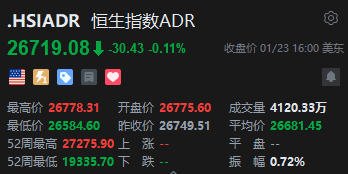
Market Overview - The US stock market indices showed mixed performance on Friday, with the Hang Seng Index ADR closing at 26,719.08 points, down by 30.43 points or 0.11% compared to the Hong Kong close [1]. Major Blue-Chip Stocks - HSBC Holdings closed at HKD 130.896, up by 0.69% from the Hong Kong close [2]. - Tencent Holdings closed at HKD 598.184, up by 0.54% from the Hong Kong close [2]. Stock Performance Summary - Tencent Holdings (HKD 595.000) saw a decrease of HKD 2.500, or -0.42%, with its ADR price at HKD 598.184, reflecting an increase of HKD 3.184 or 0.54% [3]. - Alibaba Group (HKD 168.500) increased by HKD 3.700, or 2.25%, with its ADR price at HKD 168.834, up by HKD 0.334 or 0.20% [3]. - HSBC Holdings (HKD 130.000) rose by HKD 0.300, or 0.23%, with its ADR price at HKD 130.896, up by HKD 0.896 or 0.69% [3]. - Xiaomi Group (HKD 36.240) increased by HKD 1.000, or 2.84%, with its ADR price at HKD 36.287, up by HKD 0.047 or 0.13% [3]. - AIA Group (HKD 83.050) rose by HKD 0.550, or 0.67%, with its ADR price at HKD 83.077, up by HKD 0.027 or 0.03% [3]. - Meituan (HKD 97.550) increased by HKD 0.550, or 0.57%, with its ADR price at HKD 97.735, up by HKD 0.185 or 0.19% [3]. - Kuaishou (HKD 81.250) rose by HKD 2.150, or 2.72%, with its ADR price at HKD 82.648, up by HKD 1.398 or 1.72% [3]. - Ctrip Group (HKD 485.400) increased by HKD 3.800, or 0.79%, with its ADR price at HKD 490.273, up by HKD 4.873 or 1.00% [3].
药品零售行业高质量发展意见发布,科创医药ETF嘉实(588700)一键布局生物医药产业
Xin Lang Cai Jing· 2026-01-23 03:43
Group 1 - The core viewpoint of the news highlights the strong performance of the pharmaceutical and medical services sectors, with the Shanghai Stock Exchange Sci-Tech Innovation Board Biomedicine Index rising by 1.52% as of 11:05 AM on January 23, 2026, driven by significant gains in stocks such as Chengdu Xian Dao (+5.48%) and BGI Genomics (+4.25%) [1] - The Ministry of Commerce and eight other departments have issued opinions to promote high-quality development in the drug retail industry, encouraging retail enterprises to participate in centralized drug procurement and to enhance their bargaining power through joint purchasing [1] - The Chinese pharmaceutical industry is at a pivotal point for global value reassessment, with 2026 being a critical year to validate transformation outcomes, as highlighted by CITIC Securities [1] Group 2 - As of December 31, 2025, the top ten weighted stocks in the Shanghai Stock Exchange Sci-Tech Innovation Board Biomedicine Index include companies like United Imaging Healthcare and BeiGene, collectively accounting for 48.85% of the index [2] - The CSI Innovation Medicine ETF closely tracks the Shanghai Stock Exchange Sci-Tech Innovation Board Biomedicine Index, providing an easy investment option for those without stock accounts through the linked fund [3]
