BeiGene(06160)

Search documents
海外消费周报:澳门春节假期的总访客量和日均访客量创历史新高-20260301
Shenwan Hongyuan Securities· 2026-03-01 12:33
Investment Rating - The report maintains an "Overweight" rating for the overseas consumer services sector, indicating a positive outlook for the industry [1]. Core Insights - The total visitor volume and average daily visitor volume in Macau during the Spring Festival reached historical highs, with total inbound travelers at 1.554 million and an average daily volume of 173,000, reflecting a year-on-year growth of 5.5% [6][1]. - The average hotel occupancy rate during the Spring Festival in Macau was 95.6%, peaking at 99.2% on the fourth day of the festival [6][1]. - In the overseas pharmaceutical sector, companies like BeiGene and Zai Lab are showing significant revenue growth, with BeiGene projected to achieve $5.343 billion in revenue for 2025, a 40% increase year-on-year [9][2]. Summary by Sections Overseas Consumer Services - Macau's Spring Festival saw a record total of 1.554 million inbound travelers, with a daily average of 173,000, marking a 5.5% increase year-on-year [6][1]. - The peak single-day visitor count reached approximately 228,000, the highest since records began [6][1]. - Hotel occupancy rates averaged 95.6%, with the highest rate of 99.2% on the fourth day of the festival [6][1]. Overseas Pharmaceuticals - BeiGene reported a revenue of $5.343 billion for 2025, a 40% increase from the previous year, and an adjusted net profit of $917 million, marking a return to profitability [9][2]. - Zai Lab is expected to achieve $460 million in revenue for 2025, a 15% year-on-year increase, despite a net loss of $176 million [9][2]. - The report highlights the progress of domestic pharmaceutical companies, including the efficacy results of Innovent Biologics' B7-H3 ADC in treating metastatic castration-resistant prostate cancer [10][3]. Education Sector - The report indicates a positive trend in vocational education, with significant enrollment data and a recommendation to focus on China Oriental Education, which is expected to see accelerated growth in spring 2026 [18][5]. - The education index has shown a year-to-date increase of 6.01%, outperforming the Hang Seng Index [16][5]. - The report suggests monitoring companies like New Oriental and TAL Education, which are expected to benefit from improved operational strategies and increased demand for vocational training [18][5].
核心产品全球销售280亿,百济神州结束10年亏损长跑
Guan Cha Zhe Wang· 2026-02-28 07:17
Core Insights - The company achieved its first annual profit since its establishment in 2025, with total revenue of 38.205 billion yuan, a year-on-year increase of 40.4%, and a net profit of 1.422 billion yuan, reversing a loss of 4.978 billion yuan from the previous year [1][2] Financial Performance - Total revenue reached 38.205 billion yuan, up 40.4% from 27.214 billion yuan in the previous year [2] - Product revenue was 37.770 billion yuan, reflecting a 39.9% increase from 26.994 billion yuan [2] - Operating profit was 2.562 billion yuan, while total profit was 2.558 billion yuan, both transitioning from losses in the previous year [2] - Basic earnings per share improved from -3.64 yuan to 1.00 yuan [2] - The weighted average return on equity was 5.19%, recovering from -20.20% [2] Product Performance - The core product, Baiyueze® (Zebutinib), generated global sales of 28.067 billion yuan, a 48.8% increase, accounting for 73.5% of total revenue [3][5] - Sales in the U.S. market reached 20.206 billion yuan, up 45.5%, while European sales were 4.265 billion yuan, increasing by 66.4% [5] - Other product segments, including Bai Ze An® and licensed products from Amgen, contributed significantly, with total product revenue reaching 37.770 billion yuan, making up 98.9% of total revenue [6] Cash Flow and Assets - The company reported a significant increase in operating cash flow, with free cash flow reaching 9.42 billion yuan [7] - Total assets grew to 57.423 billion yuan, a 34.1% increase from the beginning of the period, while equity attributable to shareholders rose to 30.601 billion yuan, up 26.6% [7] Research and Development - R&D expenses for 2025 were 21.46 billion yuan, a 10% increase, but the proportion of R&D spending relative to revenue decreased to 40.4% [3][8] - The company has invested over 56 billion yuan in R&D since its inception, with 14.14 billion yuan spent in 2024 alone [3] Capital Structure and Shareholder Changes - Hillhouse Capital, a cornerstone investor, has reduced its stake from 8.97% to 4.89% through two rounds of share sales in 2025, cashing out approximately 7.146 billion HKD [4] - Other shareholders, including Amgen and Baker Brothers Life Sciences, maintained their holdings, while new investors have entered the shareholder base [4]



百济神州(6160.HK)2025业绩快报:泽布放量符合预期 26年收入利润有望稳步提升
Ge Long Hui· 2026-02-28 06:42
Core Viewpoint - BeiGene achieved a revenue of $5.34 billion in 2025, representing a year-on-year increase of 40%, with product revenue of $5.28 billion, slightly exceeding previous management guidance of $5-5.3 billion [1] Group 1: Financial Performance - The company reported a net profit of $290 million, recovering from a loss of $640 million in the previous year, marking a turnaround in recurring business [1] - Management expects revenue to reach $6.2-6.4 billion in 2026, with GAAP operating profit projected at $700-800 million [1] Group 2: Product Performance - Zanubrutinib generated $3.93 billion in revenue for the year, up 49% year-on-year, with U.S. sales of $2.8 billion (up 45%), European sales of $600 million (up 66%), and Chinese sales of $340 million (up 33%) [1] - In Q4 2025, Zanubrutinib revenue was $1.15 billion, reflecting a quarter-on-quarter increase of 10% and a year-on-year increase of 38% [1] - Tislelizumab achieved $740 million in revenue for the year, a 19% increase year-on-year, with Q4 2025 revenue of $180 million, down 5% quarter-on-quarter but up 18% year-on-year [1] - Revenue from cooperative products in China reached $620 million, a 20% increase year-on-year, driven by growth in Duzallo and Belantamab Mafodotin [1] Group 3: Future Catalysts - Key catalysts for 1H26 include the approval of Sotorasib for R/R MCL in the U.S. and interim analysis for Zanubrutinib in 1L MCL Phase III trials [2] - In 2H26, the company plans to submit an accelerated approval application for BTK CDAC based on Phase II clinical data for R/R CLL and initiate Phase III trials for Sotorasib in combination therapy for multiple myeloma [2] - The revenue forecasts for FY26 and FY27 are maintained at $6.4 billion and $7.1 billion, respectively, with slight adjustments to net profit estimates reflecting increased R&D expenditures [2] - The target price is set at HKD 212.09, maintaining an "outperform" rating based on a DCF model with a WACC of 9% and a perpetual growth rate of 4% [2]
未知机构:百济神州发布2025年度业绩收入及利润2025年全年总收入5-20260228
未知机构· 2026-02-28 02:55
Summary of Company and Industry Insights from Conference Call Company: 百济神州 (BeiGene) Financial Performance - Total revenue for 2025 reached $5.3 billion, representing a 40% year-over-year growth, with Q4 2025 revenue at $1.5 billion, up 33% year-over-year [1] - GAAP net profit for Q4 2025 was $67 million and for the full year was $287 million, an increase of $218 million and $932 million respectively compared to the previous year’s net loss [1] - The full-year GAAP net profit included $76 million in equity investment impairment expenses, $25 million in non-recurring tax project expenses, and $20 million in tax expenses due to timing factors in specific jurisdictions [1] Guidance and Projections - For 2026, total revenue guidance is set between $6.2 billion and $6.4 billion, corresponding to a year-over-year growth rate of 17% to 21% [2] - Gross margin is expected to be at the high end of the 80% range, with GAAP operating profit projected to be between $700 million and $800 million, and non-GAAP operating profit between $1.4 billion and $1.5 billion [2] Core Product Performance - Global sales of 百悦泽® (Tislelizumab) reached $3.9 billion, a 49% increase year-over-year, with Q4 sales of $1.1 billion, up 38% year-over-year [2] - In the U.S. market, annual sales of 百悦泽® were $2.8 billion, a 45% increase, with Q4 sales of $845 million, up 37% year-over-year [2] - Sales of 百泽安® (Recombinant Humanized Anti-PD-1 Monoclonal Antibody) totaled $737 million, a 19% increase year-over-year, with Q4 sales of $182 million, up 18% year-over-year [2] Research and Development Milestones - For 百悦泽®, a mid-analysis of the Phase III MANGROVE study is expected in H1 2026 [2] - The application for marketing approval for 索托克拉 (BCL2) in R/R MCl patients is anticipated in H1 2026, with a Phase III study for adult patients with t(11;14) R/R multiple myeloma expected to start in H2 2026 [2] - Potential submission for BTK CDAC in R/R CLL adult patients is expected in H2 2026, along with data readout for moderate to severe chronic spontaneous urticaria in H1 2026 [2][3] - GPC3x41BB bispecific antibody is expected to initiate a potential registrational Phase II study in H2 2026 [3] - IRAK4 CDAC data readout for rheumatoid arthritis in Phase I/II is anticipated in H2 2026 [3] Additional Insights - The significant impact of expenses in Q4 on profitability was noted, indicating a concentrated effect on quarterly results [2]

未知机构:百济神州公布25年业绩25年全年总收入534亿-20260228
未知机构· 2026-02-28 02:50
Company and Industry Summary Company: 百济神州 (BeiGene) Key Financial Performance - Total revenue for 2025 reached $5.34 billion, representing a 40.2% increase year-over-year [1] - Product revenue for 2025 was $5.28 billion, up 39.8% compared to the previous year [1] - Net profit for 2025 was $290 million, a significant recovery from a net loss of $640 million in the same period last year [1] - Q4 2025 revenue was $1.5 billion, reflecting a 32.8% year-over-year increase and a 6.1% quarter-over-quarter increase [1] - Q4 2025 product revenue was $1.48 billion, up 32.1% year-over-year and 5.8% quarter-over-quarter [1] - Q4 2025 net profit was $66 million, compared to a net loss of $150 million in the same quarter last year [1] Product Performance - Revenue from the drug Tislelizumab for 2025 was $740 million, an 18.8% increase year-over-year [1] - Q4 2025 revenue for Tislelizumab was $180 million, an 18.3% increase year-over-year but a 4.5% decrease quarter-over-quarter [1] Company: 其他药品 (Other Drugs) Key Financial Performance - Revenue from the drug Zebrutinib for 2025 was $3.93 billion, a 48.6% increase year-over-year [2] - Breakdown of Zebrutinib revenue: - United States: $2.83 billion (+45.1%) - Europe: $600 million (+66.2%) - China: $340 million (+33.3%) - Rest of the World (ROW): $160 million (+105.8%) [2] - Q4 2025 revenue for Zebrutinib was $1.15 billion, a 38.4% increase year-over-year and a 10.1% increase quarter-over-quarter [2] - Q4 2025 revenue breakdown for Zebrutinib: - United States: $840 million (+37.1%, +14.4% QoQ) - Europe: $170 million (+47.2%, +2.2% QoQ) - China: $90 million (+26.0%, -5.5% QoQ) - ROW: $160 million (+61.0%, +1.8% QoQ) [2] Other Drug Revenues - XGEVA revenue for 2025 was $310 million (+36.4%), with Q4 revenue of $70 million (+12%, -16.9% QoQ) [2] - BLINCYTO revenue for 2025 was $100 million (+40.2%), with Q4 revenue of $24 million (+17.6%, -20.4% QoQ) [2] Cost and Profitability Metrics - Product gross margin for 2025 was 87.3%, an increase of 3 percentage points [2] - Selling and administrative expense ratio was 39.0%, a decrease of 9.1 percentage points [2] - R&D expense ratio was 40.2%, a decrease of 11.1 percentage points [2] - Q4 2025 product gross margin improved to 90.4% (+4.5 percentage points QoQ) [2] - Q4 2025 selling and administrative expense ratio was 37.1% (-0.5 percentage points QoQ) [2] - Q4 2025 R&D expense ratio was 41.1% (+4 percentage points QoQ) [2] Future Outlook - For 2026, total revenue is projected to be between $6.2 billion and $6.4 billion, with a gross margin above 80% [3] - GAAP operating profit is expected to be between $700 million and $800 million, while non-GAAP operating profit is projected to be between $1.4 billion and $1.5 billion [3]
扭亏为盈后百济神州股价却跌跌不休
Guo Ji Jin Rong Bao· 2026-02-27 23:53
Core Viewpoint - Despite achieving profitability in 2025, the stock price of BeiGene has experienced a significant decline, raising concerns among investors about future performance and market competition [1][3]. Financial Performance - In 2025, BeiGene reported total revenue of 38.205 billion yuan, a year-on-year increase of 40.4% - The net profit attributable to shareholders was 1.422 billion yuan, marking a turnaround from a loss of 5.379 billion yuan in the previous year - The adjusted net profit, excluding non-recurring items, was 1.381 billion yuan [1]. Stock Market Reaction - On February 26, 2025, BeiGene's Hong Kong stock price fell sharply, closing down 9.16% at 200 HKD, resulting in a market capitalization drop below 300 billion HKD - The stock continued to decline on February 27, closing at 192.3 HKD, a further decrease of 1.08%, with a market cap of 296.3 billion HKD - The A-share market also saw a decline, with a closing price of 263.44 CNY on February 26, down 5.65%, and a further drop to 257.7 CNY on February 27, down 2.18% [1]. Product Performance and Market Competition - BeiGene's core product, Zebrutinib (Brukinsa), is expected to face challenges in 2026, with sales projections falling short of expectations - In 2025, Zebrutinib generated revenue of 39.3 billion yuan, accounting for 73.5% of the company's total revenue, with a year-on-year growth rate of 48.8% - However, the quarterly growth rate for Zebrutinib in Q4 2025 was only 10.1%, significantly lower than the 20% growth in Q2 [3]. Competitive Landscape - Zebrutinib is facing increased competition, particularly from AstraZeneca's Acalabrutinib and Johnson & Johnson's Ibrutinib - AstraZeneca has recently launched a combination therapy involving Acalabrutinib, which has gained approval in key markets, posing a threat to Zebrutinib's market share [4]. Future Prospects - BeiGene's second major product, Tislelizumab (PD-1 inhibitor), is projected to have a global sales figure of 5.297 billion yuan in 2025, with an 18.6% year-on-year increase - The company plans to submit a new indication application for Tislelizumab in 2026, which could enhance its market position [6]. - Another product, Sotorasib (BCL-2 inhibitor), has received breakthrough therapy designation from the FDA and is expected to be a new growth driver in 2026, potentially offsetting the slowdown in Zebrutinib's growth [7].
智通ADR统计 | 2月28日





智通财经网· 2026-02-27 23:41
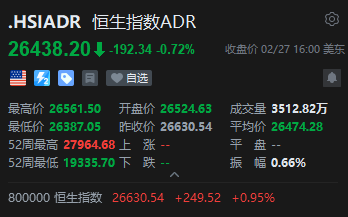
Market Overview - US stock indices experienced a decline on Friday, with the Hang Seng Index ADR closing at 26,438.20 points, down 192.34 points or 0.72% from the Hong Kong close [1] - The highest price for the ADR was 26,561.50, while the lowest was 26,387.05, with a trading volume of 35.1282 million [1] Major Blue-Chip Stocks - Most large-cap stocks fell, with HSBC Holdings closing at HKD 145.765, down 1.04% from the Hong Kong close [2] - Tencent Holdings closed at HKD 513.995, down 0.77% from the Hong Kong close [2] Stock Performance Summary - Tencent Holdings (00700) latest price: HKD 518.000, up 1.17% with an ADR price of USD 65.700, down 0.77% [3] - Alibaba Group (09988) latest price: HKD 142.900, down 0.07% with an ADR price of USD 144.110, down 1.38% [3] - HSBC Holdings (00005) latest price: HKD 147.300, up 1.59% with an ADR price of USD 93.160, down 1.04% [3] - Other notable stocks include AIA Group (01299) up 2.48%, and NetEase (099999) up 2.40% [3]
多家创新药企迎盈利拐点
Zheng Quan Ri Bao· 2026-02-27 16:22
Group 1: Company Performance - 24 innovative drug companies reported their 2025 performance, with 19 achieving positive net profit, representing 79.17% [1] - BeiGene achieved its first annual profit in 2025 with a net profit of 1.422 billion yuan, and total revenue of 38.205 billion yuan, a 40.4% increase year-on-year [1] - Microbio achieved a total revenue of 910 million yuan in 2025, a 38.24% increase, and a net profit of 51.0757 million yuan, marking a turnaround [2] - Shanghai Yizhong reported a revenue of 317 million yuan, an 82.72% increase, and a net profit of 64.132 million yuan, a significant 819.42% increase [2] Group 2: Industry Trends - The overall performance of the innovative drug industry is improving, but significant differentiation exists, with many companies still in a loss-reduction phase [1] - The continuous release of policy dividends is a key driver for performance growth, with nearly 80% of innovative drugs entering the medical insurance directory within two years [2] - The global healthcare industry saw a financing amount of 63.882 billion USD in 2025, a 10.13% increase, while domestic financing in the healthcare sector reached 73.777 billion yuan, a 39.05% increase [3] - The number of new drug IND applications in China reached 2,175 in 2025, an 8.8% increase [3]


百济神州(06160) - 自愿性公告 - 业务发展最新情况
2026-02-27 13:14
香港交易及結算所有限公司及香港聯合交易所有限公司對本公告的內容概不負責,對其準確性 或完整性亦不發表任何聲明,並明確表示概不就因本公告全部或任何部分內容而產生或因依賴 該等內容而引致的任何損失承擔任何責任。 BeOne Medicines Ltd. 百濟神州有限公司 (根據瑞士法律註冊成立的公司) (股份代號:06160) 自願性公告-業務發展最新情況 本公告由百濟神州有限公司(「本公司」)自願作出。請參閱本公告附件根據瑞士法 律準備的瑞士法定財務報表。 承董事會命 百濟神州有限公司 主席 歐雷強先生 香港,2026年2月27日 於本公告日期,本公司董事會包括主席兼執行董事歐雷強先生、非執行董事王 曉東博士,以及獨立非執行董事Olivier Brandicourt博士、Margaret Han Dugan 博士、Michael Goller先生、Anthony C. Hooper先生、Ranjeev Krishana先生、 Alessandro Riva博士、Corazon (Corsee) D. Sanders博士、Shalini Sharp女士及易 清清先生。 Ernst & Young AG Aesch ...
去年22款创新药获批临床,中关村生命科学园医药创新加速跑
Bei Jing Ri Bao Ke Hu Duan· 2026-02-27 12:49
Group 1 - The core innovation vitality of the pharmaceutical industry in the Zhongguancun Life Science Park continues to thrive, with 22 innovative drugs approved for clinical trials by 2025, focusing on breakthroughs in oncology and rare diseases [1][4] - Innovative drug company Nocare Biopharma has completed patient enrollment for its Phase III clinical trial of the new BCL2 inhibitor mesutoclax combined with BTK inhibitor ibrutinib for treating chronic lymphocytic leukemia/small lymphocytic lymphoma, marking a significant step towards market launch [2][3] - BeiGene, a leading innovative drug company from the park, announced its first annual profit since establishment, driven by the strong sales of its core innovative drug products, including a global sales revenue of 28.067 billion yuan for its drug zanubrutinib, which saw a 49% year-on-year increase [4] Group 2 - The Zhongguancun Life Science Park has showcased its 2025 innovation report, highlighting 22 innovative drugs in clinical trials across various cutting-edge fields, including rare diseases, mRNA vaccines, and cell therapy, with several achieving dual clinical trial approvals in China and the U.S. [4][5] - The rare disease drug TollB-001 developed by TuoLing BoTai has received clinical trial approvals in both China and the U.S., targeting systemic sclerosis and offering new treatment options for rare disease patients [5] - The GLP-1/FGF21 dual agonist ZT003 has been approved for clinical trials in the U.S., representing a breakthrough in metabolic disease treatment with multiple benefits including blood sugar control and weight loss [6]