
Cambricon(688256)

Search documents
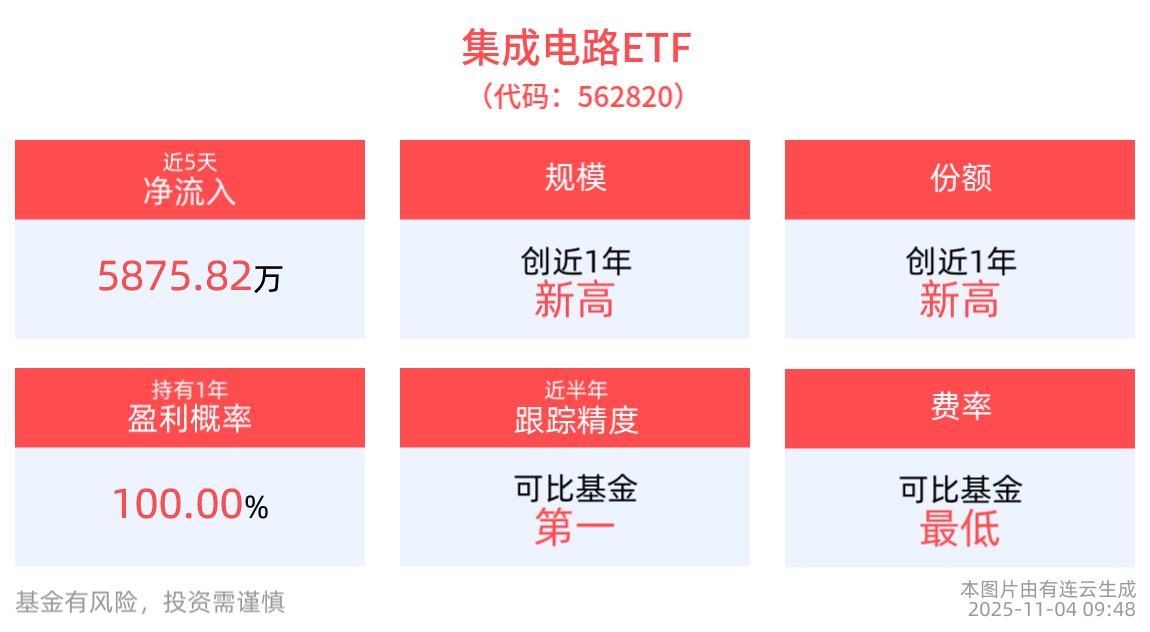
集成电路ETF(562820)红盘蓄势,最新规模、份额均创近1年新高!
Sou Hu Cai Jing· 2025-11-04 02:27
Core Insights - The integrated circuit ETF has reached a new high in scale at 184 million yuan and a new high in shares at 80.136 million, with a net inflow of 58.7582 million yuan [3] - The integrated circuit ETF has seen a 60.82% increase in net value over the past year, ranking 196 out of 3101 index equity funds, placing it in the top 6.32% [3] - The top ten weighted stocks in the CSI Integrated Circuit Total Return Index account for 55.88% of the total index, with notable companies including Cambricon, SMIC, and Haiguang Information [3] Performance Metrics - The highest single-month return since inception for the integrated circuit ETF is 31.86%, with the longest consecutive monthly gains being 4 months and a maximum increase of 58.99% [3] - The average return during the months of increase is 9.89% [3] Market Trends - The AI wave is driving a surge in computing power demand, significantly increasing the value in sectors such as servers, AI chips, optical chips, storage, and PCB boards [5] - Micron Technology anticipates that the DRAM market will remain extremely tight until 2026, exacerbating supply-demand imbalances [5] Investment Opportunities - The overall demand for AI remains strong, with Trendforce projecting a 24% year-on-year increase in capital expenditure from the top eight global CSP cloud service providers, reaching 520 billion USD by 2026, which will boost demand for computing chips [6] - There is significant potential for domestic substitution in the industry chain, suggesting that related companies may be worth monitoring [6] - Investors without stock accounts can access investment opportunities in the sector through the integrated circuit ETF linked fund (022350) [6]


芯片50ETF(516920)开盘涨0.19%,重仓股中芯国际涨0.66%,寒武纪涨1.74%
Xin Lang Cai Jing· 2025-11-04 01:39
Group 1 - The core point of the article highlights the performance of the Chip 50 ETF (516920), which opened at 1.040 yuan with a slight increase of 0.19% [1] - The major holdings of the Chip 50 ETF include companies such as SMIC, Cambricon, and others, with varying performance on the opening day [1] - The ETF's performance benchmark is the CSI Chip Industry Index return, managed by Huatai-PineBridge Fund Management Co., Ltd., with a return of 3.84% since its inception on July 27, 2021, and a recent one-month return of -7.43% [1] Group 2 - Specific stock performances include SMIC up by 0.66%, Cambricon up by 1.74%, and others like Huada Semiconductor and North Huachuang showing minimal changes [1] - The article provides a detailed overview of the ETF's performance metrics and its management structure, indicating a focus on the semiconductor industry [1]



“超42亿元天价索赔”震动科创圈 别让股权激励变纠纷导火索!
Mei Ri Jing Ji Xin Wen· 2025-11-04 01:17
Core Viewpoint - The recent lawsuit involving Cambrian (SH688256) for a compensation claim of approximately 4.287 billion yuan has highlighted the growing issues surrounding equity incentives in the tech sector, emphasizing the need for careful management of these incentives to avoid disputes [1][2]. Summary by Sections Equity Incentive Disputes - The lawsuit has drawn attention to the significant discrepancies in equity valuation before and after a company goes public, which can lead to disputes over substantial financial interests [1]. - The complexity of equity incentive agreements and insufficient rigor in related contracts are direct triggers for disputes, as these agreements span multiple legal domains [2]. Importance of Equity Incentives - Despite the risks, equity incentives remain essential for tech companies to attract and retain top talent, aligning individual interests with corporate growth [2]. Recommendations for Companies - Companies should meticulously design contract terms, clearly defining potential risk points and scenarios to minimize future disputes [3]. - It is crucial to address various situations, such as employee departures and performance issues, within the contracts to prevent ambiguity [3]. Recommendations for Employees - Employees should thoroughly review contract terms before signing, paying close attention to restrictive clauses that may affect their rights [3]. - Seeking independent legal advice is recommended to assess potential risks associated with equity agreements [3]. Professional Involvement - Companies should engage professional legal and tax advisors when designing incentive plans to ensure clarity and compliance with legal requirements [4]. - Both companies and employees should leverage professional expertise to create robust legal frameworks that support effective equity incentive programs [4].
寒武纪遭前副总起诉索赔42.87亿 手握超51亿现金仍拿10亿募资补流
Chang Jiang Shang Bao· 2025-11-04 00:18
Core Viewpoint - Cambricon has turned a profit for the first time but is facing a significant lawsuit from its former vice president, claiming compensation for stock incentive losses amounting to 4.287 billion yuan [2][4]. Financial Performance - For the first three quarters of 2025, Cambricon reported revenue of 4.607 billion yuan, a year-on-year increase of 2386.38% [9]. - The net profit attributable to shareholders reached 1.605 billion yuan, up 321.49% year-on-year [9]. - The net profit after deducting non-recurring gains and losses was 1.419 billion yuan, reflecting a growth of 264.52% [9]. - Despite the profit, the cash flow from operating activities was negative at -940 million yuan [10]. Legal Issues - The lawsuit involves former vice president Liang Jun, who claims a labor relationship with the company from October 18, 2017, to February 10, 2022, and seeks compensation for stock incentive losses based on the highest stock price of 372 yuan [4][5]. - Cambricon asserts that the lawsuit will not impact current profits, but future profit implications will depend on the court's ruling [2][5]. - The company contends that Liang's claims contradict the terms of the stock incentive plan he signed, which stipulates that his stock rights should be repurchased due to his departure during a non-disposal period [6][7]. Cash Management - As of the end of the third quarter, Cambricon had cash and cash equivalents totaling 5.178 billion yuan and short-term borrowings of 100 million yuan [3][13]. - The company announced plans to temporarily use up to 1 billion yuan of idle raised funds to supplement working capital [3][13]. Research and Development - In the first three quarters, Cambricon's R&D expenses amounted to 843 million yuan, an increase of 27.89% year-on-year [11].
寒武纪42.87亿元劳动纠纷的三重警示
2 1 Shi Ji Jing Ji Bao Dao· 2025-11-03 14:49
Core Viewpoint - A labor dispute lawsuit involving 4.287 billion yuan has emerged, marking the highest compensation claim in domestic labor disputes, highlighting the conflict between AI chip giant Cambricon and its former CTO Liang Jun [2][9]. Company Summary - Cambricon announced that former Vice President and CTO Liang Jun has filed a lawsuit in Beijing, claiming compensation for stock incentive losses amounting to 4.287 billion yuan, making it the highest labor dispute claim in China [2]. - Liang Jun, a key figure in Cambricon's early development, joined the company in 2017 and played a significant role in launching its first 7nm training chip and establishing a partnership with Huawei [3]. - The relationship between Liang and Cambricon soured in March 2022, leading to his departure, which both parties attribute to different reasons [3][4]. Legal Context - Liang Jun's previous two lawsuits regarding stock buyback issues ended in defeat, primarily due to the terms of the stock incentive plan that stipulated a buyback upon leaving during the lock-up period [6]. - The current lawsuit is framed as a labor dispute, potentially allowing Liang to argue that his stock options should be treated as performance compensation, thus shifting the burden of proof to Cambricon [7][8]. Industry Implications - This case serves as a critical examination of the talent incentive mechanisms commonly used in tech companies, particularly regarding stock options and employee retention strategies [9]. - Experts suggest that the ambiguity in agreements and incentive designs can lead to disputes, emphasizing the need for clear terms regarding employee exits and stock options [10][11]. - The volatility of stock prices in the tech industry necessitates dynamic adjustment mechanisms in incentive plans to mitigate risks associated with employee departures [12]. - Establishing effective internal communication and dispute resolution mechanisms is crucial to prevent conflicts from escalating to litigation [13][14].
深沪北百元股数量达163只,科创板股票占45.40%
Zheng Quan Shi Bao Wang· 2025-11-03 14:13
Market Overview - The average stock price of A-shares is 13.91 yuan, with 163 stocks priced over 100 yuan, a decrease of 3 from the previous trading day [1] - The Shanghai Composite Index closed at 3976.52 points, up 0.55%, while stocks priced over 100 yuan had an average increase of 3.15%, outperforming the index by 2.60 percentage points [1] Performance of High-Value Stocks - Among the stocks priced over 100 yuan, Kweichow Moutai has the highest closing price at 1435.00 yuan, up 0.35%, followed by Cambrian and GuoDun Quantum at 1346.60 yuan and 589.89 yuan respectively [1] - In the past month, the average price of stocks over 100 yuan has decreased by 0.24%, while the Shanghai Composite Index has increased by 2.41% [2] Sector Analysis - The electronics sector has the highest concentration among stocks over 100 yuan, with 60 stocks, accounting for 36.81% of the total [2] - The main board has 32 stocks, the ChiNext has 52, and the Beijing Stock Exchange has 5, with 74 stocks from the Sci-Tech Innovation Board, making up 45.40% of the high-value stocks [2] Institutional Ratings - 30 stocks priced over 100 yuan received "buy" ratings from institutions, including Zhongke Feimeng, Zhongji Xuchuang, and Zhaoyi Innovation [2] - Among the rated stocks, five have a potential upside of over 20%, with Xingyu Co. having the highest potential increase of 33.68% according to Dongfang Securities [3] Notable Stock Movements - Danah Biotechnology's stock price reached 102.10 yuan, marking a significant increase of 497.08% with a turnover rate of 94.25% and a transaction volume of 6.65 billion yuan [2][8] - The stocks with the highest gains today include Danah Biotechnology and Puran Co., while the largest declines were seen in Taotao Automotive and Juguang Technology [1]


每经热评|“超42亿元天价索赔”震动科创圈 别让股权激励变纠纷导火索!
Mei Ri Jing Ji Xin Wen· 2025-11-03 13:28
Core Viewpoint - The recent lawsuit by Liang Jun, former CTO of Cambricon (SH688256), claiming approximately 4.287 billion yuan in compensation for stock incentive losses, highlights significant issues surrounding stock incentives in the tech sector, drawing attention to the complexities and disputes that can arise in this area [2] Group 1: Stock Incentive Disputes - The lawsuit has sparked widespread market interest and emphasizes the growing concerns regarding stock incentives in innovative enterprises [2] - Disputes over stock incentives have become increasingly common in emerging sectors like technology and the internet, primarily due to two main factors: the vast difference in stock valuation before and after IPOs, and the inherent complexity of stock incentive agreements [2][3] - The disparity in stock value can lead to significant disputes, as the potential financial stakes involved are substantial, transforming minor disagreements into major conflicts [2] Group 2: Complexity of Stock Incentives - The complexity of stock incentives, coupled with insufficiently rigorous contractual agreements, serves as a direct catalyst for disputes [3] - Stock incentives span multiple legal domains, including labor law, corporate law, contract law, and securities law, making the design and execution of these agreements particularly challenging [3] Group 3: Recommendations for Companies - Companies must adopt a meticulous approach when designing contract terms for stock incentives, ensuring that all potential risks are clearly defined and addressed [3][4] - It is crucial for companies to outline specific scenarios regarding employee departure, performance issues, and other extreme situations to minimize future disputes [4] Group 4: Recommendations for Employees - Employees should thoroughly review all contractual terms related to stock incentives, paying close attention to restrictive clauses that may affect their rights [4] - Seeking independent legal advice is recommended to fully understand the implications of the terms and to assess potential risks before signing any agreements [4] Group 5: Professional Involvement - Both companies and employees should leverage professional expertise to create comprehensive and legally sound stock incentive plans [5] - Engaging specialized legal and tax advisors can help ensure that the incentive plans are clear, compliant with regulations, and designed to minimize disputes [5] Group 6: Importance of Contractual Integrity - The success of stock incentives as a driving force for innovation companies relies on a strong contractual framework and adherence to contractual obligations by both parties [5] - A commitment to contractual integrity and the establishment of a robust legal support system are essential for the effective implementation of stock incentives [5]
科创50ETF富国(588940)开盘跌1.79%,重仓股中芯国际跌1.76%,海光信息跌1.46%
Xin Lang Cai Jing· 2025-11-03 13:15
Core Viewpoint - The article discusses the performance of the Kexin 50 ETF (588940) and its major holdings, highlighting a decline in the ETF's opening price and the performance of its constituent stocks [1]. Group 1: ETF Performance - Kexin 50 ETF (588940) opened down by 1.79%, priced at 1.423 yuan [1]. - Since its establishment on May 21, 2025, the fund has achieved a return of 44.60%, while its return over the past month has been -5.12% [1]. Group 2: Major Holdings Performance - Major holdings in the ETF include: - SMIC (中芯国际) down by 1.76% - Haiguang Information (海光信息) down by 1.46% - Cambrian (寒武纪) down by 2.91% - Lanke Technology (澜起科技) down by 1.69% - Zhongwei Company (中微公司) down by 2.28% - United Imaging (联影医疗) down by 0.09% - Kingsoft Office (金山办公) up by 1.12% - Chipone (芯原股份) down by 0.56% - Stone Technology (石头科技) down by 0.01% - Transsion Holdings (传音控股) down by 0.12% [1].

科创板平均股价41.00元,6股股价超300元
Zheng Quan Shi Bao Wang· 2025-11-03 13:01
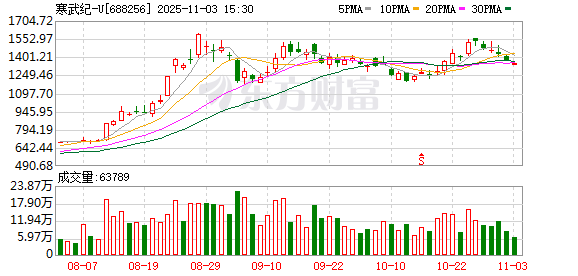
Group 1 - The average stock price of the Sci-Tech Innovation Board is 41.00 yuan, with 74 stocks priced over 100 yuan, and the highest priced stock is Cambrian-U at 1346.60 yuan, which decreased by 2.07% today [1][2] - Among the stocks priced over 100 yuan, 261 stocks increased while 324 stocks decreased today, with an average decline of 0.45% for the hundred-yuan stocks [1][2] - The average premium of the hundred-yuan stocks relative to their issue price is 475.41%, with the highest premiums for companies like Shunwei New Materials, Cambrian-U, and GuoDun Quantum at 4063.52%, 1991.32%, and 1531.40% respectively [1][2] Group 2 - The net outflow of main funds from the hundred-yuan stocks today totaled 34.34 billion yuan, with the highest net inflows for companies like Baiwei Storage, Haibo Science and Technology, and Purun Shares at 270.04 million yuan, 142.99 million yuan, and 129.67 million yuan respectively [2] - The total margin balance for hundred-yuan stocks is 970.45 billion yuan, with the highest margin balances for companies like SMIC, Cambrian-U, and Haiguang Information at 14.49 billion yuan, 14.37 billion yuan, and 8.50 billion yuan respectively [2]
侃股:社保基金持有科创板股票也是价值投资
Bei Jing Shang Bao· 2025-11-03 12:28
Core Insights - The Social Security Fund has emerged as a significant investor in 73 companies listed on the STAR Market, indicating a shift in value investment strategies beyond traditional high-dividend stocks [1][2] - Value investment is not limited to high-dividend companies; companies with core technology and growth potential in the STAR Market also represent valuable investment opportunities [1][2] Group 1: Investment Strategy - The Social Security Fund is known for its conservative approach and focus on long-term returns, typically favoring high-dividend blue-chip stocks [1] - The investment in STAR Market companies reflects a broader definition of value investment, recognizing the potential of innovative firms that may not provide immediate cash dividends [2] - The presence of the Social Security Fund in the STAR Market is expected to guide more capital towards technology innovation, fostering collaboration between technology and capital [2] Group 2: Market Dynamics - STAR Market companies are characterized by their leading positions in technology and high innovation capabilities, which may lead to significant growth and stock expansion [2] - The investment in these companies is seen as a bet on future economic growth and the potential emergence of super technology blue-chip stocks [2] - The diversified investment across 73 STAR Market companies helps mitigate risks associated with the inherent volatility of technology innovation [3]