
Cambricon(688256)

Search documents
芯片ETF(159995)开盘涨1.86%,重仓股中芯国际涨0.94%,海光信息涨3.00%
Xin Lang Cai Jing· 2026-02-24 01:39
来源:新浪基金∞工作室 芯片ETF(159995)业绩比较基准为国证半导体芯片指数收益率,管理人为华夏基金管理有限公司,基 金经理为赵宗庭,成立(2020-01-20)以来回报为93.54%,近一个月回报为3.60%。 声明:市场有风险,投资需谨慎。本文基于第三方数据库自动发布,不代表新浪财经观点,任何在本文 出现的信息均只作为参考,不构成个人投资建议。如有出入请以实际公告为准。如有疑问,请联系 biz@staff.sina.com.cn。 2月24日,芯片ETF(159995)开盘涨1.86%,报1.972元。芯片ETF(159995)重仓股方面,中芯国际开 盘涨0.94%,海光信息涨3.00%,寒武纪涨1.39%,北方华创涨1.17%,兆易创新涨2.85%,中微公司涨 1.26%,澜起科技涨3.27%,豪威集团涨1.02%,拓荆科技涨0.92%,长电科技涨1.67%。 ...




人工智能AIETF开盘涨1.28%,重仓股中际旭创涨2.07%,新易盛涨0.52%
Xin Lang Ji Jin· 2026-02-24 01:36
2月24日,人工智能AIETF(515070)开盘涨1.28%,报2.055元。人工智能AIETF(515070)重仓股方 面,中际旭创开盘涨2.07%,新易盛涨0.52%,寒武纪涨1.39%,澜起科技涨3.27%,中科曙光涨1.96%, 科大讯飞涨2.24%,海康威视涨0.62%,豪威集团涨1.02%,金山办公涨0.23%,浪潮信息涨0.87%。 声明:市场有风险,投资需谨慎。本文基于第三方数据库自动发布,不代表新浪财经观点,任何在本文 出现的信息均只作为参考,不构成个人投资建议。如有出入请以实际公告为准。如有疑问,请联系 biz@staff.sina.com.cn。 责任编辑:小浪快报 人工智能AIETF(515070)业绩比较基准为中证人工智能主题指数收益率,管理人为华夏基金管理有限 公司,基金经理为李俊,成立(2019-12-09)以来回报为102.02%,近一个月回报为-3.29%。 ...


“寒王”跳水
Guo Ji Jin Rong Bao· 2026-02-23 14:29
笔者明确表示,尽管2月2日A股市场大跌,释放了一些短期风险,但当前的市场整体风格偏向防 御,资金从高波动、高估值的科技板块流向股息率高、现金流稳定的传统板块,也就是许多投资者眼中 的"老登"股。 当前市场震荡不断,与全球政治军事和经济的不确定性密切相关,虽然全球半导体周期处在复苏通 道,一些半导体公司去年业绩也相当不错,比如三星、英伟达等,但复苏力度和持续性目前尚难说乐 观,毕竟美国的政策不确定性太大,美国对委内瑞拉和格陵兰岛等国家和地区的政治主张,以及对伊朗 等中东地区的政治军事主张,再加上俄罗斯与乌克兰的战争也在持续,这个世界充满巨大的不确定性, 这会导致整个半导体板块整体估值承压。而在这样的大背景下,寒武纪作为半导体巨头,可能会受到冲 击。 2月3日,市场明星"寒王"(寒武纪,688256)股价突然跳水:截止笔者落笔之时,寒武纪股价猛跌 至1070元,跌幅超过13%。 此前一日,笔者才撰文表示,投资者如果此时抄底,可能会面临较大风险。一语成谶。 即便如此,也只能说它的发展目前比较顺利,开始到了收获果实的季节,但离投资者期望的目标, 应该还有相当长的一段距离,未来会如何,还充满着相当大的不确定性。而在一些 ...
从寒武纪,到东方财富,再到英伟达,有多少股民能“耐寂寞”、“扛阴跌”?
Xin Lang Cai Jing· 2026-02-22 23:12
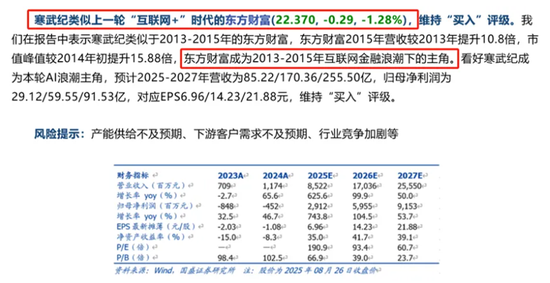
来源:基本面力场 昨天力场君以寒武纪(688256.SH)这只股票为例,就着国盛证券在研报中将其类比为东方财富 (300059.SZ)在10多年前那一波股价大涨的评价,和小伙伴们做了个交流分享。 再说大洋彼岸的英伟达(NVIDIA),与寒武纪更具有行业可比性,也更令人神往:在2021年到2022年 期间,也曾一度下跌了三分之二,随后则一路长红、涨到了没朋友,诞生了多少个千万富翁、亿万富翁 呀;只要能稳稳抓住,我不也能是千万富翁、亿万富翁的其中一个了吗? 但是从力场君的自身感受来说,这种"事后诸葛亮"的判断,在实际投资操作当中,基本没什么参考价 值,它只是基于明确结果下的后视镜,而现实持股过程中的心理恐惧,却是伴随着未知,源于对自我判 断的怀疑。 当股价走势与心理预期出现巨大偏差、眼前只有一片未知的迷雾的时候,特别是眼见着其他行业个股轮 番上涨,巨大的机会成本焦虑和比较心理,在日复一日地侵蚀耐心,有多少人还能耐得住寂寞、扛得住 阴跌?这不是对投资技巧的考验,而是一场对心性的磨砺修炼。 说回到东方财富,这是"互联网+证券资讯"行业里,后期表现最好的一个了,典型的幸存者偏差。其他 的几家就惨多了,比如赢时胜(300 ...


2025中国算力产业实录:狂热、阵痛与价值回归丨年度盘点
雷峰网· 2026-02-19 03:32
Group 1 - The core viewpoint of the article emphasizes the transformation of the AI computing power industry, driven by the emergence of DeepSeek, which optimizes computing efficiency and breaks down barriers for deploying large models, marking a significant moment for China's AI industry [2][6] - The article highlights the rapid rise and subsequent decline of integrated machines within four months, illustrating the struggles faced by intelligent computing centers amid idle computing power and the need to sell cards for survival [3][10] - A year-long investigation into the industry reveals the underlying factors that will support the scaling and ecological development of China's AI computing power, emphasizing the importance of endurance, ecology, and trust in this ongoing battle [4][25] Group 2 - DeepSeek's explosive popularity catalyzed a transformation in the AI computing power industry, prompting domestic chip manufacturers to accelerate adaptation processes, benefiting companies like Huawei and Cambricon [7][8] - The article discusses the structural contradictions in the AI computing market, where demand for computing power is surging while many intelligent computing centers face low utilization rates, leading to a paradox of computing shortages on one side and idle resources on the other [10][11] - The article notes that the AI computing power industry is entering a mature phase, with a shift from speculative profits to a focus on core business principles, as evidenced by various industry challenges such as contract breaches and fraudulent activities [12][13] Group 3 - The article outlines the emergence of domestic inference chips, driven by urgent demands for autonomy and rapid growth in inference needs, with several companies like Moore Threads and Nuxi going public [16][17] - It highlights the competitive landscape where domestic chips are attempting to challenge Nvidia's dominance, with the inference segment becoming a critical breakthrough point for domestic computing power [19][20] - The storage sector is experiencing a price surge due to increased demand, significantly impacting the AI server industry and creating survival challenges for smaller manufacturers [21][23] Group 4 - The article reflects on the key developments in 2025, from the initial excitement surrounding DeepSeek to the industry's entry into a more complex phase characterized by chaos and bubble clearing [25] - It notes the collective market entry of several domestic GPU companies, referred to as the "Four Little Dragons," which has expanded the competitive landscape for domestic computing power [25] - Looking ahead to 2026, the article emphasizes the need to focus on the real adaptation progress in AI chips and storage, tracking technological breakthroughs and capital market dynamics to witness the evolution of domestic computing power from mere usability to leadership [25]



联想创投王光熙:2026年投资更趋理性,“硅基智能”仍是长期主线丨创投贺新春
Sou Hu Cai Jing· 2026-02-17 12:30
Core Insights - Despite macroeconomic challenges, Lenovo Venture Capital has maintained a clear strategic focus, achieving significant investment milestones in 2025 [3] - The company invested in over 40 new enterprises and facilitated nearly 100 portfolio companies in securing new rounds of financing, with total investment transactions exceeding 60, 80% of which were directed towards sectors closely related to the "silicon-based ecosystem" [3] - The total number of portfolio companies has surpassed 300, with 25 successfully going public, including leading firms like CATL, Cambricon, and Haiguang Information, each valued over 500 billion [3] Industry Outlook - The industry faces a gap between technological ideals and commercial realities, particularly in fields like embodied intelligence, where establishing scalable business models is a key challenge [3] - High-quality vertical data is expected to become a core barrier for industrial AI, with China's complete industrial chain and rich scenarios providing unique advantages for incubating breakthrough technologies [3] Future Investment Strategy - Looking ahead to 2026, investments are expected to become more rational, with "silicon-based intelligence" remaining a long-term focus [4] - The company plans to deepen its investment in three main areas: the evolution of AI towards "system intelligence," focusing on intelligent agents and AI-native hardware; the commercialization of machine intelligence, leveraging the benefits of autonomous driving technology; and forward-looking investments in disruptive computing architectures such as integrated storage and computing and RISC-V [4]

跟着大资金选股!公募调仓科创板,猛攻电子、医药
市值风云· 2026-02-14 10:09
Core Viewpoint - The article discusses the current funding logic in the market, highlighting the significant movements of public funds in the technology sector, particularly in the semiconductor and biopharmaceutical industries, as they adjust their portfolios based on performance and valuation metrics [3][8]. Group 1: Public Fund Movements - Public funds have shown a notable shift in their holdings, particularly in the STAR Market, with the STAR 50 Index rising by 12.1% this year [3][4]. - The total market capitalization of STAR Market companies reached 10.4 trillion yuan, with the technology sector dominating, accounting for 62.1% of the total market cap [5][6]. - The semiconductor industry remains the core focus for fund allocation, with 12 companies in the sector having a market capitalization exceeding 10 billion yuan [9][11]. Group 2: Semiconductor Sector Insights - The market's pricing anchor for the semiconductor sector has shifted from "valuation expansion" to "performance realization," emphasizing the importance of actual earnings [13][14]. - Key drivers for future growth in the semiconductor sector include strong order backlogs, profit growth through acquisitions and expansions, and sustained price increases in advanced processes [13][14]. - Public funds have significantly increased their holdings in semiconductor materials, chip design, and equipment, with companies like ShenGong Co. seeing an 11% increase in fund holdings [15][21]. Group 3: Biopharmaceutical Sector Insights - The biopharmaceutical sector is a critical area for public funds, with major holdings in companies like BeiGene and United Imaging Healthcare, although the sector has faced a reduction in holdings for several key companies [24][26]. - The article notes that innovative drug companies are currently under pressure, with significant reductions in holdings observed in companies like BaiLi TianHeng and RongChang Biopharma [26][28]. - Despite the challenges, companies with strong earnings potential and innovative drug pipelines are still attracting interest from public funds, indicating a selective investment approach [35][40].






谁是中国AI“第一城”?
机器人圈· 2026-02-14 09:48
Core Insights - The article highlights the rapid growth and development of China's artificial intelligence (AI) industry, showcasing significant user adoption and innovation across various sectors [3][4][14][24][31]. Group 1: AI Industry Growth - By the end of 2025, China's generative AI user base is projected to reach 602 million, a 141.7% increase from the end of 2024, with a penetration rate of 42.8%, up 25.2 percentage points year-on-year [3]. - The AI industry in Beijing has surpassed 2,400 companies, including 46 listed firms and 36 unicorns, accounting for over half of the national total [4]. - Shanghai's AI industry is expected to exceed 550 billion yuan in scale by the end of 2025, with a year-on-year growth rate of over 30% [14]. Group 2: Key Players and Innovations - Major companies leading the AI sector include ByteDance, Baidu, and Huawei, focusing on areas such as large models, AI algorithms, and smart driving [5][24]. - Shenzhen has seen a 22.6% year-on-year growth in its core AI industry, with a total scale reaching 368.5 billion yuan in 2024, indicating a shift towards source innovation [24]. - Hangzhou's AI industry is projected to grow from 300 billion yuan in 2023 to 399 billion yuan in 2024, with 84 listed companies and 10 unicorns by the end of 2025 [31]. Group 3: Data and Infrastructure - Beijing has registered 123 large model products and established a data foundation with over 150 petabytes of data [4]. - Shanghai has completed 137 registrations for generative AI services, building a workforce of 300,000 in the AI sector [14]. - Shenzhen's AI industry encompasses a full range of the supply chain, from chips to applications, with 2,887 related enterprises [24].




计算机行业事件点评:Seedance2.0算力需求知多少
Guolian Minsheng Securities· 2026-02-14 00:51
Investment Rating - The report maintains a "Recommended" rating for the industry, indicating an expected relative performance exceeding 15% compared to the benchmark index over the next 12 months [8]. Core Insights - The launch of Seedance 2.0 by ByteDance marks a significant advancement in AI video generation, enabling users to create videos with simple text prompts, which is expected to enhance user engagement and frequency of use over the long term [3][5]. - The model's capabilities include multi-modal input acceptance, narrative coherence, and audio-visual synchronization, addressing key industry challenges such as character consistency and audio-visual mismatch [4][5]. - The demand for computational power is projected to increase exponentially due to the anticipated high concurrency from both consumer (C-end) content creation and business (B-end) API calls [6]. Summary by Sections Seedance 2.0 Launch and Features - Seedance 2.0 is integrated into various platforms, allowing users to generate short videos easily, which is expected to drive higher usage rates [3]. - The model supports multiple input types and can generate videos with synchronized audio, enhancing the creative process for users [4]. Computational Demand Projections - The report estimates that by October 2025, the monthly usage of AI-generated content on the platform will reach 63,900 times, with a total usage time of 1,668.2 hours [6]. - The complexity of video generation is significantly higher than that of text and images, leading to a substantial increase in computational requirements [6]. - Projections indicate that the number of required H100 GPUs for video generation could range from 2.4 million to 4.284 million under different scenarios, with a market space for H100 GPUs estimated between $4.8 billion and $8.568 billion [14][12]. Long-term Market Opportunities - The report highlights the potential for domestic computational power providers to benefit from the growth of AI video generation, with specific companies recommended for investment, including chip designers and AI server manufacturers [13]. - The user base for short videos in China is expected to exceed 1 billion by the end of 2024, with increasing daily usage times projected [7][11].


寒武纪:公司专注于主营业务
Zheng Quan Ri Bao Zhi Sheng· 2026-02-13 09:48
(编辑 楚丽君) 证券日报网讯 2月13日,寒武纪在互动平台回答投资者提问时表示,公司专注于主营业务,将持续聚焦 人工智能芯片设计领域技术创新,提升核心竞争力,积极拓展市场份额,加速场景落地,推动公司的持 续良好发展,公司2026年度具体经营业绩情况请以公司在指定披露媒体披露的定期报告等公告信息为 准。根据《上海证券交易所交易规则》《上海证券交易所科创板股票上市规则》的有关规定,公司目前 没有触发被要求停牌核查的条件。特别提醒广大投资者理性看待市场波动并注意投资风险。 ...