Cambricon(688256)

Search documents
6家深企上榜!2025胡润中国人工智能企业50强出炉
Shen Zhen Shang Bao· 2026-01-19 08:02
Core Insights - The "2025 Hurun China AI Companies Top 50" report ranks companies based on their value, highlighting the rapid growth and significance of AI in reshaping wealth in China [1][4]. Group 1: Company Rankings and Values - The top-ranked company is Cambricon, valued at 630 billion RMB, showing a 165% increase from the previous year [1][4]. - The ranking includes 21 non-listed companies, with the entry threshold set at 95 billion RMB, an increase of 35 billion RMB from last year [4]. - The average value of the listed companies is 540 billion RMB, which is 2.4 times higher than last year [4]. Group 2: Industry Trends and Growth - There is a notable increase in AI chip companies, with 14 firms making the list, up from 5 last year, driven by U.S. export controls on high-end AI chips [4][5]. - The report indicates that AI is transforming the wealth landscape in China, with significant wealth increases for key figures in the AI sector [4][6]. Group 3: New Entrants and Market Dynamics - 18 new companies joined the list, with 10 being AI chip-related, reflecting a shift in business focus for some firms from non-AI to AI [5]. - Companies like Chipone have seen a substantial increase in revenue from AI-related design services, indicating a strong market demand for AI capabilities [5][6]. Group 4: Sectoral Breakdown - The report categorizes AI companies into sectors: computing power (e.g., Cambricon), data analysis (e.g., Jingtaitech), machine vision (e.g., SenseTime), voice recognition (e.g., iFlytek), content generation (e.g., Kimi), and autonomous driving (e.g., Didi Autonomous Driving) [6][7]. - The focus on AI as a core business is emphasized, with only 31 companies meeting the criteria of having AI as their main business and a valuation above 9.5 billion RMB [4][6]. Group 5: Global Expansion and Future Outlook - AI companies are increasingly acting as "behind-the-scenes enablers" for industries like consumer electronics and new energy vehicles, with many still primarily focused on the domestic market [6][7]. - The long-term outlook suggests that companies with core technologies and practical applications will emerge as leaders, transitioning AI from a speculative concept to a foundational infrastructure [7].




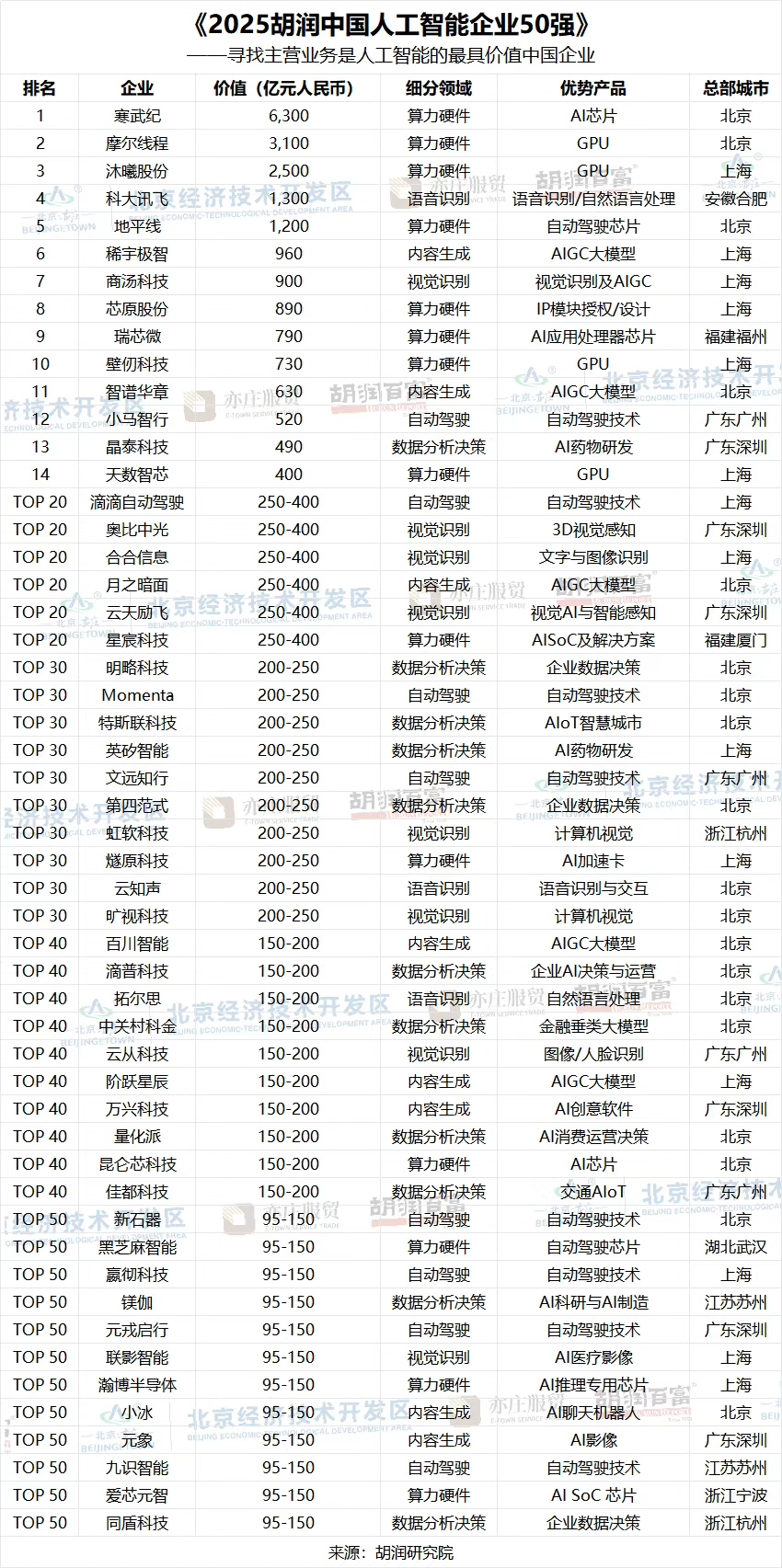
胡润研究院发布中国人工智能50强,寒武纪以6300亿元价值居榜首
Xin Lang Cai Jing· 2026-01-19 07:59
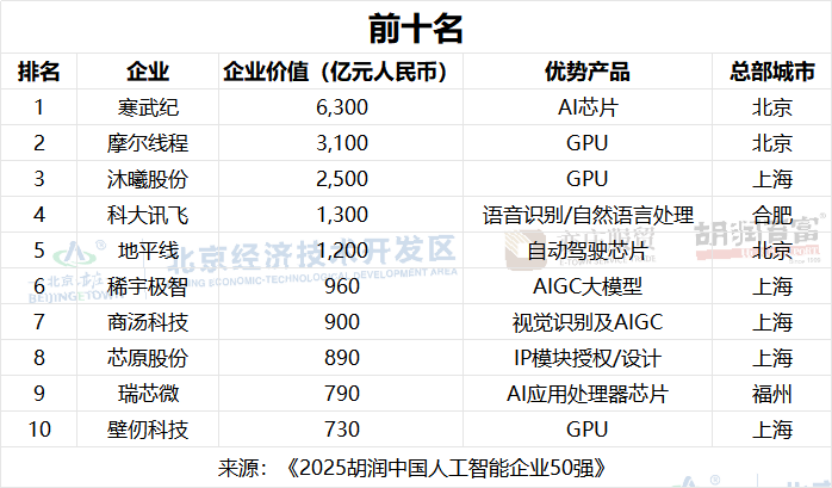
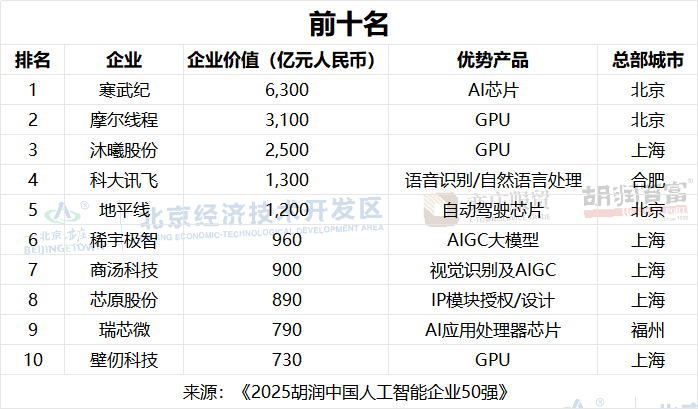
1月19日,胡润研究院发布《2025胡润中国人工智能企业50强》。AI芯片企业寒武纪以6300亿元的价值位居榜首,比去年增长165%;国产GPU第一股摩尔线 程排名第二,价值3100亿元;中国首批实现全流程国产化的高端GPU企业沐曦排名第三,价值2500亿元。 居榜单首位的寒武纪于2016年成立,源自中科院计算所,2020年A股上市成为中国AI芯片第一股。公司专注云边端一体、软硬件协同AI芯片,提供MLU架 构芯片、加速卡、整机及Cambricon Neuware软件栈,2025年上半年,寒武纪实现营收28.8亿元,同比大幅增长43倍。 摩尔线程与沐曦股份分别位列第二、三位。两家均是成立于2020年的GPU企业。摩尔线程聚焦全功能GPU研发,2025年上市,2025年前三季度营收同比增长 182%;沐曦股份则实现全流程国产化高端GPU突破,曦云系列芯片累计交付超2.8万颗,在手订单达14.3亿元。 科大讯飞以1300亿元的价值位居第四,稳居智能语音赛道标杆;地平线以1200亿元的价值位居第五,稳居车载AI芯片及智驾解决方案领军地位。 在上榜企业中,北京以19家企业的数量领先,包括寒武纪、月之暗面和云知声等知名 ...

胡润人工智能企业50强发布,苏州2家企业上榜
Yang Zi Wan Bao Wang· 2026-01-19 07:45
Core Insights - The "2025 Hurun China AI Companies Top 50" list was released, ranking companies based on their value, with a focus on those primarily engaged in artificial intelligence [1][4] - Among the listed companies, two from Suzhou, Megvii and Ninebot, specialize in data analysis and autonomous driving [1] Company Rankings - The top three companies are: 1. Cambricon with a value of 630 billion RMB, specializing in AI chips [4] 2. Moore Threads valued at 310 billion RMB, focusing on GPUs [4] 3. Muxi Technology valued at 250 billion RMB, also in the GPU sector [4] - Notably, seven out of the top ten companies are related to AI chips, including Horizon Robotics and Rockchip [4] Geographic Distribution - Beijing leads with 19 companies on the list, followed by Shanghai with 14, Shenzhen with 6, and Guangzhou with 4 [6][7] - The number of companies from Shanghai increased by 5 compared to the previous year, while Beijing saw a decrease of 1 [7] Emerging Trends - Nearly 40% of the Chinese population are users of generative AI, with 515 million users reported by mid-2025 [8] - The core value of AI is seen as enhancing human capabilities across various domains, including computation, data analysis, machine vision, voice recognition, content generation, and autonomous driving [9]

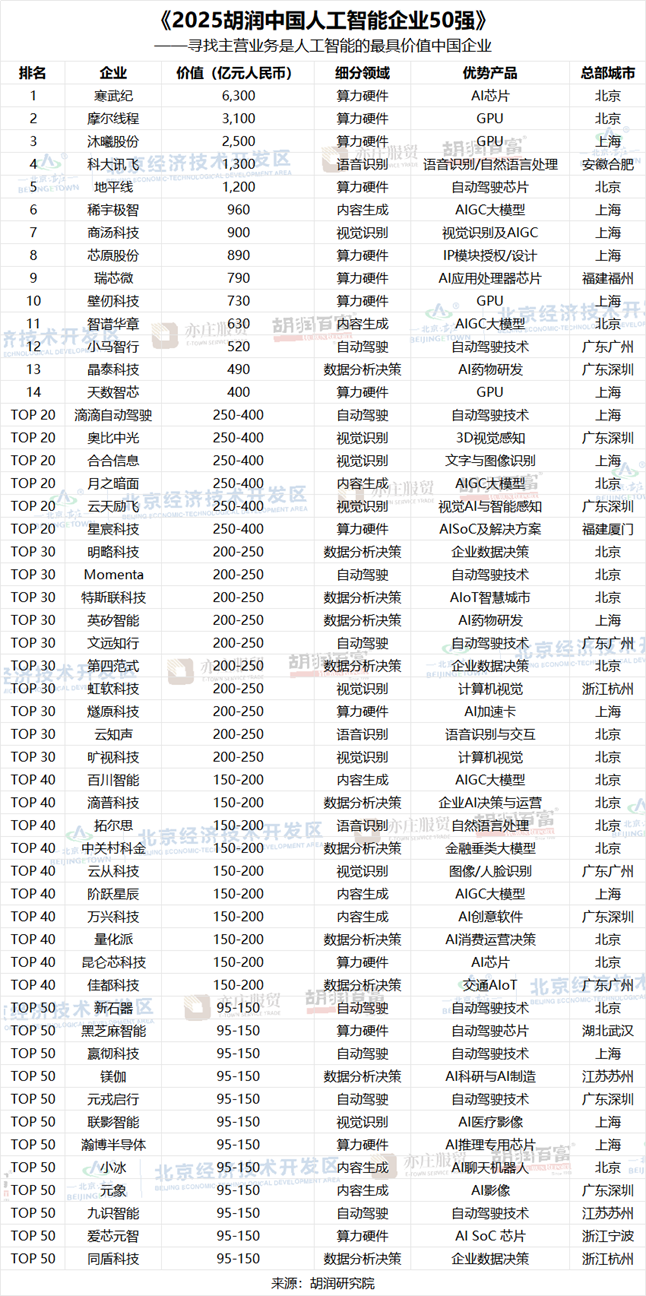
胡润发布中国AI企业50强,前10有7家芯片公司
Guan Cha Zhe Wang· 2026-01-19 07:38
Core Insights - The 2025 Hurun China AI Companies Top 50 report highlights the rapid growth and prominence of AI chip companies in China, with the top three companies being Cambricon, Moore Threads, and Muxi, all of which are AI chip-related firms [1][2][6] Group 1: Company Performance - Cambricon ranks first with a valuation of 630 billion RMB, experiencing a 165% increase from the previous year. In Q3 2025, the company reported revenue of 1.727 billion RMB, a year-on-year growth of 1332.52%, and a net profit of 567 million RMB, marking its fourth consecutive profitable quarter [1][6] - Moore Threads, established in 2020, ranks second with a valuation of 310 billion RMB. The company achieved a revenue of 785 million RMB in the first three quarters of 2025, a 182% increase compared to the previous three years combined, although it reported a net loss of 724 million RMB [1][2] - Muxi ranks third with a valuation of 250 billion RMB, reporting revenue of 1.236 billion RMB in the first three quarters of 2025, a 453.52% year-on-year increase, while its net loss narrowed to 346 million RMB [2][6] Group 2: Industry Trends - The report indicates a significant increase in the number of AI chip companies on the list, with 14 firms represented, an increase of 9 from the previous year. This growth is attributed to the tightening of high-end AI chip export controls by the U.S., prompting domestic companies to accelerate their capabilities [6][7] - The AI user base in China is substantial, with 515 million users reported by mid-2025, indicating that nearly 40% of the population are users of generative AI [6] - The top 50 list features a total of 14 companies in the computing hardware sector, the largest category, followed by 11 in data analysis and decision-making, and 8 each in content generation, visual recognition, and autonomous driving [3][4] Group 3: Market Position - The combined market value of the top three Chinese computing power companies is approximately 1.2 trillion RMB, which is only 4% of Nvidia's market value, suggesting a significant gap that may narrow in the next five years as China's computing power industry advances [7] - Major cities dominate the list, with Beijing leading with 19 companies, followed by Shanghai with 14, indicating that over 80% of the listed companies are based in first-tier cities [4]


222只,百元股数量创历史新高,科技新贵扎堆
Zheng Quan Shi Bao Wang· 2026-01-19 07:16
Group 1 - The A-share market has reached a historical high with 222 stocks closing above 100 yuan as of January 19, 2026 [1] - On January 12, 2026, there were 219 stocks above 100 yuan, nearly matching the previous peak of 219 stocks on November 29, 2021 [1] - The top three stocks by closing price are Cambrian-U at over 1400 yuan, Kweichow Moutai at 1376 yuan, and Yuanjie Technology at 748.29 yuan [1] Group 2 - Several stocks, including Moer Thread-U, Zhongji Xuchuang, Guodun Quantum, and Muxi Shares-U, have also surpassed 500 yuan [1] - The majority of the top ten stocks above 100 yuan are from the technology sector, with Kweichow Moutai being the only non-tech stock in the top ten [1]




ETF盘中资讯|寒武纪登顶中国AI企业50强!科创人工智能ETF华宝(589520)近5日狂揽1.5亿元!机构:或迎1-10加速放量阶段
Sou Hu Cai Jing· 2026-01-19 06:33
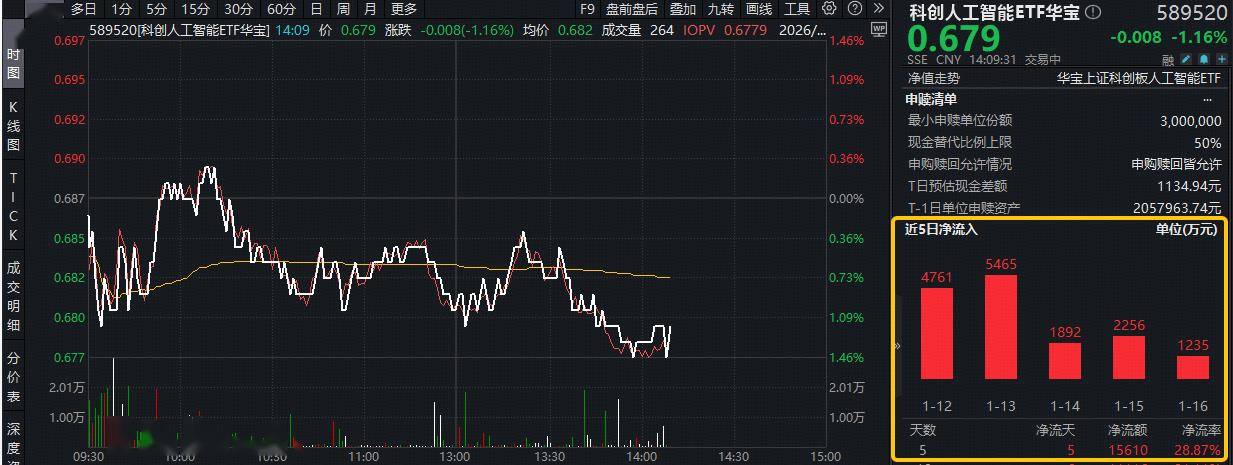
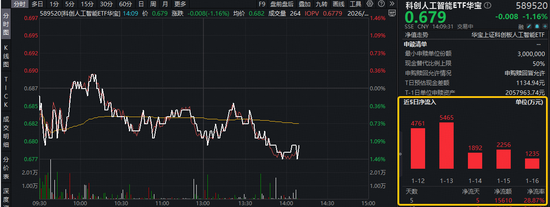
消息面上,1月19日,胡润研究院发布《2025胡润中国人工智能企业50强》,榜单聚焦于主营业务为AI算力或算法的中国企业。其中,AI芯片企业寒武纪以 6300亿元的企业价值位居榜首,比去年增长165%。 值得一提的是,芯片类产业持续迎机遇。一方面,算力被纳入新基建,地方政府提供能耗指标倾斜、补贴与税收优惠,推动智算中心集中落地于武汉、合 肥、太原等算力走廊,政策红利持续释放。另一方面,资本密集加持,AI 芯片、半导体设备等细分领域融资渠道通畅,头部企业估值与业绩形成正向循 环,加速技术迭代与产能扩张。中泰证券分析认为,算力国产链历经供应链调整,预计将进入1-10加速大放量阶段。 今日(1月19日)重点布局国产AI产业链的科创人工智能ETF华宝(589520)随市盘整回调,场内价格现跌1.16%,数据显示,该ETF此前5日连续吸金,合 计狂揽1.56亿元,反映资金看好国产AI产业链后市表现,积极进场布局! 成份股方面,星环科技领涨超6%,奥比中光、海天瑞声涨逾4%,威胜信息、芯原股份、寒武纪等个股跟涨。另一方面,合合信息跌超6%,亚信安全跌逾 5%,虹软科技、奇安信等个股跌幅居前,拖累指数表现。 【国产替代之光 ...
寒武纪登顶中国AI企业50强!科创人工智能ETF华宝(589520)近5日狂揽1.5亿元!机构:或迎1-10加速放量阶段
Xin Lang Cai Jing· 2026-01-19 06:24
今日(1月19日)重点布局国产AI产业链的科创人工智能ETF华宝(589520)随市盘整回调,场内价格 现跌1.16%,数据显示,该ETF此前5日连续吸金,合计狂揽1.56亿元,反映资金看好国产AI产业链后市 表现,积极进场布局! 成份股方面,星环科技领涨超6%,奥比中光、海天瑞声涨逾4%,威胜信息、芯原股份、寒武纪等个股 跟涨。另一方面,合合信息跌超6%,亚信安全跌逾5%,虹软科技、奇安信等个股跌幅居前,拖累指数 表现。 消息面上,1月19日,胡润研究院发布《2025胡润中国人工智能企业50强》,榜单聚焦于主营业务为AI 算力或算法的中国企业。其中,AI芯片企业寒武纪以6300亿元的企业价值位居榜首,比去年增长 165%。 值得一提的是,芯片类产业持续迎机遇。一方面,算力被纳入新基建,地方政府提供能耗指标倾斜、补 贴与税收优惠,推动智算中心集中落地于武汉、合肥、太原等算力走廊,政策红利持续释放。另一方 面,资本密集加持, AI 芯片、半导体设备等细分领域融资渠道通畅,头部企业估值与业绩形成正向循 环,加速技术迭代与产能扩张。中泰证券分析认为,算力国产链历经供应链调整,预计将进入1-10加速 大放量阶段。 中 ...
中国人工智能50强榜单出炉!寒武纪、摩尔线程、沐曦股份位列前三
Zheng Quan Shi Bao· 2026-01-19 04:53
Core Insights - The "2025 Hurun China AI Companies Top 50" report highlights the increasing valuation and significance of AI companies in China, particularly in the AI chip sector [1][6] - The threshold for inclusion in the list has risen significantly, indicating a growing market and competition within the AI industry [1] Valuation and Rankings - The average value of listed companies is 54 billion RMB, which is 2.4 times higher than the previous year [1] - The top ten companies have a valuation threshold of 73 billion RMB, more than three times the previous year's 22 billion RMB [1] - The top three companies are all AI chip-related, with Cambrian Technology leading at 630 billion RMB, followed by Moore Threads at 310 billion RMB, and Muxi Technology at 250 billion RMB [4][5] Company Performance - Cambrian Technology reported a revenue of 2.88 billion RMB in the first half of 2025, a 43-fold increase year-on-year [4] - Moore Threads achieved a revenue of 780 million RMB in the first three quarters of 2025, marking a 182% year-on-year growth [5] - Muxi Technology has focused on high-end GPU development and is among the first to achieve full domestic production [5] Geographic Distribution - Beijing leads with 19 companies on the list, followed by Shanghai with 14, indicating a concentration of AI talent and resources in major cities [7] - Over 80% of the listed companies are based in first-tier cities, showcasing their importance in the AI sector [7] Industry Trends - The number of AI chip companies on the list has increased to 14, up by 9 from the previous year, driven by domestic demand due to U.S. export controls [6] - The AI sector is reshaping wealth distribution in China, with notable increases in the wealth of key figures in the industry [9]
《2025胡润中国人工智能企业50强》重磅发布 寒武纪以6300亿价值位居榜首
Zhi Tong Cai Jing· 2026-01-19 04:51
Core Insights - The 2025 Hurun China AI Companies Top 50 list highlights the growth and valuation of AI-focused companies in China, with a significant increase in the number of AI chip companies due to tightening U.S. export controls on high-end AI chips [1][2] Company Rankings - Cambricon leads the list with a valuation of 630 billion RMB, marking a 165% increase from the previous year [1][2] - Moore Threads ranks second with a valuation of 310 billion RMB, achieving a 182% year-on-year revenue growth [3] - Muxi ranks third with a valuation of 250 billion RMB, recognized as one of the first high-end GPU companies to achieve full domestic production [3] - iFlytek, a leader in intelligent voice technology, ranks fourth with a valuation of 130 billion RMB [4] - Horizon Robotics ranks fifth with a valuation of 120 billion RMB, focusing on automotive AI chips [4] Market Trends - The list shows a total of 21 non-listed companies, with the entry threshold raised to 9.5 billion RMB, an increase of 3.5 billion RMB from last year [1] - The average valuation of listed companies is 54 billion RMB, which is 2.4 times higher than the previous year [1] - The number of AI chip companies on the list has increased to 14, up from 5 last year, indicating a shift towards domestic AI chip production [1] Geographic Distribution - Beijing leads with 19 companies on the list, followed by Shanghai with 14, and Shenzhen with 6, indicating a concentration of AI talent and resources in first-tier cities [1] Sector Breakdown - The majority of companies on the list are focused on AI chip hardware, with 14 companies in this category, reflecting the growing importance of AI infrastructure [5] - Other sectors include data analysis and decision-making with 11 companies, and content generation with 8 companies [5]
中国人工智能50强榜单出炉!寒武纪、摩尔线程、沐曦股份位列前三
证券时报· 2026-01-19 04:46
Core Insights - The article discusses the release of the "2025 Hurun China AI Companies Top 50" list, highlighting the significant growth in valuations and the increasing importance of AI companies in China [1]. Group 1: AI Companies Overview - The list features 50 companies focused on AI computing power or algorithms, with a minimum valuation of 9.5 billion RMB, an increase of 3.5 billion RMB from the previous year [1]. - The average value of the listed companies is 54 billion RMB, which is 2.4 times higher than last year [1]. - The top ten companies have a minimum valuation of 73 billion RMB, more than three times the previous year's threshold of 22 billion RMB [1]. Group 2: Leading Companies - Cambricon Technologies ranks first with a valuation of 630 billion RMB, focusing on AI core processor chip development, achieving a revenue of 2.88 billion RMB in the first half of 2025, a 43-fold increase year-on-year [4][6]. - Moore Threads, established in 2020, ranks second with a valuation of 310 billion RMB and reported a revenue of 780 million RMB in the first three quarters of 2025, a 182% year-on-year increase [5]. - Muxi Co., Ltd. ranks third with a valuation of 250 billion RMB, specializing in full-stack GPU development [6]. Group 3: Industry Trends - The AI chip sector shows a significant valuation advantage over other fields, with 14 AI chip companies making the list, an increase of 9 from the previous year [6]. - The concentration of AI companies is primarily in first-tier cities, with Beijing leading with 19 companies, followed by Shanghai with 14, indicating a strong urban cluster effect in the AI sector [8]. - The article notes that AI is reshaping China's wealth landscape, with notable increases in the wealth of individuals in the AI sector, such as Chen Tian Shi of Cambricon, whose wealth grew by nearly 150 billion RMB [10].