Cambricon(688256)

Search documents
寒王大动作!资本公积金弥补亏损!如何解读?科创人工智能ETF(589520)宽幅溢价,资金积极进场!
Xin Lang Cai Jing· 2025-12-16 03:27
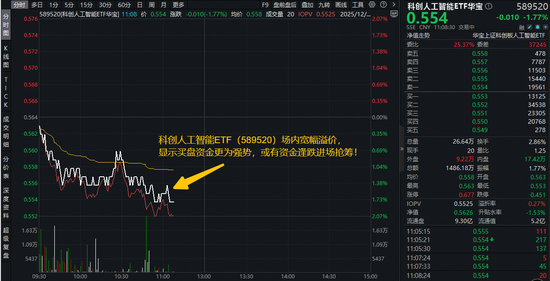
Group 1 - The core point of the article is that AI chip manufacturer Cambricon plans to use 2.778 billion yuan from its capital reserve to offset accumulated losses, which will not affect its net assets or cash flow, and will allow for potential dividend distribution after the adjustment [1][6] - Analysts noted that the capital reserve adjustment is an internal accounting measure that increases retained earnings without actual cash flow impact, thus posing no operational risks [1][6] - Cambricon's performance has been strong, with significant revenue and net profit growth expected in the first three quarters of 2025, driven by the increased sales of its cloud products [1][6] Group 2 - The AI application sector is seen as having greater potential compared to computing power, with the investment logic shifting from hardware to actual applications and commercialization [2][7] - The Sci-Tech Innovation AI ETF (589520) is strategically positioned to capture the AI industry chain, focusing on software applications, terminal applications, and chips, indicating a shift towards domestic technology [2][7] - On December 16, the ETF experienced a price drop of 1.77%, but still showed strong buying interest, indicating potential for future investment [2][8] Group 3 - The importance of information and industrial security has been highlighted in the context of technological friction, emphasizing the need for self-reliance in core technologies like AI [4] - The ETF and its associated funds are heavily invested in the domestic AI industry, with over 70% of the top ten holdings focused on semiconductor sectors, indicating a high concentration and aggressive investment strategy [4]


日经BP精选——中国半导体2026年展望:自主供应链趋完善,去英伟达化加速
日经中文网· 2025-12-16 02:54
Group 1 - The core viewpoint of the article highlights that Huawei is becoming a central player in China's semiconductor industry, particularly in AI semiconductors, challenging the dominance of Nvidia [5]. - By 2026, Huawei and emerging companies like Cambricon Technology are expected to significantly increase their AI semiconductor shipments, with a forecast of over 1 million units, more than doubling the predictions for 2024 [5]. - The article emphasizes that despite the advancements, China's manufacturing equipment and materials still lag behind the most advanced levels globally [5].


“以存代算”引爆存储涨价周期,消费电子ETF(561600)震荡蓄势
Xin Lang Cai Jing· 2025-12-16 02:44
Group 1 - The core viewpoint of the articles highlights a significant price surge in the global memory chip market, particularly in DRAM and NAND Flash, with prices increasing over 300% since September 2023, driven by the rise of AI applications [1][2] - The consumption electronics sector is expected to implement a combination of structural price increases and cost-sharing strategies with the supply chain, particularly as the demand for consumer electronics like smartphones and computers is projected to rise through 2026 [1] - The consumption electronics ETF closely tracks the performance of the China Securities Consumption Electronics Theme Index, which includes 50 listed companies involved in component production and brand design [2][3] Group 2 - The top ten weighted stocks in the China Securities Consumption Electronics Theme Index account for 56.39% of the index, indicating a concentration of investment in key players such as Luxshare Precision and Cambricon Technologies [3] - AI is enhancing the demand for consumer batteries, as the integration of AI in devices like smartphones and wearables is leading to increased power consumption and a higher demand for lithium batteries [2]




寒武纪拟用近28亿资本公积弥补亏损,前三季净利扭亏为盈
Xin Lang Cai Jing· 2025-12-16 02:12
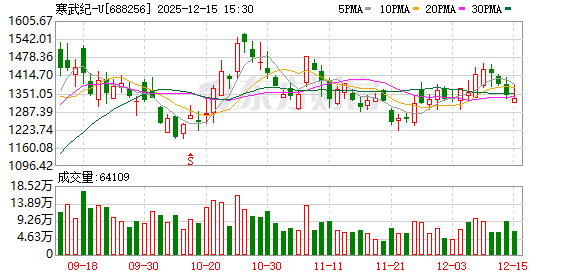
智通财经记者 | 宋佳楠 12月15日晚间,AI芯片企业寒武纪(688256.SH)发布公告称,公司已通过股东会决议,拟使用27.78亿元资本公积弥补 母公司累计亏损,将截至2024年末的负未分配利润清零。 上述消息公布后,截至12月16日发稿,寒武纪股价报1306.98元,跌1.87%,总市值为5511亿元。 今年8月以来,寒武纪股价多次超越贵州茅台,成为新"股王"。公司2025年半年报披露后,寒武纪因上半年营收同比暴 增43倍、归母净利润10.38亿元实现扭亏,股价一度冲高至1595.88元的年度峰值,首次超越茅台收盘价。 所谓资本公积,是企业收到投资者超出注册资本的出资部分及其他资本性投入形成的准备金,与经营利润无关,主要来 源于股本溢价、资产重估增值等。 10月下旬,寒武纪股价连续4个交易日站稳茅台之上,并在10月27日领先幅度达到最大,当日股价较茅台溢价超3%。 据证券日报报道,中央财经大学郑登津副教授曾指出,资本公积补亏本质是"账面修复",通过冲减累计亏损改善财务报 表结构,但不直接提升企业盈利能力。 对寒武纪而言,此举短期内可消除累计亏损对利润分配的限制,为后续实施分红创造条件,契合监管层鼓励上 ...
寒武纪一度跌3.7%,拟使用母公司资本公积27.8亿元弥补母公司累计亏损。
Xin Lang Cai Jing· 2025-12-16 02:12
寒武纪一度跌3.7%,拟使用母公司资本公积27.8亿元弥补母公司累计亏损。 ...
15日两融余额增加42.66亿元 电子行业获融资净买入居首
Sou Hu Cai Jing· 2025-12-16 02:01
个股方面,25只个股获融资净买入额超1亿元。航天电子获融资净买入额居首,净买入7.78亿元;融资净买入金额居前的还有中国平安、胜宏科技、阳光电 源、寒武纪、通宇通讯、新易盛、菲利华、摩尔线程、中科曙光等。 | 序号 | | | | | | --- | --- | --- | --- | --- | | | 证券代码 ◆ | 证券简称 = | 交易日期 ◆ | 融资净买入额(万元) ◆ | | 1 | 600879.SH | 航天电子 | 2025-12-15 | 77,847.53 | | 2 | 601318.SH | 中国平安 | 2025-12-15 | 66,889.42 | | 3 | 300476.SZ | 胜宏科技 | 2025-12-15 | 62,443.30 | | 4 | 300274.SZ | 阳光电源 | 2025-12-15 | 53,735.38 | | 5 | 688256.SH | 寒武纪 | 2025-12-15 | 45,796.87 | | 6 | 002792.SZ | 通宇通讯 | 2025-12-15 | 39,164.11 | | 7 | 300502.SZ | ...






财联社12月16日早间新闻精选
Xin Lang Cai Jing· 2025-12-16 00:16
Group 1 - The article emphasizes the importance of expanding domestic demand as a strategic initiative, advocating for a long-term mechanism to enhance consumer spending and confidence [1] - The China Securities Regulatory Commission (CSRC) is set to implement reforms to the ChiNext board and accelerate the rollout of the "1+6" reform measures for the Sci-Tech Innovation Board, aiming to enhance market stability and promote equity public funds [2] - The State Grid Corporation of China is focusing on building a new power system and energy framework to achieve carbon peak goals [3] Group 2 - The Ministry of Commerce and five other departments have issued an action plan to promote high-quality development in the service outsourcing sector, targeting the cultivation of internationally competitive leading enterprises by 2030 [4] - The State Administration of Foreign Exchange is emphasizing macro-prudential management of the foreign exchange market to maintain the stability of the RMB exchange rate and ensure a balanced international payment [5] - The first batch of L3 autonomous driving vehicles has received approval for road testing in designated areas of Beijing and Chongqing [6] Group 3 - There is a collective price increase trend among manufacturers of lithium iron phosphate cathode materials, expected to continue until the fourth quarter of next year [7] - The Henan Province Postal Regulations will take effect on March 1, 2026, imposing fines for unauthorized actions by express delivery companies [8] - Several companies, including Aerospace Electronics and TCL Technology, have announced significant capital investments and acquisitions, indicating active market movements [9] Group 4 - Nasdaq plans to submit a proposal to the SEC to extend trading hours for stocks and exchange-traded products from 16 to 23 hours per week [15] - STMicroelectronics has delivered over 5 billion RF antenna chips to SpaceX for its Starlink satellite network, with expectations to double deliveries by 2027 [17] - U.S. stock indices experienced collective declines, with the Dow Jones down 0.09%, Nasdaq down 0.59%, and S&P 500 down 0.16% [18]



OpenAI前CTO再创业,新产品接入Kimi K2 Thinking;谷歌NotebookLM集成至Gemini丨AIGC日报
创业邦· 2025-12-16 00:07
Group 1 - SenseTime launched Seko 2.0, the industry's first multi-episode generative AI model, which is based on its self-developed Seko series model. The model has successfully adapted to the domestic AI chip Cambricon, with a strategic cooperation established in October to optimize software and hardware integration [2] - Former OpenAI CTO Mira Murat has founded Thinking Machines Lab, with the latest product Tinker now valued at $50 billion. The product features the trillion-parameter Kimi K2 Thinking model, designed for long-duration reasoning and tool invocation [2] - Mill Electronics introduced the RK3576 AI edge computing box, which offers high computing power, low power consumption, and strong scalability, becoming a key tool for upgrading industrial vision, engineering machinery, and smart city sectors [2] Group 2 - Google integrated NotebookLM into Gemini, enhancing user interaction by allowing users to attach notes for additional context during conversations with AI chatbots [2]


中科寒武纪科技股份有限公司2025年第二次临时股东会决议公告
Shang Hai Zheng Quan Bao· 2025-12-15 20:34
一、会议召开和出席情况 证券代码:688256 证券简称:寒武纪 公告编号:2025-079 中科寒武纪科技股份有限公司 2025年第二次临时股东会决议公告 本公司董事会及全体董事保证公告内容不存在任何虚假记载、误导性陈述或者重大遗漏,并对其内容的 真实性、准确性和完整性依法承担法律责任。 重要内容提示: ● 本次会议是否有被否决议案:无 (三)出席会议的普通股股东、特别表决权股东、恢复表决权的优先股股东及其持有表决权数量的情 况: ■ 注:截至本次股东会股权登记日,公司回购专用账户中股份数为36,600股,不享有股东会表决权。 (四)表决方式是否符合《公司法》及公司章程的规定,股东会主持情况等。 本次会议由公司董事会召集,由公司董事长主持。本次会议采用现场投票与网络投票相结合的表决方 式。本次会议的召集、召开与表决程序符合《中华人民共和国公司法》《中华人民共和国证券法》《上 市公司股东会规则》《上海证券交易所科创板股票上市规则》《中科寒武纪科技股份有限公司章程》 (以下简称"《公司章程》")《中科寒武纪科技股份有限公司股东会议事规则》的有关规定。 (五)公司董事和董事会秘书的列席情况 1、公司在任董事9人, ...
27.78亿元!扭亏后,寒武纪大动作!
Mei Ri Jing Ji Xin Wen· 2025-12-15 15:24
Core Viewpoint - The company plans to use its capital reserve of 27.78 billion yuan to offset its accumulated losses, as its undistributed profits were reported at -27.78 billion yuan as of December 31, 2024 [2][3][5]. Financial Summary - As of December 31, 2024, the company's financial statements show accumulated undistributed profits of -27.78 billion yuan, with a surplus reserve balance of 0 yuan and a capital reserve balance of 96.25 billion yuan [5][7]. - The negative undistributed profits are primarily due to cumulative losses from previous years, and the capital reserve to be used for loss compensation originates from shareholder contributions [5][7]. Regulatory Context - The new company law effective from July 1, 2024, stipulates that loss compensation should first utilize discretionary and statutory reserves, with capital reserves used only if those are insufficient [7]. Business Performance - For the first three quarters of 2025, the company reported revenues of 46.07 billion yuan, a year-on-year increase of 2386.38%, and a net profit of 16.05 billion yuan, compared to a loss of 7.245 billion yuan in the same period last year [7]. - The basic earnings per share were reported at 3.85 yuan [7]. Market Performance - As of December 15, the company's stock closed down 0.9% at 1331.9 yuan per share, with a total market capitalization of 561.6 billion yuan [7].