
SMIC(688981)

Search documents
2025年绿色工厂、绿色工业园区!工信部发布公示名单
中国能源报· 2026-02-05 09:39
Core Viewpoint - The Ministry of Industry and Information Technology (MIIT) has released a public list of new green factories and green industrial parks for the year 2025, following recommendations from provincial departments and expert reviews [1][2]. Group 1: Announcement Details - The public announcement period for the 2025 green factories and industrial parks is from February 5, 2026, to February 19, 2026 [2]. - Contact information for inquiries includes a phone number (010—68205340) and an email address (hbc@miit.gov.cn) [2]. Group 2: Green Factory List - The list includes various companies from different regions, with a significant number located in Beijing and Tianjin, such as: - Beijing Ideal Automotive Co., Ltd. - Xiaomi Automotive Technology Co., Ltd. - Tianjin Toyota Motor Co., Ltd. New Energy Division [4][5][6]. - The list highlights a diverse range of industries, including automotive, electronics, and chemicals, indicating a broad commitment to green manufacturing practices across sectors [4][5][6].





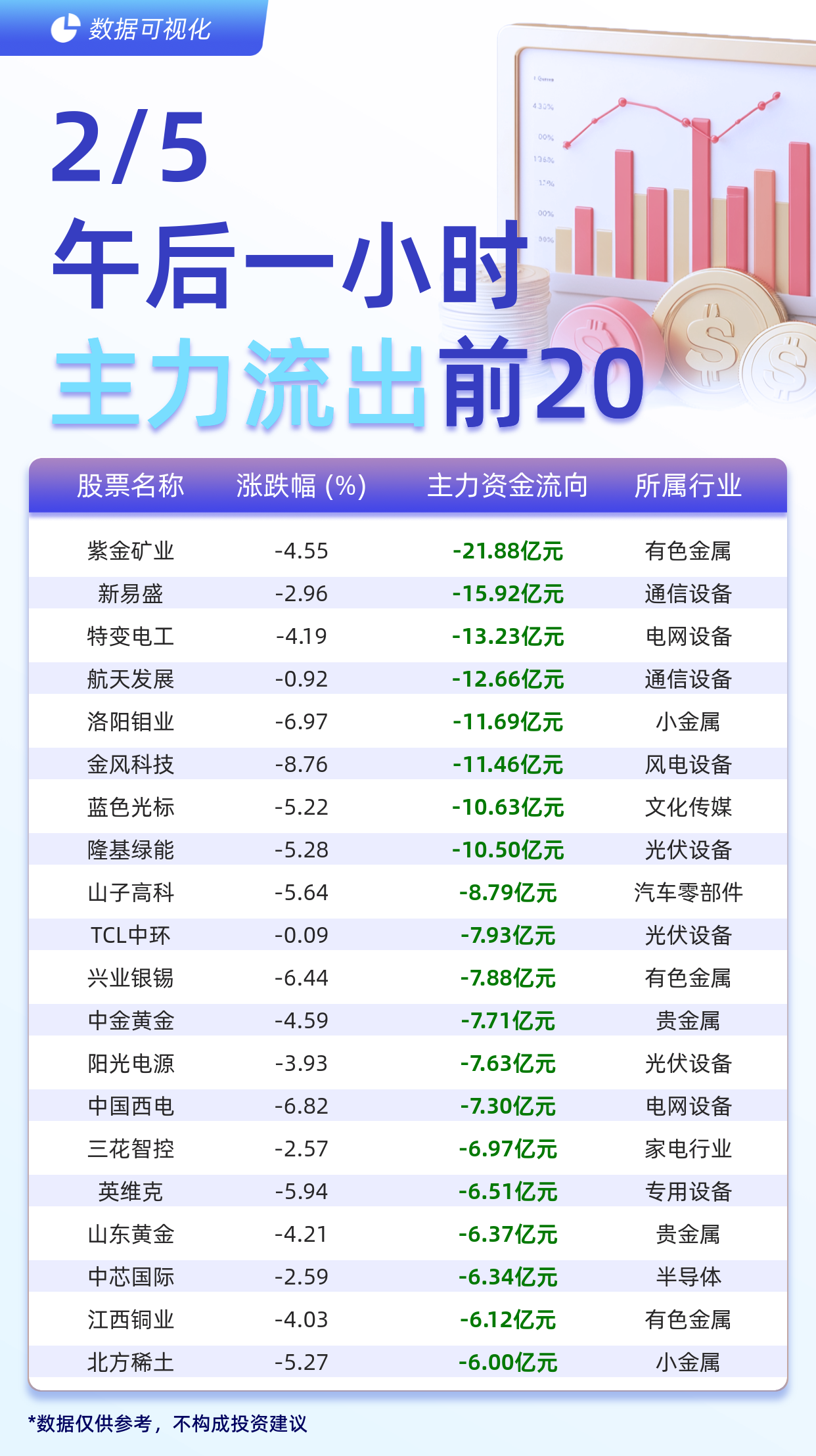
主力个股资金流出前20:紫金矿业流出22.75亿元、新易盛流出18.16亿元
Jin Rong Jie· 2026-02-05 07:43
Core Viewpoint - The data indicates significant outflows of capital from various stocks, with notable losses in both percentage and monetary terms across multiple sectors, particularly in metals, communication equipment, and renewable energy [1][2][3] Group 1: Stock Performance and Capital Outflow - Zijin Mining experienced a capital outflow of 2.275 billion, with a decline of 4.37% [2] - Xinyi Technology saw an outflow of 1.816 billion, with a decrease of 4.06% [2] - Aerospace Development had a capital outflow of 1.691 billion, reflecting a drop of 1.54% [2] - TBEA reported an outflow of 1.553 billion, with a decline of 5.05% [2] - Goldwind Technology faced a capital outflow of 1.217 billion, down by 9.02% [2] - Luoyang Molybdenum experienced an outflow of 1.203 billion, with a decrease of 6.34% [2] - BlueFocus Media saw an outflow of 1.145 billion, down by 5.76% [2] - Longi Green Energy had a capital outflow of 1.106 billion, with a decline of 5.59% [2] - Zhongjin Gold experienced an outflow of 1.033 billion, down by 5.20% [2] - Shanzhi High-Tech saw an outflow of 0.975 billion, with a decrease of 6.23% [2] - Sungrow Power Supply experienced an outflow of 0.963 billion, down by 4.12% [2] Group 2: Additional Stocks and Their Performance - Xinyi Silver experienced a capital outflow of 0.850 billion, with a decline of 6.33% [3] - China Western Power saw an outflow of 0.833 billion, down by 7.14% [3] - Inovance Technology had a capital outflow of 0.811 billion, with a decrease of 6.62% [3] - Sanhua Intelligent Control experienced an outflow of 0.806 billion, down by 3.04% [3] - TCL Zhonghuan saw an outflow of 0.781 billion, with a slight increase of 1.61% [3] - Jiangxi Copper experienced a capital outflow of 0.707 billion, down by 5.10% [3] - Shandong Gold saw an outflow of 0.683 billion, with a decline of 3.92% [3] - SMIC experienced a capital outflow of 0.676 billion, down by 2.65% [3] - Jiejia Weichuang faced an outflow of 0.626 billion, with a significant drop of 12.39% [3]


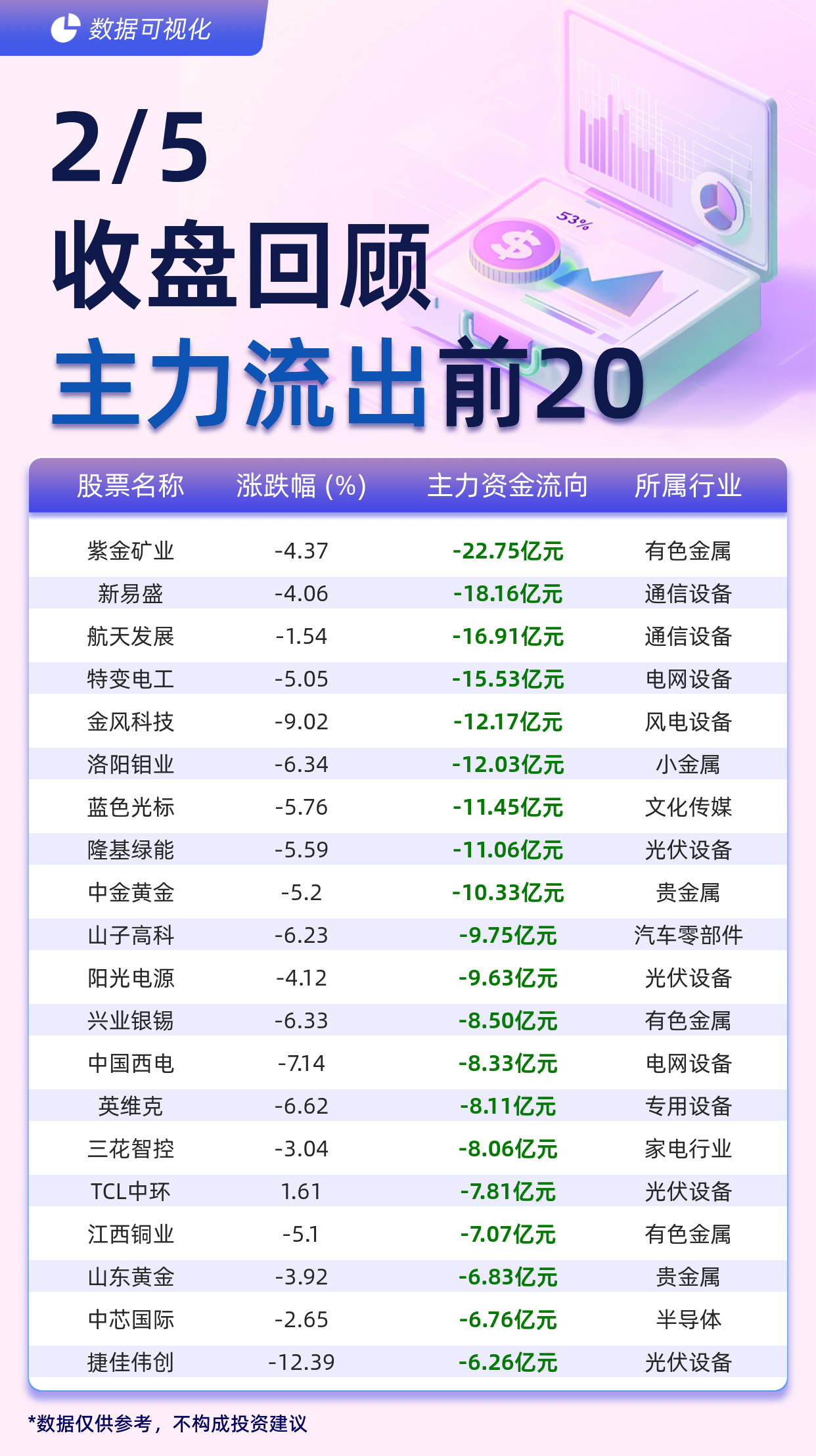
主力个股资金流出前20:紫金矿业流出21.88亿元、新易盛流出15.92亿元



Jin Rong Jie· 2026-02-05 06:40
| 中金黄金 | -4.59 | -7.71亿元 | 贵金属 | | --- | --- | --- | --- | | 阳光电源 | -3.93 | -7.63亿元 | 光伏设备 | | 中国西电 | -6.82 | -7.30亿元 | 电网设备 | | 三花智控 | -2.57 | -6.97亿元 | 家电行业 | | 英维克 | -5.94 | -6.51亿元 | 专用设{ | | 山东黄金 | -4.21 | -6.37亿元 | 贵金属 | | 中芯国际 | -2.59 | -6.34亿元 | 未营体 | | 江西铜业 | -4.03 | -6.12亿元 | 有色金属 | | 北方稀土 | -5.27 | -6.00亿元 | 小金属 | *数据仅供参考,不构成投资建议 据交易所数据显示,截至2月5日午后一小时,主力资金流出前20的股票分别为: 紫金矿业(-21.88亿元)、 新易盛(-15.92亿元)、 特变电工(-13.23亿 元)、 航天发展(-12.66亿元)、 洛阳钼业(-11.69亿元)、 金风科技(-11.46亿元)、 蓝色光标(-10.63亿元)、 隆基绿能(-10.50亿元)、 山子高 ...
资金逆势加仓!恒生科技ETF南方(520570)近20日资金净流入5.19亿元,机构认为港股科技板块仍是中长期投资主线
Ge Long Hui· 2026-02-05 06:37
银河证券认为,港股科技板块仍是中长期投资主线,在产业链涨价、国产化替代、AI应用加速推 进等多重利好共振下,有望震荡上行。 (责任编辑:刘畅 ) 【免责声明】本文仅代表作者本人观点,与和讯网无关。和讯网站对文中陈述、观点判断保持中立,不对所包含内容 的准确性、可靠性或完整性提供任何明示或暗示的保证。请读者仅作参考,并请自行承担全部责任。邮箱: news_center@staff.hexun.com 恒生科技ETF南方(520570)及场外联接(A类:020988;C类:020989)跟涨恒生科技指数,该指数覆 盖了中国科技产业中最核心的方向:互联网平台、AI与算力、半导体、新能源汽车、智能硬件、生物 医药等,囊括了当前全球最具成长性的科技赛道。其成份股既包括腾讯、阿里、京东、快手等平台型公 司,也涵盖中芯国际、小米、小鹏等硬科技与制造端代表,形成了较为完整的科技产业链结构。 从最新市盈率看,截至2月4日,恒生科技指数的市盈率(PE-TTM)为22.38倍,位于指数成立以来 的25.69%历史分位数,处于历史估值相对低位。 港股主要指数调整,截至发稿,恒生科技ETF南方(520570)成交额超1.1亿元,交投活 ...




科创芯片ETF南方(588890)开盘跌1.13%,重仓股中芯国际跌1.61%,海光信息跌2.11%
Xin Lang Cai Jing· 2026-02-05 06:28
Group 1 - The core viewpoint of the article highlights the performance of the Southern Science and Technology Chip ETF (588890), which opened down by 1.13% at 2.892 yuan on February 5 [1] - Major holdings in the ETF experienced declines, with notable drops including: SMIC down 1.61%, Haiguang Information down 2.11%, and Cambrian down 1.68% [1] - The ETF's performance benchmark is the Shanghai Stock Exchange Science and Technology Innovation Board Chip Index, managed by Southern Fund Management Co., Ltd. The fund manager is Li Jialiang [1] Group 2 - Since its establishment on April 15, 2024, the ETF has achieved a return of 192.73%, with a one-month return of 11.24% [1]





芯片ETF汇添富(516920)开盘跌0.62%,重仓股寒武纪跌1.68%,中芯国际跌1.61%
Xin Lang Cai Jing· 2026-02-05 06:01
Group 1 - The core viewpoint of the article highlights the performance of the Chip ETF Huatai Fu (516920), which opened down by 0.62% at 1.120 yuan on February 5 [1] - The major holdings of the Chip ETF experienced declines, with notable drops including Cambrian (-1.68%), SMIC (-1.61%), and GigaDevice (-4.39%) [1] - The performance benchmark for the Chip ETF is the CSI Chip Industry Index return, managed by Huatai Fu Fund Management Co., Ltd. Since its establishment on July 27, 2021, the fund has returned 12.66%, with a one-month return of 9.15% [1]


港股芯片股持续走低,华虹半导体跌超5%,中芯国际跌近4%,上海复旦跌逾2%。
Xin Lang Cai Jing· 2026-02-05 01:55
港股芯片股持续走低,华虹半导体跌超5%,中芯国际跌近4%,上海复旦跌逾2%。 ...
港股科网股,再度集体下跌
Di Yi Cai Jing Zi Xun· 2026-02-05 01:44
2月5日,恒生指数低开0.82%,恒生科技指数跌1.31%。 百度逆势涨超2%,董事会授权一项总金额不超过50亿美元的股票回购计划。 编辑|钉钉 | 名称 | 现价 | 涨跌 | 涨跌幅 | | --- | --- | --- | --- | | 恒生指数 | 26627.95 | -219.37 | -0.82% | | 恒生科技 | 5295.89 | -70.55 | -1.31% | | 恒生生物科技 | 14995.29 | -160.91 | -1.06% | | 恒生中国企业指数 | 8978.46 | -69.92 | -0.77% | | 恒生综合指数 | 4073.68 | -33.61 | -0.82% | 科网股延续跌势,哔哩哔哩跌逾4%,腾讯音乐、华虹半导体跌逾3%,阿里巴巴、快手、中芯国际、美 团等跌逾2%。 | 名称 | 现价 | 涨跌 | 涨跌幅 - | | --- | --- | --- | --- | | 哔哩哔哩-W | 233.600 | -10.000 | -4.11% | | 腾讯音乐-SW | 62.200 | -2.300 | -3.57% | | 金蝶国际 | ...




中芯国际股价连续3天下跌累计跌幅6.61%,诺德基金旗下1只基金持9505股,浮亏损失7.73万元
Xin Lang Cai Jing· 2026-02-04 11:45
从基金十大重仓股角度 数据显示,诺德基金旗下1只基金重仓中芯国际。诺德兴远优选(012036)四季度持有股数9505股,占 基金净值比例为1.07%,位居第十大重仓股。根据测算,今日浮亏损失约1.13万元。连续3天下跌期间浮 亏损失7.73万元。 诺德兴远优选(012036)成立日期2021年6月1日,最新规模1.09亿。今年以来收益4.31%,同类排名 4271/8873;近一年收益34.97%,同类排名3406/8119;成立以来收益1.47%。 来源:新浪基金∞工作室 2月4日,中芯国际跌1.03%,截至发稿,报114.84元/股,成交40.05亿元,换手率1.76%,总市值9187.71 亿元。中芯国际股价已经连续3天下跌,区间累计跌幅6.61%。 资料显示,中芯国际集成电路制造有限公司位于上海市浦东新区张江路18号,香港中环康乐广场8号交易 广场1期29楼,成立日期2000年4月3日,上市日期2020年7月16日,公司主营业务涉及提供0.35微米至14 纳米多种技术节点、不同工艺平台的集成电路晶圆代工及配套服务。主营业务收入构成为:集成电路晶 圆代工93.83%,其他6.17%。 诺德兴远优选(01 ...
中芯国际(688981) - 港股公告:证券变动月报表
2026-02-04 11:30
股份發行人及根據《上市規則》第十九B章上市的香港預託證券發行人的證券變動月報表 截至月份: 2026年1月31日 狀態: 新提交 致:香港交易及結算所有限公司 公司名稱: 中芯國際集成電路製造有限公司 呈交日期: 2026年2月4日 | 1. 股份分類 | 普通股 | 股份類別 | 不適用 | | | 於香港聯交所上市 (註1) | | 是 | | | --- | --- | --- | --- | --- | --- | --- | --- | --- | --- | | 證券代號 (如上市) | 00981 | 說明 | 無 | | | | | | | | | | 法定/註冊股份數目 | | | 面值 | | | 法定/註冊股本 | | | 上月底結存 | | | 10,000,000,000 | USD | | 0.004 | USD | | 40,000,000 | | 增加 / 減少 (-) | | | 0 | | | | USD | | | | 本月底結存 | | | 10,000,000,000 | USD | | 0.004 | USD | | 40,000,000 | | 2. 股份分類 | ...