HUA XIA BANK(600015)

Search documents
华夏向新 绿动未来 华夏银行服贸会彰显科技与温度
Sou Hu Cai Jing· 2025-09-15 20:26
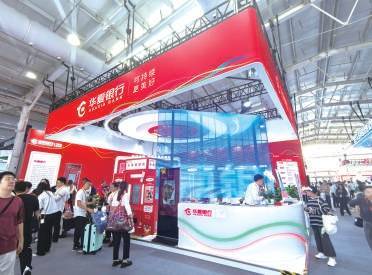
Core Viewpoint - The 2025 China International Fair for Trade in Services (CIFTIS) showcased the significant role of financial services in supporting the real economy, with Huaxia Bank highlighting its dual focus on technology and green finance [1][11]. Group 1: Event Overview - The CIFTIS took place from September 10 to 14, 2025, at the Shougang Park in Beijing, attracting numerous financial institutions [1]. - Huaxia Bank's theme was "Huaxia Towards New, Green Future," emphasizing its commitment to technology and green finance [1]. Group 2: Huaxia Bank's Innovations - Huaxia Bank created an interactive "financial playground" at its exhibition booth, featuring engaging technology scenarios to demonstrate its financial capabilities [6][8]. - The bank utilized VR technology to provide immersive experiences related to its support for renewable energy projects, allowing visitors to visualize its contributions to green finance [7]. Group 3: Consumer Engagement - Huaxia Bank introduced a "three-in-one" interactive layout at the fair, combining financial services with consumer discounts and cultural experiences [9]. - The bank's promotional activities included significant discounts for credit card users, enhancing visitor engagement and satisfaction [9]. Group 4: Financial Services Accessibility - As the "main bank" of the venue, Huaxia Bank extended its services throughout the park, ensuring easy access to cash transactions and other banking services for exhibitors and visitors [10]. - The bank also enhanced its online services to provide 24/7 support during peak times, ensuring a seamless experience for all attendees [10]. Group 5: Commitment to Green and Technology Finance - Huaxia Bank reported a green finance balance of 455.5 billion yuan, with green loans growing by 16.8% year-on-year, leading among comparable banks [12]. - The bank aims to support the transformation of the real economy by focusing on technology finance, offering tailored financial products for tech companies [12][13]. - Huaxia Bank's technology loans reached 210.5 billion yuan, reflecting a growth rate of 32.31%, significantly outpacing the overall loan growth [13]. Group 6: Future Outlook - The conclusion of the CIFTIS marks a new beginning for Huaxia Bank in deepening its financial practices, with a focus on enhancing its technology and green finance initiatives [14]. - The bank aims to channel financial resources more effectively into the real economy, supporting industrial upgrades and ecological protection [14].


谁在给银行股“站台”?股东高管集体出手,多家银行迎增持
Nan Fang Du Shi Bao· 2025-09-15 11:55
Core Viewpoint - Recent months have seen a surge in share buybacks by major shareholders and executives of listed banks, reflecting confidence in the banks' future prospects and long-term investment value [2][12]. Group 1: Share Buybacks - Multiple listed banks, including Huaxia Bank, Suzhou Bank, Nanjing Bank, and Everbright Bank, have announced significant share buybacks by shareholders and executives since September [2]. - Everbright Bank's major shareholder, Everbright Group, plans to increase its stake by investing between 50 million and 100 million yuan, with a reported increase of 13.97 million shares, representing 0.02% of the total share capital [3]. - Nanjing Bank's major shareholder, Zijin Investment Group, increased its stake by 5.68 million shares, raising its total holding from 12.56% to 13.02% [5][7]. - Huaxia Bank reported that its executives completed a share buyback plan, acquiring 4.23 million shares for 31.90 million yuan, exceeding the original plan [8]. - Suzhou Bank's executives, including the chairman and president, plan to buy at least 4.2 million yuan worth of shares, funded by their own resources [10]. Group 2: Financial Performance - In the first half of the year, 42 listed banks reported a combined revenue of approximately 2.92 trillion yuan and a net profit of over 1.1 trillion yuan, with more than 60% of institutions achieving growth in both revenue and profit [2][15]. - The banking sector has shown resilience, with significant growth in wealth management and other light capital businesses, supporting the buyback actions by shareholders and management [2][13]. - The banking sector has become one of the best-performing sectors in the A-share market, with the China Securities Bank Index rising by 15.6% [15]. - The majority of listed banks have increased their mid-term dividends, enhancing investor confidence and creating a positive cycle of performance recovery, increased dividends, and rising stock prices [15].



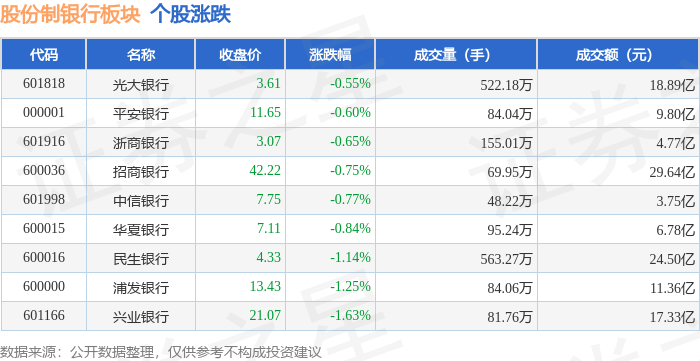
股份制银行板块9月15日跌0.97%,兴业银行领跌,主力资金净流出18.73亿元
Zheng Xing Xing Ye Ri Bao· 2025-09-15 08:42
Market Performance - On September 15, the share price of the joint-stock bank sector fell by 0.97% compared to the previous trading day, with Industrial Bank leading the decline [1] - The Shanghai Composite Index closed at 3860.5, down 0.26%, while the Shenzhen Component Index closed at 13005.77, up 0.63% [1] Individual Bank Performance - The closing prices and changes for individual banks are as follows: - Everbright Bank: 3.61, -0.55% - Ping An Bank: 11.65, -0.60% - Zheshang Bank: 3.07, -0.65% - China Merchants Bank: 42.22, -0.75% - Citic Bank: 7.75, -0.77% - Huaxia Bank: 7.11, -0.84% - Minsheng Bank: 4.33, -1.14% - Pudong Development Bank: 13.43, -1.25% - Industrial Bank: 121.07, -1.63% [1] Capital Flow Analysis - The joint-stock bank sector experienced a net outflow of 1.873 billion yuan from main funds, while speculative funds saw a net inflow of 771 million yuan, and retail investors had a net inflow of 1.102 billion yuan [1] - Detailed capital flow for individual banks shows significant net outflows for several banks, including: - Citic Bank: -11.51 million yuan from main funds - Ping An Bank: -88.85 million yuan from main funds - Pudong Development Bank: -92.47 million yuan from main funds - Industrial Bank: -248 million yuan from main funds [2]




股东高管密集出手 银行股增持潮涌
Bei Jing Shang Bao· 2025-09-14 17:06
Core Viewpoint - The recent surge in share buybacks among A-share listed banks reflects confidence in their future development and the recognition of long-term investment value, supported by a stable banking industry fundamental and improved financial performance [1][5][6]. Group 1: Share Buyback Activities - Multiple listed banks, including Everbright Bank, Nanjing Bank, Huaxia Bank, and Suzhou Bank, have disclosed share buyback progress, involving major shareholders, core management, and key personnel [1][4]. - Everbright Bank's major shareholder plans to increase its stake by investing between 50 million to 100 million yuan, with a reported buyback of 13.97 million shares, amounting to approximately 51.66 million yuan [3]. - Nanjing Bank's major shareholder increased its stake by 5.68 million shares, raising its total holding from 12.56% to 13.02% [3]. Group 2: Financial Performance - In the first half of 2025, 42 listed banks in A-shares reported a total operating income of 2.92 trillion yuan and a net profit of approximately 1.1 trillion yuan, with over 60% of banks achieving growth in both metrics [1][7]. - The improvement in financial performance is accompanied by innovations in mid-term dividend mechanisms, enhancing the investment value of banks [7]. Group 3: Market Sentiment and Investment Value - The buybacks are seen as a positive signal to the market, reinforcing investor confidence in the banking sector's development [6]. - The banking sector is experiencing a valuation recovery, with banks previously trading at historical lows now showing signs of improvement in both valuation and performance [7][8]. - Long-term funds, including insurance and social security, are increasingly investing in bank stocks, further solidifying their investment value [8]. Group 4: Industry Transformation - The banking industry is undergoing a significant transformation, shifting from a scale-driven growth model to a more refined, quality-focused approach, which is expected to enhance capital efficiency and increase non-interest income [9]. - This transformation is crucial for investment strategies, as banks with low valuations, high dividends, and weak cyclical resilience will continue to play a vital role in asset allocation [9].

鑫闻界丨上任不到仨月北银理财董事长方宜离任,刚领八千万罚单的华夏银行将迎新首席风险官
Qi Lu Wan Bao· 2025-09-13 12:48
Group 1 - The recent resignation of Fang Yi as the chairman of Beiyin Wealth Management marks the second chairman departure this year, following the resignation of Bu Yanhong in June [1] - Beiyin Wealth Management was established by Beijing Bank on November 25, 2022, with a registered capital of 2 billion yuan, making it the eighth wealth management company among city commercial banks [1] - Fang Yi's previous roles include Vice President of Beijing Bank's Jinan Branch and General Manager of the Investment Management Department at the head office [1] Group 2 - Fang Yi is set to join Huaxia Bank as the Chief Risk Officer, while the current Chief Risk Officer, Liu Xiaoli, will transition to Chief Operating Officer [2] - Huaxia Bank has undergone multiple executive adjustments in 2025, including the approval of new positions for the Chief Risk Officer and Chief Compliance Officer [2] - The management team at Huaxia Bank includes several members from Beijing Bank, indicating a trend of personnel movement between these institutions [3] Group 3 - Huaxia Bank was fined 87.25 million yuan for multiple regulatory violations, marking the largest penalty in the financial industry for 2025 [3] - The violations included improper management of loans, bills, and interbank business, along with non-compliance in regulatory data reporting [3]

中国银行业正迎来重要拐点
2 1 Shi Ji Jing Ji Bao Dao· 2025-09-13 00:27
Core Viewpoint - The banking industry is facing a critical turning point as net interest margins have fallen below non-performing loan ratios, indicating a dual pressure of shrinking income and rising risk [1][4][5] Group 1: Financial Indicators - As of Q1 2025, the non-performing loan ratio for commercial banks was 1.51%, while the net interest margin was 1.43%, marking the lowest net interest margin since 2005 [1][5] - By Q2 2025, the net interest margin further declined to 1.42%, with the non-performing loan ratio rising to 1.49% [1] - Over 20% of the 42 listed banks reported net interest margins lower than their non-performing loan ratios, highlighting a concerning trend in the industry [1][6] Group 2: Industry Response - In response to these challenges, banks are shifting towards middle-income business models, with a notable resurgence in insurance and banking (银保) business, which accounted for over 50% of income for the first time in 15 years [2][21] - Major banks like China Merchants Bank and Ping An Bank reported over 40% year-on-year growth in insurance income [2] Group 3: Asset and Liability Management - The continuous decline in net interest margins is attributed to a combination of low asset yields and rigid liability costs, exacerbated by insufficient effective credit demand and external pressures from bond market financing [10][12] - Banks are adjusting their asset-liability strategies to cope with narrowing margins, focusing on optimizing their loan structures and reducing costs [13] Group 4: Asset Quality and Risk - The total non-performing loan balance for commercial banks was reported at 34,342 billion yuan in Q2 2025, with a slight decrease from Q1 [15] - The provision coverage ratio improved to 211.97%, indicating enhanced risk mitigation capabilities [15] - However, the non-performing loan generation rate and overdue loan rates are on the rise, suggesting ongoing pressure on asset quality [17][19] Group 5: Middle-Income Business Growth - The middle-income business segment is showing signs of recovery, with non-interest income growing by 6.97% year-on-year in the first half of 2025, reversing a downward trend [21][22] - The insurance business is becoming a key growth driver, with banks leveraging their networks to enhance insurance sales [23]


服贸会秀“绿”绩
2 1 Shi Ji Jing Ji Bao Dao· 2025-09-12 23:06
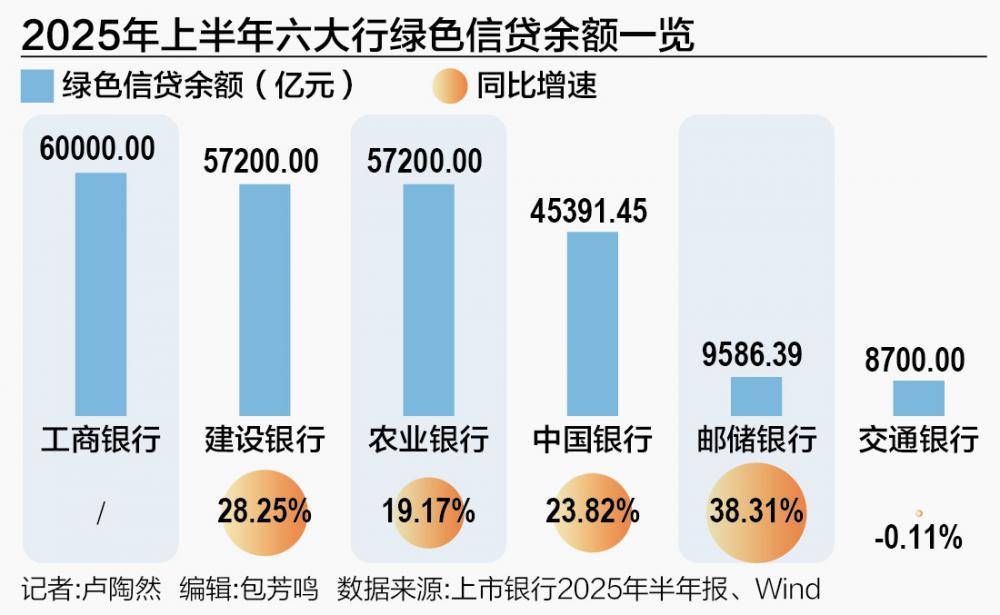
Core Insights - As of the end of Q2 2025, China's green loan balance reached approximately 42.4 trillion yuan, and the green bond balance exceeded 2.2 trillion yuan, positioning China among the top globally [1] - The carbon reduction support tool has guided financial institutions to issue carbon reduction loans exceeding 1.38 trillion yuan [1] - A total of 37 listed banks reported a combined green loan balance of 29.22 trillion yuan, with an average balance exceeding 800 billion yuan, reflecting a year-on-year growth of 41.79% [1][5] Green Loan Growth - The green loan balance of the banking system in China is leading globally, with state-owned banks playing a significant role [4] - Among the six major state-owned banks, the Industrial and Commercial Bank of China (ICBC) leads with a green loan balance of 6 trillion yuan, followed by China Construction Bank and Agricultural Bank of China, each with 5.72 trillion yuan [5] - Postal Savings Bank of China showed a remarkable year-on-year growth rate of 38.31%, nearing the 1 trillion yuan mark [5] Innovation in Green Financial Products - Banks are actively expanding and innovating specialized green financial products and service models, covering areas such as clean energy and environmental remediation [2] - The green financial product system is becoming increasingly diverse, showcasing various practical paths and innovative outcomes [2] Carbon Reduction Support Tool - The carbon reduction support tool is becoming a key indicator of banks' green financial capabilities, effectively directing financial resources towards green and low-carbon sectors [9] - In Q2 2025, 16 banks reported carbon reduction loans that facilitated a carbon reduction equivalent of over 7 million tons, with a total loan amount of nearly 24 billion yuan [9] - Major banks like ICBC and China Construction Bank have over 100 projects funded through carbon reduction loans, leading in both project numbers and loan amounts [9] Performance of Smaller Banks - Smaller banks, including city commercial banks and rural commercial banks, are showing significant growth in green loan balances, with some achieving substantial year-on-year increases [8] - Zhangjiagang Rural Commercial Bank led the rural commercial banks with a growth rate of 30.25% in green loan balances [7] - Smaller banks are encouraged to leverage local advantages and develop differentiated paths to support local green projects [8]






金融监管总局一个星期开出近2.7亿罚单,涉及17家机构,多人遭禁业
Xin Lang Cai Jing· 2025-09-12 22:13
Core Viewpoint - The National Financial Regulatory Administration has issued a second batch of fines in September, totaling over 166 million yuan, targeting various financial institutions for issues related to credit approval, regulatory data reporting, and capital operation risks [1][2][11]. Summary by Category Fines and Penalties - A total of 18 entities, including policy banks, state-owned banks, joint-stock banks, and local banks, have been penalized, with fines amounting to approximately 269 million yuan in September alone [2][11]. - Specific fines include: - Guangfa Bank: 66.7 million yuan for improper management of loans and regulatory data reporting [2]. - Hengfeng Bank: 61.5 million yuan for similar issues [2][3]. - Minsheng Bank: 5.9 million yuan for inadequate system control [4]. - Citic Bank: 5.5 million yuan for inaccurate risk classification [5]. - China Export-Import Bank: 1.3 million yuan for poor country risk management [6]. Regulatory Focus - The regulatory focus remains on compliance in credit and bill operations, with significant scrutiny on the capital operations of wealth management subsidiaries and financial asset investment companies [11]. - The recent fines highlight a trend of "responsibility to individuals," with 32 individuals facing penalties, including warnings, fines, and bans from the banking industry [11]. Institutional Responses - Guangfa Bank and Hengfeng Bank have both acknowledged the penalties and stated that they have completed the necessary rectifications and are committed to improving their risk management and internal controls [2][3]. - Huaxia Wealth Management has also accepted the penalties and emphasized compliance with regulatory requirements in their operations [7]. Notable Cases - The only individual penalty involved former employees of the Industrial and Commercial Bank of China, who were banned from the banking industry for serious violations of prudent management rules [11].
三家机构被罚超千万,最新回应
中国基金报· 2025-09-12 16:19
Core Viewpoint - A series of significant fines have been imposed on multiple financial institutions in China, highlighting ongoing regulatory scrutiny and the need for compliance improvements within the industry [2][12]. Group 1: Major Fines Imposed - Three financial institutions received fines exceeding ten million yuan: Guangfa Bank was fined 66.7 million yuan, Hengfeng Bank 61.5 million yuan, and Huaxia Wealth Management 12 million yuan [4][5]. - The total fines for ten institutions reached 162.9 million yuan, indicating a broader trend of regulatory enforcement across the sector [2][9]. Group 2: Reasons for Penalties - Guangfa Bank was penalized for improper management of loans, bills, and factoring, as well as non-compliance in regulatory data reporting [4][5]. - Hengfeng Bank faced similar issues related to loan and wealth management practices, along with non-compliance in data reporting [4][5]. - Huaxia Wealth Management was fined for irregular investment operations and inadequate system controls [4][5]. Group 3: Institutional Responses - Hengfeng Bank acknowledged the penalty and committed to addressing the underlying issues, enhancing internal controls, and improving risk management [6]. - Guangfa Bank accepted the regulatory decision and has already implemented corrective measures to optimize its risk management framework [7]. - Huaxia Wealth Management expressed its commitment to compliance and improving risk management capabilities to protect investor interests [7]. Group 4: Additional Penalties - Seven other institutions were also fined for various compliance issues, including inadequate system management and improper handling of wealth management products [9][10][11]. - Notable fines included 5.9 million yuan for Minsheng Bank and 5.5 million yuan for Citic Bank, reflecting a widespread regulatory crackdown [9][10].

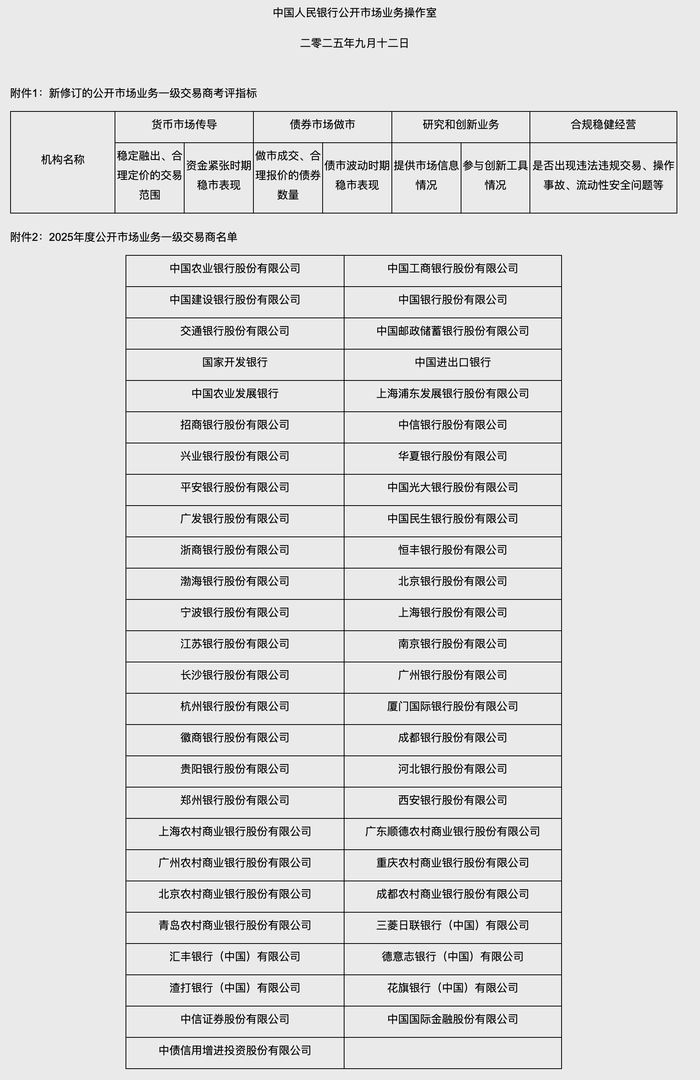
央行:调整后的一级交易商考评办法将从2025年启用,考评期内行为不当的一级交易商将被暂停参与公开市场操作
Sou Hu Cai Jing· 2025-09-12 10:45
Core Viewpoint - The People's Bank of China (PBOC) has established a new evaluation mechanism for primary dealers in the open market, which will be implemented in 2025, aiming to enhance the transmission of monetary policy and adapt to the evolving financial market [1]. Group 1: Evaluation Mechanism - The PBOC's evaluation mechanism for primary dealers was first established in 2004 and adjusted in 2018 to support smooth open market operations [1]. - The new evaluation method will focus on optimizing and simplifying assessment indicators, categorizing institutions for evaluation, and strengthening the linkage with bond market makers [1]. - The list of primary dealers for the year 2025 will remain unchanged, and any dealer exhibiting inappropriate behavior during the evaluation period may be suspended from participating in open market operations [1]. Group 2: Institutions Involved - A comprehensive list of institutions that will be evaluated includes major banks such as Agricultural Bank of China, Industrial and Commercial Bank of China, China Construction Bank, and Bank of China, among others [3][4]. - The evaluation will consider factors such as stable lending, reasonable pricing, market performance during tight funding periods, and compliance with operational standards [3].