
China Spacesat(600118)

Search documents
涨不停!商业航天再刷屏,中国卫星等28股封板
2 1 Shi Ji Jing Ji Bao Dao· 2026-01-23 10:14
Core Viewpoint - The commercial aerospace sector is experiencing significant activity, with multiple stocks reaching their daily limit up, driven by the news of Blue Arrow Aerospace's IPO progress on the STAR Market [1] Market Performance - On January 23, the market saw a late rally, with the Shenzhen Component Index rebounding after a dip, and both the ChiNext Index and Shenzhen Component Index rising over 0.5%. The North Star 50 Index surged more than 3% [1] Sector Highlights - The commercial aerospace concept stocks were notably active, with 28 stocks hitting the daily limit up. Key stocks included Ruihua Tai, Qianzhao Optoelectronics, Feiwo Technology, Zhenlei Technology, and Dongfang Risen, among others [1] IPO News - On January 22, the Shanghai Stock Exchange announced that Blue Arrow Aerospace's IPO status on the STAR Market has changed to "inquiry stage." The company aims to become the first commercial rocket stock on the STAR Market by the end of 2025 [1] - Blue Arrow Aerospace is currently in a loss position and plans to adopt the fifth set of listing standards for the STAR Market, which has now expanded to include the commercial aerospace sector [1]

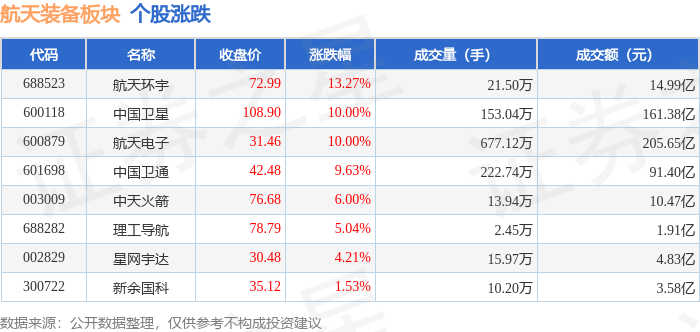
航天装备板块1月23日涨9.46%,航天环宇领涨,主力资金净流入38.33亿元
Zheng Xing Xing Ye Ri Bao· 2026-01-23 09:12
Core Viewpoint - The aerospace equipment sector experienced a significant increase of 9.46% on January 23, with Aerospace Hanyu leading the gains. The Shanghai Composite Index closed at 4136.16, up 0.33%, while the Shenzhen Component Index closed at 14439.66, up 0.79% [1]. Group 1: Stock Performance - Aerospace Hanyu (688523) closed at 72.99, with a rise of 13.27% and a trading volume of 215,000 shares [1]. - China Satellite (600118) closed at 108.90, increasing by 10.00% with a trading volume of 1,530,400 shares [1]. - Aerospace Electronics (600879) closed at 31.46, also up by 10.00%, with a trading volume of 6,771,200 shares [1]. - China Satcom (601698) closed at 42.48, rising by 9.63% with a trading volume of 2,227,400 shares [1]. - Zhongtian Rocket (003009) closed at 76.68, increasing by 6.00% with a trading volume of 139,400 shares [1]. - Other notable performances include: - Ligong Navigation (688282) at 78.79, up 5.04% [1] - StarNet Yuda (002829) at 30.48, up 4.21% [1] - Xinyu Guoke (300722) at 35.12, up 1.53% [1]. Group 2: Capital Flow - The aerospace equipment sector saw a net inflow of 3.833 billion yuan from institutional investors, while retail investors experienced a net outflow of 2.3 billion yuan [1]. - The capital flow for key stocks includes: - Aerospace Electronics (600879) with a net inflow of 1.886 billion yuan from institutional investors and a net outflow of 899.6 million yuan from retail investors [2]. - China Satellite (600118) had a net inflow of 1.483 billion yuan from institutional investors and a net outflow of 1.043 billion yuan from retail investors [2]. - China Satcom (601698) recorded a net inflow of 262 million yuan from institutional investors and a net outflow of 190 million yuan from retail investors [2]. - Zhongtian Rocket (003009) had a net inflow of 97.5 million yuan from institutional investors and a net outflow of 79.3 million yuan from retail investors [2].





A股122股涨停,太空光伏、卫星集体爆发,隆基绿能等30股涨停,CPO下跌,黄金白银逼空上涨
2 1 Shi Ji Jing Ji Bao Dao· 2026-01-23 07:39
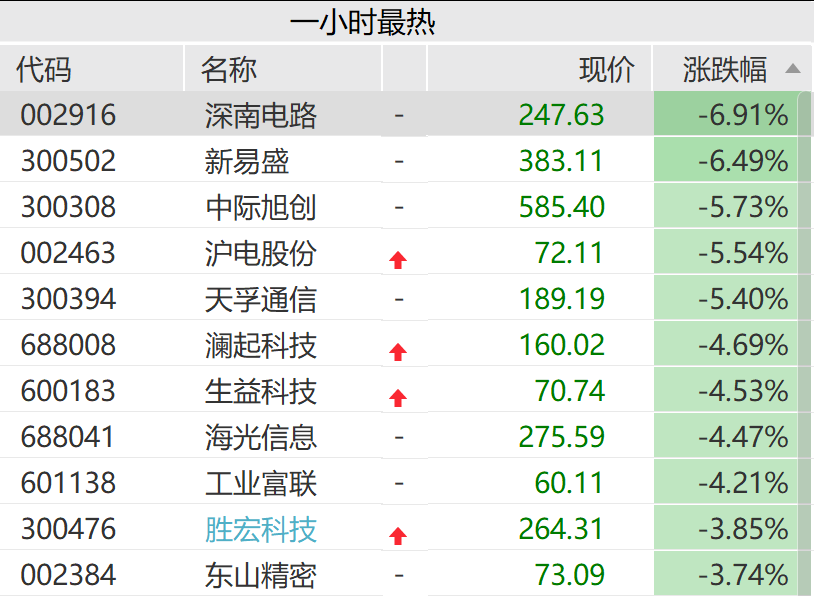
Market Overview - On January 23, A-shares saw all three major indices rise, with the Shanghai Composite Index up 0.33% to 4136 points, the Shenzhen Component Index up 0.79%, and the ChiNext Index up 0.63%. The North Star 50 Index surged by 3.82% [1] - The total market turnover reached 3.12 trillion yuan, an increase of 401.7 billion yuan compared to the previous trading day, with over 3900 stocks rising and 122 stocks hitting the daily limit [1] Sector Performance - The A-share market exhibited a divergence in performance, with the Shanghai 50 Index dropping over 1%. The CPO concept showed weak performance, with Xinyi Technology (300502) falling over 6%. Major sectors such as insurance and banking led the market decline [1] - In contrast, the domestic commodity futures market saw widespread gains, with lithium carbonate futures on the Guangxi Futures Exchange breaking through 180,000 yuan per ton, marking a rise of over 6% and reaching a new high since September 2023 [2] Precious Metals - Gold and silver continued to rise sharply, with spot gold stabilizing at 4950 USD per ounce and spot silver approaching the 100 USD mark, with an intraday increase of nearly 3%. Shanghai silver rose over 8% [2] - The National Investment Silver LOF (161226) experienced a volatile trading session, initially dropping over 8% before recovering to close down 1.15%, with a trading volume exceeding 4 billion yuan [3] Solar Energy Sector - The photovoltaic sector in A-shares experienced a significant surge, with Longi Green Energy (601012) and other companies seeing their stocks hit the daily limit. Notably, JunDa Co. (002865) achieved a two-day consecutive limit-up, while its H-shares soared over 49%, reaching a historical high [4] - The commercial aerospace sector is benefiting from favorable policies, technology advancements, and capital influx, driving rapid development in the space photovoltaic niche [9][10] Company Developments - Companies like JinkoSolar and Trina Solar are actively exploring market opportunities in space photovoltaics, with JinkoSolar's chairman emphasizing the need to explore this market [14] - Trina Solar has announced plans to accelerate the commercialization of perovskite solar cells and has made significant advancements in various solar technologies [14] - JunDa Co. has disclosed plans to invest 30 million yuan to acquire a 16.67% stake in Shanghai Xingyi Chip Energy, aiming to enter the low-orbit and space photovoltaic markets [15]



超3900只个股上涨
第一财经· 2026-01-23 07:37
Market Overview - The Shanghai Composite Index closed at 4136.16 points, up 0.33% [3] - The Shenzhen Component Index closed at 14439.66 points, up 0.79% [3] - The ChiNext Index closed at 3349.5 points, up 0.63% [3] - The STAR Market Index closed at 1899.78 points, up 1.85% [3] Sector Performance - The photovoltaic industry chain surged, with significant gains in space photovoltaic stocks [4] - The commercial aerospace concept stocks also saw a strong rally, while basic metals experienced a wave of涨停 [4] - AI applications and robotics themes were active, whereas the computing hardware industry chain adjusted, with CPO direction leading the decline [4] Key Sector Gains - Photovoltaic equipment rose by 10.07% with a net inflow of 9.103 billion [5] - BC batteries increased by 8.56% with a net inflow of 7.459 billion [5] - Zinc metal gained 5.01% with a net inflow of 0.933 billion [5] - Lead metal rose by 4.97% with a net inflow of 0.537 billion [5] - Silicon energy increased by 4.85% with a net inflow of 2.835 billion [5] Notable Stocks - Liancheng CNC surged by 29.99% to 47.16 [6] - Optech rose by 29.98% to 17.21 [6] - Laplace increased by 20.01% to 55.54 [6] - Maiwei shares rose by 20.00% to 324.36 [6] - JinkoSolar increased by 20.00% to 6.90 [6] Commercial Aerospace Stocks - Ruihua Tai rose by 20.01% to 25.91 [7] - Qianhe Optoelectronics increased by 20.01% to 39.17 [7] - Deen Precision rose by 20.00% to 31.32 [7] - Multiple stocks in this sector saw gains of 20% or more [7] Capital Flow - Main capital inflows were observed in power equipment, non-ferrous metals, national defense, and machinery sectors [10] - Notable inflows included Longi Green Energy with 2.692 billion, Aerospace Electronics with 1.886 billion, and Goldwind Technology with 1.832 billion [11] - Significant outflows were seen in stocks like New Yisheng with 3.414 billion, TBEA with 3.218 billion, and Zhongji Xuchuang with 3.045 billion [12] Institutional Insights - CITIC Construction pointed out that high silver prices are driving industrial transformation, marking the beginning of the "copper" era in photovoltaic metalization [13] - Huachuang Securities highlighted the significant potential in China's commercial aviation engine market, suggesting focus on three key industry chains [13] - CITIC Securities expects stable sales for the liquor industry during the 2026 Spring Festival, indicating opportunities for bottom-fishing in the sector [14]




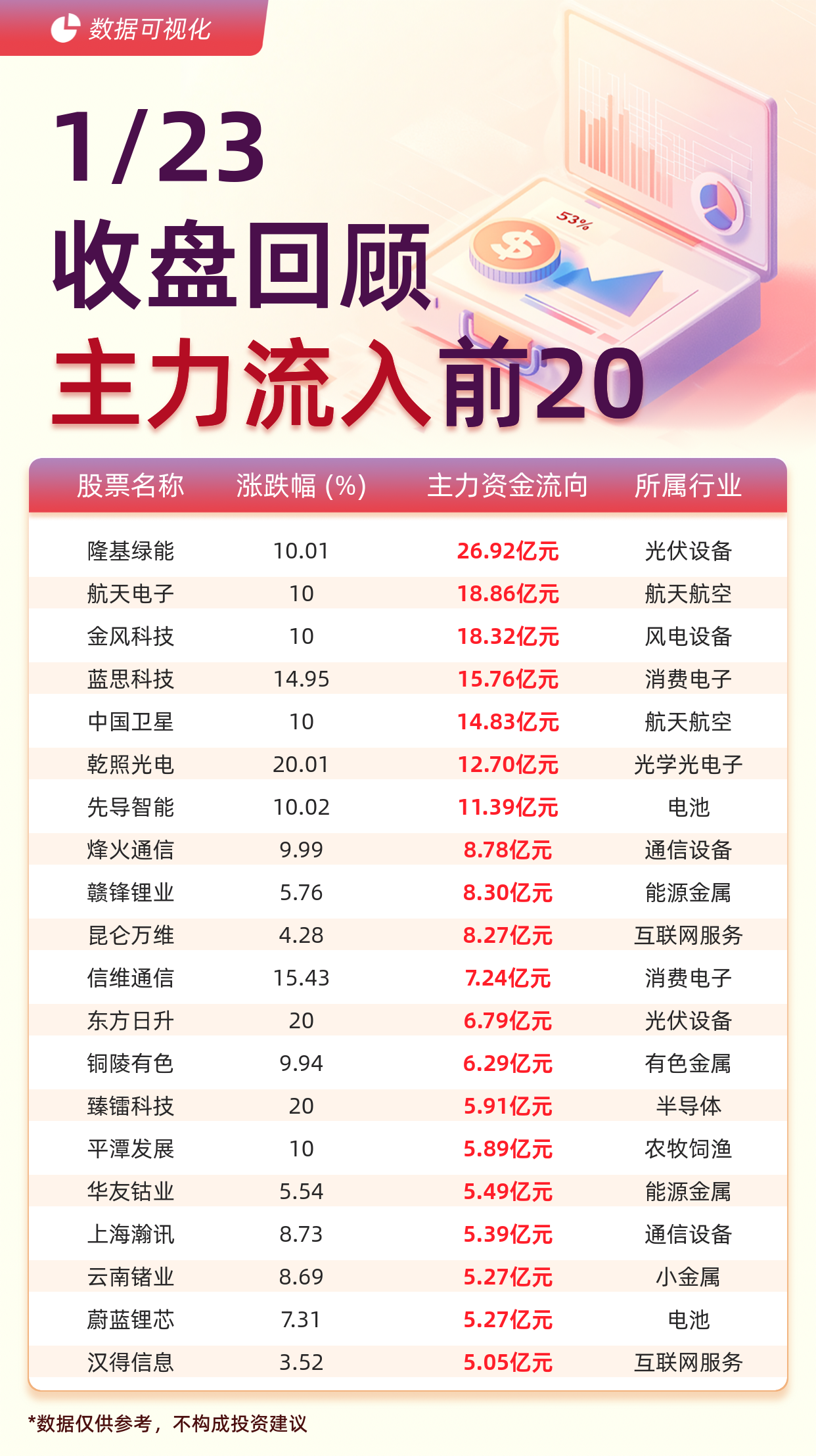
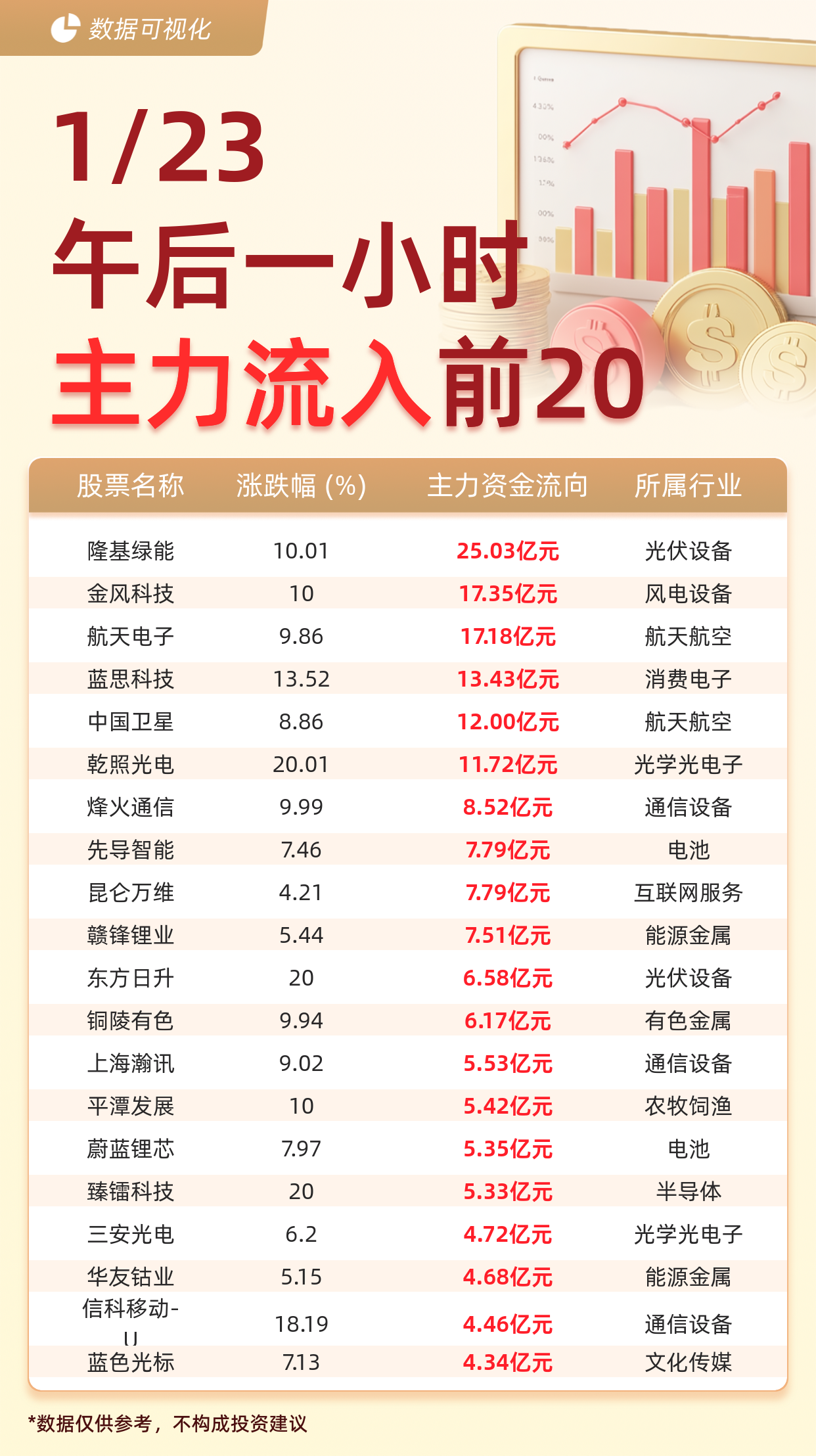
主力资金流入前20:隆基绿能流入26.92亿元、航天电子流入18.86亿元
Jin Rong Jie· 2026-01-23 07:34
Group 1 - The main stocks with significant capital inflow as of January 23 include Longi Green Energy (2.692 billion), Aerospace Electronics (1.886 billion), and Goldwind Technology (1.832 billion) [1] - Longi Green Energy experienced a price increase of 10.01% with a capital inflow of 2.692 billion [2] - Aerospace Electronics and China Satellite both saw a price increase of 10% with capital inflows of 1.886 billion and 1.483 billion respectively [2][3] Group 2 - Jin Feng Technology had a price increase of 10% and a capital inflow of 1.832 billion, indicating strong investor interest in wind energy equipment [2] - The stock of 乾照光电 (Qianzhao Optoelectronics) surged by 20.01% with a capital inflow of 1.270 billion, highlighting its performance in the optical and optoelectronic sector [2] - Other notable stocks include Yunnan Zhiye (5.27 billion) and Han's Information (5.05 billion), both showing positive capital inflows and price increases [3]



重磅规划发布!卫星产业ETF(159218)10CM涨停!中国卫星、航天电子涨停封板
Sou Hu Cai Jing· 2026-01-23 07:27
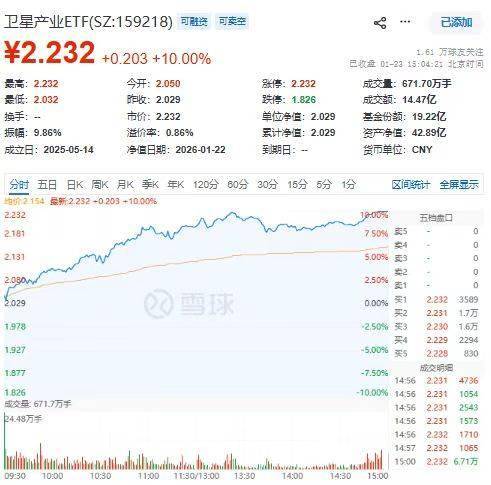
市场分析称,具体产业布局上,《规划》提出了打造航天发射与试验、火箭制造与测试、卫星制造与检 测应用、航天数据备份与应用、航天技术勤务保障、航天后勤、航天文旅7大产业。《规划》为酒泉商 业航天产业高质量发展提供了规划指导和行动纲领,利好商业航天产业发展。 风险提示:基金有风险,投资需谨慎。 1月23日,卫星板块持续强势。卫星产业ETF(159218)收涨10.00%,前几大权重股方面,中国卫星,航 天电子涨停封板,中国卫通涨9.65%,中科星图涨16.03%。成交额约14.5亿。 | 卫星产业ETF(SZ:159218) 可避 可转 | | | | | | --- | --- | --- | --- | --- | | ¥2.232 +0.203 +10.00% | | 日收盘 D1-23 15:04:21 北京时间 | 1.61 力绿友大注 | | | 赋高:2.232 今开:2.050 | 蛋傳:2.232 | 成交 : 671.70万手 | | | | 是低:2.032 阳收:2.029 | 跌停:1.826 | 成交额:14.47亿 | | | | 梅手:一 市价:2.232 | 单位净值:2.029 ...
主力资金流入前20:隆基绿能流入25.03亿元、金风科技流入17.35亿元
Jin Rong Jie· 2026-01-23 06:32
Core Insights - The main focus of the news is on the significant inflow of capital into specific stocks, highlighting the top 20 stocks with the highest capital inflow as of January 23, with notable performances in various sectors such as photovoltaic equipment, wind power, and aerospace [1][2][3] Group 1: Capital Inflow Data - Longi Green Energy leads with a capital inflow of 2.503 billion yuan and a price increase of 10.01% [2] - Goldwind Technology follows with 1.735 billion yuan and a price increase of 10% [2] - Aerospace Electronic has a capital inflow of 1.718 billion yuan with a price increase of 9.86% [2] - Lens Technology shows a strong performance with a capital inflow of 1.343 billion yuan and a price increase of 13.52% [2] - China Satellite has a capital inflow of 1.200 billion yuan and a price increase of 8.86% [2] Group 2: Sector Performance - The photovoltaic equipment sector is represented by Longi Green Energy and Oriental Sunrise, with inflows of 2.503 billion yuan and 658 million yuan respectively [2][3] - The wind power equipment sector is highlighted by Goldwind Technology with an inflow of 1.735 billion yuan [2] - The aerospace sector includes Aerospace Electronic and China Satellite, with inflows of 1.718 billion yuan and 1.200 billion yuan respectively [2] - The optical and semiconductor sectors are represented by Qian Zhao Optoelectronics and Zhen Lei Technology, with inflows of 1.172 billion yuan and 533 million yuan respectively [2][3]

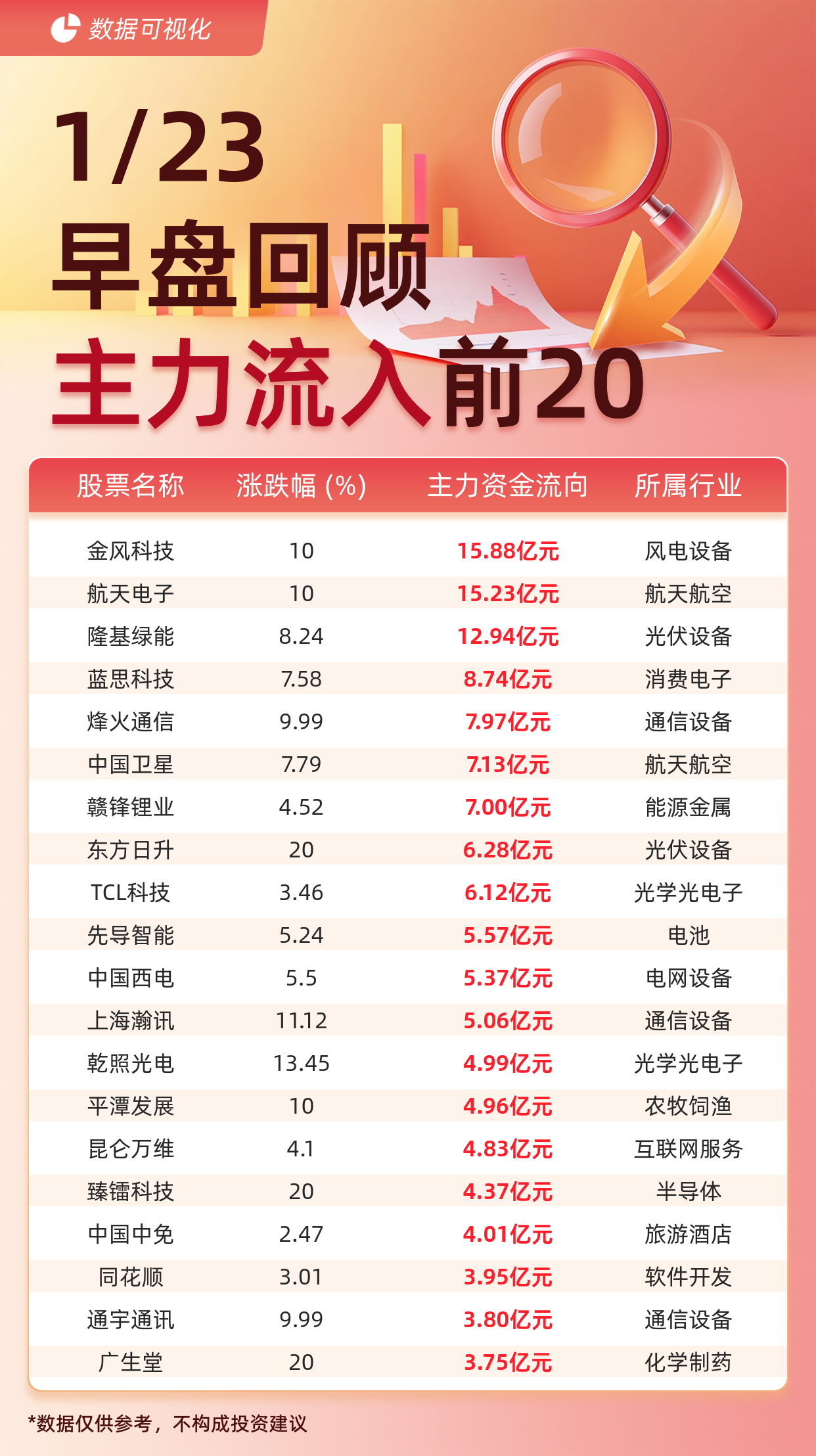
主力资金流入前20:金风科技流入15.88亿元、航天电子流入15.23亿元
Jin Rong Jie· 2026-01-23 04:27
Group 1 - The top 20 stocks with significant capital inflow include Jin Feng Technology (1.588 billion), Aerospace Electronics (1.523 billion), and Longi Green Energy (1.294 billion) [1] - Jin Feng Technology and Aerospace Electronics both experienced a price increase of 10% [2] - Longi Green Energy saw an 8.24% increase in stock price, while Dongfang Risen had the highest increase at 20% [2][3] Group 2 - The sectors represented among the top inflow stocks include wind power equipment, aerospace, photovoltaic equipment, and communication equipment [2][3] - Notable capital inflows also occurred in companies like TCL Technology (0.612 billion) and Ganfeng Lithium (0.700 billion), indicating strong investor interest in energy and technology sectors [1][2] - The data reflects a diverse range of industries, highlighting potential investment opportunities across various sectors [1][3]


卫星互联网板块强势 信维通信涨幅居前
Xin Lang Cai Jing· 2026-01-23 03:46
Core Viewpoint - The satellite internet sector is experiencing significant gains, with multiple companies showing strong stock performance on January 23rd [1] Group 1: Company Performance - Fenghuo Communication and Tongyu Communication reached their daily limit up [1] - Xunwei Communication, Aerospace Electronics, Tianyin Machinery, Jiuzhiyang, Sanwei Communication, China Satellite Communications, Putian Technology, and China Satellite also saw notable stock increases [1]


中国东方红卫星股份有限公司关于变更公司电子邮箱的公告
Xin Lang Cai Jing· 2026-01-22 19:11
变更前的公司电子邮箱:600118@spacechina.com 变更后的公司电子邮箱:600118@spacesat.com.cn 除上述变更外,公司办公地址、联系电话等其他联系方式保持不变。变更后的公司电子邮箱自本公告披 露之日起正式启用,原邮箱地址将同步停用,敬请广大投资者注意。由此给投资者带来的不便,敬请谅 解。欢迎广大投资者通过新的电子邮箱与公司沟通交流。 特此公告。 中国东方红卫星股份有限公司 证券代码:600118 股票简称:中国卫星 编号:临2026-003 中国东方红卫星股份有限公司 关于变更公司电子邮箱的公告 本公司董事会及全体董事保证本公告内容不存在任何虚假记载、误导性陈述或者重大遗漏,并对其内容 的真实性、准确性和完整性承担法律责任。 中国东方红卫星股份有限公司(简称:公司)根据实际工作需要,对公司电子邮箱进行变更,具体情况 如下: 董事会 二〇二六年一月二十三日 ...