TIBET PHARMA(600211)

Search documents
西藏药业跌2.00%,成交额1.05亿元,主力资金净流出1414.46万元
Xin Lang Zheng Quan· 2025-11-19 05:30
11月19日,西藏药业盘中下跌2.00%,截至13:24,报44.55元/股,成交1.05亿元,换手率0.72%,总市值 143.59亿元。 西藏药业所属申万行业为:医药生物-生物制品-其他生物制品。所属概念板块包括:疫苗、创新药、生 物医药、医疗器械、中药等。 截至9月30日,西藏药业股东户数4.54万,较上期增加0.57%;人均流通股7092股,较上期减少0.57%。 2025年1月-9月,西藏药业实现营业收入20.89亿元,同比减少3.96%;归母净利润7.22亿元,同比减少 8.85%。 分红方面,西藏药业A股上市后累计派现22.58亿元。近三年,累计派现15.80亿元。 机构持仓方面,截止2025年9月30日,西藏药业十大流通股东中,香港中央结算有限公司位居第七大流 通股东,持股365.85万股,相比上期增加106.82万股。创新药(159992)位居第九大流通股东,持股 158.17万股,为新进股东。南方中证1000ETF(512100)位居第十大流通股东,持股147.59万股,为新 进股东。华夏行业景气混合A(003567)退出十大流通股东之列。 责任编辑:小浪快报 资金流向方面,主力资金净流出 ...

西藏药业跌2.01%,成交额1.18亿元,主力资金净流出1588.49万元
Xin Lang Cai Jing· 2025-11-18 05:31
机构持仓方面,截止2025年9月30日,西藏药业十大流通股东中,香港中央结算有限公司位居第七大流 通股东,持股365.85万股,相比上期增加106.82万股。创新药(159992)位居第九大流通股东,持股 158.17万股,为新进股东。南方中证1000ETF(512100)位居第十大流通股东,持股147.59万股,为新 进股东。华夏行业景气混合A(003567)退出十大流通股东之列。 责任编辑:小浪快报 资金流向方面,主力资金净流出1588.49万元,特大单买入0.00元,占比0.00%,卖出140.46万元,占比 1.19%;大单买入1668.74万元,占比14.15%,卖出3116.77万元,占比26.44%。 截至9月30日,西藏药业股东户数4.54万,较上期增加0.57%;人均流通股7092股,较上期减少0.57%。 2025年1月-9月,西藏药业实现营业收入20.89亿元,同比减少3.96%;归母净利润7.22亿元,同比减少 8.85%。 分红方面,西藏药业A股上市后累计派现22.58亿元。近三年,累计派现15.80亿元。 11月18日,西藏药业盘中下跌2.01%,截至13:01,报45.28元/股 ...
董事长专访 | “内外”兼修 西藏药业转型谋新篇
Sou Hu Cai Jing· 2025-11-18 00:03
Core Viewpoint - The company is focusing on both endogenous growth and external expansion to achieve sustainable development, leveraging its core product and exploring innovative drug frontiers through strategic investments [1][5]. Internal Growth - The company has established a comprehensive industrial layout covering Tibet, Sichuan, Shanghai, and overseas markets over the past two decades [6]. - Its product range includes biopharmaceuticals, Tibetan medicine, traditional Chinese medicine, and chemical drugs, with key products addressing cardiovascular, liver, and respiratory issues [6]. - The core product, Xinhuasuan, is a self-developed national biological product for treating acute heart failure, which has maintained stable sales revenue [6]. - The company plans to invest several million yuan in evidence-based medical exploratory research for Xinhuasuan to expand its application scenarios and enhance academic promotion [6]. - Xinhuasuan has reached nearly 7,000 medical institutions, with plans to strengthen partnerships with commercial companies to further expand its coverage [6][7]. External Expansion - The company is investing in the cutting-edge field of gene editing, having invested $60 million in Accuredit Therapeutics Limited, acquiring a 40.82% stake [8][9]. - Accuredit focuses on developing in vivo gene editing technologies and products, aiming to provide innovative treatment solutions with cost advantages [9]. - The company also invested $30 million in Jiangsu Chentai Pharmaceutical Technology Co., acquiring a 13.04% stake, with Chentai's Zorifertinib being a significant product for advanced non-small cell lung cancer [10]. Future Strategy - The company aims to enhance its innovation platform to support cutting-edge innovation and increase its product pipeline, focusing on both internal and external growth strategies [11]. - Future efforts will include increasing R&D investment and project introduction, driven by new media marketing and innovative drug development to improve profitability and sustainable growth [11].

“内外”兼修 西藏药业转型谋新篇
Shang Hai Zheng Quan Bao· 2025-11-17 19:14
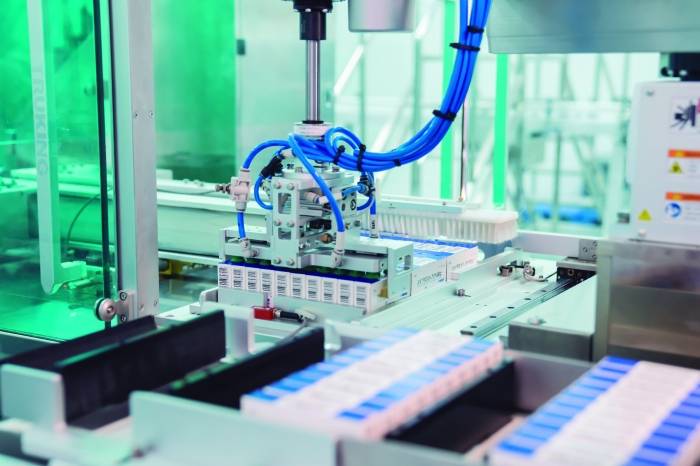
◎记者 孙小程 西藏药业一度让不少同行艳羡——大单品新活素经久不衰,支撑其业绩常年保持稳定。 但硬币的另一面,显然是单一产品依赖度过高的风险,这是始终悬在西藏药业头顶的现实考题。 西藏药业生产线 西藏药业厂区 居安常思危,如何摆脱"单腿走路"的局面? 近日,上海证券报记者走进西藏药业,探寻其在新时期的转型密码。西藏药业董事长陈达彬将其总结 为:内源性增长与外延式扩张并重。对内拓展新活素的市场覆盖率,深挖藏药资源护城河;对外通过投 资基因编辑企业,持续探索创新药前沿领域。"内外"兼修,让谋求可持续发展的西藏药业迈向更广阔的 增长空间。 守正于"内" 夯实发展根基 从雪域高原出发,西藏药业在二十余年的时间里,逐步构建起覆盖西藏、四川、上海及海外市场的产业 版图。 目前,西藏药业产品涵盖生物制药、藏药、中药和化学药领域,主要产品涉及心脑血管、肝胆、扭挫伤 及风湿、类风湿、感冒等,代表品种有新活素、依姆多、诺迪康、十味蒂达胶囊、雪山金罗汉止痛涂膜 剂、小儿双清颗粒等。 其中,新活素是西藏药业拥有自主研发的国家生物制品一类新药,是治疗急性心衰的基因工程药物。新 活素能快速改善心衰患者的心衰症状和体征,提高患者的生存质量 ...
西藏药业:截至2025年9月30日,公司股东总数45448户
Zheng Quan Ri Bao Wang· 2025-11-17 14:13
证券日报网讯西藏药业(600211)11月17日在互动平台回答投资者提问时表示,截至2025年9月30日, 公司股东总数45,448户。 ...
生物制品板块11月14日涨0.3%,金迪克领涨,主力资金净流出5983.73万元
Zheng Xing Xing Ye Ri Bao· 2025-11-14 08:51
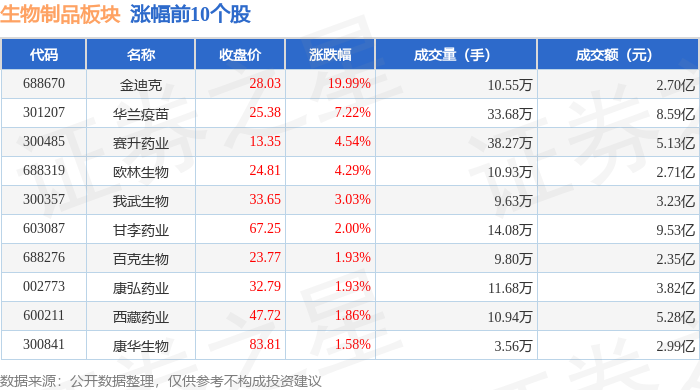
Market Overview - The biopharmaceutical sector increased by 0.3% on November 14, with Jindike leading the gains [1] - The Shanghai Composite Index closed at 3990.49, down by 0.97%, while the Shenzhen Component Index closed at 13216.03, down by 1.93% [1] Stock Performance - Jindike (688670) closed at 28.03, up by 19.99% with a trading volume of 105,500 shares and a transaction value of 270 million [1] - Hualan Ting (301207) closed at 25.38, up by 7.22% with a trading volume of 336,800 shares [1] - Other notable performers include: - Saikai Pharmaceutical (300485) at 13.35, up by 4.54% [1] - Olin Bio (616889) at 24.81, up by 4.29% [1] - Wowo Bio (300357) at 33.65, up by 3.03% [1] Capital Flow - The biopharmaceutical sector experienced a net outflow of 59.84 million from institutional investors, while retail investors saw a net inflow of 23.85 million [2][3] - Key stocks with significant capital flow include: - Ganli Pharmaceutical (603087) with a net inflow of 62.98 million from institutional investors [3] - Jindike (688670) with a net inflow of 40.32 million from institutional investors [3] - Hualan Ting (301207) with a net inflow of 27.99 million from institutional investors [3]




西藏药业(600211.SH):公司目前没有明确治疗流感病毒的药
Ge Long Hui· 2025-11-12 08:20
Group 1 - The core viewpoint of the article is that Xizang Pharmaceutical (600211.SH) currently does not have a specific drug for treating influenza virus [1] - The company's product, Xiaor Shuangqing Granules, is a unique national Class III new drug and a Category B product under the national medical insurance [1] - Xiaor Shuangqing Granules is recommended in the "Clinical Application Guidelines for Traditional Chinese Medicine in Treating Acute Upper Respiratory Infections in Children - 2020" [1] Group 2 - The main function of Xiaor Shuangqing Granules is to clear heat and detoxify, addressing both exterior and interior conditions [1] - It is indicated for children with symptoms of exterior heat syndrome, including fever, runny nose, red throat, thirst, dry stools, red urine, red tongue, and yellow coating [1] - The product is used for acute upper respiratory infections presenting the aforementioned symptoms [1]
西藏药业:公司目前没有明确治疗流感病毒的药
Ge Long Hui· 2025-11-12 08:17
Core Viewpoint - The company currently does not have a specific drug for treating influenza virus, but it offers a product called Xiaoer Shuangqing Granules, which is a national Class III new drug and a Category B product under the national medical insurance system [1] Company Summary - Xiaoer Shuangqing Granules is exclusively produced and sold by the company [1] - The product is recommended in the "Clinical Application Guidelines for Traditional Chinese Medicine in Treating Acute Upper Respiratory Infections in Children - 2020" [1] - The main functions of the product include clearing heat and detoxifying, addressing both exterior and interior conditions [1] Indication Summary - The product is indicated for children with symptoms of exterior heat syndrome, including fever, runny nose, red throat, thirst, dry stools, red urine, red tongue, and yellow coating [1] - It is specifically used for acute upper respiratory infections presenting with the aforementioned symptoms [1]
生物制品板块11月11日跌0.08%,禾元生物领跌,主力资金净流出6.71亿元
Zheng Xing Xing Ye Ri Bao· 2025-11-11 08:39
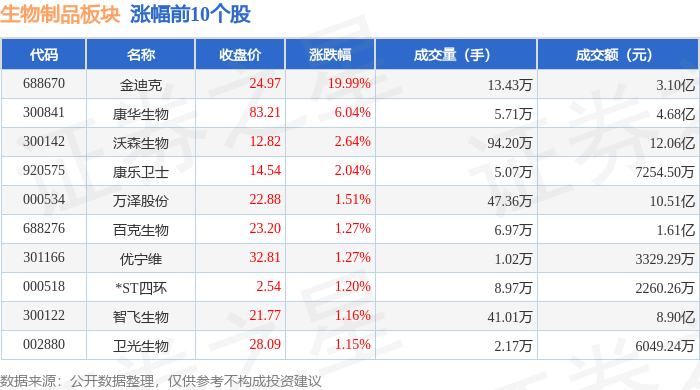
Market Overview - The biopharmaceutical sector experienced a slight decline of 0.08% on November 11, with He Yuan Bio leading the drop [1] - The Shanghai Composite Index closed at 4002.76, down 0.39%, while the Shenzhen Component Index closed at 13289.0, down 1.03% [1] Stock Performance - Notable gainers included: - Jin Ke (688670) with a closing price of 24.97, up 19.99% on a trading volume of 134,300 shares and a transaction value of 310 million [1] - Kanghua Bio (300841) closed at 83.21, up 6.04% with a trading volume of 57,100 shares [1] - Watson Bio (300142) closed at 12.82, up 2.64% with a trading volume of 942,000 shares [1] - Significant losers included: - Bu Yuan Bio (688765) closed at 86.00, down 8.02% with a trading volume of 107,600 shares [2] - Ao Pu Mai (688293) closed at 59.18, down 3.65% with a trading volume of 17,900 shares [2] - Rongchang Bio (688331) closed at 86.00, down 2.55% with a trading volume of 45,900 shares [2] Capital Flow - The biopharmaceutical sector saw a net outflow of 671 million from institutional investors, while retail investors contributed a net inflow of 335 million [2] - The capital flow for key stocks showed: - Jin Ke had a net inflow of 48.11 million from institutional investors, but a net outflow of 24.49 million from speculative funds [3] - Zhifei Bio (300122) experienced a net inflow of 15.25 million from institutional investors, with a net outflow of 23.20 million from retail investors [3] - Kanghua Bio had a net inflow of 14.35 million from institutional investors, but a net outflow of 23.26 million from speculative funds [3]

生物制品板块11月7日跌0.37%,禾元生物领跌,主力资金净流出6.79亿元
Zheng Xing Xing Ye Ri Bao· 2025-11-07 08:37
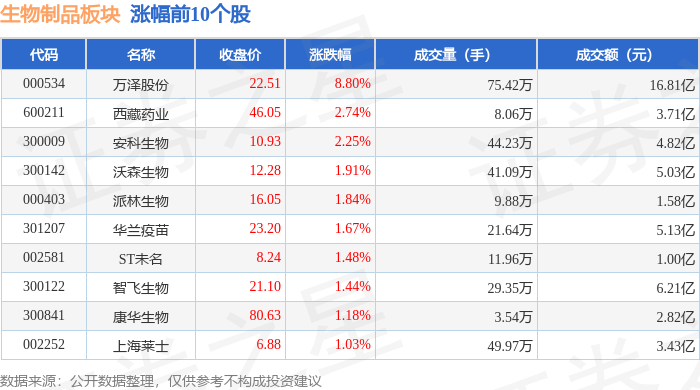
Core Viewpoint - The biopharmaceutical sector experienced a decline of 0.37% on November 7, with He Yuan Bio leading the drop. The Shanghai Composite Index closed at 3997.56, down 0.25%, while the Shenzhen Component Index closed at 13404.06, down 0.36% [1]. Group 1: Stock Performance - Wan Ze Co. (000534) saw a significant increase in stock price, closing at 22.51 with an 8.80% rise and a trading volume of 754,200 shares, amounting to 1.681 billion yuan [1]. - Tibet Pharmaceutical (600211) closed at 46.05, up 2.74%, with a trading volume of 80,600 shares, totaling 371 million yuan [1]. - Anke Bio (300009) increased by 2.25%, closing at 10.93 with a trading volume of 442,300 shares, amounting to 482 million yuan [1]. - The overall biopharmaceutical sector saw a net outflow of 678 million yuan from institutional investors, while retail investors had a net inflow of 304 million yuan [2][3]. Group 2: Capital Flow - The main capital inflow was observed in Tibet Pharmaceutical, with a net inflow of 26.13 million yuan from institutional investors, while retail investors had a net outflow of 36.64 million yuan [3]. - Anke Bio also experienced a net inflow of 23.91 million yuan from institutional investors, with retail investors seeing a net outflow of 13.09 million yuan [3]. - The overall trend indicates a mixed sentiment in the biopharmaceutical sector, with institutional investors pulling back while retail investors showed some interest [2][3].