JLPC(600513)

Search documents
联环药业:控股子公司获得《药品注册证书》
Xin Lang Cai Jing· 2025-09-04 09:11
Core Viewpoint - The approval of the drug "Amlodipine Besylate Tablets" by the National Medical Products Administration is expected to enhance the product line and market competitiveness of the company and its subsidiary, but it is not anticipated to have a significant impact on recent operating performance [1] Group 1: Product Approval - The company's subsidiary, Xinxiang Changle Pharmaceutical Co., Ltd., has received the drug registration certificate for Amlodipine Besylate Tablets, with specifications of 5mg and 10mg [1] - The total sales revenue for Amlodipine Besylate Tablets in hospitals nationwide for the year 2024 is projected to reach 1.216 billion yuan [1] Group 2: R&D Investment - Changle Pharmaceutical's research and development investment for this drug approval is approximately 3.83 million yuan [1]
联环药业(600513.SH):苯磺酸氨氯地平片获得《药品注册证书》
Ge Long Hui A P P· 2025-09-04 09:11
Group 1 - The core point of the article is that Lianhuan Pharmaceutical (600513.SH) announced that its subsidiary, Xinxiang Changle Pharmaceutical Co., Ltd., has received the drug registration certificate from the National Medical Products Administration for Amlodipine Besylate Tablets, a commonly used medication for regulating vascular pressure [1] Group 2 - The drug Amlodipine Besylate Tablets is recognized for its role in managing blood vessel pressure, indicating its significance in the pharmaceutical market [1]
联环药业(600513.SH):苯磺酸氨氯地平片完成药品注册
智通财经网· 2025-09-04 09:09
Core Viewpoint - The company has received approval from the National Medical Products Administration for its drug, Amlodipine Besylate Tablets, which is commonly used to regulate vascular pressure [1] Company Summary - The company's subsidiary, Xinxiang Changle Pharmaceutical Co., Ltd., has been granted a drug registration certificate for Amlodipine Besylate Tablets [1] - Amlodipine Besylate Tablets are recognized as a standard medication for managing blood vessel pressure [1]
联环药业跌2.00%,成交额2.89亿元,主力资金净流出2934.96万元
Xin Lang Cai Jing· 2025-09-03 03:43
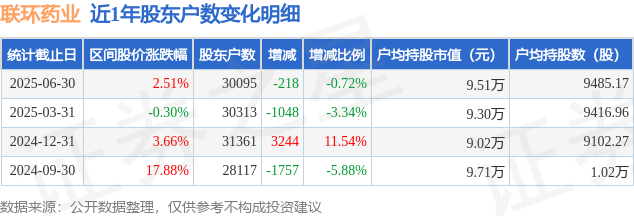
Core Viewpoint - Lianhuan Pharmaceutical's stock has experienced significant fluctuations, with a year-to-date increase of 119.12%, but a recent decline in the last five trading days by 5.99% [1][2]. Group 1: Stock Performance - As of September 3, Lianhuan Pharmaceutical's stock price was 21.52 CNY per share, with a market capitalization of 6.143 billion CNY [1]. - The stock has seen a trading volume of 289 million CNY and a turnover rate of 4.61% [1]. - The company has appeared on the "Dragon and Tiger List" nine times this year, with the most recent appearance on August 21, where it recorded a net buy of -44.74 million CNY [1]. Group 2: Financial Performance - For the first half of 2025, Lianhuan Pharmaceutical reported a revenue of 1.285 billion CNY, representing a year-on-year growth of 14.12% [2]. - The net profit attributable to shareholders was -40.03 million CNY, a decrease of 163.65% compared to the previous period [2]. Group 3: Shareholder Information - As of June 30, 2025, the number of shareholders was 30,100, a decrease of 0.72% from the previous period [2]. - The average number of circulating shares per shareholder increased by 0.72% to 9,485 shares [2]. - The company has distributed a total of 343 million CNY in dividends since its A-share listing, with 111 million CNY distributed in the last three years [3].
江苏国企改革板块9月2日跌0.85%,联环药业领跌,主力资金净流出7.2亿元


Sou Hu Cai Jing· 2025-09-02 09:42
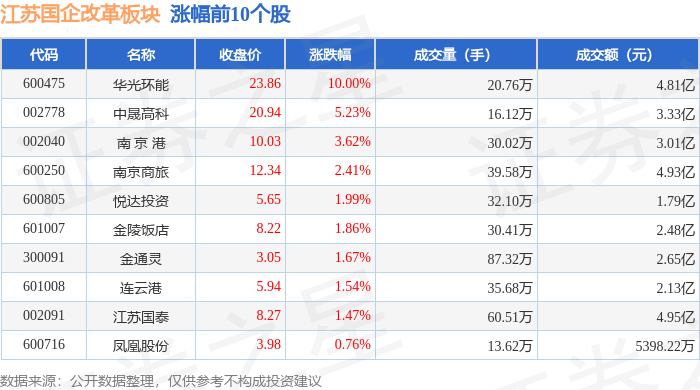
Market Overview - On September 2, the Jiangsu state-owned enterprise reform sector fell by 0.85% compared to the previous trading day, with Lianhuan Pharmaceutical leading the decline [1] - The Shanghai Composite Index closed at 3858.13, down 0.45%, while the Shenzhen Component Index closed at 12553.84, down 2.14% [1] Stock Performance - Notable gainers in the Jiangsu state-owned enterprise reform sector included: - Huami Environmental Energy (600475) with a closing price of 23.86, up 10.00% [1] - Zhongsheng High-Tech (002778) with a closing price of 20.94, up 5.23% [1] - Nanjing Port (002040) with a closing price of 10.03, up 3.62% [1] - Major decliners included: - Lianhuan Pharmaceutical (600513) with a closing price of 21.96, down 6.63% [2] - Tongxingbao (301339) with a closing price of 16.73, down 4.35% [2] - Nanjing Chemical Fiber (600889) with a closing price of 15.16, down 4.29% [2] Capital Flow - The Jiangsu state-owned enterprise reform sector experienced a net outflow of 720 million yuan from institutional investors, while retail investors saw a net inflow of 409 million yuan [2][3] - The capital flow for specific stocks showed: - Huami Environmental Energy (600475) had a net inflow of 1.421 billion yuan from institutional investors [3] - Jiangsu Jinzhu (002091) had a net inflow of 12.13 million yuan from institutional investors [3] - Nanjing Travel (600250) had a net inflow of 10.72 million yuan from institutional investors [3]

联环药业涨2.03%,成交额3.31亿元,主力资金净流入1260.89万元
Xin Lang Cai Jing· 2025-08-29 03:08
Group 1 - The core viewpoint of the news is that Lianhuan Pharmaceutical has shown significant stock performance with a year-to-date increase of 140.30%, despite a recent decline of 4.07% over the last five trading days [1] - As of August 29, Lianhuan Pharmaceutical's stock price reached 23.60 yuan per share, with a total market capitalization of 6.737 billion yuan [1] - The company has been actively traded, with a net inflow of main funds amounting to 12.6089 million yuan and significant trading volumes in large orders [1] Group 2 - Lianhuan Pharmaceutical operates in the pharmaceutical and biological industry, specifically in chemical pharmaceuticals and preparations, and is categorized under several concept sectors including small-cap and biomedicine [2] - For the first half of 2025, Lianhuan Pharmaceutical reported a revenue of 1.285 billion yuan, reflecting a year-on-year growth of 14.12%, while the net profit attributable to the parent company was -40.0284 million yuan, a decrease of 163.65% [2] - The company has distributed a total of 343 million yuan in dividends since its A-share listing, with 111 million yuan distributed over the past three years [3]
联环药业2025年中报简析:增收不增利
Zheng Quan Zhi Xing· 2025-08-27 22:56
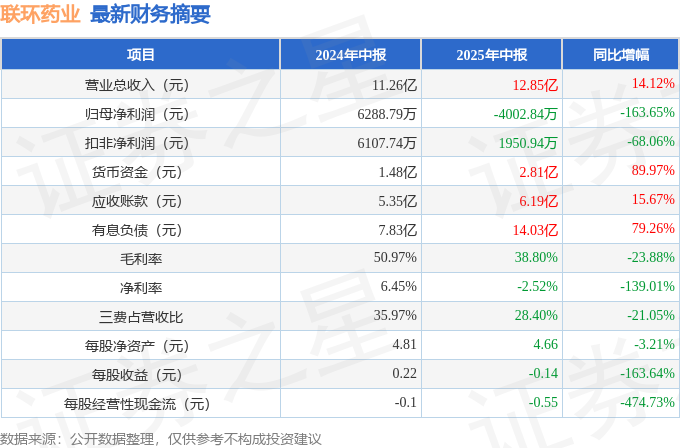
Group 1 - The core viewpoint of the article highlights that Lianhuan Pharmaceutical (600513) has experienced revenue growth but a significant decline in profit, with total revenue reaching 1.285 billion yuan, a year-on-year increase of 14.12%, while net profit attributable to shareholders was -40.0284 million yuan, a year-on-year decrease of 163.65% [1] - In Q2, the company reported total revenue of 658 million yuan, reflecting a year-on-year increase of 9.99%, but the net profit attributable to shareholders was -63.0879 million yuan, a year-on-year decline of 307.92% [1] - The financial indicators show a gross margin of 38.8%, down 23.88% year-on-year, and a net margin of -2.52%, down 139.01% year-on-year [1] Group 2 - The company's return on invested capital (ROIC) for the previous year was 5.58%, indicating generally weak capital returns, with a median ROIC of 7.46% over the past decade [2] - The company's business model relies heavily on research and marketing, necessitating a thorough examination of the underlying drivers of these aspects [2] - The cash flow situation is concerning, with cash and cash equivalents to current liabilities at only 22.49%, and the average operating cash flow over the past three years to current liabilities at just 7.97% [2]
联环药业股价下跌5.1% 上半年亏损4003万元
Jin Rong Jie· 2025-08-27 20:53
Group 1 - The stock price of Lianhuan Pharmaceutical closed at 22.89 yuan on August 27, down 1.23 yuan or 5.1% from the previous trading day [1] - The company operates in the chemical pharmaceutical industry, focusing on the research, production, and sales of chemical raw materials and formulations, with products covering various therapeutic areas including anti-infectives, cardiovascular drugs, and digestive system medications [1] - Lianhuan Pharmaceutical completed the acquisition of Changle Pharmaceutical and signed an investment agreement with Longyi Pharmaceutical [1] Group 2 - The company reported a half-year revenue of 1.29 billion yuan, representing a year-on-year increase of 14.1%, but incurred a net loss attributable to shareholders of 40.03 million yuan, a decline of 163.7% year-on-year [1] - In the second quarter, the company experienced a loss of 63.09 million yuan, a year-on-year decrease of 307.9% [1] - Sales of the key product, Aipuliet Tablets, reached 116 million yuan, showing a year-on-year growth of 4.85% [1] Group 3 - On August 27, the net outflow of main funds from Lianhuan Pharmaceutical was 128 million yuan, accounting for 1.96% of the circulating market value [1] - Over the past five trading days, the cumulative net outflow of main funds reached 632 million yuan, representing 9.67% of the circulating market value [1]
联环药业(600513)6月30日股东户数3.01万户,较上期减少0.72%
Zheng Quan Zhi Xing· 2025-08-27 11:41
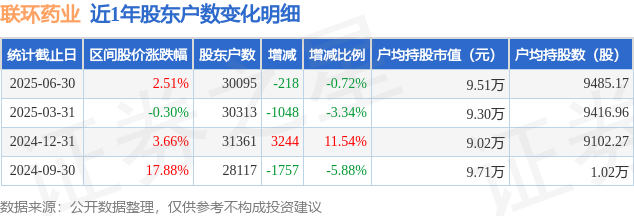
Core Viewpoint - Lianhuan Pharmaceutical reported a decrease in shareholder accounts and average shareholding value, indicating a trend of reduced investor engagement despite a slight increase in stock price over the observed period [1][2]. Group 1: Shareholder Statistics - As of June 30, 2025, the number of shareholders for Lianhuan Pharmaceutical was 30,095, a decrease of 218 accounts or 0.72% from March 31, 2025 [1][2]. - The average number of shares held per account increased from 9,417 shares to 9,485 shares, with an average market value of 95,100 yuan [1][2]. - Compared to the chemical pharmaceutical industry, Lianhuan's shareholder count is below the industry average of 33,000 accounts, and its average market value is significantly lower than the industry average of 394,700 yuan [1][2]. Group 2: Stock Performance - From March 31, 2025, to June 30, 2025, Lianhuan Pharmaceutical's stock price increased by 2.51%, while the number of shareholders decreased [1][2]. - During this period, the net outflow of funds from major investors was 74.91 million yuan, while retail investors contributed a net inflow of 88.67 million yuan [2].
联环药业6月30日股东户数3.01万户,较上期减少0.72%
Zheng Quan Zhi Xing· 2025-08-27 10:29
Group 1 - The core point of the article highlights that Lianhuan Pharmaceutical's shareholder count decreased to 30,095 as of June 30, 2025, representing a reduction of 218 shareholders or 0.72% compared to March 31, 2025 [1][2] - The average shareholding value per shareholder for Lianhuan Pharmaceutical is 95,100 yuan, which is below the industry average of 394,700 yuan for A-share listed companies in the chemical pharmaceutical sector [1][2] - The stock price of Lianhuan Pharmaceutical increased by 2.51% from March 31, 2025, to June 30, 2025, despite the decrease in shareholder count [1][2] Group 2 - From March 31, 2025, to June 30, 2025, the net outflow of main funds for Lianhuan Pharmaceutical was 74.91 million yuan, while retail investors saw a net inflow of 88.67 million yuan [2] - The average number of shares held per shareholder increased from 9,416.96 shares on March 31, 2025, to 9,485.17 shares on June 30, 2025 [2] - The overall trend in shareholder count shows fluctuations, with a notable increase of 3,244 shareholders from December 31, 2024, to March 31, 2025, followed by a decrease in the subsequent quarter [2]