
LAO BAI GAN JIU(600559)

Search documents
老白干酒1—9月实现归母净利4亿元
Bei Jing Shang Bao· 2025-10-29 11:46
Core Insights - The company reported a significant decline in revenue and net profit for the first three quarters of 2025, with revenue at 3.33 billion yuan, down 18.53% year-on-year, and net profit at 400 million yuan, down 28.04% year-on-year [1] Revenue Breakdown - Revenue from products priced below 100 yuan reached 1.738 billion yuan, a decrease of 14.96% year-on-year, while products priced above 100 yuan generated 1.574 billion yuan, down 22.06% year-on-year [1] Regional Sales Performance - The primary sales market for the company remains Hebei, with revenue from various regions as follows: Hebei at 2.019 billion yuan (down 13.82%), Hunan at 644 million yuan (down 20.2%), Anhui at 299 million yuan (down 34.72%), Shandong at 137 million yuan (down 3.24%), and other provinces at 202 million yuan (down 32.8%) [1]

老白干酒:前三季度营收33.3亿元,100元以上产品收入17.38亿
Cai Jing Wang· 2025-10-29 09:52
Core Insights - The company reported a significant decline in revenue across various regions for the first three quarters of 2025 compared to the same period in 2024, indicating a challenging market environment [1] Revenue Performance by Region - Hebei's revenue decreased by 13.8%, from 234.30 million to 201.93 million [1] - Hunan experienced a 20.2% drop in revenue, falling from 80.67 million to 64.38 million [1] - Anhui saw the most substantial decline of 34.7%, with revenue decreasing from 45.73 million to 29.85 million [1] - Shandong's revenue slightly decreased by 3.2%, from 14.20 million to 13.74 million [1] - Other provinces reported a 32.8% decline, with revenue dropping from 30.08 million to 20.22 million [1] - Overseas revenue also fell by 18.8%, from 1.35 million to 1.09 million [1] Product Revenue Analysis - Revenue from products priced above 100 yuan decreased by 14.96%, totaling 1.738 billion [1] - Revenue from products priced below 100 yuan saw a more significant reduction of 22.06%, amounting to 1.574 billion [1]


老白干酒(600559) - 河北衡水老白干酒业股份有限公司2025年前三季度经营数据公告
2025-10-29 09:30
河北衡水老白干酒业股份有限公司 2025 年前三季度经营数据公告 证券代码:600559 证券简称:老白干酒 公告编号:2025-025 单位:万元 币种:人民币 产品档次 2025 年 1-9 月营业收入 2024 年 1-9 月营业收入 同比(%) 100 元以上 173,792.33 204,360.64 -14.96 100 元以下 157,412.27 201,975.23 -22.06 | 直销(含团购、 | 24,272.71 | 25,209.83 | -3.72 | | --- | --- | --- | --- | | 线上销售) | | | | | 经销商模式 | 306,931.90 | 381,126.04 | -19.47 | 三、按地区分类情况 本公司董事会及全体董事保证本公告内容不存在任何虚假记载、误导性陈 述或者重大遗漏,并对其内容的真实性、准确性和完整性承担法律责任。 根据《上海证券交易所上市公司自律监管指引第 3 号——行业信息披露》 之《第十二号——酒制造》第十六条相关规定,河北衡水老白干酒业股份有限公 司现将 2025 年前三季度主要经营数据(未经审计)披露如下: 一 ...
老白干酒(600559) - 2025 Q3 - 季度财报
2025-10-29 09:20
河北衡水老白干酒业股份有限公司 2025 年第三季度报告 证券代码:600559 证券简称:老白干酒 河北衡水老白干酒业股份有限公司 2025 年第三季度报告 本公司董事会及全体董事保证本公告内容不存在任何虚假记载、误导性陈述或者 重大遗漏,并对其内容的真实性、准确性和完整性承担法律责任。 重要内容提示: 公司董事会及董事、高级管理人员保证季度报告内容的真实、准确、完整,不存在虚假记载、误 导性陈述或重大遗漏,并承担个别和连带的法律责任。 公司负责人、主管会计工作负责人及会计机构负责人(会计主管人员)保证季度报告中财务信息 的真实、准确、完整。 第三季度财务报表是否经审计 □是 √否 一、主要财务数据 (一) 主要会计数据和财务指标 单位:元 币种:人民币 | | | 本报告期比 | | 年初至报告期 | | --- | --- | --- | --- | --- | | 项目 | 本报告期 | 上年同期增 | 年初至报告期末 | 末比上年同期 | | | | 减变动幅度 | | 增减变动幅度 | | | | (%) | | (%) | | 营业收入 | 848,603,935.97 | -47.55 | 3 ...
老白干酒:Q3净利7939.23万元,同比下降68.48%
Ge Long Hui A P P· 2025-10-29 09:07
Core Viewpoint - The company reported a significant decline in both revenue and net profit for the first three quarters of the year, primarily due to weak demand in the liquor market and reduced shipments [1] Financial Performance - For the first three quarters, the company achieved a revenue of 3.33 billion yuan, a year-on-year decrease of 18.53% [1] - The net profit attributable to shareholders was 400 million yuan, down 28.04% year-on-year [1] - In the third quarter, revenue was 849 million yuan, reflecting a substantial year-on-year decline of 47.55% [1] - The net profit for the third quarter was approximately 79.39 million yuan, which represents a 68.48% decrease year-on-year [1] Market Conditions - The decline in performance is attributed to weak consumer demand for liquor during the reporting period, leading to a reduction in shipments and consequently lower revenue [1]
老白干酒:第三季度归母净利润7939.23万元,同比下降68.48%
Xin Lang Cai Jing· 2025-10-29 08:55
老白干酒10月29日公告,2025年第三季度实现营业收入8.49亿元,同比下降47.55%;归属于上市公司股 东的净利润7939.23万元,同比下降68.48%;基本每股收益0.09元。前三季度实现营业收入33.3亿元,同 比下降18.53%;归属于上市公司股东的净利润4亿元,同比下降28.04%;基本每股收益0.44元。 ...
老白干酒:前三季度净利润同比下降28%
Di Yi Cai Jing· 2025-10-29 08:53
老白干酒发布2025年第三季度报告,前三季度实现营业收入33.30亿元,同比下降18.53%;归属于上市 公司股东的净利润为4.00亿元,同比下降28.04%。第三季度营业收入为8.49亿元,同比下降47.55%;归 属于上市公司股东的净利润为7939.23万元,同比下降68.48%。 (文章来源:第一财经) ...
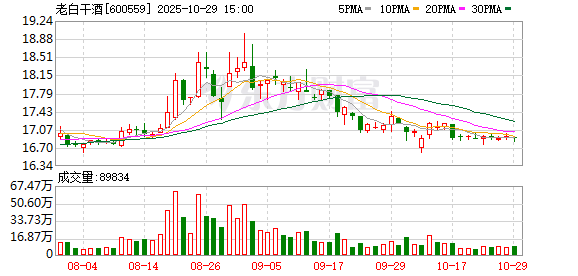
老白干酒:前三季度净利润同比下降28% 白酒消费需求较弱出库减少
Xin Lang Cai Jing· 2025-10-29 08:51
Core Insights - The company reported a significant decline in revenue and net profit for the first three quarters of 2025, with revenue at 3.33 billion yuan, a year-on-year decrease of 18.53% [1] - The net profit attributable to shareholders was 400 million yuan, down 28.04% year-on-year [1] - In the third quarter alone, revenue was 849 million yuan, reflecting a substantial year-on-year decline of 47.55% [1] - The net profit for the third quarter was approximately 79.39 million yuan, a decrease of 68.48% compared to the same period last year [1] - The primary reason for the decline in performance is attributed to weak consumer demand for liquor and reduced shipments during the reporting period [1]
国信证券:白酒行业筑底信号增多 板块进入布局阶段
智通财经网· 2025-10-29 02:08
Core Viewpoint - The investment opportunities in the liquor sector are currently characterized by market divergence, with expectations of a significant decline in performance for liquor companies in Q3 2025, while both valuation and holdings are at low levels, and positive factors on both supply and demand sides are gradually increasing [1] Group 1: Market Dynamics - The industry demand is expected to recover on a month-on-month basis, particularly during the dual festivals, leading to a more optimistic market outlook regarding performance and price expectations, which will likely result in valuation recovery as demand improves [1] - The first phase of recovery is driven by dividend yield pricing, while the second phase will see a return to long-term confidence in liquor assets as supply-demand relationships improve and performance indicators are realized [1] Group 2: Historical Performance Analysis - Historical data indicates that the majority of liquor companies confirmed their stock price bottoms between Q4 2013 and Q1 2014, despite a continued decline in performance and market conditions [2] - The stock price performance remained relatively stable after the third quarter of 2013, with most companies generating absolute returns within one month post earnings report, attributed to the market's sufficient digestion of performance decline expectations [2] Group 3: Business Strategies of Liquor Companies - Liquor companies are leveraging channels to amplify brand and product advantages, signaling changes in supply-side dynamics during the adjustment phase [3] - High-end liquor brands are focusing on maintaining brand strength, with companies like Moutai and Wuliangye adapting their strategies to enhance channel management and product offerings [3] - Regional leaders are concentrating on their base markets while expanding into lower-tier markets, with companies like Yanghe and Gujing enhancing their presence in these areas [3]





2025年1-4月中国白酒(折65度,商品量)产量为130.8万千升 累计下降7.8%
Chan Ye Xin Xi Wang· 2025-10-23 01:24
Core Viewpoint - The Chinese liquor industry is experiencing a decline in production, with a significant drop in output expected in 2025, indicating potential challenges for major companies in the sector [1] Industry Summary - According to the National Bureau of Statistics, the production of Chinese liquor (converted to 65 degrees, in commodity volume) is projected to be 281,000 kiloliters in April 2025, representing a year-on-year decrease of 13.8% [1] - From January to April 2025, the cumulative production of Chinese liquor (converted to 65 degrees, in commodity volume) is expected to reach 1,308,000 kiloliters, reflecting a cumulative decline of 7.8% [1] - The report by Zhiyan Consulting provides an analysis of the market status and investment prospects for the Chinese liquor industry from 2025 to 2031, highlighting the ongoing challenges and potential shifts in the market landscape [1] Company Summary - Major listed companies in the Chinese liquor industry include Kweichow Moutai (600519), Wuliangye (000858), Yanghe Brewery (002304), Luzhou Laojiao (000568), Shanxi Fenjiu (600809), Gujing Gongjiu (000596), Shui Jing Fang (600779), Shede Liquor (600702), Jiu Gui Jiu (000799), and Lao Bai Gan Jiu (600559) [1]


