LAO BAI GAN JIU(600559)

Search documents
白酒行业更新报告:白酒筑底,政策、批价双重催化
GUOTAI HAITONG SECURITIES· 2026-01-30 02:01
Investment Rating - The report assigns an "Accumulate" rating for the liquor industry [4]. Core Insights - The liquor industry has entered a deep adjustment period, but recent positive changes in the real estate and domestic demand sectors, along with the market-oriented transformation of Moutai, are stimulating incremental demand and driving up prices, leading to a valuation recovery [2]. - The report recommends stocks with price elasticity such as Guizhou Moutai, Wuliangye, and Luzhou Laojiao, as well as those expected to clear inventory like Yingjia Gongjiu, Gujing Gongjiu, Shanxi Fenjiu, Jianshiyuan, Zhenjiu Lidu, Shede Jiuye, and Jinhui Jiu [4]. Summary by Sections Market Environment - The real estate sector is showing signs of recovery, and policies are becoming more favorable. The liquor industry is a typical cyclical sector, with market pricing influenced by both internal demand and real estate conditions. The government has prioritized boosting domestic demand as a key task for the 14th Five-Year Plan, with plans to develop a strategy for expanding domestic demand from 2026 to 2030 [4]. - The real estate market is gradually bottoming out after years of adjustment, with recent government actions aimed at stabilizing market expectations and improving conditions [4]. Moutai's Market Transformation - Moutai's market-oriented reform has sparked incremental demand, with significant attention on liquor sales during the Spring Festival. Moutai has introduced various products on its iMoutai platform, leading to a surge in online purchases and stable price performance [4]. - As of January 29, Moutai's price has increased by over 1,600 RMB, with transaction prices exceeding 1,700 RMB, indicating successful price-volume strategies [4]. Industry Outlook - The liquor industry is believed to be at the bottom of its cycle, with liquidity improvements and expectations likely to catalyze stock prices. The report anticipates that if prices stabilize, the pressure on stock prices will lessen, and further positive signals from policies could enhance stock performance [4]. - The report includes earnings forecasts for key liquor companies, indicating a compound annual growth rate (CAGR) of 5% for Moutai from 2024 to 2026, with a price-to-earnings (PE) ratio projected to decrease from 21 to 19 [5].




今日白酒板块表现强势,皇台酒业、酒鬼酒、金徽酒、水井坊、泸州老窖、金种子酒领涨,板块整理
Jin Rong Jie· 2026-01-29 10:46
最新股价:14.48元 日涨幅:+10.03% 亮点:甘肃区域性白酒(核心股)企业,拥有一定的品牌历史积淀。 酒鬼酒(000799.SZ) 白酒(核心股)板块全线飘红,多股午后涨停!消费复苏预期点燃板块热情,皇台酒业、酒鬼酒、金徽 酒、水井坊、泸州老窖、金种子酒领涨,板块整理如下: 最新股价:56.85元 皇台酒业(000995.SZ) 日涨幅:+10.00% 日涨幅:+10.01% 亮点:中国西北地区优势白酒(核心股)企业,旗下拥有"金徽"、"陇南春"两大品牌。 水井坊(600779.SH) 最新股价:41.99元 日涨幅:+10.01% 亮点:主营"水井坊"系列高端白酒(核心股),是中国知名的高端白酒品牌。 泸州老窖(000568.SZ) 最新股价:124.23元 日涨幅:+10.00% 亮点:中国馥郁香型白酒(核心股)创立者,产品具有"前浓、中清、后酱"的独特风格。 金徽酒(603919.SH) 最新股价:21.54元 亮点:浓香型白酒(核心股)鼻祖,"国窖1573"是中国白酒鉴赏标准级酒品。 金种子酒(600199.SH) 最新股价:10.30元 日涨幅:+10.04% 亮点:深耕安徽地区的白酒(核心 ...


白酒板块罕见大涨!
Zheng Quan Ri Bao Wang· 2026-01-29 10:29
Core Viewpoint - The A-share liquor sector experienced a significant surge, with the liquor ETF rising by 10.08% and the China Securities Liquor Index increasing by 9.79% on January 29, driven by macroeconomic expectations and seasonal factors related to the upcoming Spring Festival [1][2]. Group 1: Market Performance - 20 liquor companies saw stock price increases, with 18 reaching the daily limit, including notable gains from Kweichow Moutai (8.61% increase) and others like Jinzhongzi Liquor and Huangtai Liquor, both around 10% [1][2]. - The wholesale price of Feitian Moutai has been rising, surpassing 1600 yuan, indicating a market recovery signal as the product remains sold out on official platforms [3]. Group 2: Expert Insights - Experts attribute the price increase to a combination of Moutai's proactive price control and seasonal demand, suggesting that the liquor sector is a target for capital investment due to its cyclical nature [4]. - The overall industry is under pressure, with several companies forecasting significant declines in net profit, indicating a challenging competitive landscape and increased inventory issues [4]. Group 3: Future Outlook - Analysts suggest that the proactive inventory adjustments by liquor manufacturers and the stabilization of high-end liquor prices could lead to a healthier market development [5]. - The upcoming Spring Festival is expected to boost demand, with the liquor sector seen as a value opportunity for investors, despite the need for cautious optimism regarding long-term trends [5].



白酒板块1月29日涨9.16%,金种子酒领涨,主力资金净流入83.24亿元
Zheng Xing Xing Ye Ri Bao· 2026-01-29 09:03
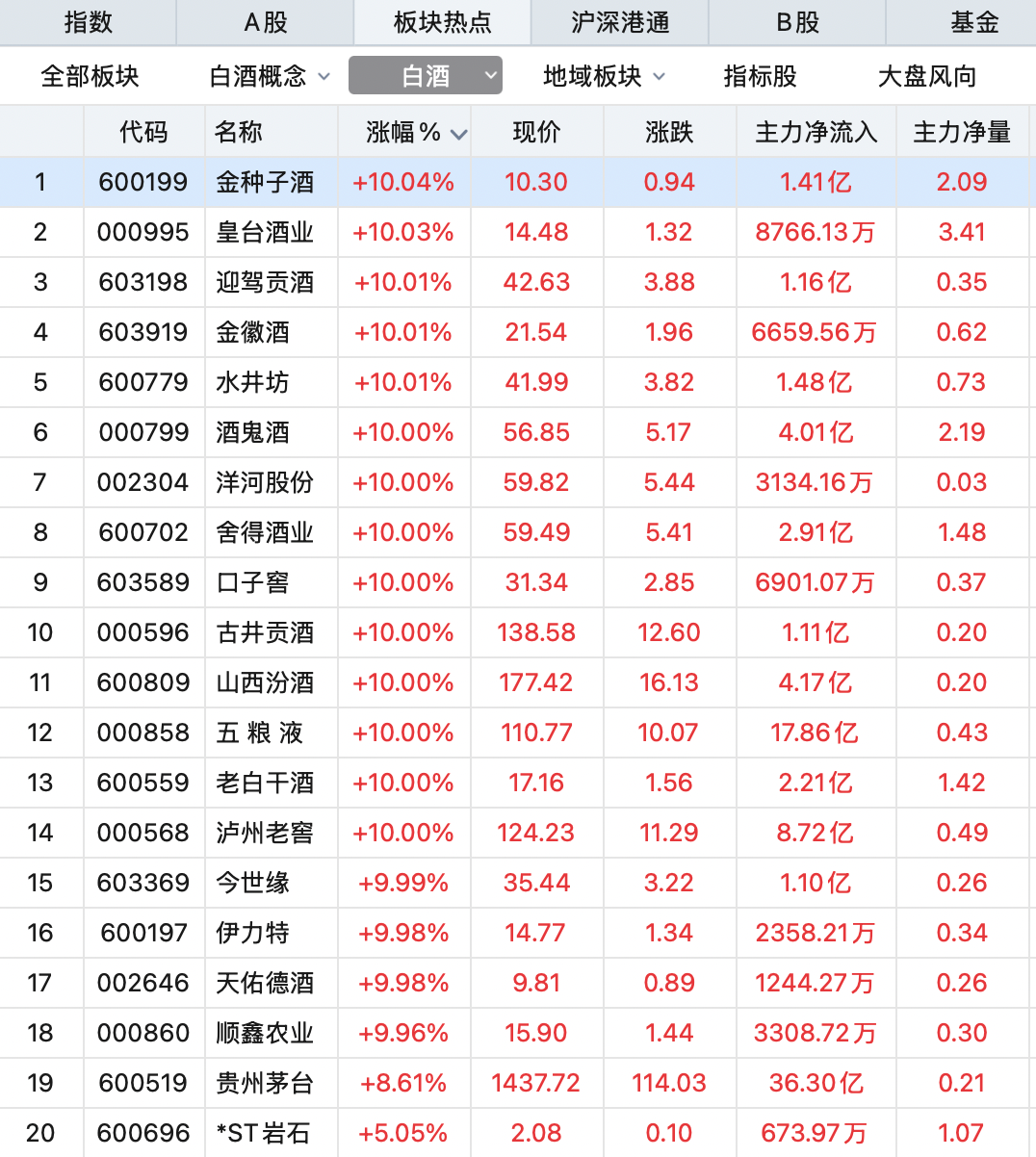
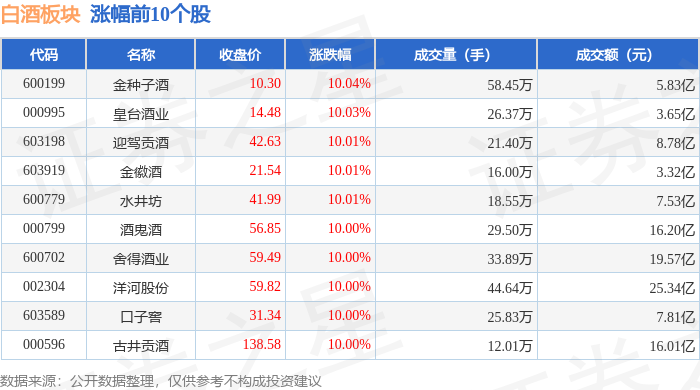
证券之星消息,1月29日白酒板块较上一交易日上涨9.16%,金种子酒领涨。当日上证指数报收于 4157.98,上涨0.16%。深证成指报收于14300.08,下跌0.3%。白酒板块个股涨跌见下表: | 代码 | 名称 | 收盘价 | 涨跌幅 | 成交量(手) | 成交额(元) | | | --- | --- | --- | --- | --- | --- | --- | | 661009 | 金种子酒 | 10.30 | 10.04% | 58.45万 | | 5.83亿 | | 000995 | 皇台酒业 | 14.48 | 10.03% | 26.37万 | | 3.65亿 | | 603198 | 迎驾贡酒 | 42.63 | 10.01% | 21.40万 | | 8.78亿 | | 616809 | 全徽酒 | 21.54 | 10.01% | 16.00万 | | 3.32亿 | | 600779 | 水井坊 | 41.99 | 10.01% | 18.55万 | | 7.53亿 | | 000799 | 酒鬼酒 | 56.85 | 10.00% | 29.50万 | | 16.20亿 | | 6 ...
白酒狂欢!泸州老窖等8股涨停,贵州茅台涨近8%飞天批价突破1600元,券商看好底部配置机会
Jin Rong Jie· 2026-01-29 06:23
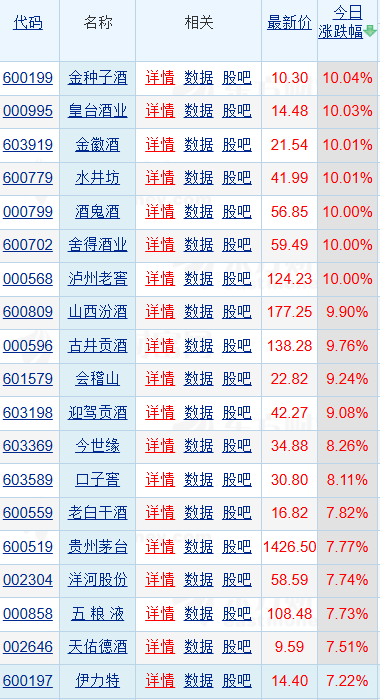
相关行业: 高端白酒(核心股):高端白酒凭借深厚的品牌壁垒和稳定的消费群体,在行业调整期展现出更强的抗 风险能力。随着春节商务宴请、礼品馈赠等消费场景复苏,高端白酒批价回升、动销向好,相关龙头企 业将率先受益于行业复苏红利,业绩弹性值得期待。 区域白酒(核心股):区域白酒企业依托本地消费市场优势,积极调整渠道策略、优化产品结构,叠加 各地产区政策扶持,有望在存量竞争中实现突围。部分区域酒企推出亲民酒、口粮酒等产品,贴合大众 消费需求,将进一步巩固本地市场份额,打开成长空间。 午后,白酒(核心股)板块持续拉升,板块内8只个股涨停,泸州老窖、酒鬼酒、皇台酒业、金种子 酒、舍得酒业、水井坊、金徽酒、流金科技纷纷涨停,古井贡酒、五粮液、顺鑫农业、洋河股份、天佑 德酒、古越龙山、伊力特、贵州茅台、老白干酒、山西汾酒、会稽山、迎驾贡酒、今世缘、口子窖涨超 5%。 | 代码 | 名称 | 相关 | 最新价 | रे | | --- | --- | --- | --- | --- | | | | | | 涨跌幅号 | | 600199 | 金种子酒 | 详情 数据 股吧 | 10.30 | 10.04% | | 000995 ...


老白干酒股价涨5%,南方基金旗下1只基金位居十大流通股东,持有668.82万股浮盈赚取521.68万元
Xin Lang Cai Jing· 2026-01-29 06:04
Group 1 - The stock price of Laobai Gan Liquor increased by 5%, reaching 16.38 yuan per share, with a trading volume of 441 million yuan and a turnover rate of 3.04%, resulting in a total market capitalization of 14.984 billion yuan [1] - Laobai Gan Liquor, established on December 30, 1999, and listed on October 29, 2002, is primarily engaged in the production and sales of liquor, with its main business revenue composition being: Laobai Gan Brewing 51.47%, Wuling Division 21.21%, Qianlong Drunk Division 14.63%, Wenwang Division 9.68%, and Kongfu Family Division 3.75% [1] Group 2 - Southern Fund's Southern CSI 1000 ETF (512100) is among the top ten circulating shareholders of Laobai Gan Liquor, having reduced its holdings by 73,700 shares to 6.6882 million shares, representing 0.74% of the circulating shares, with an estimated floating profit of approximately 5.2168 million yuan [2] - The Southern CSI 1000 ETF (512100) was established on September 29, 2016, with a latest scale of 78.996 billion yuan, achieving a year-to-date return of 10.57% and a one-year return of 45.56%, ranking 1555 out of 5551 and 1739 out of 4285 in its category, respectively [2] Group 3 - The fund manager of Southern CSI 1000 ETF (512100) is Cui Lei, who has been in the position for 7 years and 85 days, managing total assets of 137.02 billion yuan, with the best fund return during the tenure being 285.52% and the worst being -15.93% [3]
老白干酒:股价走势受到宏观经济、政策环境、市场情绪等多种因素影响
Zheng Quan Ri Bao· 2026-01-28 13:19
Core Viewpoint - The stock price of Laobaigan Liquor is influenced by various factors including macroeconomic conditions, policy environment, and market sentiment, while the intrinsic value of the company ultimately determines its long-term market capitalization [2]. Group 1 - The company's board and management are focused on enhancing operational management and improving the quality of operations to boost profitability [2]. - Laobaigan Liquor emphasizes the importance of value creation through solidifying its core business [2]. - The company adheres to legal and regulatory requirements for timely information disclosure, encouraging stakeholders to monitor updates on the Shanghai Stock Exchange and designated media [2].
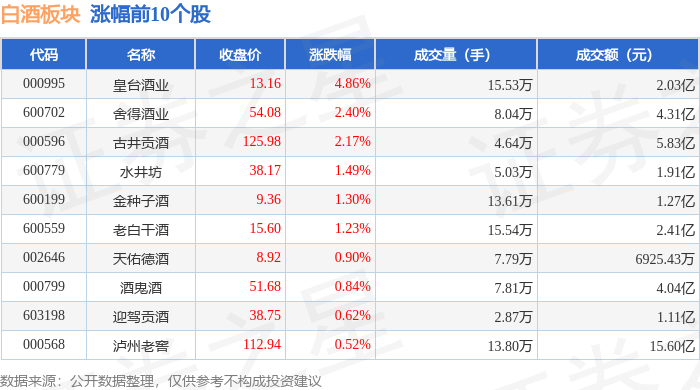
白酒板块1月28日跌0.79%,*ST岩石领跌,主力资金净流出12.38亿元
Zheng Xing Xing Ye Ri Bao· 2026-01-28 08:58
证券之星消息,1月28日白酒板块较上一交易日下跌0.79%,*ST岩石领跌。当日上证指数报收于 4151.24,上涨0.27%。深证成指报收于14342.9,上涨0.09%。白酒板块个股涨跌见下表: 从资金流向上来看,当日白酒板块主力资金净流出12.38亿元,游资资金净流入13.56亿元,散户资金净流 出1.18亿元。白酒板块个股资金流向见下表: | 代码 | 名称 | 主力净流入 (元) | 主力净占比 游资净流入 (元) | | 游资净占比 散户净流入(元) | | 散户净占比 | | --- | --- | --- | --- | --- | --- | --- | --- | | 000568 泸州老窖 | | 1.07 Z | 6.89% | -6686.18万 | -4.29% | -4056.45万 | -2.60% | | 600809 山西汾酒 | | 7464.03万 | 5.95% | 1.05亿 | 8.38% | -1.80亿 | -14.33% | | 000995 | 皇台酒业 | 2633.56万 | 12.95% | -253.88万 | -1.25% | -2379.67万 ...

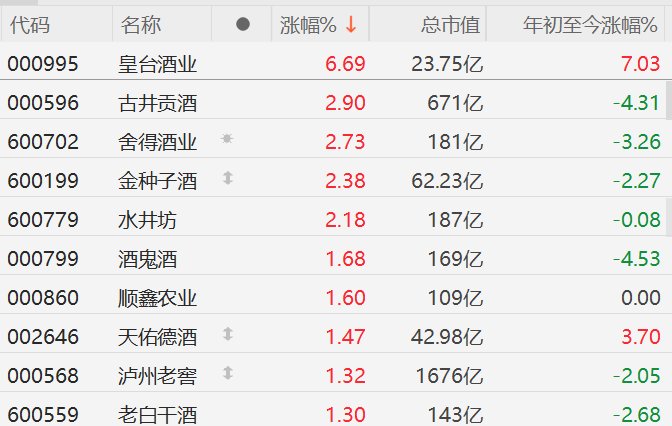
白酒股拉升,古井贡酒、舍得酒业涨超2%
Ge Long Hui A P P· 2026-01-28 06:04
Core Viewpoint - The A-share market has seen a rise in liquor stocks, with notable increases in several companies, indicating positive market sentiment in the sector [1]. Group 1: Stock Performance - Huangtai Liquor Industry (000995) increased by 6.69%, with a total market capitalization of 2.375 billion [2] - Gujing Gongjiu (000596) rose by 2.90%, with a market cap of 67.1 billion, but has a year-to-date decline of 4.31% [2] - Shede Liquor (600702) saw a 2.73% increase, with a market cap of 18.1 billion and a year-to-date decline of 3.26% [2] - Jinzongzi Liquor (600199) increased by 2.38%, with a market cap of 6.223 billion and a year-to-date decline of 2.27% [2] - Shuijingfang (600779) rose by 2.18%, with a market cap of 18.7 billion and a year-to-date change of -0.08% [2] - Jiugui Liquor (000799) increased by 1.68%, with a market cap of 16.9 billion and a year-to-date decline of 4.53% [2] - Shunxin Agriculture (000860) rose by 1.60%, with a market cap of 10.9 billion and no change year-to-date [2] - Tianyoude Liquor (002646) increased by 1.47%, with a market cap of 4.298 billion and a year-to-date increase of 3.70% [2] - Luzhou Laojiao (000568) saw a 1.32% increase, with a market cap of 167.6 billion and a year-to-date decline of 2.05% [2] - Laobaigan Liquor (600559) increased by 1.30%, with a market cap of 1.43 billion and a year-to-date decline of 2.68% [2] Group 2: Market Signals - The MACD golden cross signal has formed, indicating a positive trend for these stocks [1].

白酒板块1月27日跌0.56%,*ST岩石领跌,主力资金净流出3.86亿元
Zheng Xing Xing Ye Ri Bao· 2026-01-27 08:49
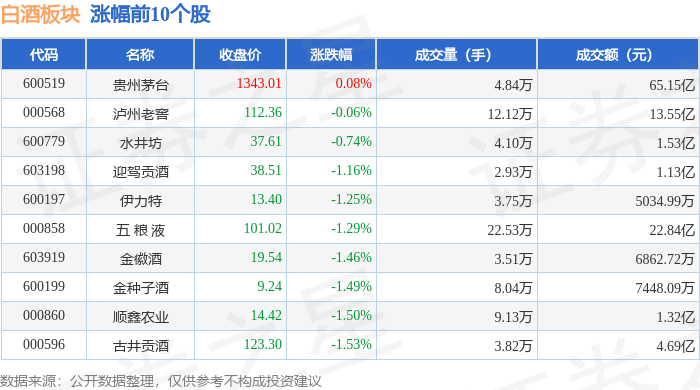
Core Viewpoint - The liquor sector experienced a decline of 0.56% on January 27, with *ST Rock leading the drop, while the Shanghai Composite Index rose by 0.18% and the Shenzhen Component Index increased by 0.09% [1]. Group 1: Liquor Sector Performance - The closing prices and performance of key liquor stocks showed mixed results, with Kweichow Moutai slightly up by 0.08% at 1343.01, while several others like Wuliangye and Luzhou Laojiao saw declines of 1.29% and 0.06% respectively [1]. - The total trading volume for Kweichow Moutai was 48,400 hands, with a transaction value of 6.515 billion yuan, while Wuliangye had a trading volume of 225,300 hands and a transaction value of 2.284 billion yuan [1]. Group 2: Capital Flow Analysis - The liquor sector saw a net outflow of 386 million yuan from institutional investors and 289 million yuan from retail investors, while retail investors had a net inflow of 675 million yuan [2]. - Specific stocks like Kweichow Moutai experienced a net inflow of 39.8 million yuan from institutional investors, while *ST Rock had a net outflow of 68,400 yuan [3]. Group 3: ETF Performance - The Food and Beverage ETF (product code: 515170) tracked the sub-index of the food and beverage industry, showing a decline of 2.01% over the past five days, with a price-to-earnings ratio of 19.31 times [5]. - The Consumer ETF (product code: 510630) tracked the main consumer industry index, with a decline of 1.52% over the past five days and a price-to-earnings ratio of 20.22 times [6].