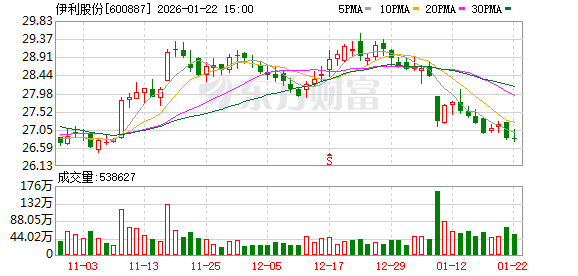
YILI(600887)

Search documents
中国消费行业:2026 年 GCC 会议要点 -估值仍具吸引力,消费复苏迹象显现-China Consumer Sector_ 2026 GCC takeaways_ Sector valuation remains attractive with signs of consumption recovery
2026-01-26 02:50
Summary of Key Points from the Conference Call Industry Overview - **Sector**: China Consumer Sector - **Key Insights**: The sector shows signs of consumption recovery despite a near-term property market downturn. Valuation remains attractive, approximately 1 standard deviation below 10-year averages, indicating that a consumption recovery is not yet priced in [2][21]. Consumer Staples - **Baijiu**: Anticipated demand support for mid-end baijiu due to easing alcohol bans and private consumption growth. Companies are expected to accelerate channel transformations for sustainable EPS growth [3][8]. - **Beer**: Premiumization continues through product diversification and in-home channel expansion, despite on-trade softness. CR Beer expects low-single-digit volume growth in 2025, with Heineken volumes projected to grow by 20% YoY [3][8]. - **Dairy**: Liquid milk sales are expected to recover modestly in 2026, driven by marketing and innovation, despite a weak 2025. Fresh milk shows resilience with double-digit growth [3][8]. - **Freshly-Made Beverages (FMB)**: Guming is expected to maintain steady SSSG in 2026 through category expansion and dine-in growth, despite the phase-out of delivery subsidies [3][8][19]. - **Condiments**: Sequentially improving demand is expected, with Haitian focusing on multi-product categories and Jonjee anticipating a cleaner 2026 after a weak 4Q25 [3][8]. Consumer Discretionary - **Home Appliances**: Companies like Midea and Haier expect higher overseas growth compared to domestic markets in 2026. Strategies include price hikes and operational efficiencies [4][10]. - **Jewelry**: Brands with unique designs may consolidate post-VAT reform. Laopu is expected to achieve strong sales growth due to increased focus on value-added services [4][10]. - **Restaurants**: Intense competition leads to divergent strategies, with some companies lowering prices while others upgrade offerings. DPC Dash is on track for expansion despite market uncertainties [4][10]. Stock Implications - **Most Preferred Stocks**: CR Beer, Guming, MIXUE, China Foods, YUM China, among others, are highlighted as preferred investments due to their growth potential [5]. - **Least Preferred Stocks**: Companies like Swellfun, Nongfu, and Gree are noted as less favorable due to various challenges [5]. Key Risks - Risks include demand recovery uncertainties, cost inflation or deflation, and changes in the competitive landscape. These factors could significantly impact the consumer sector's performance [21]. Additional Insights - **Pet Food**: The industry is shifting towards online sales, with over 85% of sales occurring digitally. Competition is intensifying, pushing brands towards innovation and product differentiation [13]. - **Snack Sector**: Rapid category diversification and channel restructuring are creating growth opportunities, particularly through snack discounters [9][12]. This summary encapsulates the essential insights and projections from the conference call, providing a comprehensive overview of the current state and future outlook of the China consumer sector.





食品饮料行业周报:茅台批价坚挺旺季氛围渐起,鸣鸣很忙上市催化零食板块-20260125
Shenwan Hongyuan Securities· 2026-01-25 13:08
Investment Rating - The report maintains a positive outlook on the liquor sector, particularly on premium brands like Guizhou Moutai, Luzhou Laojiao, and Shanxi Fenjiu, while also highlighting the potential of other brands such as Wuliangye and Jinjing Wine [2][7]. Core Insights - The liquor market is undergoing a restructuring phase, with expectations of a double-digit decline in sales year-on-year for Q1 2026, but a potential stabilization in Q2 and a turning point in Q3 [2][7]. - The report anticipates a recovery in the liquor sector by the end of 2026 and into 2027, driven by improved fundamentals and valuation [2][7]. - The consumer goods sector is showing structural improvements, with competition shifting from price to quality, leading to a gradual balance in supply and demand [2][9]. Summary by Sections 1. Weekly Insights on Food and Beverage - The food and beverage sector saw a decline of 1.41% last week, with liquor down 2.80%, underperforming the Shanghai Composite Index by 2.25 percentage points [6]. - Notable stock performances included a 19.59% increase for Haoxiangni and a 14.32% rise for Wancheng Group [6]. 2. Market Performance of Food and Beverage Sectors - The report highlights the price stability of Moutai, with a current price of 1560 RMB per bottle, up 20 RMB from the previous week, indicating a positive trend in pricing [8][27]. - The report notes that Moutai's pricing has found a bottom, reducing downward risks significantly, and anticipates a potential increase in sales volume as the Spring Festival approaches [8]. 3. Industry Events and Updates - The report mentions the upcoming IPO of Mingming Hen Mang, a leading snack retail chain, which is expected to catalyze the snack sector [10]. - The report emphasizes the importance of supply chain management and digitalization in enhancing competitive advantages for companies like Mingming Hen Mang [10]. 4. Valuation Table - The food and beverage sector's dynamic PE is currently at 19.27x, with a premium rate of 10%, while the liquor sector's dynamic PE stands at 17.50x, indicating a zero premium [27].






湖北和广东调研反馈、周观点:啤酒推新蓄力,烘焙旺季稳健-20260125
GOLDEN SUN SECURITIES· 2026-01-25 11:22
Investment Rating - The report maintains an "Accumulate" rating for the food and beverage industry [5] Core Insights - The upcoming Spring Festival is expected to boost sales in the liquor sector, with Moutai leading the industry towards an unexpected improvement. Short-term focus should be on the demand for the Spring Festival, while medium-term investments should target leading brands across various price segments [1] - In the beer segment, new product launches are being prepared, with a focus on high-growth channels and consumer trends towards personalized and diversified consumption [2] - The baking sector is showing stable performance, with companies like Lihigh Foods preparing for the sales peak and benefiting from favorable policies regarding cream products [3] Summary by Relevant Sections Liquor Sector - The Spring Festival is driving demand, with Moutai expected to lead the market. Key short-term stocks include Guizhou Moutai, Guo Jiu Gong Jiu, and others, while medium-term focus should be on Wuliangye and Shanxi Fenjiu [1] Beer Sector - Current beer sales are in a low season, but new product launches and high growth in instant retail channels are promising. Companies like Chongqing Beer are launching new 1L cans to meet consumer preferences [2] Food Sector - Lihigh Foods is preparing for the sales peak with a focus on quality over quantity, while Anqi Yeast is benefiting from declining sugarcane prices, enhancing profit margins [3] - Yizhi Konjac is experiencing rapid demand growth, with a stable supply chain and product innovation driving its market position [4]



行业周报:春节旺季备货催化,大众品迎来布局窗口-20260125
KAIYUAN SECURITIES· 2026-01-25 08:42
Investment Rating - The industry investment rating is "Positive" (maintained) [1] Core Viewpoints - The food and beverage sector is currently at a low position in terms of fundamentals and valuations, presenting significant investment opportunities as the peak season approaches [4][12] - The food and beverage index experienced a decline of 1.4% from January 19 to January 23, ranking 25th among 28 sectors, underperforming the CSI 300 by approximately 0.8 percentage points [12][13] - The Consumer Price Index (CPI) rose by 0.8% year-on-year in December 2025, indicating a mild recovery trend, and has returned to relatively high levels compared to recent years [4][12] - The upcoming Spring Festival is expected to catalyze performance in the sector, with strong demand for consumer goods, particularly in the snack segment, which continues to show upward momentum [4][12] Summary by Sections Weekly Insights - The food and beverage sector is positioned for a recovery as it approaches the peak season, with a notable increase in demand expected during the Spring Festival [4][12] - The sector's current valuation aligns with policy support aimed at boosting consumption, providing a safety margin for investments [4][12] Market Performance - The food and beverage index's performance was weaker than the broader market, with specific sub-sectors like snacks (+6.1%), processed foods (+4.9%), and baked goods (+4.3%) showing relative strength [12][13] Upstream Data - Recent data indicates a decline in some upstream raw material prices, with whole milk powder prices down 13.5% year-on-year as of January 20, 2026 [19][21] - The price of fresh milk was reported at 3.03 CNY per kilogram, reflecting a year-on-year decrease of 2.6% [19][21] Alcohol Industry Data - In December 2025, the production of liquor (65-degree equivalent) decreased by 12.1% year-on-year, with a total production of 354.9 million liters for the year [42][43] Recommended Investment Targets - Key investment opportunities identified include raw milk/dairy products, the snack sector, and the restaurant supply chain, with specific companies highlighted for their growth potential [4][5][12]

饮料乳品板块1月23日跌0.18%,妙可蓝多领跌,主力资金净流出1.41亿元
Zheng Xing Xing Ye Ri Bao· 2026-01-23 09:04
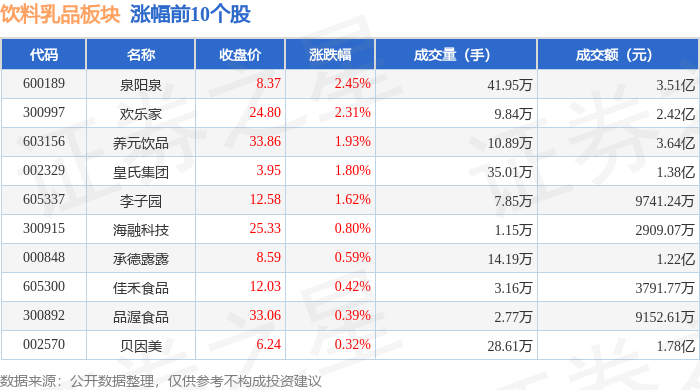
Market Overview - The beverage and dairy sector experienced a decline of 0.18% on January 23, with Miaokelan leading the drop [1] - The Shanghai Composite Index closed at 4136.16, up 0.33%, while the Shenzhen Component Index closed at 14439.66, up 0.79% [1] Stock Performance - Notable gainers in the beverage and dairy sector included: - Quanyangquan (code: 681009) with a closing price of 8.37, up 2.45% and a trading volume of 419,500 shares, totaling 351 million yuan [1] - Huanlejia (code: 300997) closed at 24.80, up 2.31% with a trading volume of 98,400 shares, totaling 242 million yuan [1] - Qiaoyuan Beverage (code: 603156) closed at 33.86, up 1.93% with a trading volume of 108,900 shares, totaling 364 million yuan [1] - Conversely, the following stocks saw declines: - Miaokelan (code: 600882) closed at 23.75, down 3.34% with a trading volume of 153,200 shares, totaling 368 million yuan [2] - Weiweijia (code: 600300) closed at 3.71, down 2.11% with a trading volume of 665,200 shares, totaling 248 million yuan [2] - New Dairy (code: 002946) closed at 19.19, down 1.34% with a trading volume of 45,200 shares, totaling 86.94 million yuan [2] Capital Flow - The beverage and dairy sector saw a net outflow of 141 million yuan from institutional investors, while retail investors contributed a net inflow of 229 million yuan [2] - Detailed capital flow for selected stocks includes: - Yili Group (code: 600887) with a net inflow of 1.10 billion yuan from institutional investors, but a net outflow of 162.69 million yuan from retail investors [3] - Huangshi Group (code: 002329) had a net inflow of 13.98 million yuan from institutional investors, with a net outflow of 5.66 million yuan from retail investors [3] - Liziyuan (code: 605337) saw a net inflow of 8.75 million yuan from institutional investors, with a net outflow of 1.70 million yuan from retail investors [3]





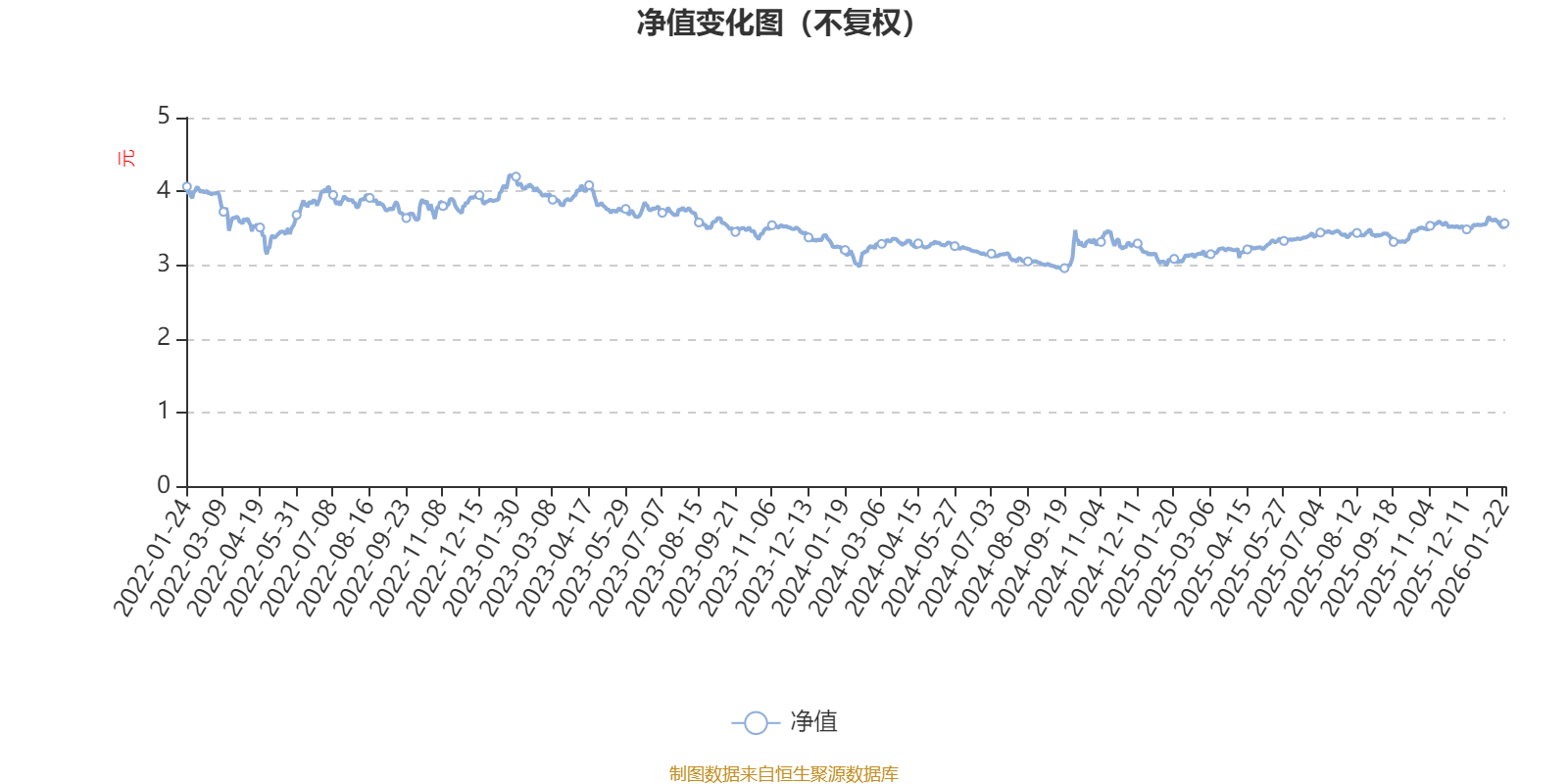
诺安新动力灵活配置混合A:2025年第四季度利润499.71万元 净值增长率7.26%
Sou Hu Cai Jing· 2026-01-23 08:23
Core Viewpoint - The AI Fund Nuon New Power Flexible Allocation Mixed A (320018) reported a profit of 4.9971 million yuan for Q4 2025, with a weighted average profit per fund share of 0.2548 yuan. The fund's net value growth rate for the reporting period was 7.26%, and the fund size reached 65.8123 million yuan by the end of Q4 2025 [3][14]. Fund Performance - As of January 22, the unit net value of the fund was 3.565 yuan. The fund manager, Li Xiaojie, has managed four funds over the past year, all of which have yielded positive returns. The highest growth rate among these funds was 48.16% for Nuon Low Carbon Economy Stock A, while the lowest was 5.05% for Nuon Huili Mixed A [3]. - The fund's net value growth rates over various periods are as follows: 2.18% over the last three months (ranking 1015/1286), 2.83% over the last six months (ranking 1146/1286), 16.89% over the last year (ranking 980/1286), and -15.38% over the last three years (ranking 1190/1286) [3]. Investment Strategy - The fund's Q4 holdings were primarily in dividend-related assets such as banks, oil and petrochemicals, and non-bank financials. The fund reduced its allocation in the banking sector while increasing its positions in non-bank financials and oil and petrochemicals [3]. Risk Metrics - The fund's Sharpe ratio over the last three years was -0.0472, ranking 1192/1275 among comparable funds [8]. - The maximum drawdown over the last three years was 30.05%, with the largest single-quarter drawdown occurring in Q1 2022 at 17.43% [10]. Portfolio Composition - As of December 31, the fund's average stock position over the last three years was 74.15%, compared to the industry average of 72.57%. The fund reached a peak stock position of 79.28% at the end of 2021 and a low of 51.69% by the end of Q3 2022 [13]. - The top ten holdings of the fund as of Q4 2025 included China Ping An, China Pacific Insurance, China Petroleum, Oppein Home, China Shenhua, New China Life Insurance, Sinopec, Shaanxi Coal and Chemical Industry, Yili Group, and Jiangsu Bank [17].




华西证券:汇率升值利好国内资产 重视食品饮料板块三重共振机会
智通财经网· 2026-01-23 03:56
Core Viewpoint - The recent appreciation of the RMB is expected to benefit the food and beverage sector through reduced import costs, improved domestic demand, and increased foreign investment allocation [1][2]. Group 1: Recent Developments - The RMB has accelerated its appreciation, breaking the 7 mark offshore on December 25 and reaching 6.96 onshore by January 22, indicating enhanced economic momentum and improved export competitiveness [1]. - Historical analysis shows that during previous RMB appreciation cycles (May-November 2020 and November-December 2022), the food and beverage sector outperformed the CSI 300 index by 18% and 12%, respectively [2]. Group 2: Cost, Demand, and Valuation Dynamics - Cost: The appreciation of the RMB reduces the converted prices of imported raw materials, leading to lower manufacturing costs and improved profitability. Key raw materials affected include soybeans, palm oil, oats, barley, and tree nuts [2]. - Demand: The recovery of domestic demand is a fundamental support for the strong RMB, which will further lower companies' restocking costs, shifting the industry from passive destocking to active restocking, thus reinforcing demand resilience [2]. - Valuation: The liquidity remains ample during the RMB appreciation cycle, enhancing the inflow of foreign capital into A-shares, which is expected to bring liquidity premiums to the food and beverage sector, known for its high foreign ownership [2]. Group 3: Investment Recommendations - The report highlights three main lines of focus for investment: 1. Cost benefits, recommending companies such as Ximai Food, Lihigh Food, Miaokelando, Qiaqia Food, and H&H [3]. 2. Demand recovery, recommending companies like Anjijia Food, Qianwei Central Kitchen, Youran Dairy, Modern Farming, New Dairy, and Wancheng Group [3]. 3. Valuation recovery, recommending companies including Yili Group, Mengniu Dairy, Xianle Health, Weilong Delicious, and Yanjinpuzi [3].




伊利股份:公司近期与西藏刚坚集团有限公司深化多维度合作
Zheng Quan Ri Bao· 2026-01-22 14:10
Group 1 - The core viewpoint of the article highlights that Yili Group is enhancing its collaboration with Tibet Gangjian Group to develop sales channels in the Tibetan region and promote new specialty products, including nutritional meals for students [2] - This partnership aims to upgrade the distribution channels in the Tibetan plateau and improve the nutritional standards of local residents [2] - The initiative is expected to significantly increase the accessibility of high-quality dairy products in the region, ensuring safe and timely delivery to the Tibetan community through standardized and digitalized channels [2]
伊利股份:面对员工在职场不同发展阶段的多元需求,公司构建了覆盖全周期的人才培养体系
Zheng Quan Ri Bao Zhi Sheng· 2026-01-22 14:07
Core Viewpoint - Yili Group is actively developing a comprehensive talent cultivation system to support employees' career advancement in response to diverse needs at different stages of their professional development [1] Group 1: Talent Development Initiatives - The company has established a full-cycle talent cultivation system to provide solid support for career progression [1] - Yili has set up a "Digital Application Capability Development Center" and launched the "Yiqi Learning" digital learning platform to adapt to the digital era [1] - Innovative projects such as the "AI Super Capability Exploration Plan" have been introduced to enhance employees' skills [1] Group 2: Employee Empowerment - The company emphasizes practical training through "human-machine symbiosis" exercises to help employees master core competencies in data-driven thinking and decision-making [1] - Yili aims to empower employees with precise capability enhancement, ensuring they possess the "super capabilities" needed to navigate through transformative changes [1] Group 3: Long-term Talent Strategy - The company adheres to a long-term talent philosophy, implementing a tiered and categorized training mechanism tailored to the growth paths of employees at different stages [1]
伊利股份:公司积极布局数智化赛道
Zheng Quan Ri Bao· 2026-01-22 14:06
证券日报网讯 1月22日,伊利股份在互动平台回答投资者提问时表示,公司作为最早加速数智化升级的 中国乳企,积极布局数智化赛道。公司打造智能工厂,不仅实现了线上与线下、实体与虚拟、自动化与 智能化交互的无缝融合,还保证了产品全过程可视化、可数据化。同时,在下游公司推动"全域、全场 景、全生命周期"的消费者数智化运营,开发了与1.5亿消费者在线协同共创新品的智能洞察系统。2025 年伊利携手多家海内外企业、科研机构共同启动"全球智链生态圈",将聚焦AI技术在乳业生产、质量管 控、供应链管理等方面的应用研发,推动技术创新与突破。 (文章来源:证券日报) ...