Caida Securities(600906)

Search documents
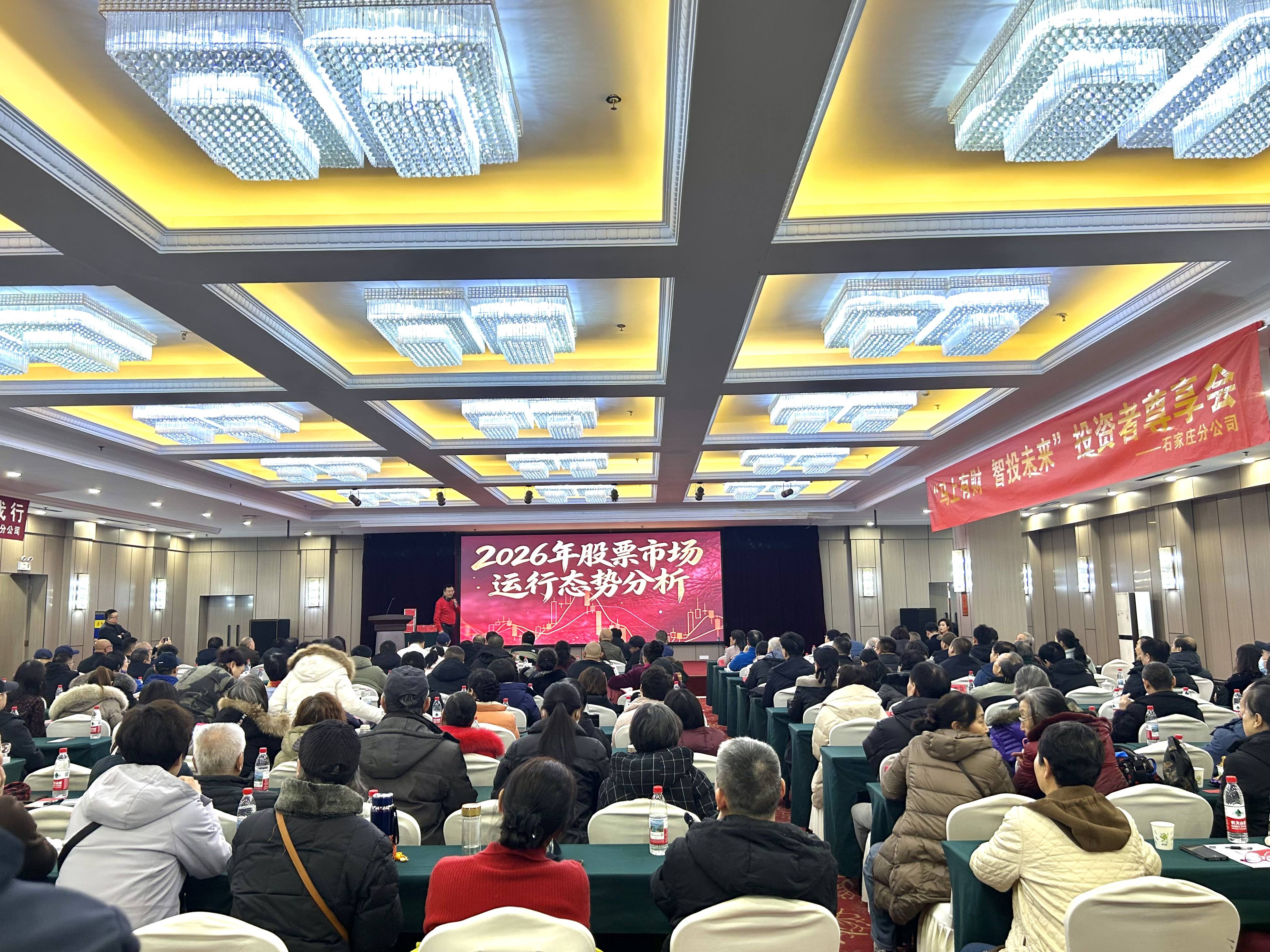
聚焦投资需求 财达证券石家庄分公司积极为客户搭建学习交流平台
Sou Hu Cai Jing· 2026-01-19 09:16
Group 1 - The core event was the annual client appreciation meeting held by Caida Securities Shijiazhuang branch, attended by over 200 clients and industry experts to discuss investment strategies [1][3] - The meeting featured presentations from index researchers who provided insights into macroeconomic conditions and policy highlights, aiming to help clients grasp the "core investment password" [2][3] - A well-known private fund manager shared practical investment strategies, offering valuable insights that helped clients refine their investment approaches based on a clear understanding of macro trends [2][3] Group 2 - The management of Caida Securities Shijiazhuang branch emphasized a future focus on client needs, aiming to enhance service precision and professionalism to support clients in wealth growth [4]


证券类App,最新月活排名出炉
中国基金报· 2026-01-19 08:13
Core Insights - The monthly active users (MAU) of securities apps reached 175 million in December 2025, marking a 1.75% month-on-month increase and a 2.26% year-on-year increase, achieving a new monthly high for the year [4][3] - Throughout 2025, the MAU of securities apps experienced a recovery after a dip in the middle of the year, with a significant rebound in November leading to a peak at year-end [4][2] - The competition for traffic between third-party platforms and brokerage self-operated apps intensified, with brokerages accelerating the integration of AI technology in advisory and trading scenarios to enhance service models and user experience [4][12] Monthly Active Users Overview - In December 2025, the MAU for securities apps was 175.32 million, with notable monthly changes: November had 172.30 million (up 2.06% month-on-month) and October had 168.82 million (down 3.38% month-on-month) [5][4] - The MAU trend for 2025 showed a starting point of 161.84 million in January, peaking in December after a recovery phase post-May [4][5] Leading Apps and Market Dynamics - The top three securities apps by MAU in December were Tonghuashun (36.70 million), Dongfang Caifu (18.22 million), and Dazhihui (12.97 million) [6][5] - Among brokerage self-operated apps, Huatai's Zhangle Wealth reached over 12 million MAU, followed by Guotai Haitong Junhong with 10.40 million [6][5] - The number of brokerage apps with an average monthly active user count exceeding 6 million increased to 14 in 2025, indicating a growing concentration in the market [8][7] AI Technology Integration - The application of AI technology in the securities industry has accelerated, with multiple brokerages launching intelligent tools across key areas such as intelligent research, trading, and advisory services [12][11] - Notable advancements include the upgrade of trading robots by Galaxy Securities and the introduction of AI advisory platforms by various brokerages, enhancing service efficiency and user experience [13][12] - Despite the current limitations of AI tools in guaranteeing stable investment returns, their functionality is expanding, addressing various investment challenges and improving investors' capabilities in data analysis and strategy formulation [12][13]






国资撤离、高管密集变动,财达证券发生了什么?
Shen Zhen Shang Bao· 2026-01-16 00:36
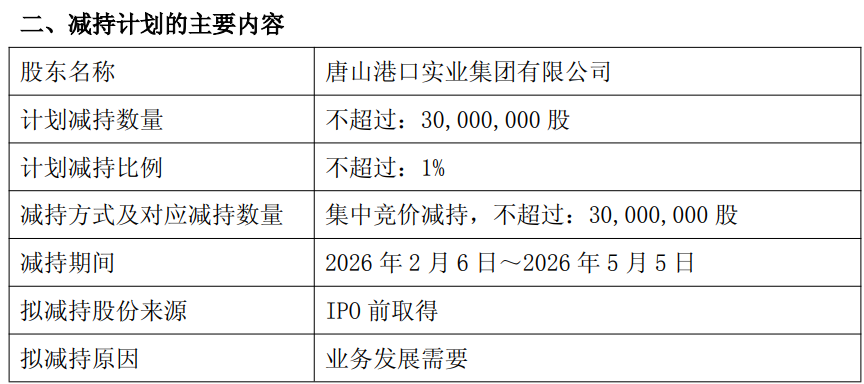
Core Viewpoint - Tangshan Port Industrial Group plans to reduce its stake in Caida Securities by up to 30 million shares, representing 1% of the total share capital, due to business development needs [1][2]. Shareholder Reduction Plan - Shareholder Name: Tangshan Port Industrial Group [2] - Planned Reduction Quantity: Up to 30,000,000 shares [2] - Planned Reduction Ratio: Up to 1% [2] - Reduction Method: Centralized bidding [2] - Reduction Period: February 6, 2026, to May 5, 2026 [2] - Source of Shares for Reduction: Acquired before IPO [2] - Reason for Reduction: Business development needs [2] - Estimated Cash from Reduction: Approximately 205 million yuan based on a closing price of 6.84 yuan per share [2]. Shareholding Structure - Tangshan Port holds 80 million shares, representing 2.47% of Caida Securities, making it the fourth-largest shareholder [2][3]. - Combined with Hebei Port Group, which holds 340 million shares (10.48%), they collectively own 420 million shares, accounting for 12.94% of the total share capital [3]. Previous Shareholder Actions - This reduction follows a previous significant reduction by the second-largest shareholder, Hebei Guokong Operations, which sold 97.32 million shares for 667 million yuan between July and September 2025 [3]. Financial Performance - For the first three quarters of 2025, Caida Securities reported revenue of 2.072 billion yuan, a year-on-year increase of 21.52%, and a net profit of 664 million yuan, a significant increase of 79.5% [5]. - Despite the growth in performance, the stock price has fluctuated without significant breakthroughs since its listing in May 2021, with a peak of 18.48 yuan and a low of 5.39 yuan by 2024 [5]. Corporate Governance Changes - On January 9, 2026, Caida Securities announced a change in management, appointing Hu Hongsong as the new general manager while Zhang Ming remains as the party secretary and chairman [4].
又见券商股减持 财达证券(600906.SH)股东拟套现3000万股 近期减持有增多之势
智通财经网· 2026-01-15 03:24
Core Viewpoint - The recent announcement by Caida Securities regarding a significant shareholder's plan to reduce their stake highlights ongoing trends in shareholder behavior within the brokerage sector, reflecting both market activity and strategic business needs [1][5][12]. Shareholder Reduction Plans - On January 14, Caida Securities announced that shareholder Tangshan Port plans to reduce its holdings by up to 30 million shares, representing 1% of the company's total share capital, between February 6 and May 5 [1][6]. - This follows a previous reduction by the second-largest shareholder, Hebei Guokong Operations, which sold 97.32 million shares last September, alongside a reduction of 4.67 million shares by Qinhuangdao Caixin Assets, totaling over 102 million shares [5][8]. Market Context - The active market environment has led to increased shareholder reductions among brokerage firms, with analysts suggesting that despite short-term impacts on stock prices, the long-term investment value of brokerage stocks remains strong [5][12]. - As of January 14, Caida Securities' stock price was 7.01 yuan, with a price-to-book ratio of 1.85, indicating that the market capitalization of the shares to be sold by Tangshan Port is approximately 210 million yuan [7]. Shareholding Structure - Tangshan Port currently holds 80 million shares, accounting for 2.47% of Caida Securities, with the planned reduction representing 37.5% of its total holdings. Together with Hebei Port, they control 12.94% of the company [7][9]. - The controlling shareholder of Caida Securities is Tangshan Steel Group, holding 32.62%, while the actual controller is the Hebei State-owned Assets Supervision and Administration Commission, with a 55.52% stake [9]. Broader Industry Trends - The trend of shareholder reductions is not isolated to Caida Securities; other brokerage firms like Guosheng Securities and Dongfang Fortune have also reported similar shareholder activities, indicating a broader pattern within the industry [10][11]. - Analysts remain optimistic about the brokerage sector's potential, citing the current market conditions and the expected performance improvements due to policy support and market recovery [12][13].
财达证券股份有限公司关于持股5%以上股东的一致行动人减持股份计划公告
Shang Hai Zheng Quan Bao· 2026-01-14 18:53
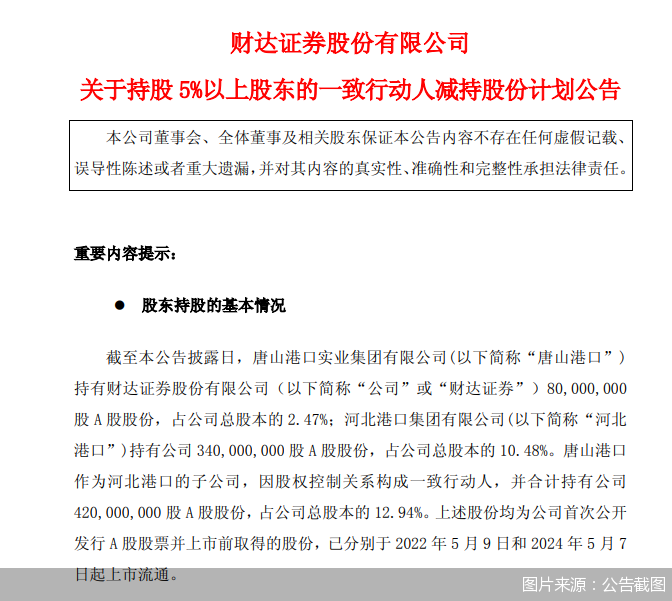
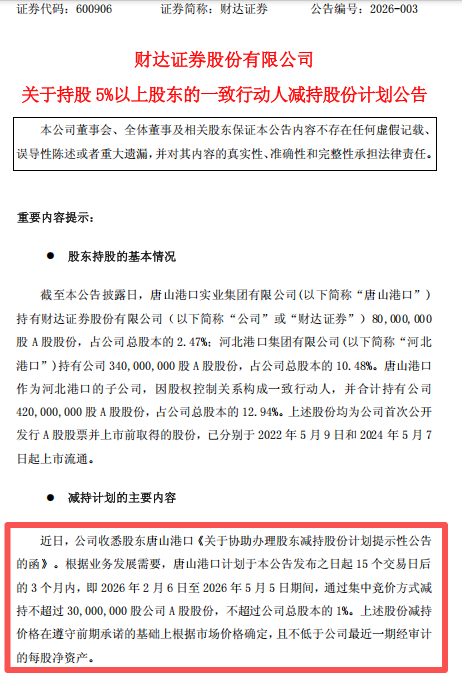
Group 1 - The core point of the announcement is that Tangshan Port Industrial Group Co., Ltd. plans to reduce its shareholding in Caida Securities by up to 30,000,000 shares, which is 1% of the total share capital, within a specified period [3][10] - As of the announcement date, Tangshan Port holds 80,000,000 shares (2.47% of total shares) and Hebei Port Group holds 340,000,000 shares (10.48% of total shares), making their combined holding 420,000,000 shares (12.94% of total shares) [2][3] - The reduction will occur through centralized bidding and will be priced based on market conditions, not lower than the latest audited net asset value per share [3][4] Group 2 - The reduction plan is set to take place from February 6, 2026, to May 5, 2026, starting 15 trading days after the announcement [3][4] - The announcement confirms that the reduction plan aligns with previous commitments made by the shareholders regarding shareholding ratios and reduction methods [5][9] - The company will continue to monitor the implementation of the reduction plan and fulfill its information disclosure obligations as required [10]
财达证券:关于持股5%以上股东的一致行动人减持股份计划公告
Zheng Quan Ri Bao· 2026-01-14 13:44
Group 1 - The core point of the article is that Tangshan Port Industrial Group Co., Ltd. plans to reduce its holdings in the company by up to 30 million A-shares, which represents a maximum of 1% of the total share capital [2] - As of the announcement date, Tangshan Port holds 80 million A-shares, accounting for 2.47% of the total share capital, while Hebei Port Group holds 340 million A-shares, accounting for 10.48% [2] - Together, Tangshan Port and Hebei Port Group hold a total of 420 million A-shares, which is 12.94% of the company's total share capital [2] Group 2 - The planned reduction of shares by Tangshan Port is set to occur within a three-month period from February 6, 2026, to May 5, 2026, starting 15 trading days after the announcement [2] - The reduction will be executed through a centralized bidding method [2]
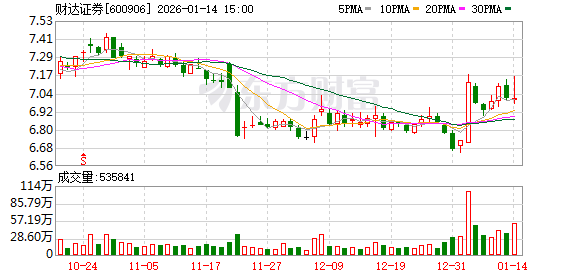
财达证券:唐山港口实业集团拟减持不超1%股份
Zhi Tong Cai Jing· 2026-01-14 12:18
Group 1 - The company, 财达证券, announced that 唐山港口实业集团有限公司 plans to reduce its holdings by up to 30 million shares of the company's A-shares, which represents no more than 1% of the total share capital [1] - The reduction will take place within a three-month period from February 6, 2026, to May 5, 2026, starting 15 trading days after the announcement [1] - The method of reduction will be through centralized bidding [1]

财达证券(600906.SH):唐山港口实业集团拟减持不超1%股份
智通财经网· 2026-01-14 12:12
Core Viewpoint - The announcement indicates that Tangshan Port Industry Group Co., Ltd. plans to reduce its holdings in the company by up to 30 million A-shares, representing no more than 1% of the total share capital, within a specified period from February 6, 2026, to May 5, 2026 [1] Summary by Category - **Company Actions** - Tangshan Port Industry Group Co., Ltd. intends to sell up to 30 million shares of the company through a centralized bidding method [1] - The reduction in shareholding is planned to occur within a three-month window starting from February 6, 2026 [1] - **Shareholding Impact** - The planned reduction will not exceed 1% of the company's total share capital [1]
财达证券(600906.SH):唐山港口拟减持不超过3000万股公司A股股份
Ge Long Hui· 2026-01-14 11:47
Group 1 - The core point of the article is that Tianjin Port plans to reduce its shareholding in Caida Securities by selling up to 30 million A-shares, which represents no more than 1% of the company's total share capital [1] - The share reduction will take place within a three-month period from February 6, 2026, to May 5, 2026, starting 15 trading days after the announcement [1] - The selling price of the shares will be determined based on market conditions, adhering to previous commitments, and will not be lower than the latest audited net asset value per share of the company [1]
财达证券:唐山港口计划减持不超过3000万股公司A股股份
Bei Jing Shang Bao· 2026-01-14 11:41
Core Viewpoint - The announcement from Caida Securities regarding the share reduction plan by its significant shareholder, Tangshan Port Industrial Group, indicates a strategic move to adjust holdings based on business development needs [4] Group 1: Shareholder Actions - Tangshan Port plans to reduce its holdings by up to 30 million A-shares, which represents no more than 1% of the company's total share capital, within a three-month period from February 6, 2026, to May 5, 2026 [4] - As of the announcement date, Tangshan Port holds 80 million A-shares, accounting for 2.47% of the total share capital of Caida Securities [4] - Together with Hebei Port Group, which holds 340 million A-shares (10.48% of total share capital), Tangshan Port and Hebei Port Group collectively own 420 million A-shares, representing 12.94% of the total share capital [4] Group 2: Shareholding Structure - The shares held by Tangshan Port and Hebei Port Group were acquired prior to the company's initial public offering and have been tradable since May 9, 2022, and May 7, 2024, respectively [4]