CHINA MOBILE(600941)

Search documents
新浪财经资讯AI速递:昨夜今晨财经热点一览 丨2026年2月2日
Sou Hu Cai Jing· 2026-02-01 22:52
Group 1: Gold and Silver Market Dynamics - Recent fluctuations in gold and silver prices have led to significant market reactions, with gold experiencing its largest single-day drop since 1983 and silver prices plummeting by as much as 36% in a single day [1] - The Shenzhen Shui Bei market has shown a split response, with some investors engaging in panic selling while others are seizing the opportunity to buy at lower prices, leading to a surge in gold purchases [1][2] - Many banks have issued risk warnings, advising investors to approach the market with caution and avoid impulsive trading behaviors [1] Group 2: Real Estate Sector Outlook - The A-share and Hong Kong real estate sectors have shown strong performance, with several brokerage firms indicating that despite ongoing profit pressures, positive signals are emerging in the market [2] - Factors contributing to this stabilization include a slight decrease in the number of second-hand homes listed in major cities, supportive policy measures, and historically low valuations in the sector [2] - Institutions like CITIC Securities and Shenwan Hongyuan suggest that the most challenging period for the real estate sector may be over, recommending a focus on high-quality companies with core resources and operational capabilities [2] Group 3: Telecommunications Tax Changes - Major Chinese telecom operators, including China Mobile, China Unicom, and China Telecom, announced a tax adjustment that will increase the VAT rate on mobile data, SMS, and broadband services from 6% to 9% starting January 1, 2026 [3] - This change is expected to have a direct impact on the revenue and profit margins of these telecom companies [3] Group 4: Federal Reserve Leadership Changes - The nomination of Kevin Warsh as the new Federal Reserve Chair by Trump has caused significant market turbulence and a reevaluation of the Fed's role [4] - Warsh's reformist stance is anticipated to lead to aggressive interest rate cuts and a reduction of the Fed's balance sheet, aiming to diminish the Fed's power and size [4] - However, his radical approach may heighten tensions within the Fed and the broader market, facing substantial resistance and uncertainty [4] Group 5: Shenzhen Economic Performance - Shenzhen's GDP reached 3.87 trillion yuan in 2025, marking a 5.5% year-on-year growth, the highest among the top five cities [5] - The city is recognized as a leader in industrial output and foreign trade, contributing 10% of the national total [5] - Shenzhen also excels in various key areas, including the total number of business entities, R&D investment intensity, international patent applications, and cross-border e-commerce scale [5] Group 6: Capital Market Regulation - Regulatory authorities have emphasized the need to consolidate the positive momentum in capital markets, focusing on risk prevention, enhanced regulation, and promoting high-quality development [6] - Plans to deepen reforms in the ChiNext board and implement measures to support new productive forces have been outlined [6] - The guidelines for strategic investors indicate a minimum holding ratio of 5%, encouraging long-term capital to engage more deeply in corporate governance [6] Group 7: Banking Sector Adjustments - Ningbo Bank has reduced its interest rate on demand deposits to 0%, with other banks also lowering rates on gold accounts due to increased market volatility [8] - This trend is part of a broader strategy to manage risks and lower funding costs, potentially paving the way for future reductions in loan interest rates [8] Group 8: Silver Market Auction - A silver building in Hunan, constructed with 2.5 tons of silver, is set to be auctioned at a valuation of only 6.88 yuan per gram, significantly below market prices, raising public interest in asset valuation methods [7] Group 9: Oracle's Financial Challenges - Oracle is facing significant financial pressure due to aggressive expansion in AI data centers, leading to considerations of layoffs affecting 20,000 to 30,000 employees and potential divestitures of its Cerner medical software division [10] - The company has seen its stock and bond prices under pressure as several banks have ceased lending to its data center projects, exacerbating its financing challenges [10]



喜娜AI速递:昨夜今晨财经热点要闻|2026年2月2日
Sou Hu Cai Jing· 2026-02-01 22:17
Group 1 - The market is experiencing volatility due to concerns over the nomination of Kevin Warsh as the next Federal Reserve Chairman, which has led to fears of changes in monetary policy [2] - The yield curve issue in U.S. Treasury bonds reflects a broader economic dilemma, and regardless of who leads the Federal Reserve, the current situation is unlikely to change [2] - The A-share market is showing weakness, while global asset performance is mixed, influenced by the Federal Reserve's personnel changes [2] Group 2 - The telecom operators in China, including China Mobile, China Telecom, and China Unicom, will see their value-added tax rate increase from 6% to 9%, impacting their revenue and profits starting January 1, 2026 [3] - Multiple brokerages are optimistic about the A-share market's spring performance, suggesting a focus on technology, consumption, and cyclical sectors such as semiconductors and AI applications [3] - Tencent is accelerating its AI strategy, transitioning to a "smart agent ecosystem," which may lead to a reevaluation of its AI business and partnerships [4] Group 3 - Gold prices have experienced significant fluctuations, with a recent drop of over 12% after briefly surpassing $4500 per ounce, driven by concerns over U.S. liquidity tightening [5] - Local governments in China have set economic growth targets for 2026, with many regions adjusting their CPI and investment growth targets, indicating potential trading opportunities related to policy implementation [5] - The Hong Kong stock market is expected to have upward potential in the medium to long term, with a focus on technology and non-bank financial sectors, as economic stability may attract more investment [5]


特朗普称希望与伊朗“能够达成协议”;深圳水贝“杰我睿”进展:有消费者收到兑付方案;国投白银LOF复牌;何小鹏回应机器人摔倒 | 每经早参
Mei Ri Jing Ji Xin Wen· 2026-02-01 21:47
Taxation and Regulatory Changes - The State Taxation Administration has announced an increase in the threshold for value-added tax (VAT) from 500 yuan to 1000 yuan per transaction starting this year, with specific exemptions for certain activities [5] - New regulations for export tax rebates have been introduced to streamline the process, leveraging big data and new technologies to enhance efficiency for taxpayers [5] Shipbuilding Industry - China's shipbuilding industry is set to maintain its global leadership for the 16th consecutive year, with projections indicating that by 2025, six Chinese companies will rank among the top ten in terms of shipbuilding completion, new orders, and orders on hand [5] Energy Consumption - Shanghai's electricity consumption is expected to exceed 200 billion kilowatt-hours for the first time in 2025, reaching 208.88 billion kilowatt-hours, marking a year-on-year growth of 5.28% [6] Automotive Industry - In January 2026, several major automotive brands reported year-on-year sales growth, with Hongmeng Zhixing achieving a 65.6% increase in deliveries, while other brands like Xiaomi and Xpeng saw declines compared to the previous month [18] Telecommunications Sector - China Mobile, China Unicom, and China Telecom have announced that from January 1, 2026, the VAT rate for certain telecommunications services will increase from 6% to 9%, which will impact their revenue and profit [19]





中国移动有限公司关于电信服务增值税税目适用范围调整的公告
Shang Hai Zheng Quan Bao· 2026-02-01 18:52
Core Viewpoint - The announcement from the Ministry of Finance and the State Taxation Administration of the People's Republic of China indicates a change in the tax classification for certain telecommunication services, which will affect the revenue and profit of China Mobile starting January 1, 2026 [1]. Group 1: Tax Changes - The tax category for services such as mobile data, SMS, multimedia messaging, and internet broadband access will change from value-added telecommunications services to basic telecommunications services [1]. - The applicable VAT rate for these services will increase from 6% to 9% [1]. Group 2: Company Response - China Mobile emphasizes its commitment to its core business and aims to strengthen and enhance its telecommunications, computing power, and intelligent services [1]. - The company plans to focus on foundational network improvements, promote comprehensive innovation, and enhance management efficiency to build a world-class technology service enterprise [1].
电信服务增值税税目适用范围调整 三大运营商聚焦算力等新兴业务布局
Shang Hai Zheng Quan Bao· 2026-02-01 18:15
Core Viewpoint - The three major telecom operators in China are adjusting their business strategies in response to changes in tax regulations, focusing on innovation and the development of computing power services to drive high-quality growth [1][2]. Group 1: Tax Regulation Impact - The Ministry of Finance and the State Taxation Administration announced that starting January 1, 2026, the tax category for certain telecom services will change from value-added telecom services to basic telecom services, with the VAT rate increasing from 6% to 9% [2]. Group 2: Strategic Focus and Performance - China Telecom is implementing a comprehensive strategy to enhance its cloud and AI services, aiming to create an integrated intelligent cloud service platform [3]. - China Mobile is focusing on strengthening its communication services and expanding its capabilities in computing and intelligent services [3]. - China Unicom is concentrating on core areas such as connectivity, computing, services, and security to build differentiated advantages [3]. - The three operators are transitioning to a strategic "gear-shifting" phase, placing artificial intelligence at the core of their strategies, with significant achievements already noted [3]. Group 3: Financial Performance - China Unicom reported a revenue of 293 billion yuan for the first three quarters of 2025, a year-on-year increase of 1.0%, with a net profit of 8.8 billion yuan, up 5.2% [4]. - China Telecom's IDC revenue reached 27.5 billion yuan, a 9.1% increase year-on-year, contributing to a total revenue of 394.3 billion yuan, up 0.6% [4]. - China Mobile achieved a revenue of 794.7 billion yuan, a 0.4% increase, with a net profit of 115.4 billion yuan, up 4.0% [4].
股市必读:中国移动(600941)1月30日主力资金净流入4465.49万元,占总成交额3.36%
Sou Hu Cai Jing· 2026-02-01 17:20
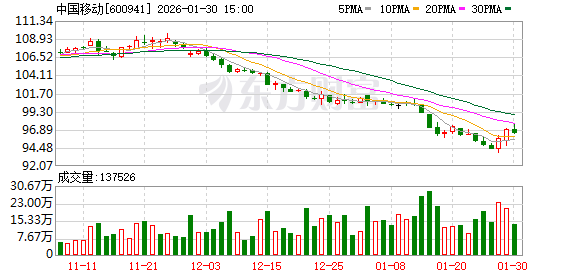
Group 1 - The stock price of China Mobile (600941) closed at 96.38 yuan on January 30, 2026, down by 0.62%, with a turnover rate of 1.52% and a trading volume of 137,500 shares, amounting to a total transaction value of 1.33 billion yuan [1] - On January 30, the net inflow of main funds was 44.65 million yuan, accounting for 3.36% of the total transaction value, while retail investors experienced a net outflow of 33.14 million yuan, representing 2.49% of the total transaction value [2][1] Group 2 - Starting from January 1, 2026, the VAT rate for mobile data services, SMS, MMS, and broadband access services will be adjusted from 6% to 9%, with the applicable tax category changing from value-added telecommunications services to basic telecommunications services [1][2] - This adjustment is expected to impact the company's revenue and profit, prompting the company to continue focusing on its core business, enhancing service capabilities, and promoting innovation and management optimization [1]
中国移动:电信服务增值税税率6%调至9%,影响公司收入利润
Mei Ri Jing Ji Xin Wen· 2026-02-01 14:01
Core Viewpoint - The adjustment of the VAT tax category for telecommunications services in China will impact the revenue and profit of China Mobile, as the VAT rate changes from 6% to 9% starting January 1, 2026 [1][4]. Group 1 - The Ministry of Finance and the State Taxation Administration of China announced that from January 1, 2026, the tax category for services such as mobile data, SMS, MMS, and internet broadband access will change from value-added telecommunications services to basic telecommunications services [1][4]. - The corresponding VAT rate for these services will increase from 6% to 9% [1][4]. - The company aims to strengthen its core telecommunications services, computing power services, and intelligent services while focusing on network enhancement and innovation [1][4].

中国三大电信运营商宣布调整电信服务增值税税率
Zhong Guo Xin Wen Wang· 2026-02-01 13:43
Group 1 - The core point of the news is the adjustment of the value-added tax (VAT) rate for telecommunications services in China, increasing from 6% to 9%, which will impact the revenue and profits of major telecom operators [2][3] - The adjustment is set to take effect on January 1, 2026, and applies to services such as mobile data, SMS, multimedia messaging, and internet broadband access [2] - The change is characterized as a "repositioning" of the tax category rather than an additional tax burden, aiming to clarify the public nature of basic communication services and enhance operational efficiency in the industry [4] Group 2 - The announcement from the Ministry of Finance and the State Taxation Administration specifies the applicable VAT rates and the scope of services, with the current VAT rates in China being 13% for the basic rate, and 9% and 6% for preferential rates [4] - The repositioning is expected to encourage telecom operators to focus more on core activities such as network construction and service assurance, reducing homogeneous marketing competition [4]
宽带、短信等增值税税率由6%提高至9%,会涨价吗?
Di Yi Cai Jing· 2026-02-01 13:42
Core Viewpoint - The adjustment of the VAT tax rate applicable to telecommunications services in China will impact the revenue and profits of the three major telecom operators, China Mobile, China Unicom, and China Telecom, starting from January 1, 2026 [1][2]. Group 1: Tax Rate Changes - The new regulation changes the applicable tax category for mobile data services, SMS, MMS, and internet broadband access from value-added telecommunications services (6% VAT) to basic telecommunications services (9% VAT) [1][2]. - The definition of basic telecommunications services has been expanded to include mobile data services, SMS, MMS, and internet broadband access, which were previously classified under value-added telecommunications services [2]. Group 2: Financial Implications - The increase in VAT from 6% to 9% for certain services may lead to higher costs for consumers, although the extent of this price increase will depend on consumer demand elasticity [2][3]. - The adjustment is expected to increase the tax burden on telecom companies, but given their state-owned status and market position, the impact is considered manageable [2]. - The adjustment in tax rates is anticipated to contribute to increased fiscal revenue, addressing the growing fiscal pressure faced by the government [3]. Group 3: Broader Economic Context - In 2025, the national general public budget revenue is projected to be 21,604.5 billion yuan, a decrease of 1.7% from the previous year, while government fund budget revenue is expected to decline by 7% [3].
宽带、短信等增值税税率由6%提高至9%,会涨价吗?
第一财经· 2026-02-01 13:32
Core Viewpoint - The adjustment of the VAT tax rate applicable to certain telecommunications services in China is expected to impact the revenue and profits of the three major telecom operators: China Mobile, China Unicom, and China Telecom. The VAT rate for these services will increase from 6% to 9% starting January 1, 2026, as per the new regulations issued by the Ministry of Finance and the State Administration of Taxation [3][4]. Summary by Sections VAT Rate Adjustment - The new regulations redefine the scope of basic telecommunications services to include mobile data services, SMS, MMS, and internet broadband access, which were previously classified under value-added telecommunications services with a lower VAT rate of 6% [4]. - The adjustment expands the range of services subject to the 9% VAT rate, thereby increasing the tax burden on the three major telecom operators [4]. Impact on Telecom Operators - The increase in VAT from 6% to 9% for certain services may lead to higher costs for the telecom operators, which could potentially be passed on to consumers depending on demand elasticity [5]. - Voice call services, which were already subject to a 9% VAT rate, will not see a price increase due to this adjustment [5]. Financial Context - The adjustment is part of broader fiscal measures aimed at addressing increasing fiscal revenue challenges, as indicated by the decline in public budget revenues and the increase in budget expenditures in recent years [6].