
BOB(601169)

Search documents
北京银行再遭罚没超4000万元,合规治理困境持续加深
Guan Cha Zhe Wang· 2025-11-29 03:14
Core Viewpoint - The People's Bank of China has imposed significant penalties on Beijing Bank for multiple violations, totaling over 40 million yuan, highlighting serious compliance issues within the bank's operations [1][2][3]. Summary by Category Regulatory Actions - Beijing Bank was penalized for nine violations, including breaches of account management, anti-money laundering regulations, and customer identity verification [2][3]. - The total fines included the confiscation of illegal gains amounting to 1,886.3 yuan and a fine of 25.2685 million yuan [1][2]. Compliance Issues - The violations indicate systemic weaknesses in key areas such as payment settlement, anti-money laundering, and credit information management [2][3]. - A total of 11 responsible personnel from various core departments were also fined, reflecting the widespread nature of the compliance failures [1][2]. Financial Performance - In Q1 2025, Beijing Bank reported a revenue of 17.127 billion yuan, a year-on-year decrease of 3.18%, marking the first quarterly negative growth in 12 years [3][5]. - The bank's total assets reached 4.75 trillion yuan, but growth has slowed, with a revenue decline of 1.08% in the first three quarters of 2025 [3][5]. Competitive Position - As of June 2025, Beijing Bank's asset scale of 4.75 trillion yuan was surpassed by Jiangsu Bank's 4.79 trillion yuan, indicating increasing competitive pressure [5]. - The bank's core Tier 1 capital adequacy ratio has been declining, from 9.54% in 2022 to 8.95% in 2024 [5].


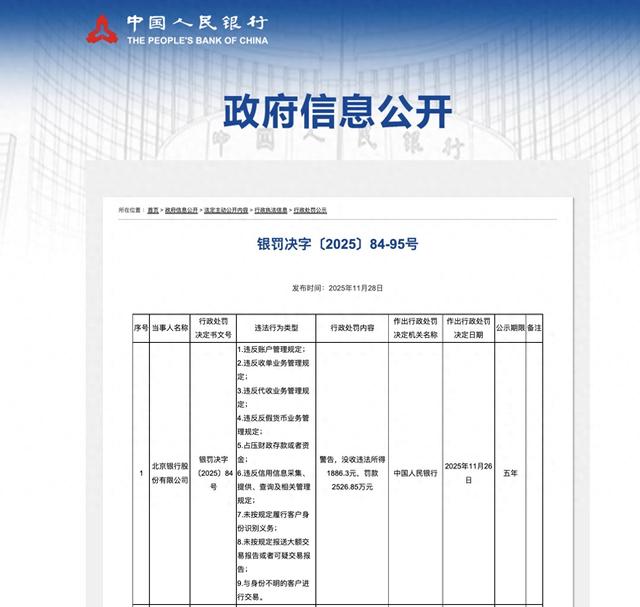
北京银行被罚款逾2500万元 另有11名工作人员遭罚
Mei Ri Jing Ji Xin Wen· 2025-11-28 14:02
Core Points - The People's Bank of China has imposed administrative penalties on Beijing Bank, including a warning, confiscation of illegal gains, and a fine of 25.2685 million yuan [2] - A total of 11 staff members from various departments at Beijing Bank have also been penalized for their involvement in the violations [2] Summary of Violations - Beijing Bank committed nine violations, including: - Violating account management regulations - Violating regulations on acquiring business - Violating regulations on collection business - Violating anti-counterfeit currency regulations - Misappropriating fiscal deposits or funds - Violating credit information collection, provision, inquiry, and related management regulations - Failing to fulfill customer identity verification obligations as required - Failing to report large transactions or suspicious transactions as required - Conducting transactions with unidentified customers [2] Penalties on Staff - Specific penalties for staff members include: - Li from the Operations Management Department received a warning and a fine of 85,000 yuan - Hou from the Retail Banking Department received a warning and a fine of 210,000 yuan - Wang from the Electronic Banking Department received a warning and a fine of 100,000 yuan - Zhao from the Operations Management Department received a warning and a fine of 195,000 yuan - Wang from the Credit Card Center's Risk Management Department received a fine of 40,000 yuan - Zhang from the Personal Credit Department received a fine of 80,000 yuan - Dou from the Legal Compliance Department received a fine of 55,000 yuan - He from the Corporate Banking Department received a fine of 10,000 yuan - Wang from the Credit Card Center received a fine of 35,000 yuan - Lu from the Transaction Banking Department received a fine of 35,000 yuan - Yang from the Personal Credit Department received a fine of 20,000 yuan [2]

北京银行因违反账户管理规定等被罚超2500万元
Shang Hai Zheng Quan Bao· 2025-11-28 13:29
来源:上海证券报·中国证券网 罚单显示,北京银行的主要违法违规行为是:违反账户管理规定,违反收单业务管理规定,违反代收业 务管理规定,违反反假货币业务管理规定,占压财政存款或者资金,违反信用信息采集、提供、查询及 相关管理规定,未按规定履行客户身份识别义务,未按规定报送大额交易报告或可疑交易报告,与身份 不明的客户进行交易。 上证报中国证券网讯(记者 黄坤)11月28日,央行行政处罚公示显示,北京银行被处以警告,没收违 法所得1886.3元,罚款2526.85万元。 ...
赋能新质生产力!北京银行携手中国投资协会创投委打造股债联动共创空间
新浪财经· 2025-11-28 11:29
Core Viewpoint - The event highlighted the critical role of venture capital in driving the "technology-industry-finance" cycle, with a strong emphasis on policy support for the venture capital industry to foster technological innovation and economic development [2][3]. Group 1: Venture Capital and Policy Support - The central government has repeatedly emphasized the importance of venture capital for technological innovation, proposing measures such as the establishment of a national venture capital guidance fund and the development of secondary market funds to provide institutional support for the industry [2]. - The venture capital sector is seen as a key force in consolidating the foundation of the real economy and promoting high-quality development, with expectations of significant policy, market, and industry support over the next five years [2]. Group 2: Banking and Venture Capital Integration - The integration of banking and venture capital is viewed as a vital pathway to stimulate innovation and drive industrial upgrades, with Beijing Bank focusing on providing comprehensive services tailored to the needs of technology innovation [3]. - Beijing Bank plans to establish a strategic alliance for equity and debt linkage, creating a new ecosystem for high-quality development in technology finance [3]. Group 3: Research and Collaboration Initiatives - The event featured the release of the "China Venture Capital Market Development Index Report," which includes various indices to track the dynamics and structural changes in the Chinese venture capital market [5]. - A strategic cooperation agreement was signed between Beijing Bank and the China Investment Association Venture Capital Committee to enhance collaboration and create integrated solutions for equity empowerment and debt support [5]. Group 4: Beijing Bank's Commitment to Technology Innovation - Beijing Bank has positioned itself as a leader in serving technology innovation, establishing a private equity business center and expanding its network to nearly 3,000 VC/PE institutions [6]. - The bank has provided over 1.4 trillion yuan in credit to 58,000 technology SMEs, supporting a significant portion of companies listed on various stock exchanges, demonstrating its commitment to fostering the growth of specialized and innovative enterprises [6].

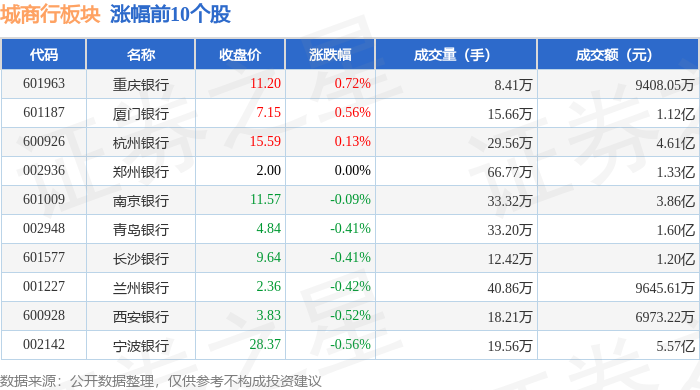
城商行板块11月28日跌0.62%,上海银行领跌,主力资金净流出3.79亿元
Zheng Xing Xing Ye Ri Bao· 2025-11-28 09:05
Core Viewpoint - The city commercial bank sector experienced a decline of 0.62% on November 28, with Shanghai Bank leading the drop, while the overall stock market showed slight gains [1][2]. Market Performance - The Shanghai Composite Index closed at 3888.6, up 0.34% - The Shenzhen Component Index closed at 12984.08, up 0.85% [1]. Individual Stock Performance - Chongqing Bank: Closed at 11.20, up 0.72%, with a trading volume of 84,100 shares and a turnover of 94.08 million yuan - Xiamen Bank: Closed at 7.15, up 0.56%, with a trading volume of 156,600 shares and a turnover of 112 million yuan - Hangzhou Bank: Closed at 15.59, up 0.13%, with a trading volume of 295,600 shares and a turnover of 461 million yuan - Zhengzhou Bank: Closed at 2.00, unchanged, with a trading volume of 667,700 shares and a turnover of 13.3 million yuan - Nanjing Bank: Closed at 11.57, down 0.09%, with a trading volume of 333,200 shares and a turnover of 38.6 million yuan - Qingdao Bank: Closed at 4.84, down 0.41%, with a trading volume of 332,000 shares and a turnover of 16 million yuan - Changsha Bank: Closed at 9.64, down 0.41%, with a trading volume of 124,200 shares and a turnover of 12 million yuan - Lanzhou Bank: Closed at 2.36, down 0.42%, with a trading volume of 408,600 shares and a turnover of 96.46 million yuan - Xi'an Bank: Closed at 3.83, down 0.52%, with a trading volume of 182,100 shares and a turnover of 6.97 million yuan - Ningbo Bank: Closed at 28.37, down 0.56%, with a trading volume of 195,600 shares and a turnover of 557 million yuan [1][2]. Capital Flow Analysis - The city commercial bank sector saw a net outflow of 379 million yuan from institutional investors, while retail investors contributed a net inflow of 86.74 million yuan [2][3]. - The following stocks had notable capital flows: - Hangzhou Bank: Net inflow of 9.48 million yuan from institutional investors - Qilu Bank: Net inflow of 6.55 million yuan from institutional investors - Suzhou Bank: Net inflow of 6.07 million yuan from institutional investors - Qingdao Bank: Net inflow of 3.22 million yuan from institutional investors - Lanzhou Bank: Net inflow of 2.34 million yuan from institutional investors - Zhengzhou Bank: Net outflow of 0.96 million yuan from institutional investors - Guizhou Bank: Net outflow of 1.41 million yuan from institutional investors - Xi'an Bank: Net outflow of 2.69 million yuan from institutional investors - Nanjing Bank: Net outflow of 9.30 million yuan from institutional investors - Chongqing Bank: Net outflow of 9.87 million yuan from institutional investors [3].



从“企业找服务”到“服务找企业” 长沙首创上市服务新模式
Chang Sha Wan Bao· 2025-11-27 23:30
未来五年,北京银行计划为长沙地区提供总额1000亿元的意向性投融资支持,同步推出的,还有北京银 行为长沙上市公司和上市后备企业量身定制的融资产品"上市苗圃贷-湘e贷",并在授信审批、利率优 惠、担保方式等方面提供全方位优先支持。 作为全国率先推出的服务模式,"北京之家"致力于整合政府与市场两端资源,让"企业找服务"转变 为"服务找企业",让长沙企业身处潇湘腹地,可享"首都资源"之利;赴京办事,也能切身感受"如归故 里"般的坚实支撑。 成果正在逐步显现。截至今年10月31日,"湘e贷"已累计为195家长沙地区企业提供授信13.34亿元,实 际投放贷款8.85亿元。其中,55家上市后备企业获得授信5.95亿元,用信3.73亿元。此外,已有企业通 过"北京之家"平台成功对接投资机构,并签署3.5亿元股权意向投资协议。 金融活,经济活;金融稳,经济稳。近年来,长沙锚定"三高四新"美好蓝图,"量体裁衣"创新金融服务 工具,全生命周期支持创新型企业和颠覆性产业、未来产业,为长沙高质量发展注入强劲金融动能。截 至目前,长沙共有境内外上市公司93家。 长沙晚报11月27日讯(全媒体记者 范宏欢)"希望政府支持专注于细分领域的 ...
北京银行联合中国儿童中心举办“京苗财商嘉年华”活动
新浪财经· 2025-11-27 11:48
Core Viewpoint - The collaboration between Beijing Bank and the China Children's Center aims to enhance financial literacy among children aged 6-12 through immersive and interactive educational activities, contributing to the development of child-friendly cities and financial empowerment [2][3]. Group 1: Collaboration and Educational Goals - The China Children's Center, as a national-level extracurricular education institution, focuses on the comprehensive development of children and has accumulated rich educational resources and practical models over the years [3]. - The partnership with Beijing Bank leverages the bank's professional advantages to provide financial resources and scenario-based services for children's quality education, aligning with national calls to integrate financial literacy into the basic education system [3]. Group 2: Event Structure and Activities - The event features four core areas: "Currency Enlightenment," "Career Experience," "Financial Competition," and "Safety Protection," designed to cater to different children's growth needs and interests [4]. - Activities include hands-on experiences with currency evolution, real banking processes, financial games, and safety knowledge, aimed at enhancing children's understanding of financial concepts and skills [4][5]. Group 3: Child-Centric Approach - The event emphasizes listening to children's voices, allowing them to actively participate and express their needs and expectations, thus making them the "little masters" of the activities [6][7]. - The establishment of the "Jingmiao Observation Group" enables children to contribute ideas for optimizing activities and content, fostering a sense of ownership and engagement in their learning process [7]. Group 4: Future Initiatives - Beijing Bank plans to deepen its collaboration with the China Children's Center, creating more systematic financial education projects through the "Jingmiao Club," integrating resources from financial enlightenment, cultural heritage, and social welfare [7].

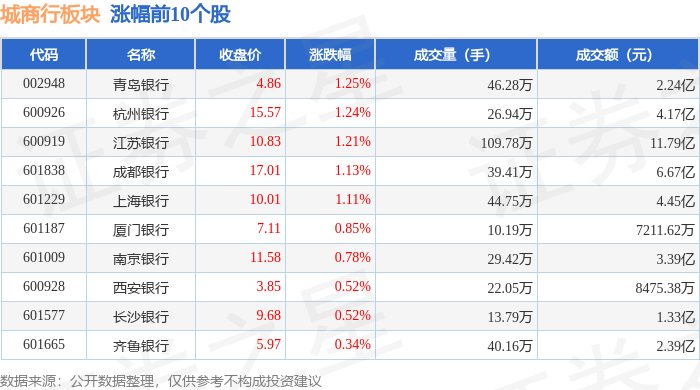
城商行板块11月27日涨0.69%,青岛银行领涨,主力资金净流入7276.85万元
Zheng Xing Xing Ye Ri Bao· 2025-11-27 09:07
Core Insights - The city commercial bank sector experienced a rise of 0.69% on November 27, with Qingdao Bank leading the gains [1] - The Shanghai Composite Index closed at 3875.26, up 0.29%, while the Shenzhen Component Index closed at 12875.19, down 0.25% [1] Stock Performance Summary - Qingdao Bank (002948) closed at 4.86, up 1.25% with a trading volume of 462,800 shares and a transaction value of 224 million [1] - Hangzhou Bank (600926) closed at 15.57, up 1.24% with a trading volume of 269,400 shares and a transaction value of 417 million [1] - Jiangsu Bank (616009) closed at 10.83, up 1.21% with a trading volume of 1,097,800 shares and a transaction value of 1.179 billion [1] - Chengdu Bank (601838) closed at 17.01, up 1.13% with a trading volume of 394,100 shares and a transaction value of 667 million [1] - Shanghai Bank (601229) closed at 10.01, up 1.11% with a trading volume of 447,500 shares and a transaction value of 445 million [1] - Xiamen Bank (601187) closed at 7.11, up 0.85% with a trading volume of 101,900 shares and a transaction value of 72.116 million [1] - Nanjing Bank (6000009) closed at 11.58, up 0.78% with a trading volume of 294,200 shares and a transaction value of 339 million [1] - Xi'an Bank (600928) closed at 3.85, up 0.52% with a trading volume of 220,500 shares and a transaction value of 84.754 million [1] - Changsha Bank (601577) closed at 9.68, up 0.52% with a trading volume of 137,900 shares and a transaction value of 133 million [1] - Qilu Bank (601665) closed at 5.97, up 0.34% with a trading volume of 401,600 shares and a transaction value of 239 million [1] Capital Flow Analysis - The city commercial bank sector saw a net inflow of 72.7685 million from institutional investors, while retail investors experienced a net inflow of 16.4028 million [2] - The sector faced a net outflow of 89.1713 million from speculative funds [2] Individual Stock Capital Flow - Jiangsu Bank (600919) had a net inflow of 75.1851 million from institutional investors, while it faced a net outflow of 38.3807 million from speculative funds [3] - Shanghai Bank (601229) saw a net inflow of 33.6962 million from institutional investors, with a net outflow of 37.6450 million from speculative funds [3] - Qilu Bank (601665) had a net inflow of 23.2129 million from institutional investors, while it faced a net outflow of 7.1943 million from speculative funds [3] - Chengdu Bank (601838) experienced a net inflow of 21.6104 million from institutional investors, with a significant net outflow of 68.9418 million from speculative funds [3] - Hangzhou Bank (600926) had a net inflow of 17.6667 million from institutional investors, while it faced a net outflow of 41.0399 million from speculative funds [3]
北京银行济南分行以 “领航 e 贷”破解科技企业融资难题
Qi Lu Wan Bao· 2025-11-27 06:59
Core Viewpoint - Beijing Bank's Jinan Branch is addressing the financing challenges faced by specialized and innovative enterprises through the launch of the "Linghang e-loan" product, which offers efficient online credit services to support technological innovation and economic development in Shandong Province [1][2]. Group 1: Financing Solutions - The "Linghang e-loan" product provides a streamlined online application process, intelligent approval, and rapid funding disbursement, effectively injecting financial resources into specialized enterprises [1][2]. - Customized financing solutions are developed based on four dimensions: credit limits, efficiency, guarantees, and services, with national-level "little giant" enterprises eligible for up to 20 million yuan and provincial-level specialized enterprises up to 10 million yuan [2]. - The approval process utilizes an intelligent model to dynamically assess the technological value and industrial potential of enterprises, allowing for automated approvals and quick access to funds [2]. Group 2: Comprehensive Support Ecosystem - The bank integrates various resources to create an "Enterprise Home" ecosystem, providing value-added support to technology companies, including professional listing guidance and supply chain financial services [3]. - A smart matching service platform is established to connect enterprises based on their industry attributes and development needs, fostering collaboration and creating a win-win ecosystem among banks, enterprises, and institutions [3]. Group 3: Case Study and Future Strategy - A case study highlights a gear manufacturing company that received a tailored financing solution of 10 million yuan through the "Linghang e-loan," enabling it to optimize its financial structure and focus on technological upgrades and market expansion [4]. - Moving forward, the bank aims to deepen its service system for technological innovation, enhance precision services for key client groups, and innovate collaborative financial solutions to support the growth of specialized enterprises [4][5].
北京银行:以人工智能驱动为引领,赋能全行数字化经营
Cai Jing Wang· 2025-11-27 04:32
Core Insights - The core viewpoint of the articles emphasizes the strategic shift in digital transformation within the banking sector, particularly focusing on the integration of artificial intelligence (AI) as a key driver for business innovation and service enhancement [1][7]. Digital Transformation Strategy - Beijing Bank initiated a three-year digital transformation action plan in 2022, transitioning from phase 1.0 to 2.0, achieving advanced results in digital operations [1]. - The bank's digital transformation strategy is built around the concepts of One Bank, One Data, and One Platform, aiming for comprehensive integration and support for various data applications [2]. AI Integration and Infrastructure - A unified financial operating system was established, breaking down system barriers and enabling interconnectivity, which supports the bank's AI capabilities [2]. - The unified financial operating system was launched in October 2022 and became operational in June 2023, significantly enhancing technology research and business innovation [2]. Innovation and Efficiency - The unified financial operating system has supported over 190 innovation projects and facilitated the launch of more than 700 capabilities, enhancing operational efficiency [3]. - The system includes a feature called "Xiao Jing Search," which has launched over 270 applications to improve employee productivity [3]. Business Growth and Digital Services - The corporate banking sector constitutes a significant portion of Beijing Bank's operations, with a digital financial technology service capability system comprising 75 physical systems [4]. - The bank has developed a one-stop online comprehensive service platform for inclusive finance, enabling online applications and rapid loan approvals [5]. Retail Banking Development - Beijing Bank's retail customer base has surpassed 32 million, with a digital operation framework (CPCT²R) designed to deliver tailored financial products through various channels [6]. - The bank's digital operations encompass online, offline, and remote banking, enhancing customer engagement and service delivery [6]. AI-Driven Strategy - The "All in AI" strategy aligns with national development goals, focusing on comprehensive AI integration across the bank's operations [7]. - The bank has developed a dual-driven self-research system for AI, enhancing operational efficiency and risk management [7][8]. Future Directions - Beijing Bank aims to accelerate the application of financial AI, fostering deep integration with business needs and enhancing digital transformation capabilities [8].