
BOB(601169)

Search documents
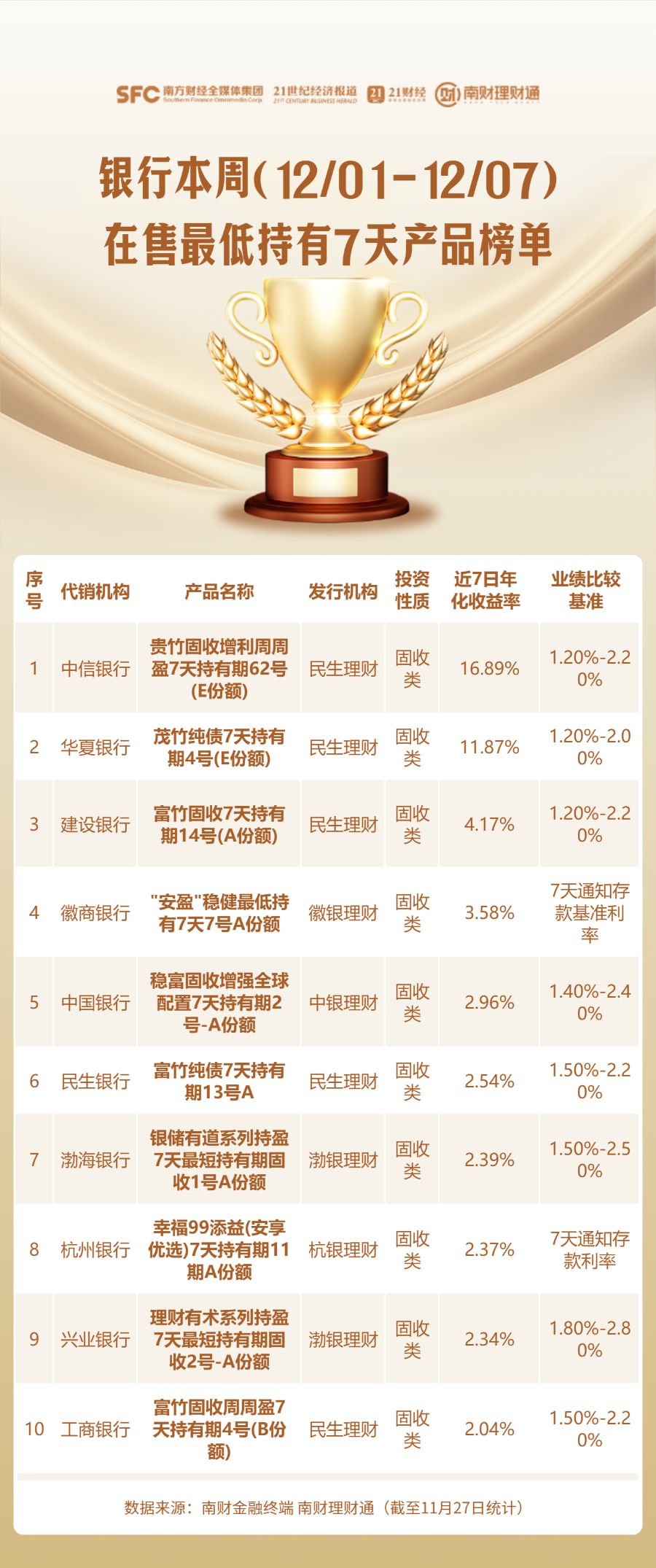
哪家商业银行最低持有期理财产品收益更高?
2 1 Shi Ji Jing Ji Bao Dao· 2025-12-02 10:37
Core Insights - The article focuses on the performance of minimum holding period RMB public offering products, ranking them based on annualized returns for holding periods of 7, 14, 30, and 60 days [1][4][12] Group 1: 7-Day Holding Period Products - The top-performing product is from Minsheng Bank with an annualized return of 4.17% [3] - Other notable products include: - Huishang Bank with 3.58% [3] - Bank of China with 2.96% [3] - Minsheng Bank's Fuzhu Pure Bond with 2.54% [3] - Bohai Bank with 2.39% [3] Group 2: 14-Day Holding Period Products - Minsheng Bank's product "Jingxiang Fixed Income Incremental Dual-Week" leads with a return of 34.68% [5] - Other significant products include: - Minsheng Bank's Fuzhu Pure Bond with 5.66% [5] - WeBank's "Anying" Stable Income with 4.47% [5] - SPDB's "Wealth Management Series" with 2.33% [5] Group 3: 30-Day Holding Period Products - Minsheng Bank's "Guizhu Fixed Income Incremental Monthly" tops the list with a return of 21.23% [9] - Other key products include: - Minsheng Bank's Fuzhu Fixed Income with 13.53% [9] - Bank of China with 7.64% [9] - Huishang Bank's "Happiness 99" with 6.07% [9] Group 4: 60-Day Holding Period Products - The leading product is from Minsheng Bank with a return of 15.12% [13] - Other notable products include: - CITIC Bank's Fuzhu Pure Bond with 8.94% [14] - Bank of China with 4.57% [14] - Huishang Bank's product with 3.46% [14]







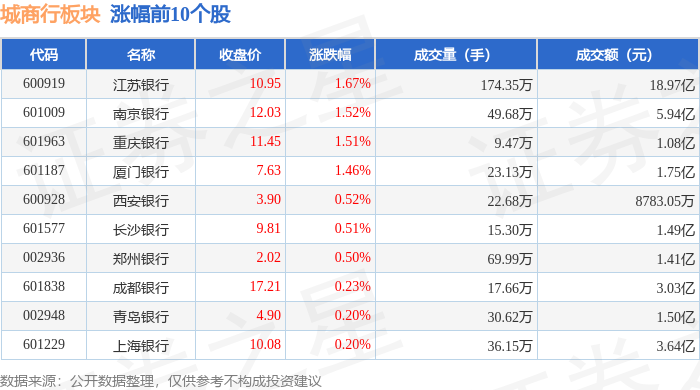
城商行板块12月2日涨0.43%,江苏银行领涨,主力资金净流出3.16亿元
Zheng Xing Xing Ye Ri Bao· 2025-12-02 09:05
Group 1 - The city commercial bank sector increased by 0.43% on December 2, with Jiangsu Bank leading the gains [1] - The Shanghai Composite Index closed at 3897.71, down 0.42%, while the Shenzhen Component Index closed at 13056.7, down 0.68% [1] - Jiangsu Bank's closing price was 10.95, reflecting a 1.67% increase, with a trading volume of 1.7435 million shares and a transaction value of 1.897 billion [1] Group 2 - The city commercial bank sector experienced a net outflow of 316 million from institutional funds, while retail investors saw a net inflow of 421 million [2][3] - The trading data for various banks showed mixed performance, with Ningbo Bank declining by 0.69% and Guizhou Bank remaining unchanged [2] - Shanghai Bank had a net outflow of 46.6477 million from institutional funds, while retail investors contributed a net inflow of 2.33839 million [3]





北京银行因九项违规领2527万元罚单,11名高管被追责
Nan Fang Du Shi Bao· 2025-12-02 08:57
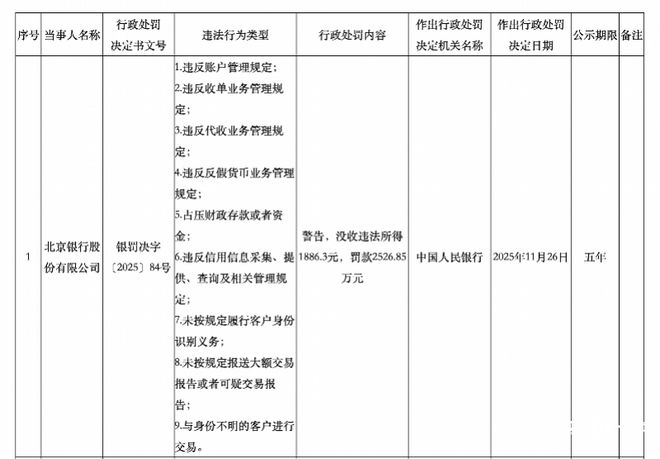
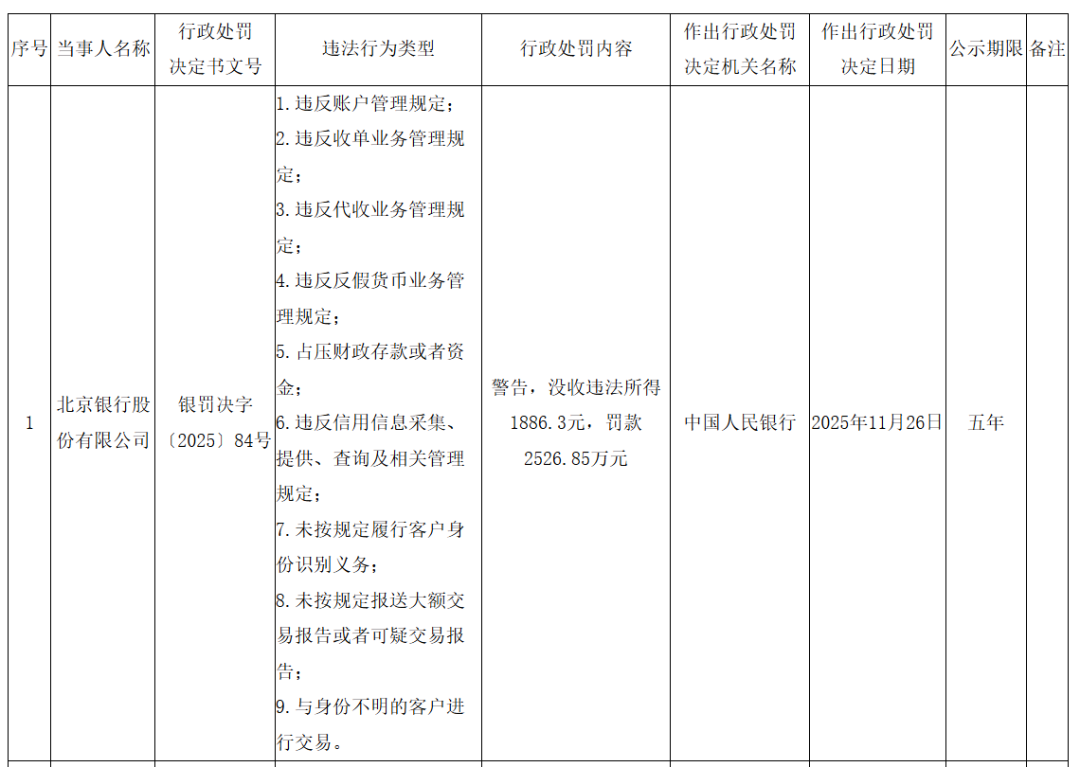
Core Viewpoint - The People's Bank of China has imposed significant penalties on Beijing Bank for multiple violations, including a fine of 25.2685 million yuan and the confiscation of illegal gains amounting to 1,886.3 yuan, along with accountability measures against 11 responsible individuals [1][3]. Regulatory Actions - Beijing Bank was penalized for nine types of violations covering critical areas such as fund management, anti-money laundering, and credit information management [1][2]. - The violations include breaches of account management regulations, improper handling of collection and payment services, non-compliance with anti-counterfeit currency regulations, and failures in customer identity verification [2][3]. Individual Accountability - Among the 11 individuals held accountable, a retail banking department employee received the highest fine of 210,000 yuan for multiple violations, including improper management of collection services and transactions with unidentified clients [3]. - Other fines ranged from 10,000 to 195,000 yuan for various infractions related to anti-counterfeit regulations and credit information management [3]. Financial Penalties Overview - In 2025, Beijing Bank has faced multiple regulatory penalties totaling over 32.96 million yuan, including a previous fine of 5.3 million yuan for inaccurate loan risk classifications and other violations [3][4]. Financial Performance - As of September 2025, Beijing Bank reported total assets of 4.89 trillion yuan, a year-to-date increase of 15.95%, while its operating income decreased by 1.08% year-on-year to 51.588 billion yuan [4][5]. - The bank's net profit attributable to shareholders was 21.064 billion yuan, reflecting a slight increase of 0.26% year-on-year [4]. Income Structure - The bank's net interest income grew by 1.79% year-on-year, driven by asset expansion, while non-interest income fell by 9.22% due to fluctuations in investment income [4]. - Notably, corporate loans increased by 11.98%, with significant growth in technology finance, green finance, and inclusive small and micro loans [4]. Asset Quality and Capital Adequacy - As of September 2025, the non-performing loan ratio was 1.29%, a slight decrease of 0.02 percentage points from the beginning of the year [5]. - However, the provision coverage ratio dropped by 12.96 percentage points to 195.79%, and capital adequacy ratios also declined, with the total capital adequacy ratio at 12.82% [5].
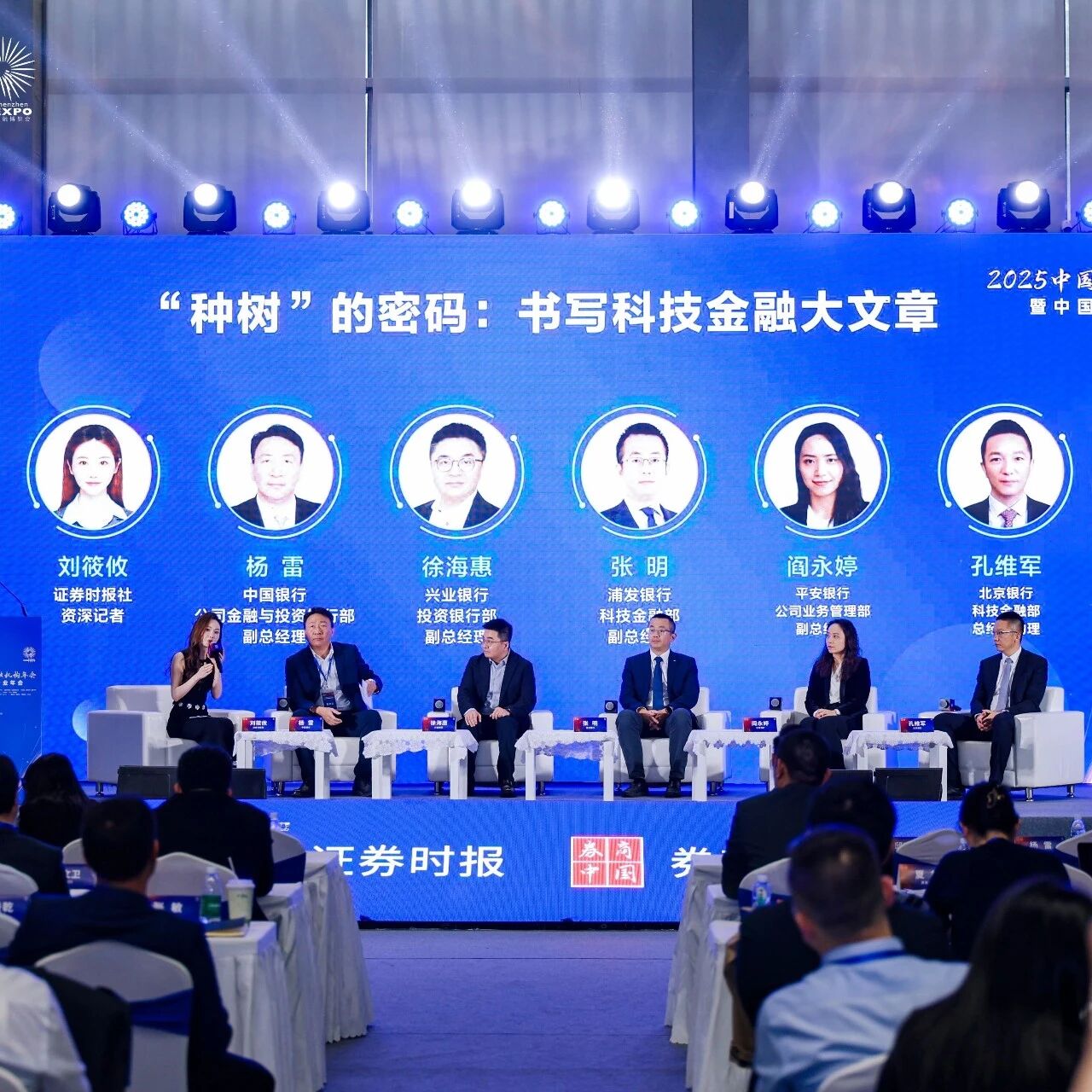
破解“种树”的密码!五家银行谋篇科技金融方法论
券商中国· 2025-12-02 03:45
Core Viewpoint - The article emphasizes that technology finance has become a strategic focus for the banking industry, driven by policy guidance and market dividends, and highlights the ongoing exploration of effective lending mechanisms in this sector [1]. Group 1: Organizational Structure - All five banks prioritize technology finance in their strategic frameworks, with a consensus on the necessity of specialized teams and organizational setups to support this business [3][4]. - China Bank has established a multi-tiered organizational structure for technology finance, enhancing its ability to understand the needs of tech enterprises [3]. - SPD Bank aims to strengthen its position as the preferred banking partner for tech companies by creating a specialized organizational framework that includes a dedicated technology finance team [3]. Group 2: Product Offerings - Ping An Bank has set up technology finance centers at both the headquarters and key branches, focusing on a wide range of clients and offering products that span the entire business cycle, including investment banking and transaction banking services [4]. - Beijing Bank has developed a specialized technology finance system and launched the "Leading e-loan" product, which has seen significant uptake, with cumulative loans exceeding 140 billion yuan [5]. Group 3: Risk Management - The article discusses the challenges banks face in assessing the value and risks of tech companies, particularly smaller ones, due to their unique characteristics such as light assets and long R&D cycles [6]. - Ping An Bank has formed a research team to evaluate industry segments and has developed an evaluation system focusing on intellectual property and financial health [6][7]. - Beijing Bank has implemented a dual approach to risk assessment, combining offline credit committees with an online approval system to better understand tech enterprises [7]. Group 4: Market Dynamics - The article notes a mismatch between supply and demand in the technology finance sector, with a significant increase in loan coverage for tech SMEs but unmet needs from early-stage companies [8]. - SPD Bank has shifted its focus from traditional lending to technology investment banking, aiming for high-quality development in technology finance [8]. Group 5: Strategic Recommendations - Recommendations include focusing on the quality of development rather than just quantity, emphasizing product differentiation and innovation, and utilizing syndicate loans to spread risk [9][10]. - The article suggests that banks should collaborate to support promising tech enterprises, balancing equity and debt financing to mitigate risks associated with market fluctuations [9][10].


中国金融板块-追踪工业风险:制造业固定资产投资增速显著放缓,助力更快管控风险-China Financials-Tracking industrial risks further notable slowdown in manufacturing FAI growth to help contain risks more quickly
2025-12-02 02:08
Summary of Key Points from the Conference Call Industry Overview - **Industry**: China Financials, specifically focusing on manufacturing and infrastructure investments in China [1][5][7] Core Insights and Arguments - **Manufacturing FAI Growth**: There has been a notable slowdown in manufacturing Fixed Asset Investment (FAI) growth, dropping to 2.7% year-over-year (yoy) from 4.0% yoy in the previous month, indicating steady progress on capital expenditure (capex) slowdown [7] - **Liability Growth**: Total liability growth for industrial firms moderated to 5.0% yoy, while manufacturing firms saw a slight increase to 5.9% yoy. This moderation is expected to lead to more rational capacity expansion [2][7] - **Revenue Decline**: Manufacturing revenue declined by 4.3% yoy, attributed to lower production levels due to overcapacity control efforts. The Value-Added Industrial (VAI) growth also slowed to 4.9% yoy from 6.5% yoy in September [3][10] - **Profit Growth**: Manufacturing profit growth moderated to 7.7% yoy from 9.9% yoy in September, influenced by higher financing costs and lower production [10] Future Outlook - **Infrastructure Investment**: A potential increase in infrastructure investments, supported by a new RMB 500 billion fund from the China Development Bank, is expected to bolster demand in 2026 and aid in the digestion of overcapacity risks [8][3] - **Sector Performance**: 77.1% of sectors experienced a slowdown in capex in October 2025 compared to the first half of 2025, while 39.3% of sectors showed profit improvement [9][7] Additional Important Information - **PPI Trends**: The Producer Price Index (PPI) rebounded month-over-month for the first time since December 2024, with the year-over-year decline narrowing to 2.1% [7] - **Investment Sentiment**: The overall sentiment towards the China Financials sector remains attractive, with ongoing efforts in financial tightening contributing to anti-involution measures [5][4] This summary encapsulates the critical insights from the conference call, highlighting the current state and future expectations of the manufacturing and financial sectors in China.




央行再开千万级罚单!事涉两家上市银行
证券时报· 2025-11-30 11:03
央行再度开出1000万元以上罚单! 此次被罚,北京银行事涉反洗钱领域等9项违规行为,具体包括:违反账户管理规定;违反收单业务管理规定;违反代收业务管理规定;违反反假货币业务管理规 定;占压财政存款或者资金;违反信用信息采集、提供、查询及相关管理规定;未按规定履行客户身份识别义务;未按规定报送大额交易报告或者可疑交易报告; 与身份不明的客户进行交易。 11月28日,中国人民银行官网披露的行政处罚信息显示,北京银行因涉反洗钱领域等9项违规行为,被监管予以警告,合计被罚没约2527万元,11名有关责任人遭到 处罚;同日,华夏银行也因反洗钱领域等10项违规行为被警告,合计罚没约1381万元,该行8名责任人遭到罚款处罚。 对于上述相关处罚,华夏银行方面回应券商中国记者表示,此次处罚是基于2022年央行开展的综合执法检查发现问题做出的,所涉及的问题已全部整改完毕。该行 还表示,将严格落实监管要求,持续强化内控合规管理,推动业务经营健康发展。 北京银行合计被罚2527万元 11月28日,据行政处罚信息,北京银行被央行予以警告,没收违法所得1886.3元,罚款2526.85万元。 与此同时,央行还处罚了与上述违规行为有关的北 ...
央行再开千万级罚单!事涉两家上市银行
券商中国· 2025-11-30 09:24
Core Viewpoint - The People's Bank of China has imposed significant fines on Beijing Bank and Huaxia Bank for multiple violations related to anti-money laundering and other regulatory issues, highlighting ongoing compliance challenges in the banking sector [1][2][3]. Group 1: Beijing Bank Penalties - Beijing Bank was fined a total of approximately 25.27 million yuan, which includes the confiscation of illegal gains amounting to 1,886.3 yuan [2]. - The violations involved nine specific areas, including breaches of account management regulations and failure to perform customer identity verification as required [2]. - Eleven responsible individuals from various departments of Beijing Bank were also penalized, with fines ranging from 10,000 to 210,000 yuan [2]. Group 2: Huaxia Bank Penalties - Huaxia Bank faced fines totaling around 13.81 million yuan, including the confiscation of illegal gains of 154,600 yuan [3]. - The bank was found to have committed ten violations, similar to those of Beijing Bank, including issues with account management and customer identity verification [3]. - Eight individuals associated with the violations were fined between 10,000 and 130,000 yuan, with some also receiving warnings [3]. Group 3: Responses and Compliance Measures - Huaxia Bank stated that the penalties were based on issues identified during a comprehensive enforcement inspection conducted by the People's Bank of China in 2022, and all identified problems have been rectified [4]. - The bank emphasized its commitment to strengthening internal control and compliance management to ensure healthy business operations moving forward [4].
央行重拳出击 华夏银行、北京银行合计被罚近4000万元
Jing Ji Guan Cha Bao· 2025-11-30 06:23
Core Viewpoint - The People's Bank of China has issued significant fines to Huaxia Bank and Beijing Bank, totaling nearly 40 million yuan, highlighting deep-rooted issues in anti-money laundering, credit management, and account management within commercial banks [2][5]. Group 1: Penalties and Violations - Huaxia Bank was fined 13.655 million yuan, while Beijing Bank faced a penalty of 25.2685 million yuan, with both banks receiving warnings and having illegal gains confiscated [2][3]. - A total of 21 management personnel from both banks were held accountable, with violations spanning multiple critical departments including operations, personal business, credit card centers, and legal compliance [2][4]. - Huaxia Bank was found to have ten violations, including breaches of account management, clearing management, and anti-money laundering obligations [2][3]. Group 2: Systemic Issues and Regulatory Environment - Both banks exhibited systemic deficiencies in fulfilling core anti-money laundering obligations, particularly in customer identity verification and transaction reporting [4][6]. - The regulatory environment has intensified, with a notable increase in penalties across various banking institutions, reflecting a "zero tolerance" stance towards internal control failures and compliance deficiencies [5][6]. - The increase in penalties and the number of fines issued in 2025 compared to 2024 indicates a significant rise in regulatory scrutiny, with a 10.36% increase in the number of fines and a 49.34% increase in total penalty amounts [5]. Group 3: Structural Problems and Future Directions - The frequent violations in areas such as anti-money laundering and credit management are symptomatic of structural issues, including fragmented internal controls and outdated technological systems [6][7]. - Actions like "occupying fiscal deposits" pose direct threats to public fund safety, indicating a disregard for institutional boundaries under performance pressure [7]. - Future regulatory efforts should focus on embedding compliance into product design and operational processes, rather than solely relying on post-violation penalties [7].
两家银行,领千万级罚单
Zhong Guo Zheng Quan Bao· 2025-11-30 00:17
11月28日,中国人民银行发布的行政处罚公示显示,北京银行因9项违法行为被中国人民银行处以警告,并没收违法所得1886.3元,罚款2526.85万元。华 夏银行因10项事由被没收违法所得15.456791万元,罚款1365.5万元。两家银行均有多名相关责任人被处以警告、罚款等行政处罚。 罚单信息显示,北京银行的违法行为类型包括:违反账户管理规定;违反收单业务管理规定;违反代收业务管理规定;违反反假货币业务管理规定;占压 财政存款或者资金;违反信用信息采集、提供、查询及相关管理规定;未按规定履行客户身份识别义务;未按规定报送大额交易报告或者可疑交易报告; 与身份不明的客户进行交易。 11位相关责任人受到处罚,分别被处以1万元—21万元不等的罚款,其中还有多人受到警告。 | 序号 当事人名称 | 行政处罚 | 违法行为类型 | 行政处罚内容 | 作出行政处罚 | 作出行政处罚 | 公示期限 备注 | | --- | --- | --- | --- | --- | --- | --- | | | 决定书文号 | | | 决定机关名称 | 决定日期 | | | | | 1. 违反账户管理规定; | | | | | | ...
收单业务等违规!两家银行被罚近4000万元
Xin Lang Cai Jing· 2025-11-29 08:17
Core Points - The People's Bank of China announced significant administrative penalties against Beijing Bank and Huaxia Bank for multiple violations related to account management and acquiring services, totaling nearly 40 million yuan [1] Group 1: Beijing Bank - Beijing Bank was fined a total of 25.2685 million yuan, including the confiscation of illegal gains amounting to 1,886.3 yuan, due to nine violations including account management and acquiring services [2][4] - Eleven staff members from Beijing Bank were penalized, with fines ranging from 1,000 to 210,000 yuan for various violations [4][5] - Specific violations by Beijing Bank included failure to comply with customer identity verification obligations and engaging in transactions with unidentified clients [4][6] Group 2: Huaxia Bank - Huaxia Bank faced a total penalty of 13.8096 million yuan, which included the confiscation of illegal gains of 154,567.91 yuan, due to ten violations including account management and clearing services [6][8] - Eight individuals from Huaxia Bank were fined, with penalties ranging from 10,000 to 130,000 yuan for their respective roles in the violations [8][9] - Huaxia Bank acknowledged the penalties as a result of issues identified during a comprehensive enforcement inspection conducted by the People's Bank of China in 2022, and stated that all identified issues have been rectified [9]
