Linyang Energy(601222)

Search documents
密集披露:中标大单
Shang Hai Zheng Quan Bao· 2025-09-22 14:03
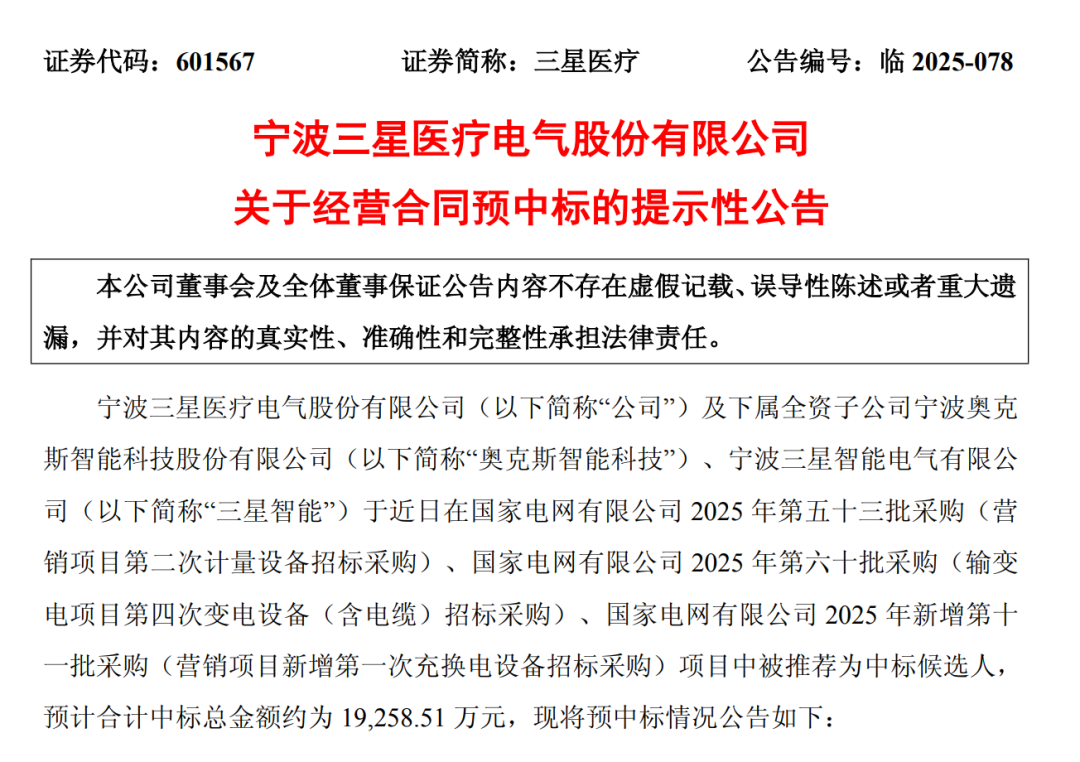
Group 1 - Samsung Medical and its subsidiaries have been recommended as candidates for winning bids in multiple procurement projects from the State Grid Corporation of China, with a total expected bid amount of approximately 193 million yuan [1][4] - A total of 11 listed companies have announced their pre-bid status for State Grid projects in recent days, with a combined bid amount of about 1.18 billion yuan [1][4] - Baiyun Electric and its subsidiary Guilin Capacitor are recommended candidates for nine sub-projects under the State Grid's procurement, with a total bid amount of 162 million yuan, accounting for 3.25% of the company's projected 2024 revenue [4][5] Group 2 - The State Grid Corporation plans to invest over 650 billion yuan in 2025, marking a historical high, while the Southern Power Grid Company has also set a record investment of 175 billion yuan [7][8] - Recent policies from the Ministry of Industry and Information Technology and other departments aim to maintain a 6% annual revenue growth for traditional power equipment and steady growth for new energy equipment by 2026 [8] - The electric power equipment industry is expected to benefit from the ongoing green and low-carbon energy transition, with strong demand anticipated [8][9]


9月22日早间重要公告一览
Xi Niu Cai Jing· 2025-09-22 03:50
Group 1 - Global Printing announced that shareholder Hong Kong Yuanshi International Co., Ltd. plans to reduce its stake by up to 3.2004 million shares, accounting for 1% of the total share capital, due to personal funding needs [1] - Sunflower intends to acquire 100% equity of Xi Pu Materials and 40% equity of Zhejiang Beid Pharmaceutical through a combination of share issuance and cash payment, with stock resuming trading on September 22, 2025 [1][2] - Crown Zhong Ecology is planning a change in control, leading to a temporary suspension of its stock and convertible bonds due to significant uncertainties [2] Group 2 - China Oil Engineering's wholly-owned subsidiary signed a $513 million EPC contract for an LNG pipeline project in the UAE, covering approximately 180.5 kilometers of natural gas pipeline with a 36-month construction period [3] - Shanxi Fenjiu announced that shareholder Huachuang Xinrui (Hong Kong) Co., Ltd. plans to reduce its stake by up to 16.2006 million shares, representing no more than 1.33% of the total share capital [4] - Brother Technology's subsidiary received a drug registration certificate for Iopamidol injection, which is included in the national medical insurance catalog [5] Group 3 - Lin Yang Energy is expected to win a bid for a metering equipment project from the State Grid, with an estimated total bid amount of approximately 142 million yuan [6] - Huahai Chengke received approval from the China Securities Regulatory Commission for issuing shares and convertible bonds to purchase assets and raise no more than 800 million yuan in matching funds [8] - Jindi Co. signed a framework agreement to acquire controlling interest in Unico Precision, which specializes in manufacturing gears and automotive parts [10] Group 4 - Ruifeng High Materials announced that its major shareholder plans to reduce its stake by up to 2.4 million shares, accounting for 0.9584% of the total share capital [12] - Changliang Technology's director plans to reduce his stake by 1.05 million shares, representing 0.129% of the total share capital [14] - Zhongjing Food's director plans to reduce his stake by up to 150,000 shares, accounting for 0.10% of the total share capital [16] Group 5 - Haitai Technology announced that two shareholders plan to reduce their stakes by a total of up to 2.53% of the total share capital [18] - Zhenlei Technology's chairman is under detention but the company states that control has not changed and operations remain normal [20] - Huakang Co. plans to distribute a cash dividend of 0.2 yuan per share, totaling approximately 60.61 million yuan [19]


江苏林洋能源股份有限公司关于重大经营合同预中标的提示性公告
Shang Hai Zheng Quan Bao· 2025-09-21 18:42
Core Viewpoint - Jiangsu Linyang Energy Co., Ltd. has been recommended as a candidate for a major procurement project by State Grid Corporation of China, which is expected to positively impact the company's performance in 2025 and 2026 [1][3]. Summary by Sections Pre-bid Project Details - The pre-bid project is part of the State Grid Corporation's 2025 53rd procurement batch for marketing project second metering equipment [1]. - The project includes ten sub-packages, such as A-level single-phase smart energy meters and high-end smart energy meters [2]. Bid Quantity and Financial Impact - The total quantity of pre-bid items is 445,300 units, with significant quantities in various sub-packages, including 320,000 units for the first sub-package and 75,000 units for the second [3]. - The estimated total bid amount is approximately 141.88 million yuan, which is expected to have a positive impact on the company's operating performance in 2025 and 2026 [3]. Bid Notification and Delivery Timeline - The bid notification period has not yet concluded, and the company has not received the official bid notification from State Grid Corporation [4]. - Delivery timelines will depend on the actual contract requirements from provincial companies, introducing some uncertainty regarding the impact on the company's performance [4].
300948,筹划易主,周一停牌
Shang Hai Zheng Quan Bao· 2025-09-21 15:34
Group 1 - Guanzhong Ecological is planning a change in control and will suspend trading from September 22, 2025, for up to two trading days [1] - Sunflower intends to acquire 100% equity of Xipu Materials and 40% equity of Beid Pharmaceutical, with trading resuming on September 22, 2025 [1] - Jintou City Development is adjusting its major asset restructuring plan [1] - Zhongke Tongda has terminated its major asset restructuring project [1] Group 2 - Huitian Co., Ltd. and other companies are planning to list in Hong Kong [2] - Taotao Automotive has approved its application for an initial public offering of H shares in Hong Kong [2] - Longxun Co., Ltd. is also planning to issue H shares and apply for listing in Hong Kong [2] Group 3 - Four companies will receive risk warnings, including Fudan Fuhua, which will change its stock name to ST Fuhua and be subject to a 5% price limit [3][4] - Juewei Food will also change its stock name to ST Juewei and be subject to a 5% price limit [3] - Chuangyi Information will change its stock name to ST Chuangyi and be subject to a 20% price limit [4] - Sikui will change its stock name to ST Sikui and be subject to a 20% price limit [4] Group 4 - Multiple companies are undergoing executive personnel changes, including China Petroleum, where Huang Yongzhang has resigned as president [6] - Huashan City A has seen the resignation of its chairman and vice chairman due to retirement and job changes [6] - China Ruilin's chairman has resigned due to age reasons [6] Group 5 - Sunflower is planning a major asset restructuring involving the acquisition of Xipu Materials and Beid Pharmaceutical, focusing on high-end semiconductor materials [9] - Jintou City Development is adjusting its major asset restructuring plan to sell real estate assets while retaining property management [10] - Zhongke Tongda has terminated its planned acquisition of a technology company due to failure to reach agreement on key terms [11] Group 6 - ST King Kong has been accepted for reorganization by the court, and its stock will be subject to additional delisting risk warnings [12] - ST New Power is under investigation by the China Securities Regulatory Commission for information disclosure violations [14] - Zhenlei Technology's chairman is under detention but the company states that control has not changed [14] Group 7 - Guotai Environmental has had its chairman's detention lifted, allowing him to resume duties [15] - Pingming Technology is planning a major matter that may lead to a change in control, resulting in continued suspension of trading [15] Group 8 - Shunhao Co., Ltd. plans to repurchase shares with a total amount between 100 million and 200 million yuan [16] - Baoli International is considering an investment in semiconductor testing equipment company Hongtai Technology [16] - Jindi Co., Ltd. is acquiring control of Guangzhou Yuni Precision Co., Ltd. [17] Group 9 - SF Holding reported a revenue of 24.787 billion yuan in August 2025, a year-on-year increase of 7.86% [18] - China Oil Engineering signed an EPC contract worth 513 million USD for a gas pipeline project in the UAE [18] - Linyang Energy is a recommended candidate for a procurement project with a total expected amount of approximately 142 million yuan [19] Group 10 - Wuzhou Transportation's major shareholder plans to increase its stake with a loan commitment of up to 153 million yuan [21] - Shanxi Fenjiu's shareholder plans to reduce its stake by up to 16.2006 million shares [21][22]


林洋能源(601222) - 江苏林洋能源股份有限公司关于重大经营合同预中标的提示性公告
2025-09-21 09:45
证券代码:601222 证券简称:林洋能源 公告编号:临 2025-57 江苏林洋能源股份有限公司 关于重大经营合同预中标的提示性公告 本公司董事会及全体董事保证本公告内容不存在任何虚假记载、误导性陈述 或者重大遗漏,并对其内容的真实性、准确性和完整性承担法律责任。 国家电网有限公司于 2025 年 9 月 19 日在国家电网有限公司电子商务平台 (ECP)公告了"国家电网有限公司 2025 年第五十三批采购(营销项目第二次计 量设备招标采购)推荐的中标候选人公示",江苏林洋能源股份有限公司(以下简 称"公司")为国家电网有限公司评标委员会推荐的中标候选人,现将相关预中标 情况提示如下: 一、预中标项目的主要内容 公司本次预中标项目为国家电网有限公司 2025 年第五十三批采购(营销项目 第二次计量设备招标采购)(招标编号:0711-25OTL08322016),该项目由国家电 网有限公司委托国网物资有限公司作为招标代理机构采用公开招标方式进行。 本次招标共分十个分标,其中:第一分标为 A 级单相智能电能表(分标编号: SG2531-1307-23001 ); 第 二 分 标 为 B 级 三 相 智 能 电 ...
林洋能源:预中标国家电网1.42亿元计量设备采购项目
Xin Lang Cai Jing· 2025-09-21 09:40
Core Viewpoint - The company has been recommended as a candidate for the 53rd batch of procurement by the State Grid Corporation of China, with a total of 445,300 units expected to be awarded, amounting to approximately 141.88 million yuan [1] Group 1 - The company is the recommended candidate for the State Grid's procurement project, specifically for the second bidding of metering equipment [1] - The total expected award includes 10 packages with a combined quantity of 445,300 units [1] - The estimated total amount from this bid is around 141.88 million yuan, which is expected to positively impact the company's operating performance in 2025 and 2026 [1]
林洋能源(601222.SH)预中标1.42亿元国家电网采购项目
智通财经网· 2025-09-21 09:36
Group 1 - The core point of the article is that LinYuan Energy (601222.SH) has been recommended as a successful bidder for a procurement project by State Grid Corporation of China, with an estimated total bid amount of approximately 142 million yuan [1] - The announcement was made on September 19, 2025, regarding the 53rd batch of procurement by State Grid Corporation, specifically for the second measurement equipment bidding project [1] - The expected contracts are anticipated to have a positive impact on the company's operating performance in 2025 and 2026, while the execution of these contracts will not affect the company's operational independence [1]
林洋能源预中标1.42亿元国家电网采购项目
智通财经网· 2025-09-21 09:34
Core Viewpoint - LinYuan Energy (601222.SH) has been recommended as a successful bidder for the State Grid Corporation of China's procurement project, with an estimated total bid amount of approximately 142 million yuan [1] Group 1: Company Performance - The expected total bid amount of approximately 142 million yuan is based on the pre-bid quantity and pricing calculations [1] - The contract is anticipated to have a positive impact on the company's operating performance for the years 2025 and 2026 [1] - The execution of the contract will not affect the company's operational independence [1]
林洋能源在上海成立两家储能科技公司
Zheng Quan Shi Bao Wang· 2025-09-15 07:15
Core Viewpoint - Recently, two companies, Shanghai Juqi Hong Energy Storage Technology Co., Ltd. and Shanghai Qiyang Energy Storage Co., Ltd., were established, both under the legal representative Lu Jianrong, focusing on energy storage technology services and related activities [1] Company Summary - Both companies are fully owned by Jiangsu Linyang Energy Storage Technology Co., Ltd., which is a subsidiary of Linyang Energy (601222) [1] - The business scope of the new companies includes energy storage technology services, emerging energy technology research and development, mechanical equipment development, battery sales, and battery accessory sales [1]
大能源行业2025年第37周周报:山东机制电价竞价及绿电就近消纳解读关注绿色甲醇和能源RWA机遇-20250915
Hua Yuan Zheng Quan· 2025-09-15 07:09
Investment Rating - The report maintains a "Positive" investment rating for the utility industry [1] Core Insights - The first mechanism electricity price bidding results for renewable energy in Shandong have been released, indicating a significant market-oriented shift in policy [3][17] - Wind power mechanism electricity price is set at 319 CNY/MWh, which is a 20% premium over the 2024 average spot trading price, while solar power is at 225 CNY/MWh, a 33% premium [3][24] - The report emphasizes the importance of management and operational capabilities for renewable energy operators in a market-driven environment [4][30] Summary by Sections Electricity Sector - The Shandong province has become the first to implement a market-oriented mechanism for renewable energy pricing, with significant participation from over 3000 projects [18][21] - The mechanism electricity volume for wind power is 59.67 billion kWh, while for solar power it is only 12.48 billion kWh, reflecting a stronger policy support for wind energy [3][23] - The report suggests that the future of solar power installations in Shandong may see reduced investment enthusiasm due to current pricing pressures and non-technical cost reductions [4][29] Grid Sector - New pricing mechanisms for nearby consumption of green electricity have been established, which will protect grid interests and promote cost reductions for users [6][35] - The system operation costs will be charged based on the electricity delivered, allowing for potential savings in electricity costs for high-load enterprises [7][37] - The report highlights that the new pricing structure will benefit wind power and energy storage development, making them key components in the green electricity landscape [8][42] Renewable Energy Assets - The report discusses the acceleration of Real World Assets (RWA) in the distributed solar sector, with significant investments from companies like JinkoSolar and GCL-Poly [10][44] - The RWA framework is expected to enhance liquidity and value reassessment of quality distributed solar assets, benefiting original equity holders [11][47] - The collaboration between LinYuan Energy and Ant Group aims to digitize energy assets, further supporting the RWA initiative [12][48] Green Methanol - A major project for green methanol production has been announced by Goldwind, with a total investment of approximately 18.92 billion CNY, aiming to produce 600,000 tons of green methanol annually [13][49] - The report anticipates a surge in demand for green methanol as multiple projects are set to commence production in the coming years [13][49] - Key suppliers and equipment manufacturers in the green methanol sector are expected to see performance improvements as the market expands [13][49]