高股息配置

Search documents
财信证券袁闯:估值驱动行情延续 节后把握结构性机会
Zhong Guo Zheng Quan Bao· 2026-02-14 01:18
Core Viewpoint - The A-share market is influenced by multiple factors, showing characteristics of valuation-driven and structural differentiation, with an upward trend expected to continue post-Spring Festival [1][2]. Market Dynamics - The A-share market is experiencing a clear upward trend supported by improving corporate earnings, increased willingness of residents to invest, and ongoing policies to optimize industry competition [2]. - Short-term market fluctuations are expected due to seasonal effects, particularly around the Lunar New Year, but the overall upward trend remains intact [2][4]. Market Structure Characteristics - Historical data shows that since 2009, the average spring market rally lasts 57 days with an average increase of over 20%, with value blue-chip sectors performing well before the Spring Festival [3]. - The equity market is currently in a bullish window until early March 2026, with a focus on risk management and strategic positioning [3]. Post-Spring Festival Outlook - The A-share market is anticipated to continue its upward trend post-Spring Festival, supported by macroeconomic recovery, stable policy environment, and regulatory measures to prevent overheating [4]. - There is potential for a "red envelope market" if consumer data exceeds expectations, reinforcing cyclical sector support [4]. Investment Strategies - The investment logic post-Spring Festival will focus on "value supporting growth," with a shift from low-risk to high-risk preferences, emphasizing technology and cyclical sectors [7]. - Five key investment themes are recommended: 1. AI industry chain focusing on application development and performance-driven investments [7]. 2. High dividend yield assets, particularly in stable cash flow sectors like home appliances and banking [7]. 3. Sectors benefiting from policy-driven improvements, such as coal, steel, and lithium [7]. 4. Core areas of domestic demand recovery, including health, sports, and travel industries [8]. 5. Investment opportunities in strategic and industrial metals, anticipating a rebound in prices [8].
估值驱动行情延续 节后把握结构性机会
Zhong Guo Zheng Quan Bao· 2026-02-13 22:45
Group 1 - The A-share market is influenced by multiple factors, showing characteristics of valuation-driven and structural differentiation, with a clear upward trend expected to continue post-Spring Festival [2][4] - The core support for the market's upward trend includes improving corporate earnings prospects, increased willingness of residents to invest, and ongoing policies to optimize industry competition [2][4] - The market is expected to experience a "red envelope market" post-Spring Festival, driven by the current market's duration and upward amplitude being significantly lower than the average of previous uptrends [4][7] Group 2 - The investment logic post-Spring Festival will focus on "value supporting growth," with a shift from low-risk to high-risk preferences, emphasizing technology and cyclical price increases [7] - Five key investment themes are suggested: 1. The artificial intelligence industry chain, focusing on application rather than hardware [7][8] 2. High dividend assets, particularly in stable cash flow sectors like white goods and banking [7][8] 3. Anti-involution sectors benefiting from improved competition, such as coal and steel [7][8] 4. Core areas of domestic demand recovery, including health and tourism sectors [7][8] 5. Investment opportunities in strategic and industrial metals, expected to see a rebound in 2026 [7][8] Group 3 - The market structure shows significant calendar effects and valuation-driven characteristics, with the average increase of the Wind All A Index being over 20% during the spring market since 2009 [3] - The equity market is currently in a bullish window until early March 2026, with a strategy of "rapid gains and risk control" [3][4] - The bond market is experiencing downward pressure on yields, with the 10-year government bond yield expected to fluctuate between 1.80% and 1.85% [3]
估值驱动行情延续节后把握结构性机会
Zhong Guo Zheng Quan Bao· 2026-02-13 20:23
Core Viewpoint - The A-share market is expected to continue its upward trend post-Spring Festival, driven by a combination of trend inertia, seasonal effects, and policy environment support [3] Market Characteristics - The A-share market is influenced by multiple factors, exhibiting a complex overall pattern characterized by clear trends, numerous short-term disturbances, and significant structural differentiation [1] - The core support for the market's upward trend includes improving corporate profit prospects, increased willingness of residents to invest, and ongoing policies to reduce competition [1][2] Short-term Market Dynamics - The pre-Spring Festival period has led to a temporary decline in market activity as some funds opted to secure profits amid uncertainty, but this has not altered the core market trend [2] - Historical data shows that since 2009, the average spring market rally has lasted 57 days with an average increase of over 20% [2] Investment Strategy - Post-Spring Festival, the investment logic will focus on "value supporting growth," with a shift from low-risk to high-risk preferences, emphasizing technology and cyclical sectors [4] - Five key investment themes are recommended: 1. Artificial intelligence industry chain, shifting focus from hardware to application [5] 2. High dividend yield assets, particularly in stable cash flow sectors like white goods and banking [5] 3. Anti-involution sectors benefiting from improved competition dynamics, such as coal and steel [5] 4. Core areas of domestic demand recovery, focusing on sectors with strong growth potential like health and tourism [6] 5. Investment opportunities in strategic and industrial metals, anticipating a rebound in prices [6] Market Outlook - The market is expected to experience a "red envelope market" post-Spring Festival, with potential for further expansion if consumer data exceeds expectations [3] - The overall market is projected to maintain a "stable and upward" characteristic, with limited downside potential for indices [3]
继续扫货!平安人寿再度增持国寿H股 持股比例升至9.14%
2 1 Shi Ji Jing Ji Bao Dao· 2026-01-28 11:53
Core Insights - Ping An Life Insurance has increased its stake in China Life H-shares to 9.14% by purchasing 11.891 million shares at an average price of HKD 32.0553 per share, totaling approximately HKD 381 million [1] - This acquisition reflects a broader trend of insurance capital increasing their stakes in various companies, with over 30 instances of such actions recorded since 2025 [2] Group 1: Investment Activities - Ping An Life has been actively acquiring shares in China Life since reaching the 5% threshold in August 2025, with its stake growing from 5% to over 9% [1] - In addition to China Life, Ping An has also made significant investments in China Pacific Insurance H-shares, acquiring approximately 1.74 million shares and reaching a 5.04% stake [3] - The company has built a high-dividend financial asset pool in the Hong Kong market, significantly increasing its holdings in major banks such as Agricultural Bank of China, China Merchants Bank, and Postal Savings Bank [4][5] Group 2: Market Trends and Strategies - The trend of insurance companies increasing their stakes in stocks is seen as a response to declining risk-free interest rates and a search for high-dividend, stable enterprises [2] - Analysts suggest that insurance stocks are being redefined as "alternative dividend assets," indicating a shift in investment strategy towards high-yielding stocks [3] - Ping An's investment strategy is guided by a "three criteria" principle, focusing on reliable operations, growth potential, and sustainable dividends [6]
金融工程定期:港股量化:组合超额创新高,12月维持高股息配置
KAIYUAN SECURITIES· 2025-12-02 06:45
Quantitative Models and Construction Methods - **Model Name**: Hong Kong CCASS Preferred 20 Portfolio **Model Construction Idea**: The model leverages CCASS data from the Hong Kong Stock Exchange to track and replicate the monthly holdings of high-performing brokers. The goal is to identify brokers with superior performance and construct a portfolio based on their holdings[4][38][40] **Model Construction Process**: 1. At the end of each month, all brokers are ranked based on their standardized excess Sharpe ratio and monthly win rate. These two metrics are equally weighted to form a composite score 2. The top N brokers with the highest composite scores are selected to form a pool of high-performing brokers (N=10) 3. The holdings of these brokers are aggregated, and the top M stocks by weight are retained (M=20) 4. The selected stocks are equally weighted to construct the portfolio Formula: $ \text{Composite Score} = \text{Standardized Excess Sharpe Ratio} + \text{Monthly Win Rate} $ **Model Evaluation**: The model effectively identifies high-performing brokers and constructs a portfolio with consistent excess returns and risk-adjusted performance[40][41][42] Model Backtesting Results - **Hong Kong CCASS Preferred 20 Portfolio**: - November 2025 performance: Portfolio return 0.13%, Hang Seng Index return -0.18%, excess return 0.32%[42] - Full period (2020.1–2025.11): - Annualized excess return: 19.7% - Annualized volatility: 7.6% - Sharpe ratio: 2.59 - Maximum drawdown: -6.0% - Monthly win rate: 78.9%[42][43][45] - Annual performance breakdown: - 2020: Annualized excess return 37.4%, Sharpe ratio 3.85, maximum drawdown -5.4%, monthly win rate 91.7% - 2021: Annualized excess return 11.5%, Sharpe ratio 1.40, maximum drawdown -5.1%, monthly win rate 50.0% - 2022: Annualized excess return 12.2%, Sharpe ratio 1.48, maximum drawdown -4.5%, monthly win rate 75.0% - 2023: Annualized excess return 20.3%, Sharpe ratio 2.99, maximum drawdown -3.7%, monthly win rate 75.0% - 2024: Annualized excess return 22.5%, Sharpe ratio 3.38, maximum drawdown -3.7%, monthly win rate 91.7% - 2025: Annualized excess return 15.9%, Sharpe ratio 3.17, maximum drawdown -2.0%, monthly win rate 90.9%[43][44][45]
第七届金麒麟银行业最佳分析师第一名浙商证券梁凤洁最新观点:银行股Q4深蹲起跳 推荐稳健高股息大行
Xin Lang Zheng Quan· 2025-12-01 03:49
Core Insights - The article discusses the performance of the banking sector in October 2025, highlighting a decline in credit demand and a shift in deposit trends, indicating ongoing challenges in the financial landscape [1][2][3]. Credit Performance - Excluding non-bank financial institutions, credit showed a negative growth in October, with a decrease in both retail and corporate loans. Residential loans fell by 360.4 billion yuan, a year-on-year decrease of 520.4 billion yuan, indicating a contraction in consumer credit demand [1][2]. - Corporate loans saw an increase of 350 billion yuan, but short-term loans decreased by 190 billion yuan, reflecting limited demand for medium to long-term projects [2]. Social Financing - In October, social financing increased by 815 billion yuan, a year-on-year decrease of 597 billion yuan. Government bond issuance was 489.3 billion yuan, down 560.2 billion yuan from the previous year, suggesting a weakening support from government debt [3]. Deposit Trends - The M1 growth rate decreased to 6.2%, while M2 growth was at 8.2%. There is a continued trend of deposits moving towards non-bank financial institutions, with total deposits increasing by 610 billion yuan, but household deposits fell by 1.3 trillion yuan [4]. - The total scale of wealth management products reached a historical high of 33.2 trillion yuan, reflecting a significant increase of 1.1 trillion yuan from the previous month [4]. Banking Sector Performance - For the first three quarters of 2025, listed banks showed resilience with revenue growth of 0.9% and profit growth of 1.6%. State-owned banks performed well, while the performance of smaller banks varied [5][6]. - The net interest margin for listed banks stabilized at 1.37%, with a slight improvement in the interest spread for smaller banks, indicating a recovery in profitability [9]. Investment Recommendations - The article suggests that the banking sector may experience a rebound in Q4, driven by a rebalancing of market styles and increased interest in high-dividend stocks. Recommendations include both smaller banks in economically developed regions and larger, stable banks [12].






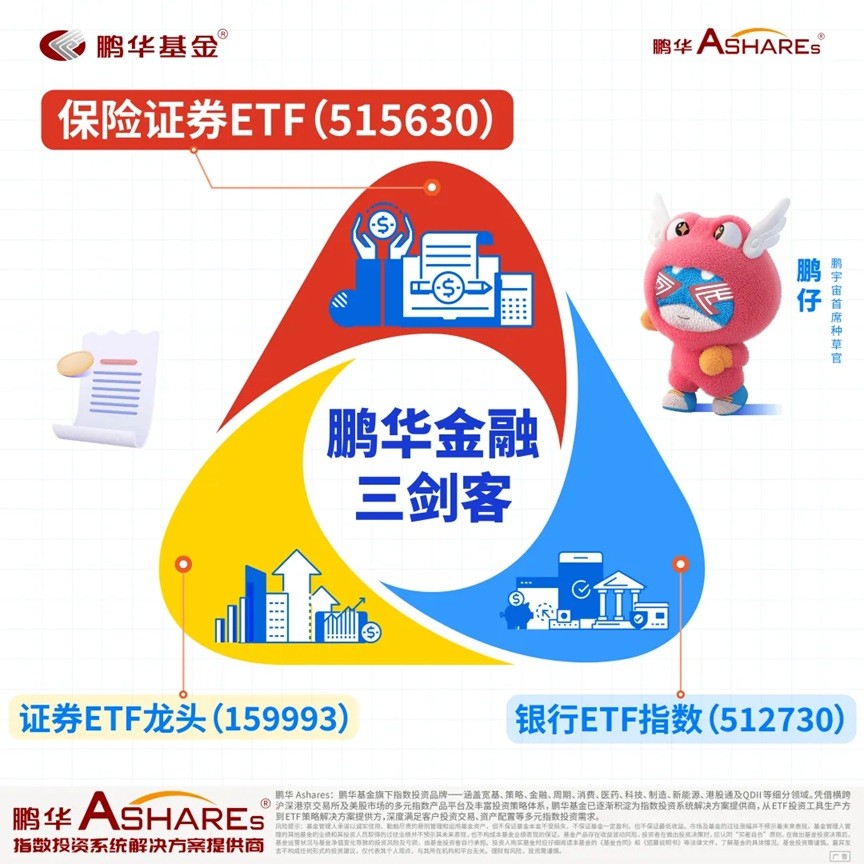
岁末年初如何布局?借鹏华Ashares“金融三剑客”布局“银伟达”
Cai Fu Zai Xian· 2025-11-18 02:41
Core Viewpoint - The banking sector in the A-share market has demonstrated significant defensive attributes amid recent market fluctuations, with bank indices rising against the backdrop of a broader market decline, leading to historical highs for some state-owned banks [2] Group 1: Market Performance - As of November 12, the banking index has shown resilience, even as the overall market experiences downturns, earning the nickname "Silver Weida" from investors, reflecting both humor and recognition of the sector's strong performance [2] - The strong performance of the banking sector is attributed to a combination of factors, including heightened market risk aversion, sustained allocation of long-term funds, and reinforced expectations of monetary policy easing [2] Group 2: Investment Dynamics - The key driver for capital inflow into bank stocks is the demand for safety, as funds have shifted from high-volatility sectors to low-valuation, high-dividend defensive sectors due to significant corrections in the A-share growth sector [2] - The high dividend yield of bank stocks is a major attraction for investors, with the China Securities Index showing a dividend yield of approximately 3.89% as of November 12, significantly higher than the 1.80% yield of 10-year government bonds, making it a preferred choice for low-risk capital [2] Group 3: Institutional Investment Trends - Insurance and long-term funds have been increasing their allocations to the banking sector, with a report indicating that in Q3 2025, insurance capital increased its holdings in the banking sector by 8.36 billion shares, with the number of banks held rising to 23, including 10 that saw increased holdings [2] Group 4: Future Outlook - The overall fundamental outlook for the banking industry remains stable, with expectations for steady revenue and profit growth in 2026, primarily due to a narrowing of net interest margin pressures [4] - There are signs of marginal improvement in the banking sector's fundamentals, with expectations for a stabilization and potential recovery in fee income growth, while the generation of non-performing loans remains stable [4] - As the economic recovery becomes clearer, the banking sector's fundamentals are expected to continue improving, presenting investment opportunities through products like the Penghua Bank ETF index [4]

机构:水泥板块具备高股息的配置逻辑
Zheng Quan Shi Bao Wang· 2025-10-21 00:33
Group 1 - The Ministry of Industry and Information Technology held a meeting to discuss the stabilization of growth in the cement industry, emphasizing the need to implement the "Cement Industry Stabilization Growth Work Plan (2025-2026)" to enhance quality and efficiency [1] - The meeting highlighted the significant supply-demand imbalance in the cement industry, aiming for dynamic balance and industrial transformation while prohibiting new capacity and regulating existing capacity [1] - According to Everbright Securities, cement prices in East China have declined, with weak downstream demand observed before and after the National Day holiday, leading to an average shipment rate below 45% for major cement enterprises [1] Group 2 - Caitong Securities noted that the cement sector has a high dividend configuration logic, with expectations for demand recovery and price rebound, as current PE and PB ratios are at the bottom [2] - The cement industry has seen continuous strengthening of supply-side control measures, including the prohibition of new capacity and staggered production in northern regions, with production halts extending from 10 days to up to a month in some areas [2] - Future improvements in demand, particularly from real estate and infrastructure projects, are expected to enhance supply control capabilities, positively impacting prices and potentially restoring company profitability and valuations [2]
增量险资叠加无风险利率下行,红利资产投资价值持续强化!中证红利ETF(515080)今日迎分红权益登记
Sou Hu Cai Jing· 2025-09-16 02:47
Core Viewpoint - The China Securities Dividend ETF (515080) is set to distribute dividends for the third quarter, with a dividend of 0.15 yuan per ten shares, reflecting a distribution ratio of 0.95% [1][15]. Dividend Distribution - This marks the 14th dividend distribution since the ETF's inception, with a cumulative dividend amount of 3.65 yuan per ten shares [1][15]. - The annual dividend ratios for the past five years (2020-2024) were 4.53%, 4.14%, 4.19%, 4.78%, and 4.66% respectively [1][15]. Market Trends - Recent market conditions have seen a return of funds to high-dividend stocks, with the China Securities Dividend ETF experiencing a net subscription of 134 million yuan over four consecutive days [1]. - The 40-day return differential of the China Securities Dividend Index relative to the Wind All A Index was -12.25% as of September 12, indicating underperformance compared to the broader market [1][6]. Investment Insights - Long-term investment strategies are being bolstered by policies encouraging insurance companies to increase their equity holdings, potentially adding several hundred billion yuan to the A-share market annually [2][17]. - The current dividend yield of the China Securities Dividend Index is 4.86%, significantly higher than the 10-year government bond yield of 1.87%, enhancing the attractiveness of dividend-paying assets [9][12]. Performance Metrics - The latest price-to-earnings (PE) ratio for the China Securities Dividend Index is 8.18, with historical percentiles indicating a high valuation relative to the past five and ten years [12][19]. - The China Securities Dividend Index has shown varied performance over the last five years, with annual returns of 3.49% (2020), 13.37% (2021), -5.45% (2022), 0.89% (2023), and 12.31% (2024) [19].

险资出手举牌保险股!什么信号?
Zhong Guo Zheng Quan Bao· 2025-08-16 14:38
Core Viewpoint - The recent stake acquisitions by China Ping An in two insurance companies signal a positive outlook for the insurance sector, indicating that insurance stocks are being recognized as valuable long-term investments due to their dividend potential and improved valuations [1][6][7]. Group 1: Stake Acquisitions - China Ping An increased its holdings in China Life and China Pacific Insurance, acquiring 9.5 million shares and 1.74 million shares respectively, triggering mandatory disclosures [3][4]. - Following these acquisitions, China Ping An's stake in China Life rose from 4.91% to 5.04%, while its stake in China Pacific increased from 4.98% to 5.04%, and then further to 5.10% after additional purchases [3][4]. Group 2: Market Performance - Insurance stocks have shown strong performance recently, with China Pacific's H-shares rising over 6% and A-shares increasing over 5% in just two days [4]. - The premium income data for China Pacific indicates a 9% year-on-year growth in life insurance premiums and a 0.8% increase in property insurance premiums for the first seven months of 2025 [4]. Group 3: Analyst Insights - Analysts suggest that the stake acquisitions by insurance companies reflect a recognition of the sector's long-term value and a shift towards high-dividend strategies [6][7]. - The current market environment, characterized by increased investment pressure and changes in accounting standards, is driving insurance companies to pursue stable long-term returns through equity investments [6][7]. Group 4: Future Outlook - The insurance industry is expected to benefit from lower interest rates and favorable capital market conditions, which may alleviate pressure on profit margins and enhance the long-term investment appeal of insurance stocks [7][8]. - Policies aimed at boosting consumption are anticipated to positively impact the property insurance sector, contributing to sustained premium income growth [8].