
GAC GROUP(601238)

Search documents
余承东造访广汽集团,双方又有哪些大动作?
Nan Fang Du Shi Bao· 2026-01-05 13:15
Core Viewpoint - The collaboration between GAC Group and Huawei aims to enhance the competitiveness of smart mobility solutions globally, focusing on the integration of cutting-edge technologies like AI and the HarmonyOS ecosystem [1][3]. Group 1: Partnership Development - GAC Group signed a comprehensive cooperation framework agreement with Huawei on January 5, 2026, marking a significant step in their ongoing partnership [1]. - The partnership will leverage both companies' strengths in electric vehicle manufacturing, operating systems, smart cockpits, and global services to accelerate the smart and international development of China's automotive industry [1][3]. Group 2: Technological Collaboration - GAC Group will work with Huawei to deepen the implementation of the HarmonyOS ecosystem in enterprise operations and user services, aiming to boost business growth and productivity [3]. - The collaboration will expand the technical cooperation boundaries, particularly in AI and other advanced fields, enhancing product innovation and technology application [3][4]. Group 3: Historical Context - GAC Group has been a pioneer in collaborating with Huawei since signing a strategic cooperation agreement in June 2017, focusing on smart connected electric vehicles [4]. - Over the past year, GAC and Huawei have engaged in multiple significant collaborations, including the establishment of GH Project Company with a registered capital of 1.5 billion yuan to accelerate joint initiatives [5]. Group 4: Brand Development - The "Qijing" brand was officially announced in September 2025, representing a high-end smart electric vehicle brand co-created by GAC Group and Huawei, integrating advanced smart technologies [6]. - GAC Group and Huawei's collaboration has led to the rapid deployment of the GAC Huawei Cloud Car Machine technology, which was implemented in the Aion UT model within 20 days of its global debut [6].

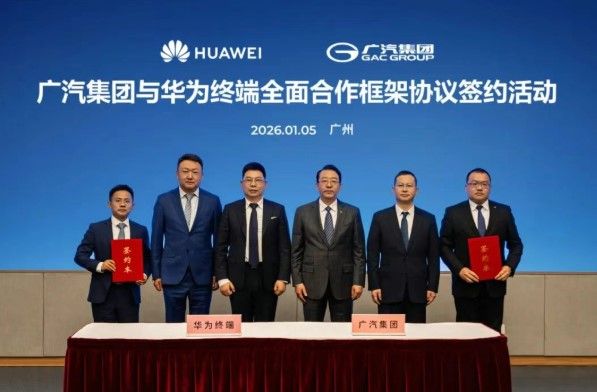
广汽集团与华为终端签约,将深化鸿蒙生态与AI技术合作
Bei Ke Cai Jing· 2026-01-05 13:13
Core Viewpoint - GAC Group and Huawei Terminal signed a comprehensive cooperation framework agreement to jointly develop competitive smart mobility solutions by leveraging their strengths in electric vehicle manufacturing, operating systems, smart cockpits, and global services [1] Group 1: Partnership Details - The collaboration will focus on co-building the HarmonyOS ecosystem and joint innovation in AI technologies [1] - GAC Group plans to integrate its industry advantages and market demands with Huawei Terminal for multi-dimensional technology implementation and product innovation [1] Group 2: Product Development - GAC's models, including the A800, M8, and S9, will feature Huawei's advanced driving and smart cockpit technologies [1] - The partnership aims to enhance the smart cockpit experience by deepening the integration of the Xiaoyi intelligent system, creating a new generation of smart cockpits with improved perception and interaction capabilities [1] Group 3: Market Strategy - GAC Group intends to develop tailored applications and services in collaboration with Huawei to enrich the smart mobility experience under the HarmonyOS ecosystem [1] - The partnership will accelerate GAC's expansion into the overseas smart mobility market [1]
广汽集团与华为终端签约 深化鸿蒙生态与AI技术合作
Zheng Quan Shi Bao Wang· 2026-01-05 11:34
Core Viewpoint - Huawei and GAC Group have signed a comprehensive cooperation framework agreement to jointly innovate in the fields of the HarmonyOS ecosystem, AI, and smart mobility solutions, aiming to enhance the competitiveness of China's automotive industry on a global scale [1] Group 1: Partnership Details - The agreement was signed by key representatives from both companies, including Huawei's Executive Director Yu Chengdong and GAC Group's Liang Weiqiang [1] - The collaboration will focus on deep integration of strengths in electric vehicle manufacturing, operating systems, smart cockpits, and global services [1] Group 2: Strategic Goals - The partnership aims to accelerate the intelligent and international development of the Chinese automotive industry [1] - Both companies will work together to create globally competitive smart mobility solutions [1]
广汽集团(601238) - H股公告-广汽集团2026年第一次临时股东会记录日期
2026-01-05 10:00
香港交易及結算所有限公司及香港聯合交易所有限公司對本公告的內容概不負責,對其 準確性或完整性亦不發表任何聲明,並明確表示,概不對因本公告全部或任何部分內容 而產生或因依賴該等內容而引致的任何損失承擔任何責任。 為確定符合資格出席臨時股東會並於會上投票之本公司普通股股本中每股面值人民幣1.00 元之海外上市外資股(「H股」)的持有人的記錄日期為香港時間二零二六年一月十九日(星 期一)。為符合資格出席臨時股東會並於會上投票,H股持有人最遲須於香港時間二零二 六年一月十九日(星期一)下午四時三十分或之前將所有已填妥有關股份過戶文件連同有 關股票送達本公司H股股份過戶登記處卓佳證券登記有限公司,地址為香港夏愨道16號遠 東金融中心17樓。 有關臨時股東會的詳情(包括會議日期及地點在內)將載於本公司適時發出之通函及相關 會議通告。 承董事會命 廣州汽車集團股份有限公司 GUANGZHOU AUTOMOBILE GROUP CO., LTD. 2238 二零二六年第一次臨時股東會記錄日期 廣州汽車集團股份有限公司(「本公司」)計劃於二零二六年一月二十三日(星期五)召開及 舉行二零二六年第一次臨時股東會(「臨時股東會」)。 ...
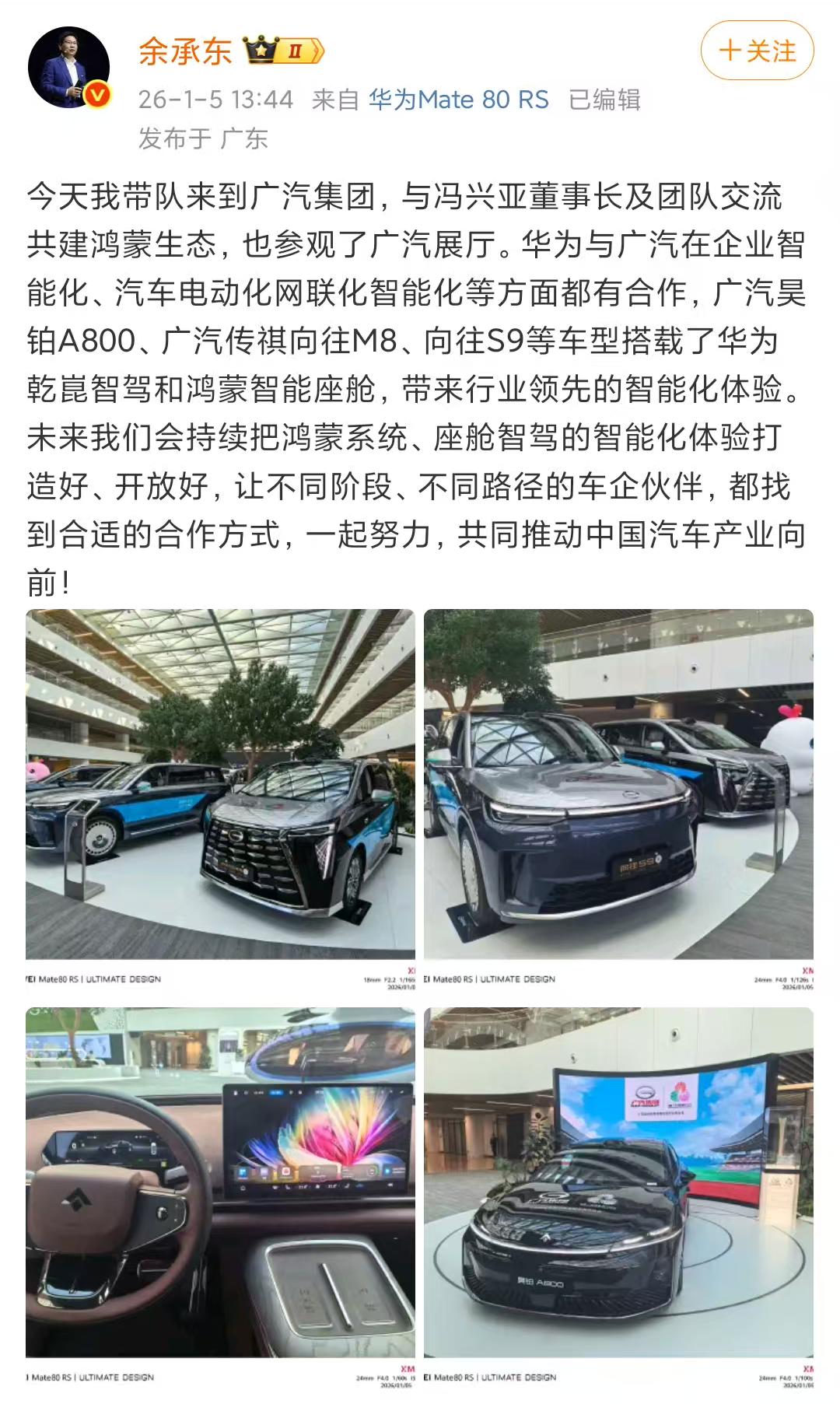
华为余承东带队前往广汽集团交流共建鸿蒙生态
Jin Rong Jie· 2026-01-05 09:46
Core Insights - Huawei's Executive Director Yu Chengdong visited GAC Group to discuss collaboration on the HarmonyOS ecosystem and showcased GAC's models equipped with Huawei's intelligent driving and smart cockpit technologies [1][4]. Group 1: Collaboration and Product Development - GAC's models such as A800, M8, and S9 are now featuring Huawei's intelligent driving and HarmonyOS smart cockpit, enhancing the smart experience in the automotive sector [1]. - Huawei aims to continuously improve and open up the HarmonyOS system and intelligent driving experiences, allowing various automotive partners to find suitable collaboration methods [1]. - The partnership between GAC and Huawei is seen as a strategic move to penetrate the high-end smart electric vehicle market, with the first model under the "Qijing" brand set to launch in June 2026 [4]. Group 2: Sales Performance - GAC Group reported cumulative vehicle sales of 1.1837 million units for the first three quarters of 2025, with Q3 sales reaching 428,400 units, reflecting a quarter-on-quarter growth of 11.49% [6]. - The total consolidated revenue for GAC Group reached 66.929 billion yuan, with Q3 revenue at 24.318 billion yuan, showing a quarter-on-quarter increase of 6.98% [6]. - The self-owned brands of GAC, including GAC Trumpchi, Aion, and Haobo, achieved significant growth, with combined Q3 sales of 159,500 units, marking a quarter-on-quarter increase of 15.09% [6].
广汽集团(02238) - 二零二六年第一次临时股东会记录日期
2026-01-05 09:12
香港交易及結算所有限公司及香港聯合交易所有限公司對本公告的內容概不負責,對其 準確性或完整性亦不發表任何聲明,並明確表示,概不對因本公告全部或任何部分內容 而產生或因依賴該等內容而引致的任何損失承擔任何責任。 GUANGZHOU AUTOMOBILE GROUP CO., LTD. 2238 二零二六年第一次臨時股東會記錄日期 廣州汽車集團股份有限公司(「本公司」)計劃於二零二六年一月二十三日(星期五)召開及 舉行二零二六年第一次臨時股東會(「臨時股東會」)。 為確定符合資格出席臨時股東會並於會上投票之本公司普通股股本中每股面值人民幣1.00 元之海外上市外資股(「H股」)的持有人的記錄日期為香港時間二零二六年一月十九日(星 期一)。為符合資格出席臨時股東會並於會上投票,H股持有人最遲須於香港時間二零二 六年一月十九日(星期一)下午四時三十分或之前將所有已填妥有關股份過戶文件連同有 關股票送達本公司H股股份過戶登記處卓佳證券登記有限公司,地址為香港夏愨道16號遠 東金融中心17樓。 有關臨時股東會的詳情(包括會議日期及地點在內)將載於本公司適時發出之通函及相關 會議通告。 承董事會命 廣州汽車集團股份有限公司 ...
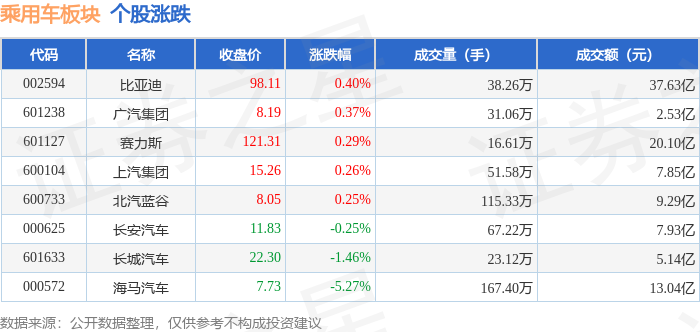
乘用车板块1月5日跌0.02%,海马汽车领跌,主力资金净流出5.24亿元
Zheng Xing Xing Ye Ri Bao· 2026-01-05 08:59
Market Overview - The passenger car sector experienced a slight decline of 0.02% on January 5, with Haima Automobile leading the drop [1] - The Shanghai Composite Index closed at 4023.42, up by 1.38%, while the Shenzhen Component Index closed at 13828.63, up by 2.24% [1] Individual Stock Performance - BYD (002594) closed at 98.11, with a gain of 0.40% and a trading volume of 382,600 shares, amounting to 3.763 billion yuan [1] - GAC Group (601238) closed at 8.19, up by 0.37%, with a trading volume of 310,600 shares, totaling 253 million yuan [1] - Seres (601127) closed at 121.31, increasing by 0.29%, with a trading volume of 166,100 shares, amounting to 2.010 billion yuan [1] - SAIC Motor (600104) closed at 15.26, up by 0.26%, with a trading volume of 515,800 shares, totaling 785 million yuan [1] - BAIC Blue Valley (600733) closed at 8.05, increasing by 0.25%, with a trading volume of 1.1533 million shares, amounting to 929 million yuan [1] - Changan Automobile (000625) closed at 11.83, down by 0.25%, with a trading volume of 672,200 shares, totaling 793 million yuan [1] - Great Wall Motors (601633) closed at 22.30, down by 1.46%, with a trading volume of 231,200 shares, totaling 514 million yuan [1] - Haima Automobile (000572) closed at 7.73, down by 5.27%, with a trading volume of 1.674 million shares, amounting to 1.304 billion yuan [1] Fund Flow Analysis - The passenger car sector saw a net outflow of 524 million yuan from institutional investors, while retail investors contributed a net inflow of 425 million yuan [1] - Notable fund flows for individual stocks include: - SAIC Motor: Institutional net inflow of 14.6084 million yuan, retail net outflow of 29.7881 million yuan [1] - GAC Group: Institutional net inflow of 5.9313 million yuan, retail net inflow of 503.72 million yuan [1] - Great Wall Motors: Institutional net inflow of 1.8031 million yuan, retail net outflow of 2.81908 million yuan [1] - BAIC Blue Valley: Institutional net outflow of 41.4566 million yuan, retail net inflow of 178.232 million yuan [1] - Changan Automobile: Institutional net outflow of 76.5608 million yuan, retail net inflow of 566.669 million yuan [1] - Seres: Institutional net outflow of 86.9124 million yuan, retail net inflow of 78.6812 million yuan [1] - BYD: Institutional net outflow of 131 million yuan, retail net inflow of 87.1496 million yuan [1] - Haima Automobile: Institutional net outflow of 211 million yuan, retail net inflow of 238 million yuan [1]





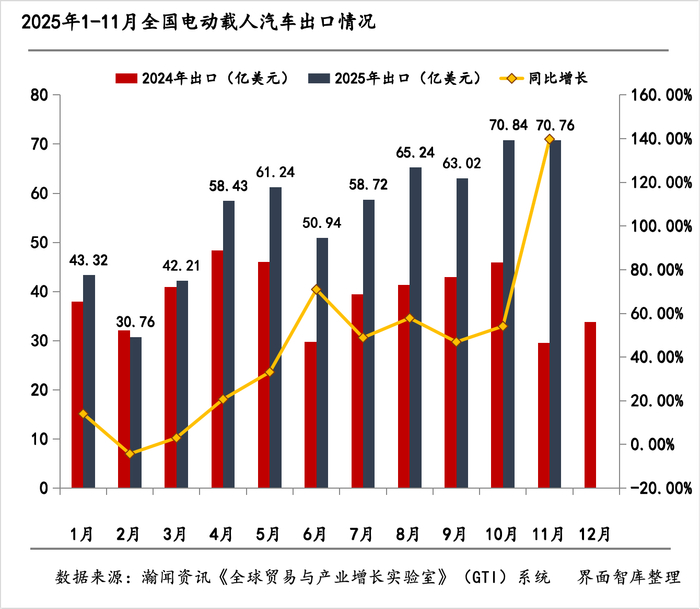
电动载人汽车出海月报|11月出口额同比飙升140%,全球市场加速渗透
Xin Lang Cai Jing· 2026-01-05 08:41
智通财经记者 | 贾璐 智通财经编辑 | 崔宇 【编者按】为了更全面、更及时、更精确地反映电动载人汽车出口状况,2025年3月起,智通财经/界面 智库和瀚闻资讯联合推出《中国电动载人汽车出海月报》。《中国电动载人汽车出海月报》旨在呈现全 国及各省电动载人汽车出口金额、出口数量和出口目的地等指标的月度变化趋势,以期为政府、企业和 投资者等提供决策参考。我们将于每月27日左右发布相关月报。 根据界面智库与瀚闻资讯统计,2025年11月,中国电动载人汽车贸易增长动能全面爆发,结构性分化态 势进一步凸显。进口方面延续收缩态势,出口方面则展现出强劲的加速势头,11月当月出口金额达 70.76亿美元,同比大幅增长139.83%,环比微降0.11%;出口数量达39.94万辆,同比激增144.93%,环 比增长6.52%。1-11月累计出口量已达337.31万辆,同比增长63.59%,增速较1-10月显著扩大6.99个百分 点,全球市场拓展进入高速增长通道。 从细分市场看,11月电动载人汽车出口分化路径更为清晰。乘用车领域呈现"量价齐升"的强劲增长格 局,在整体出口中占据绝对主导,出口量39.83万辆,占比高达99.73%, ...



启境猎装轿跑密集现身多地,路测城市数量突破20城
Qi Lu Wan Bao· 2026-01-05 07:37
1月5日消息,广汽集团(601238)与华为联合打造的全新品牌"启境"首款猎装轿跑近期频繁被目击于公 共道路,引发广泛关注。作为华为乾崑"第一境",启境是华为乾崑唯一技术、团队、流程、理念四大资 源毫无保留投入的品牌,代表了华为乾崑在智能汽车领域的最高战略意图。 综合汽车社区、路测追踪平台及行业信源信息,该车型的路测活动已扩展至全国20余座城市,测试密度 和地理跨度均处于行业前列。尽管外观仍处保密状态,但其猎装轿跑形态,融合轿跑流线美学与掀背式 尾门实用性,已通过车身轮廓显露无遗。 测试内容不仅包括传统机械性能,如转向精准度、悬架滤震表现,更深入考察智能座舱语音识别准确 率、多屏联动流畅度、自动泊车成功率等用户体验细节。此外,有消息表示,该款车型在不同网络环境 下的V2X通信稳定性也成为验证重点之一。 此次广泛路测也被视为市场预热的重要环节,在消费者对智能化、设计感与实用性的综合要求日益提升 的当下,启境通过实车高频曝光,逐步建立产品认知与品牌期待。随着工程验证进入尾声,这款集美 学、科技与性能于一体的猎装轿跑,将在今年6月份正式揭开面纱,冲击细分市场格局。 ...