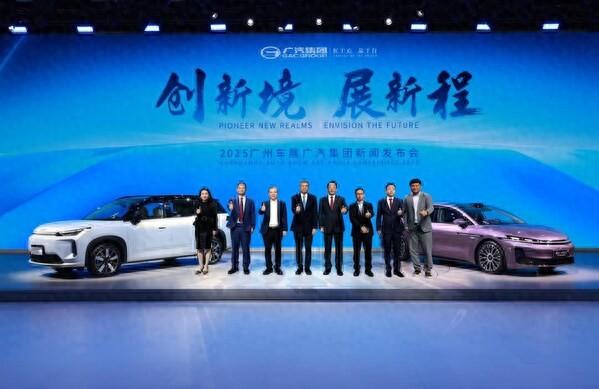
广汽昊铂A800

Search documents
广汽集团五大品牌集结花城广场,闪耀“广货行天下”汽车专场
2 1 Shi Ji Jing Ji Bao Dao· 2026-03-28 05:44
Core Viewpoint - The event "Guangdong Goods Going Global, State-owned Enterprises Building Craftsmanship" organized by GAC Group aims to showcase the value of GAC's automotive brands and promote high-quality development of Guangdong's manufacturing industry through immersive experiences and media outreach [2] Group 1: Event Overview - The event, lasting two days, features GAC's five major brands, including GAC Aion, GAC Trumpchi, GAC Honda, and GAC Toyota, showcasing their manufacturing capabilities and product quality [2] - Key government officials and media representatives attended the event, highlighting the collaboration between government and enterprise [2] Group 2: Product Showcase - GAC's five brands presented 10 main models, covering various categories such as sedans, SUVs, and MPVs, as well as multiple energy systems including hybrid and electric vehicles [3] - GAC Aion's i60, recognized as a "national good car," incorporates advanced technologies like self-developed smart driving and battery systems, while GAC Trumpchi showcased hybrid models emphasizing family and business use [3] Group 3: Pricing and Promotions - The showcased models range in price from 53,800 yuan to 319,800 yuan, catering to diverse consumer needs [4] - Attractive subsidies and promotional offers were introduced, including trade-in incentives and financial support for new models, such as the GAC Trumpchi M8 HEV with a limited-time subsidy of 5,000 yuan [5][6] Group 4: Quality and Brand Development - GAC Group emphasizes technological innovation and quality, aiming to enhance the "Guangdong Goods" brand and ensure that every vehicle meets market standards [7] - The company plans to achieve cumulative production and sales of 30 million vehicles by mid-year, reflecting its commitment to high quality and consumer trust [7] Group 5: International Expansion - GAC Group is actively expanding its international market presence, with over 350,000 overseas users and a target of nearly 130,000 units in exports by 2025, marking a 48% year-on-year growth [8] - The company has established a presence in 87 countries and regions, with over 630 sales service outlets, and aims to challenge 250,000 units in overseas sales by 2026 [9] Group 6: Future Outlook - GAC Group will continue to focus on quality and innovation, collaborating with various stakeholders to enhance the reputation of "Guangdong Goods" and contribute to the high-quality development of Guangdong's manufacturing sector [9]


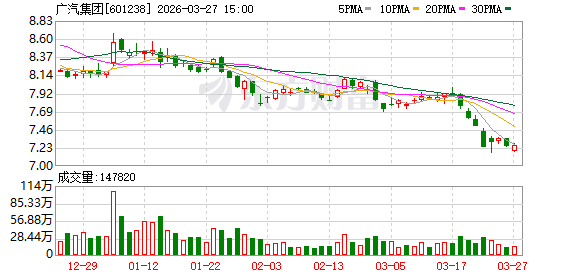
地方两会丨广州市人大代表冯兴亚建言低空经济商业化
Zhong Guo Jing Ying Bao· 2026-01-22 06:48
Core Viewpoint - Guangzhou is accelerating the construction of a trillion-level automotive industry cluster, focusing on the integration of smart and electric vehicles, autonomous driving, and the localization of key components [1][2]. Group 1: Industry Development and Challenges - Guangzhou has established a robust automotive industry base with nine vehicle manufacturers and over a thousand parts suppliers, achieving an average annual growth rate of over 60% in new energy vehicle production over the past five years [2][3]. - Despite its strengths, the automotive industry in Guangzhou faces challenges in commercializing cutting-edge technologies, coordinating the supply chain, and improving infrastructure [2][3]. - The city has opened 2,601 kilometers of smart connected vehicle testing roads, with over 8.36 million kilometers of autonomous driving demonstration operations covering ten major application scenarios [3]. Group 2: Strategic Recommendations - The company suggests focusing on low-altitude economy and autonomous driving as core areas for future industry development, proposing to accelerate the commercialization of electric vertical takeoff and landing vehicles [4][5]. - Recommendations include enhancing vehicle-to-grid (V2G) policies, improving automotive export logistics, and making Guangzhou a pilot city for automotive aftermarket modifications to meet consumer demands [5]. - The Guangzhou government has set 2026 as a key year for industry development, planning to build a low-altitude industrial ecosystem and an intelligent connected vehicle industrial park [5]. Group 3: Innovation and Ecosystem - The automotive industry in Guangzhou is characterized by a collaborative ecosystem with local leaders like GAC Group driving transformation through integrated reforms and efficient operational systems [3][4]. - GAC Group has received nearly 2,000 orders for its GOVY AirCab flying car, with production expected to start soon, supporting the development of low-altitude economy applications [4]. - The company emphasizes the importance of technological innovation to overcome development bottlenecks and maintain Guangzhou's core position in the national automotive industry landscape [2][3].
广汽与华为从“拍桌子”到协同合作 加速迈入智能化
Zhong Guo Jing Ying Bao· 2026-01-07 04:47
Core Insights - The visit of Huawei's executive Yu Chengdong to GAC Group marks a significant step in their collaboration on smart vehicles, culminating in a comprehensive cooperation framework agreement [2][3] - The agreement signifies a shift from project-level cooperation to a long-term strategic partnership, focusing on the integration of technology and product development in the smart automotive sector [3][5] Group 1: Cooperation Framework - The cooperation framework between GAC Group and Huawei is centered around the co-construction of the HarmonyOS ecosystem, emphasizing joint innovation in AI and other cutting-edge technologies [4][5] - This partnership aims to enhance GAC's smart upgrade and support the international expansion of China's automotive industry [5][6] - Both companies will work on integrating their strengths in electric vehicle manufacturing, operating systems, smart cockpits, and global service systems [4][5] Group 2: Product Development - GAC's new brand, Qijing, is set to play a crucial role in deepening the collaboration, with new models featuring Huawei's advanced driving and smart cockpit systems [7][8] - The first model from Qijing, a stylish shooting brake, is expected to launch in 2026, showcasing a collaborative design process involving significant input from both GAC and Huawei [7][8] - The product development process has been characterized by intense discussions and negotiations, reflecting the high standards both companies aim to achieve [8][9] Group 3: Strategic Alignment - The ongoing collaboration aligns with GAC Group's strategic plan "Smart Travel 2027," which prioritizes smart technology as a core focus [9][10] - The partnership has expanded from hardware to software, covering various aspects of automotive technology, with a consistent emphasis on smart solutions [9][10] - GAC and Huawei's joint initiatives, such as the Huawei cloud vehicle technology, have already been implemented in GAC's models, enhancing the overall smart experience [9]
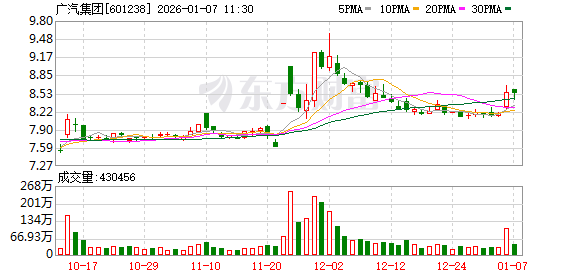
华为余承东带队前往广汽集团交流共建鸿蒙生态
Jin Rong Jie· 2026-01-05 09:46
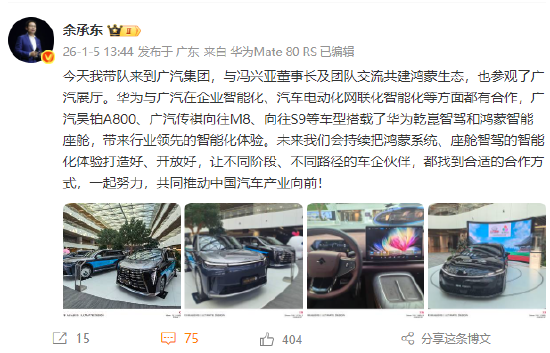
Core Insights - Huawei's Executive Director Yu Chengdong visited GAC Group to discuss collaboration on the HarmonyOS ecosystem and showcased GAC's models equipped with Huawei's intelligent driving and smart cockpit technologies [1][4]. Group 1: Collaboration and Product Development - GAC's models such as A800, M8, and S9 are now featuring Huawei's intelligent driving and HarmonyOS smart cockpit, enhancing the smart experience in the automotive sector [1]. - Huawei aims to continuously improve and open up the HarmonyOS system and intelligent driving experiences, allowing various automotive partners to find suitable collaboration methods [1]. - The partnership between GAC and Huawei is seen as a strategic move to penetrate the high-end smart electric vehicle market, with the first model under the "Qijing" brand set to launch in June 2026 [4]. Group 2: Sales Performance - GAC Group reported cumulative vehicle sales of 1.1837 million units for the first three quarters of 2025, with Q3 sales reaching 428,400 units, reflecting a quarter-on-quarter growth of 11.49% [6]. - The total consolidated revenue for GAC Group reached 66.929 billion yuan, with Q3 revenue at 24.318 billion yuan, showing a quarter-on-quarter increase of 6.98% [6]. - The self-owned brands of GAC, including GAC Trumpchi, Aion, and Haobo, achieved significant growth, with combined Q3 sales of 159,500 units, marking a quarter-on-quarter increase of 15.09% [6].
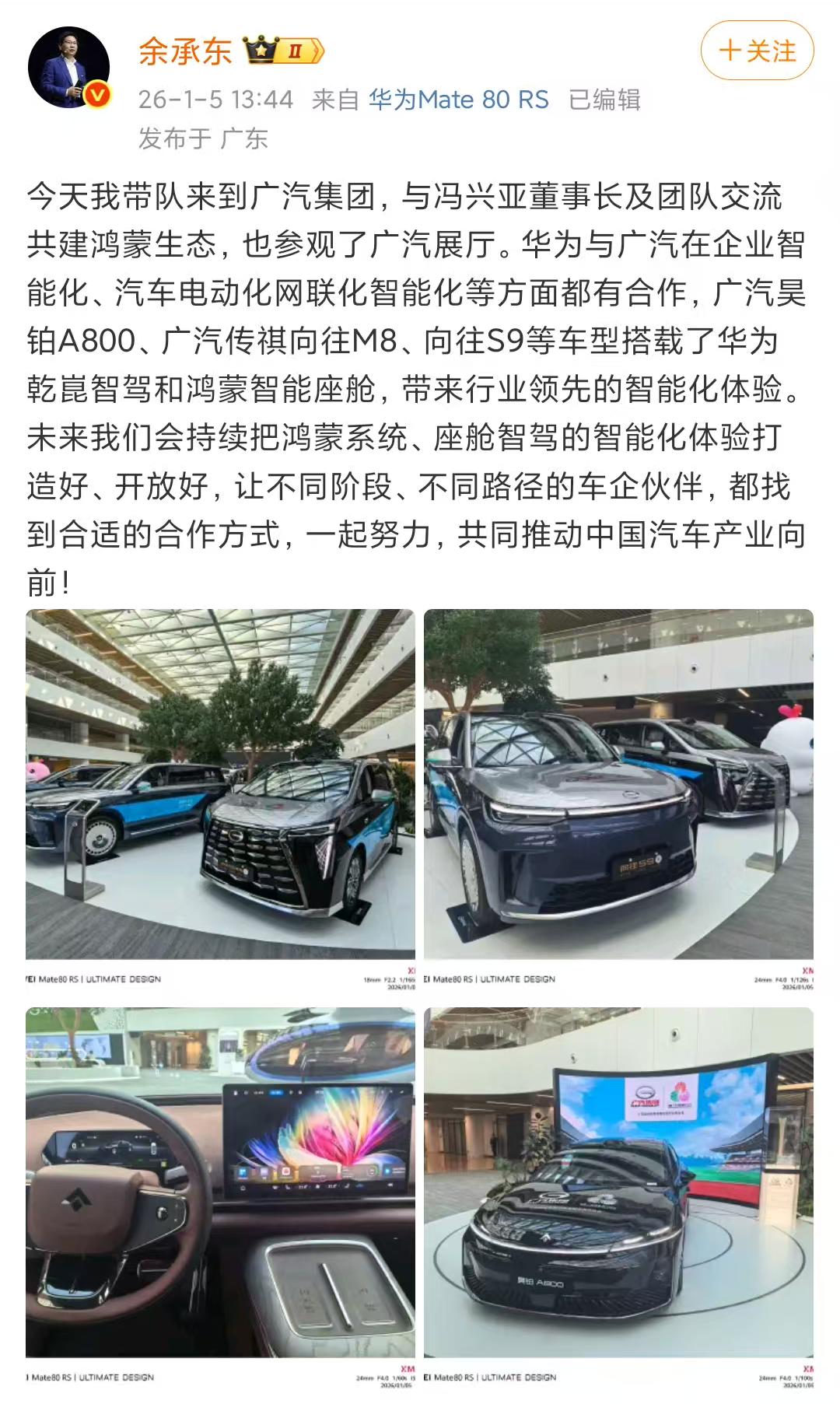
华为余承东到访广汽集团:与冯兴亚及团队交流共建鸿蒙生态
Xin Lang Cai Jing· 2026-01-05 06:42
Core Viewpoint - Huawei's Executive Director, Yu Chengdong, announced collaboration with GAC Group to build the HarmonyOS ecosystem and enhance smart vehicle experiences [1][3] Group 1: Collaboration and Partnerships - Huawei and GAC Group are cooperating in areas such as enterprise intelligence, electric vehicles, and connected smart technologies [1][3] - Models like GAC A800, GAC Trumpchi M8, and M9 are equipped with Huawei's advanced driving and HarmonyOS smart cockpit, providing industry-leading intelligent experiences [1][3] Group 2: Future Plans - Huawei aims to continuously improve and open up the HarmonyOS system and smart cockpit experiences, allowing various automotive partners to find suitable collaboration methods [1][3] - The goal is to collectively advance the Chinese automotive industry [1][3]
广汽昊铂 A800 豪华轿车内饰细节公布:鸿蒙座舱加持,配全球最长 6536mm 双环抱氛围灯
Xin Lang Cai Jing· 2025-12-18 14:25
Core Viewpoint - GAC Aotai A800 luxury sedan has officially launched L3 level autonomous driving road testing, becoming the first model in the country to obtain a license for high-speed testing at 120 km/h [5][35][39] Group 1: Vehicle Features - The GAC Aotai A800 features the HarmonySpace cockpit with a front and rear wrap-around design and a mainless lighting layout, including a touch screen in the rear armrest for vehicle control [2][32] - The vehicle dimensions are 5130 mm in length, 1966 mm in width, and 1500 mm in height, with a wheelbase of 3020 mm [26][56] - It is equipped with a 1.5-liter range extender engine producing 118 kW, paired with lithium iron phosphate batteries from Jiangsu Zhengli New Energy Technology Co., Ltd [27][57] Group 2: Autonomous Driving Technology - The GAC Aotai A800 is equipped with Huawei's QianKun intelligent driving system (HUAWEI ADS 4) and features the new WEWA technology architecture and a comprehensive collision avoidance system (CAS 4.0) [41][56] - The vehicle includes advanced sensing capabilities with a 360° all-weather perception matrix, featuring two 4D millimeter-wave radars and three high-precision solid-state LiDARs, improving detection accuracy from 50 cm to 20 cm [11][41] - The L3 intelligent brain is designed for faster judgment and more precise execution of driving commands [12][42] Group 3: Safety Features - The GAC Starling Safety Guard System incorporates eight redundant designs to ensure stability in extreme scenarios, providing dual insurance through mutual backup [21][53] - The system includes an automatic emergency steering system (AES) to avoid dangers from sudden obstacles [21][53] - The vehicle's safety architecture is aimed at instilling confidence in users regarding smart travel [23][53]

中国自动驾驶迈出关键一步 重庆跻身全国第一方阵!
Xin Lang Cai Jing· 2025-12-16 14:04
Core Viewpoint - The Ministry of Industry and Information Technology of China has officially granted the first batch of L3 conditional autonomous driving vehicle permits, marking a significant transition from closed testing to commercial application in the autonomous driving sector [2][15]. Group 1: Approval and Implementation - Changan Automobile and BAIC Jihe have received approval to conduct road trials in designated areas of Chongqing and Beijing [2][15]. - Changan's vehicle can achieve autonomous driving in congested traffic conditions on highways and urban expressways at speeds up to 50 km/h, limited to specific routes in Chongqing [15][21]. - This approval positions Chongqing among the leading cities in China for autonomous driving applications, contributing to the development of standards, technology iteration, and industrial application [15][19]. Group 2: Market Growth and Industry Dynamics - The autonomous driving market in China is rapidly expanding, with projections estimating it will approach 450 billion yuan by 2025, driven by technological advancements and cost reductions [5][16]. - Numerous domestic automakers are accelerating their investments in the autonomous driving sector, with Changan leveraging its "Tianshu Intelligent" self-developed technology system for L3-level autonomous driving [5][16]. - The competitive landscape among automakers is fostering technological advancements, with hardware costs decreasing and software algorithms maturing, leading to more affordable smart configurations in vehicles [18][21]. Group 3: Infrastructure and Ecosystem Development - The transition of L3 autonomous driving from closed environments to open roads tests not only the technical capabilities of automakers but also the comprehensive capabilities of cities in terms of smart network ecosystems, regulatory innovation, and infrastructure [19][22]. - Chongqing has established 17 trial routes for intelligent connected vehicles, facilitating the testing of L3 and L4 autonomous driving capabilities [22]. - The successful implementation of autonomous vehicles will necessitate the development of new infrastructure, including roadside perception devices and traffic information systems, thereby stimulating related industries [18][22].


L3级准入破冰 自动驾驶商业化落地驶入快车道
Bei Jing Shang Bao· 2025-12-15 22:56
Core Insights - The Ministry of Industry and Information Technology (MIIT) of China has officially announced the first batch of L3 conditional autonomous driving vehicle permits, with Changan Automobile and BAIC Jihe receiving approvals for trial operations in designated areas of Chongqing and Beijing respectively [1][2] Group 1: L3 Autonomous Driving Development - The approval of L3 autonomous driving vehicles is expected to accelerate technological iterations within the industry and drive computing platforms towards automotive-grade standards and scalable applications [1][6] - L3 autonomous driving allows for partial decision-making by the system under specific conditions, enabling drivers to completely disengage from driving tasks [2][6] - Changan's approved model can achieve autonomous driving at speeds up to 50 km/h in congested scenarios on designated highways, while BAIC's Alpha S (L3 version) can reach speeds of 80 km/h on certain routes in Beijing [2] Group 2: Industry Competition and Collaboration - Major automotive companies have entered a competitive mode to commercialize autonomous driving technology, with several firms, including BAIC, GAC, and BYD, being included in the first batch of intelligent connected vehicle trial operations [4][6] - The collaboration between automotive manufacturers and technology companies is crucial for the commercial viability of L3 autonomous driving, with Horizon Robotics and Huawei providing essential technological support [5][6] Group 3: Safety and Regulatory Framework - The shift in driving responsibility due to autonomous driving raises concerns about accident liability, with regulations evolving to clarify responsibilities among users and autonomous systems [3][6] - The MIIT and other departments have emphasized the need for improved regulations and safety standards to support the growth of the autonomous driving sector [5][6] - The market for autonomous driving in China is projected to approach 450 billion yuan by 2025, driven by technological advancements and cost reductions [6]
众多华系车企,广汽昊铂A800凭何率先拿下L3高速测试牌照?
Di Yi Cai Jing· 2025-11-28 02:20
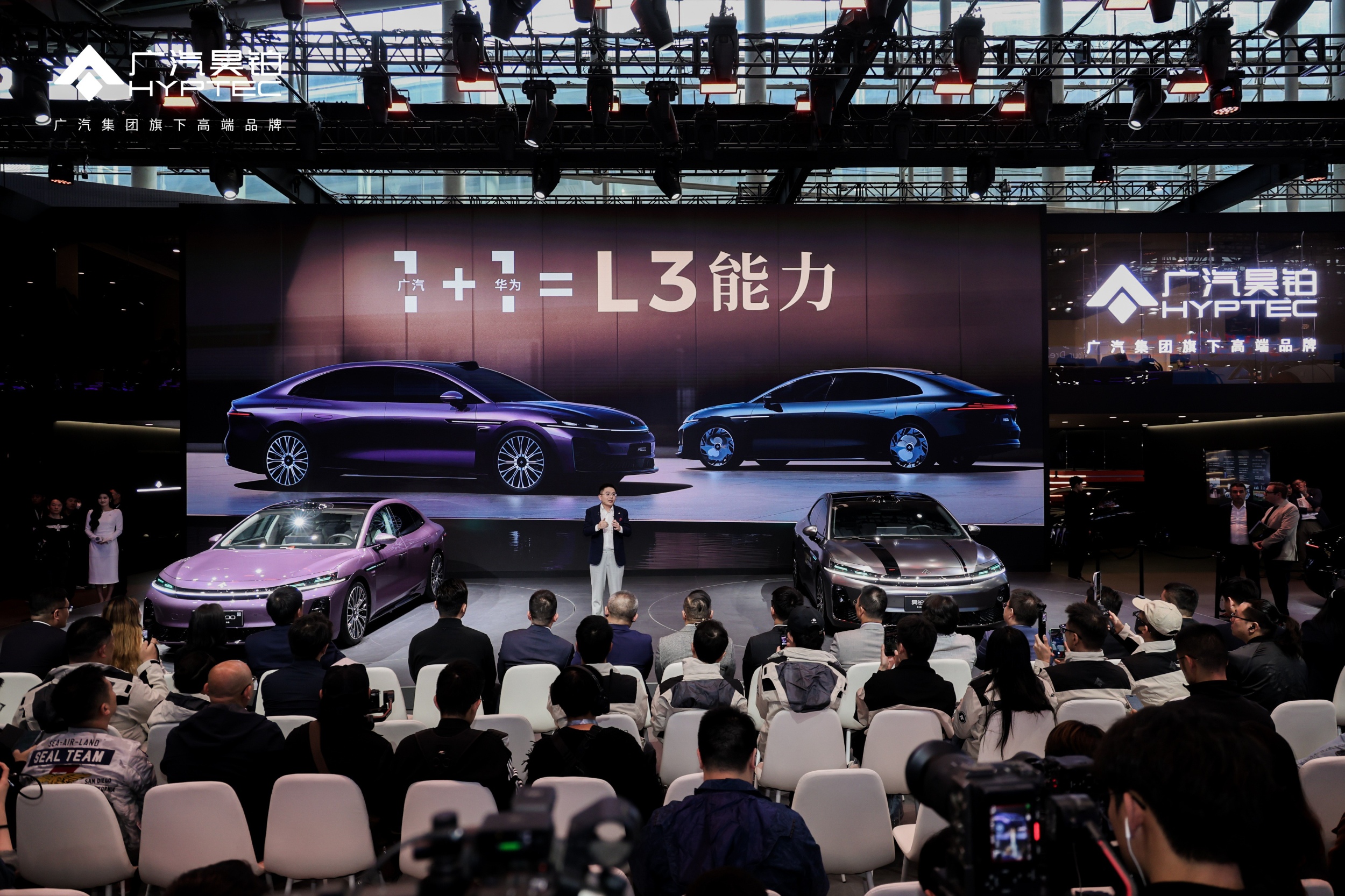
Core Insights - GAC Aion's A800 has officially launched L3 conditional autonomous driving road testing, achieving a testing speed of 120 km/h, making it the first in the country to obtain a license for L3 highway testing at this speed [1][3][17] Group 1: Partnership and Development - The collaboration between GAC and Huawei has resulted in a comprehensive high-level intelligent driving solution, integrating GAC's Starling Safety Guardian System with Huawei's QianKun Intelligent Driving ADS 4 [5][7] - Over 30 car manufacturers are collaborating with Huawei, but GAC Aion stands out by being the first to secure the L3 highway testing license at 120 km/h [1][3] Group 2: Technological Advancements - The A800 features Huawei's QianKun ADS 4 system, which includes a 360° all-weather perception matrix with 34 high-precision sensors, enhancing its ability to recognize complex road conditions [5][7] - The decision-making capabilities of the A800 are powered by an advanced end-to-end architecture that processes vast amounts of road information in real-time, ensuring precise decision-making in various scenarios [5][7] Group 3: Safety Features - The vehicle incorporates eight key systems with dual redundancy to ensure basic driving capabilities in case of a single system failure, enhancing overall safety [7] - The collaboration aims to create the safest intelligent vehicle, demonstrating a commitment to the final preparations for the commercial launch of L3 technology [7] Group 4: Interior and User Experience - The A800 showcases innovative interior design and smart technology, featuring a unique "front and rear dual embrace" cockpit layout that balances driving enjoyment and passenger comfort [8][12][15] - The vehicle includes the HarmonySpace 5 cockpit, which transitions from simple Q&A interactions to proactive service based on user habits and situational awareness [15] Group 5: Market Positioning - The A800 represents a significant milestone in the transition from concept to reality, achieving over 95% fidelity to its concept car design, reflecting both aesthetic innovation and user-centric design [12][17] - The vehicle is positioned as a "Chinese intelligent flagship sedan," showcasing GAC and Huawei's technological prowess and commitment to redefining intelligent mobility [15][17]
广汽集团携全品牌登陆2025广州车展
Huan Qiu Wang· 2025-11-24 05:53
Core Viewpoint - The 23rd Guangzhou International Auto Show showcases GAC Group's achievements from the "Panyu Action" reform, emphasizing user-centric strategies and the introduction of four major engines: new technology, new products, new services, and new ecosystems to enhance user experience and competitiveness [1][3]. Group 1: New Technology - GAC Group aims to enhance user experience through breakthroughs in new energy power, safety, intelligent chassis, and AI technology, contributing to a better quality of life for users [3]. Group 2: New Products - The company has established a comprehensive R&D system for its independent brands to meet diverse user demands, ranging from daily commuting to high-quality travel experiences [3]. Group 3: New Services - GAC is promoting channel transformation to make services more accessible and is continuously enhancing over 300 features and experiences through OTA upgrades, ensuring vehicles remain updated and valuable [3]. Group 4: New Ecosystem - GAC plans to collaborate on energy ecosystems, charging networks, intelligent ecosystems, and innovative business models to create the best user experience [3]. Group 5: Product Showcase - At the auto show, GAC presented various smart technology models, including the flagship sedan A800 in collaboration with Huawei, and multiple models from GAC Trumpchi and GAC Aion. GAC Honda and GAC Toyota also showcased popular models and the latest achievements in their hybrid strategy [4]. Group 6: Commercial Vehicles - GAC launched the new energy heavy truck T9 and highlighted its subsidiaries, such as GAC Mobility and GAC Toyota Engine, at the exhibition [4].