AGRICULTURAL BANK OF CHINA(601288)

Search documents
多家银行公告!落实个人消费贷款最新财政贴息政策
Sou Hu Cai Jing· 2026-01-23 19:43
Core Viewpoint - The implementation of the latest fiscal interest subsidy policy for personal consumption loans aims to boost consumption and expand domestic demand, with several major banks actively participating in this initiative [1][6][7][8][9]. Group 1: Policy Implementation - The fiscal interest subsidy policy for personal consumption loans has been extended until December 31, 2026, covering the period from September 1, 2025, to December 31, 2026 [6][10]. - The credit card installment payment subsidy policy will be effective from January 1, 2026, to December 31, 2026 [6]. Group 2: Policy Optimization - The policy has been optimized to include credit card installment payments, expanding the support range [9][11]. - The subsidy criteria have been broadened by removing the restriction on single transactions of 50,000 yuan and above [9][12]. - The subsidy standards have been improved by eliminating the 500 yuan cap on single transaction subsidies and the 1,000 yuan cap for individual borrowers at the same financial institution [9][12]. - Customers who have previously signed the personal consumption loan subsidy agreement will automatically benefit from the new subsidy policy starting January 1, 2026, without needing to re-sign the agreement [12].




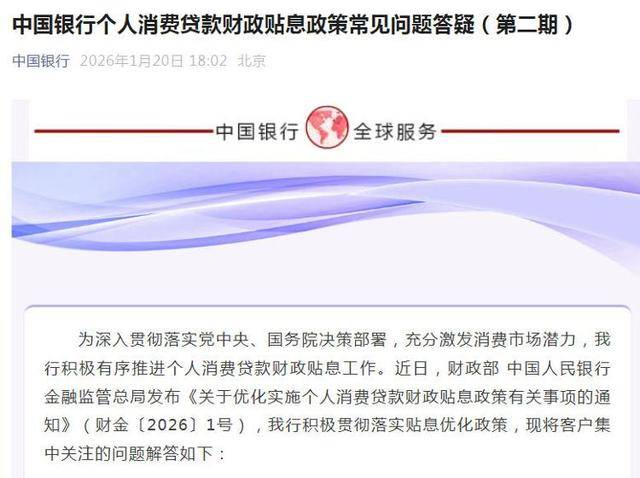
消费贷利率降至2%?银行优化贴息方案
Zhong Guo Zheng Quan Bao· 2026-01-23 12:17
Core Viewpoint - The recent optimization of the personal consumption loan interest subsidy policy by the Ministry of Finance, the People's Bank of China, and the financial regulatory authority aims to stimulate consumer spending and economic recovery by extending the policy until the end of 2026 and broadening its scope [1][2][3] Group 1: Policy Changes - The minimum annual interest rate for personal consumption loans is now 3%, with a subsidy rate of 1%, allowing for a maximum subsidy of 3,000 yuan for loans of 300,000 yuan [1] - The updated policy now includes credit card installment payments under the subsidy scheme, which was previously excluded [2] - Restrictions on the usage scenarios for subsidies have been lifted, allowing for broader applicability beyond specific categories like car purchases and home appliances [2] Group 2: Implementation and Impact - Borrowers can sign agreements through mobile banking to access the subsidy, with the system automatically calculating eligible subsidy amounts during repayment [3] - The policy is expected to enhance consumer spending potential and provide targeted support for economic recovery, as noted by industry experts [3]

2025年债券承销机构成绩单出炉:中国银行、中信证券领跑
2 1 Shi Ji Jing Ji Bao Dao· 2026-01-23 11:43
Core Insights - The bond underwriting market in 2025 shows a clear trend of "the strong getting stronger," with market share concentrated among a few leading institutions [1][4][8] - Competition among underwriters is intensifying, with banks and securities firms leveraging their unique strengths to differentiate themselves [2][6] - Regulatory bodies are taking steps to ensure market order and prevent irrational competition, particularly in pricing and underwriting practices [2][6] Group 1: Market Overview - The total bond issuance in 2025 reached 89.76 trillion yuan, a year-on-year increase of approximately 11% [2] - The issuance of interest rate bonds was 33.80 trillion yuan, up 18%, while credit bonds reached 21.95 trillion yuan, growing by 8% [2] - The market is characterized by a large total volume, diverse categories, and differentiated competition [2] Group 2: Competitive Landscape - In the banking sector, China Bank led with over 16 trillion yuan in underwriting, capturing more than 10% of the market share [4] - The top four state-owned banks collectively hold nearly 40% of the market share, indicating a strong position [4] - In the securities sector, CITIC Securities topped the list with 22,496.07 billion yuan in underwriting and a market share of 14.08% [4][5] Group 3: Sector-Specific Insights - Local government bond issuance reached a record high of approximately 10.29 trillion yuan, reflecting a year-on-year growth of 5.2% [6] - The financial bond market is predominantly led by securities firms, with CITIC Securities holding a market share of 17.56% [6] - The asset-backed securities (ABS) market shows a concentration of resources among leading firms, with CITIC Securities leading at 12.32% market share [7] Group 4: International Market Dynamics - The offshore bond market saw a total issuance of approximately $307.07 billion, a year-on-year increase of about 15.75% [7][8] - The market features a mix of domestic and foreign institutions, with China Bank leading at $14.70 billion in underwriting [8] - The competitive landscape in the offshore market is relatively dispersed, with no single institution dominating [8]


25Q4基金对银行持仓点评:主动基金环比持平,被动基金增持
GUOTAI HAITONG SECURITIES· 2026-01-23 11:10
股票研究 /[Table_Date] 2026.01.23 票 研 究 主动基金环比持平,被动基金增持 [Table_Industry] 商业银行 | [姓名table_Authors] | 电话 | 邮箱 | 登记编号 | | --- | --- | --- | --- | | 马婷婷(分析师) | 021-23185608 | matingting@gtht.com | S0880525100001 | | 陈惠琴(分析师) | 021-38676666 | chenhuiqin@gtht.com | S0880525100003 | 本报告导读: 25Q4 主动基金对银行持仓比例环比持平于 1.9%,被动基金持仓比例环比+1.6pct 至 7.0%,其中宁波银行、兴业银行、中国银行、建设银行等获主动基金增配。 25Q4 基金对银行持仓点评 投资要点: [Table_Summary] 2025 年四季度基金重仓持股情况披露(主动基金包括普通股票型、 偏股混合型、灵活配置型,被动基金包括被动指数型、指数增强型): [Table_Report] 相关报告 商业银行《国有大行投放力度较大,不良压力或 企稳》20 ...




丈量地方性银行(1):江苏127家区域性银行全梳理-20260123
GF SECURITIES· 2026-01-23 11:08
Investment Rating - The industry investment rating is "Buy" [2] Core Insights - The report provides a comprehensive analysis of 127 regional banks in Jiangsu Province, highlighting their asset and liability structures, profitability, and asset quality [6][18] - Jiangsu's regional banks have shown a significant increase in asset growth, with major city commercial banks growing at 19.4%, surpassing the growth of listed city commercial banks at 14.2% [24][26] - The report indicates that the loan-to-asset ratio for city commercial banks is projected to reach 48.4% in 2024, reflecting a gradual increase in lending activities [30] - Jiangsu's regional banks exhibit better return on assets (ROA) compared to listed banks, with city commercial banks outperforming by 16 basis points and rural commercial banks by 9 basis points [6][42] - The asset quality of Jiangsu's regional banks is superior to that of listed banks, with lower non-performing loan ratios and higher provision coverage ratios [6][42] Summary by Sections 1. Economic Structure of Jiangsu Province - Jiangsu Province is focusing on new industrialization and strategic emerging industries, with significant contributions from cities like Nanjing and Suzhou [13][14] 2. Overview of 127 Regional Banks in Jiangsu - The report categorizes the banks into city commercial banks, rural commercial banks, and others, with a total of 127 banks established between 2006 and 2015 [18][20] 3. Asset/Liability Structure - The asset growth of major city commercial banks is accelerating, while rural commercial banks are experiencing a decline in growth rates [24][26] - The loan-to-asset ratio for city commercial banks is expected to increase to 48.4% by 2024, indicating a shift towards more lending [30] 4. Profitability - Jiangsu's regional banks have a higher ROA compared to listed banks, with city commercial banks showing a 16 basis point advantage [6][42] 5. Asset Quality/Capital Levels - Jiangsu's regional banks maintain a lower non-performing loan ratio compared to listed banks, with city commercial banks having a 30 basis point lower ratio [6][42]

个人消费贷“国补”政策加码,实际利率跌入2字头
2 1 Shi Ji Jing Ji Bao Dao· 2026-01-23 10:49
Group 1 - The Ministry of Finance, the People's Bank of China, and the Financial Regulatory Administration have extended the personal consumption loan interest subsidy policy until the end of 2026, indicating a reinforcement of the "national subsidy" policy for personal consumption loans [1] - Major state-owned banks, including ICBC, ABC, BOC, CCB, BOCOM, and PSBC, have announced the implementation of the optimized personal consumption loan subsidy policy, which includes extending the policy deadline, expanding the support scope, and raising the subsidy standards [1][2] - The actual interest rates for high-quality customers benefiting from the subsidy can drop to around 2%, which is lower than the current housing loan rates, with annualized rates for consumer loans generally remaining around 3% [2] Group 2 - Ant Consumer Finance has also extended its subsidy policy until the end of 2026, removing the previous limit on single transaction subsidies and supporting diverse consumer needs [3] - Various banks are actively launching promotional measures, such as increasing loan limits and maintaining low interest rates, to stimulate consumer spending, especially in response to the upcoming Spring Festival [4] - The combination of fiscal subsidies and financial incentives from banks aims to lower consumer financing costs and enhance customer loyalty, effectively driving consumption [4]


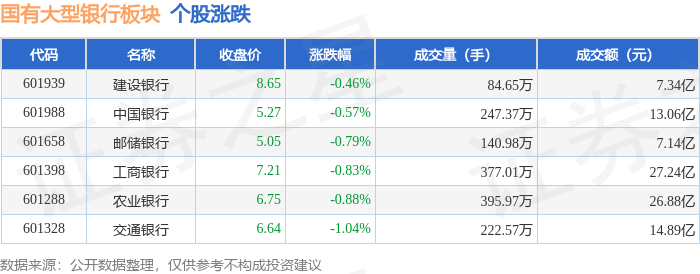
国有大型银行板块1月23日跌0.8%,交通银行领跌,主力资金净流出2.08亿元
Zheng Xing Xing Ye Ri Bao· 2026-01-23 09:04
Group 1 - The core viewpoint of the news is that the state-owned large bank sector experienced a decline of 0.8% on January 23, with the Bank of Communications leading the drop [1] - The Shanghai Composite Index closed at 4136.16, up 0.33%, while the Shenzhen Component Index closed at 14439.66, up 0.79% [1] - The trading performance of individual state-owned banks showed varying degrees of decline, with Agricultural Bank down 0.88% and Bank of Communications down 1.04% [1] Group 2 - The net outflow of main funds from the state-owned large bank sector was 208 million yuan, while retail funds saw a net outflow of 63.04 million yuan [1] - The table of fund flows indicates that the Bank of Communications had a main fund net inflow of 78.11 million yuan, but also a significant retail net outflow of 55.17 million yuan [2] - Agricultural Bank experienced the largest main fund net outflow of 149 million yuan, despite a retail net inflow of 89.79 million yuan [2]
关于落实个人消费贷款财政贴息政策优化 六大行集体公告
Sou Hu Cai Jing· 2026-01-23 06:45
Group 1 - The core viewpoint of the news is that major Chinese banks have announced the implementation of an optimized personal consumption loan interest subsidy policy, which will automatically apply to eligible loans after January 1, 2026 [1][3] Group 2 - The implementation period for the personal consumption loan interest subsidy policy has been extended to December 31, 2026 [3] - The support scope has been expanded to include credit card bill installment services [3] - The subsidy field has been broadened by removing the restriction on single transactions of 50,000 yuan and above [3] - The subsidy standards have been improved by eliminating the cap of 500 yuan on single transaction subsidies and the cumulative subsidy limit of 1,000 yuan for each borrower at a single institution for amounts below 50,000 yuan [3]
多家银行发布公告,明确个人消费贷款财政贴息细节
Sou Hu Cai Jing· 2026-01-23 06:18
Core Viewpoint - The Ministry of Finance, the People's Bank of China, and the Financial Regulatory Administration have extended the implementation period of the personal consumption loan interest subsidy policy until the end of this year and included credit card installment services in the support scope, prompting several financial institutions to announce related service measures [1]. Group 1: Policy Implementation - The personal consumption loan interest subsidy policy will be effective from September 1, 2025, to December 31, 2026, as stated by major state-owned banks [3]. - Consumers who have already signed the "Personal Consumption Loan Interest Subsidy Service Agreement" will automatically benefit from the new subsidy policy for consumption occurring after January 1, 2026, without needing to sign a new agreement [2][3]. Group 2: Adjustments in Consumption Loan Areas - The China Bank has removed the restriction on consumption transactions of 50,000 yuan (inclusive) and above, meaning that transactions in this range will no longer be limited to specific categories such as household vehicles, education, and healthcare [5]. - The Industrial and Commercial Bank of China has detailed the subsidy scope, which includes areas such as household vehicles, elderly care, education, cultural tourism, home decoration, electronic products, and healthcare [7]. Group 3: Credit Card Installment Details - The Bank of Communications has set the annual interest subsidy rate for credit card bill installments at 1%, with a maximum subsidy limit of 3,000 yuan per year for each borrower across all personal consumption loans and credit card installments [9]. Group 4: Inclusion of Financial Institutions - The new policy also includes city commercial banks, rural commercial banks, foreign banks, consumer finance companies, and auto finance companies as processing institutions, facilitating access for the public [11]. Group 5: Monitoring and Compliance - Financial institutions are required to strengthen monitoring of loan purposes and fund flows, with penalties for fraudulent activities or misuse of funds, including the potential recovery of subsidies already granted [13].
信用卡分期也有补贴,多家银行响应
Hua Xia Shi Bao· 2026-01-23 06:17
Core Viewpoint - The Ministry of Finance, the People's Bank of China, and the Financial Regulatory Bureau have extended the personal consumption loan interest subsidy policy until the end of 2026, allowing each borrower to enjoy a subsidy cap of 3,000 yuan, and including credit card installment payments in the support scope [2][3]. Group 1: Policy Changes - The implementation period for the personal consumption loan interest subsidy policy is now from September 1, 2025, to December 31, 2026 [3]. - The policy has removed the previous cap of 500 yuan on single transaction subsidies and the cumulative subsidy cap of 1,000 yuan for loans below 50,000 yuan, while maintaining the annual cap of 3,000 yuan per borrower at a single institution [5]. Group 2: Bank Responses - Major banks such as China Construction Bank and China Merchants Bank have announced that customers who previously signed subsidy agreements will automatically apply the new subsidy policy without needing to re-sign [4]. - The Industrial and Commercial Bank of China has launched a dedicated section for "Fiscal Subsidy and Installment Relief" on its app, allowing users to manage their installment payments and subsidies through various channels [6]. Group 3: Credit Card Inclusion - The inclusion of credit card installment payments in the subsidy policy aims to shift the focus from large purchases to frequent daily spending, thereby activating overall consumer demand [7]. - This move is expected to effectively reach a large consumer base, particularly targeting younger and lower-tier market segments, enhancing the consumption potential in these areas [7]. Group 4: Consumer Finance Companies - Consumer finance companies are actively adapting to the policy changes, ensuring that subsidy benefits reach consumers efficiently [10]. - Ant Group's consumer finance division has reported a 23% year-on-year increase in subsidies provided to consumers, indicating a positive impact on consumer spending [10]. Group 5: Specific Initiatives - Haier's consumer finance service has introduced interest-free installment plans for home appliances, contributing to the revitalization of the home appliance market [11]. - Other financial institutions, such as Zhaolian Finance and Du Xiaoman, have launched promotional activities to attract new customers and reduce borrowing costs through various interest subsidy initiatives [11].