
ICBC(601398)

Search documents
涉及贵金属!国有大行再出手,部分杠杆降至1倍
Xin Lang Cai Jing· 2026-02-28 00:40
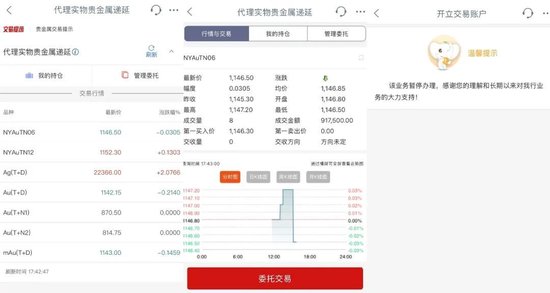
Core Viewpoint - Recent adjustments by major banks in China have raised the margin requirements for personal precious metal trading to 100%, reflecting increased market risks and aiming to protect investors' interests [1][2][4]. Group 1: Margin Adjustments - Industrial and Commercial Bank of China (ICBC) announced that starting February 27, 2026, the margin for various gold and silver contracts will increase from 80% to 100%, effectively reducing leverage from 1.25 times to 1 time [1][2]. - Agricultural Bank of China (ABC) also stated that from February 26, 2026, the margin for similar contracts will be adjusted to 100% due to heightened market volatility [4]. - Construction Bank (CCB) confirmed the same margin increase for its contracts effective February 27, 2026, aligning with the other major banks [4]. Group 2: Historical Context and Trends - Prior to these adjustments, ICBC had raised the margin from 60% to 80% on February 9, 2026, indicating a trend of tightening risk management in response to market conditions [2][4]. - Postal Savings Bank had previously set a higher margin of 120% for certain contracts, reflecting a significant increase in trading thresholds [4]. - The adjustments are part of a broader trend where banks are tightening personal precious metal trading operations, including closing inactive accounts and limiting functionalities [10][11]. Group 3: Market Implications - The increase in margin requirements means that investors must now fully fund their trades, eliminating the ability to leverage their positions [6]. - The adjustments come amid a significant rise in gold prices, with projections suggesting that international gold prices could reach $6,000 per ounce by 2026, although volatility is expected to increase [12].




21家系统重要性银行名单出炉:5家城商行入围
Zhong Guo Jing Ying Bao· 2026-02-27 18:53
Core Viewpoint - The People's Bank of China and the National Financial Regulatory Administration have released a list of 21 systemically important banks in China, which includes 5 city commercial banks, aiming to enhance macro-prudential management and regulatory oversight [1][7]. Group 1: Regulatory Requirements - The selected banks will face higher regulatory requirements, including increased capital thresholds ranging from 0.25% to 1.5% in additional capital requirements, which must be in the form of core Tier 1 capital [3][6]. - The banks will also need to develop detailed recovery and resolution plans (RRP), enhancing their governance, risk management, and data governance capabilities [3][4]. Group 2: Impact on Banking Operations - The operational behaviors of the selected banks will be scrutinized more closely, focusing on their business scale, complexity, interconnections, and substitutability to prevent risk concentration [4][5]. - The inclusion in the list will drive internal management upgrades, requiring banks to invest in risk measurement, stress testing, data aggregation, and corporate governance [4][10]. Group 3: Market Perception and Financing Costs - Inclusion in the list may enhance the market reputation and customer confidence of the banks, but the higher regulatory demands could impact their profitability metrics in the short term [6][8]. - The dynamic nature of the assessment system suggests that more qualifying small and medium-sized banks may enter the list in the future, depending on their operational behaviors [8][9]. Group 4: Governance and Risk Culture - Strengthening corporate governance and risk culture is essential, with a focus on establishing effective boards and risk management committees within the systemically important banks [10]. - The effectiveness of macro-prudential management relies on a comprehensive regulatory framework that includes identification, monitoring, and resolution processes [10].






支持地方高水平对外开放 银行深耕跨境金融稳外贸
Zhong Guo Jing Ying Bao· 2026-02-27 18:51
Group 1: Core Insights - The Chinese government emphasizes the need for high-level opening-up to promote high-quality development and create a new development pattern, as highlighted in the 20th Central Committee's Fourth Plenary Session [1] - Local government work reports consistently prioritize "expanding high-level opening-up" as a key task for economic and social development [1][2][3] Group 2: Regional Initiatives - Shenzhen's 2026 government work report focuses on enhancing internationalization and open capabilities, promoting high-quality international economic cooperation, and deepening bilateral investment [2] - Heilongjiang's report identifies high-level opening-up as a critical task for the 14th Five-Year Plan, aiming to create a new high ground for northern opening and enhance international economic cooperation [3] - Shandong's report emphasizes trade innovation and the development of new markets, aiming to stabilize traditional markets while expanding into emerging ones [3] Group 3: Financial Sector Support - Financial institutions like Industrial and Commercial Bank of China and Bank of China are enhancing their service capabilities for export and multinational enterprises to improve domestic companies' competitiveness in international markets [1][6] - Banks are focusing on providing comprehensive financial solutions for cross-border operations, including international trade financing and cross-border loans [6][7] - The demand for cross-border financial services is increasing, prompting banks to innovate and adapt their service models to meet the diverse needs of enterprises [7][8]

金融助力乡村振兴:从“应急输血”到“长效造血”
Zhong Guo Jing Ying Bao· 2026-02-27 18:51
Core Viewpoint - The People's Bank of China and other regulatory bodies have issued guidelines to establish a normalized financial support mechanism aimed at preventing poverty and promoting rural revitalization, emphasizing the importance of long-term support rather than short-term aid [1][2] Financial Support Mechanism - The guidelines prioritize the establishment of a long-term financial support system, focusing on preventing poverty and revitalizing rural areas, with an emphasis on optimizing microcredit policies and directing resources to key rural areas [2][7] - Financial institutions are encouraged to transition from emergency support to institutionalized mechanisms to address potential risks and stimulate internal growth [2][8] Bank Initiatives - Agricultural Bank of China has implemented a "one county, one file" mechanism to accurately assess financial needs in poverty-stricken areas, with a loan balance of 603.3 billion yuan supporting nearly 920,000 impoverished individuals [3] - Industrial and Commercial Bank of China has increased its loan balance to poverty-stricken areas to approximately 1.36 trillion yuan, with a 12.1% increase in loans to key rural revitalization counties [4] Challenges in Implementation - Financial institutions face challenges such as risk management, high operational costs, and the need for a more collaborative approach among banks to avoid fragmented funding [5][9] - The lack of a robust credit system and insufficient digital integration hinder the effective delivery of financial services to rural areas [9] Recommendations for Improvement - Banks are advised to leverage digital transformation to reduce costs and improve efficiency, and to innovate financial products tailored to local needs [6][8] - Collaboration with government and guarantee institutions is essential to establish risk-sharing mechanisms and enhance the sustainability of financial support [6][8]
多家银行上调个人客户上金所延期合约保证金比例
Zheng Quan Ri Bao· 2026-02-27 16:37
Core Viewpoint - The recent increase in risk within the precious metals market has led several major state-owned banks in China to adjust the margin requirements for personal clients trading on the Shanghai Gold Exchange [1][2]. Group 1: Margin Requirement Adjustments - On February 24, the Bank of China announced adjustments to the margin requirements and price fluctuation limits for personal clients trading gold and silver deferred contracts [1]. - Agricultural Bank of China stated that starting from February 26, 2026, the margin requirement for Au (T+D), mAu (T+D), and Ag (T+D) contracts will be increased from 80% to 100% [1]. - Industrial and Commercial Bank of China (ICBC) also announced that from February 27, 2026, the margin requirement for various gold and silver contracts will be raised to 100% [1]. Group 2: Rationale Behind Adjustments - ICBC's customer service indicated that the adjustment to a 100% margin requirement is a response to significant price volatility in the domestic and international precious metals markets, aimed at mitigating market risk and protecting investors [2]. - The increase in margin requirements effectively reduces the leverage available to traders, meaning that for a contract valued at 1 million yuan, the required margin will increase from 800,000 yuan to 1 million yuan [2]. - Financial expert Tian Lihui noted that the current international gold prices are at historically high levels, influenced by global "reflation" expectations, geopolitical risk premiums, and the reassessment of U.S. dollar credit, with banks raising margins to create necessary risk buffers and curb potential speculative bubbles [2].
25Q4银行业监管指标数据点评:净利润增速转正,息差阶段性企稳
Orient Securities· 2026-02-27 15:31
Investment Rating - The report maintains a "Positive" outlook for the banking sector in 2026 [5] Core Insights - The banking sector is expected to return to a fundamental narrative in 2026, supported by policy financial tools and resilient asset expansion. The net interest margin is anticipated to stabilize during the ongoing deposit repricing cycle, while structural risks are expected to receive policy support [3][48] - The report highlights two main investment themes: 1. High-quality mid-sized banks with solid fundamentals, including Nanjing Bank (601009, Buy), Ningbo Bank (002142, Buy), and Chongqing Rural Commercial Bank (601077, Buy) 2. Large state-owned banks with stable fundamentals and good defensive value, including Bank of Communications (601328, Not Rated) and Industrial and Commercial Bank of China (601398, Not Rated) [3][49] Summary by Sections Net Profit Growth - As of Q4 2025, the net profit growth of commercial banks turned positive at +2.3%, with a quarter-on-quarter increase of +2.3 percentage points, continuing the upward trend since Q2 2025. The growth rate for city and rural commercial banks improved significantly, rising by 11.1 percentage points and 11.9 percentage points compared to Q3 2025, respectively [8][9] Asset Growth and Credit Stability - Total asset growth for commercial banks reached 9.01% as of Q4 2025, with a quarter-on-quarter increase of +0.2 percentage points. The credit growth remained stable, with a year-on-year growth rate of 7.3% [12][12] Net Interest Margin Stabilization - The net interest margin for commercial banks remained stable at 1.42% in Q4 2025. The asset yield is under pressure, but there are positive marginal changes observed, with the new loan interest rate's year-on-year decline narrowing significantly [29][29] Asset Quality - The non-performing loan (NPL) ratio for commercial banks was 1.50% as of Q4 2025, with a quarter-on-quarter decrease of 2 basis points. The improvement in asset quality for rural commercial banks is primarily driven by significant NPL write-offs [33][34] Capital Adequacy - The core tier one capital adequacy ratio for commercial banks increased by 4 basis points to 12.60% as of Q4 2025, indicating an improvement in capital replenishment capacity [44][45]




保证金比例上调至100%!国有大行再压降贵金属业务杠杆
Guo Ji Jin Rong Bao· 2026-02-27 13:56
Core Viewpoint - Major banks have raised the margin ratio for personal precious metal deferred contracts to 100% as a proactive risk management measure in response to increased volatility in the precious metals market [1][4]. Group 1: Margin Ratio Adjustments - Industrial and Commercial Bank of China, Agricultural Bank of China, and China Construction Bank have all announced increases in the margin ratio for personal clients' deferred contracts on the Shanghai Gold Exchange to 100% [3][4]. - The margin ratio for various contracts, including Au (T+D) and Ag (T+D), has been adjusted from 80% to 100%, effectively eliminating trading leverage [3][4]. - This adjustment is part of a series of increases, with banks having already implemented 3 to 4 rounds of margin ratio hikes within the year [1][4]. Group 2: Risk Management Implications - Raising the margin ratio to 100% serves as a direct and effective risk control measure to protect investors from potential losses due to leveraged trading [1][5]. - Experts suggest that this move will help mitigate tail risks and operational pressures for banks while also reducing speculative trading volumes [5][8]. - The adjustment reflects a broader trend among state-owned banks to adopt more conservative risk parameters in light of market volatility [8]. Group 3: Market Outlook - The precious metals market is currently experiencing high volatility, influenced by geopolitical uncertainties and expectations of changes in global monetary policy [7]. - Despite short-term price fluctuations, structural demand, such as central bank gold purchases, provides a buffer for the market, reinforcing the strategic value of precious metals as a long-term investment [7]. - If gold and silver prices continue to exhibit high volatility, it is likely that more institutions will follow suit in raising margin ratios to maintain consistent investor protection [8].
工商银行党委研究部署树立和践行正确政绩观学习教育工作
Xin Lang Cai Jing· 2026-02-27 13:32
Core Viewpoint - The meeting of the Industrial and Commercial Bank of China (ICBC) emphasizes the importance of implementing the correct performance view as outlined by General Secretary Xi Jinping, marking it as a significant task for the party's construction this year [1][5]. Group 1: Meeting Objectives and Importance - The learning education initiative is a major deployment by the central leadership, crucial for implementing the strategic directives from the 20th Central Committee and ensuring the effective execution of the 14th Five-Year Plan [5]. - It aims to consolidate the results of internal party education, promote strict governance within the party, and enhance the construction of leadership teams and cadre [5]. Group 2: Implementation Strategies - The meeting calls for a focus on the theme of serving the public, making scientific decisions, and ensuring practical actions, while integrating learning, inspection, and rectification [6]. - It emphasizes the need for continuous learning through both collective and individual study, utilizing both positive and negative case studies for guidance and warning [6]. - The meeting stresses the importance of identifying and addressing issues based on party principles, ensuring that rectification efforts are closely linked with central inspections and the implementation of the 14th Five-Year Plan [6]. Group 3: Responsibilities and Coordination - The overall responsibility for the learning education lies with the bank's party committee, which will coordinate efforts through a dedicated working group [6]. - Each level of the party organization is tasked with ensuring effective implementation and guidance, focusing on practical outcomes and avoiding formalism [6].

如何识别,怎样防范?这样的“反洗钱”宣传直达身边入脑入心
Xin Lang Cai Jing· 2026-02-27 09:08
Group 1 - The core viewpoint of the articles emphasizes the proactive measures taken by the Industrial and Commercial Bank of China (ICBC) in Yangzhou to enhance public awareness and prevention capabilities against money laundering risks [1][2]. - ICBC Yangzhou focuses on three main promotional scenarios: streets, communities, and enterprises, aiming to deliver anti-money laundering knowledge directly to the public and businesses [1]. - The bank engages with local communities, such as Jiangwang Street, to explain common money laundering methods and hidden characteristics using simple language, particularly highlighting risks related to large gold purchases and online transactions [1]. Group 2 - A specialized campaign titled "Anti-Money Laundering Knowledge for the Elderly" was conducted in the Jiefangqiao community, targeting the elderly who are often vulnerable to financial scams [2]. - The campaign utilized case analysis and situational reminders to educate the elderly about common scams, such as "gold purchasing" and "unqualified financial management," and the potential legal risks and financial losses associated with them [2]. - ICBC also tailored anti-money laundering presentations for businesses, focusing on themes like "gold investment fraud" and the dangers of account leasing, to raise awareness of the impact of money laundering on personal credit and corporate reputation [2].
瑞雪迎祥币 服务暖人心——工行南通崇川人民路支行马年纪念币兑换圆满收官
Jiang Nan Shi Bao· 2026-02-27 04:25
Core Viewpoint - The launch of the 2026 Year of the Horse commemorative coin and banknote exchange took place despite adverse weather conditions, showcasing strong public interest and effective service management by the bank [1][2]. Group 1: Event Overview - The exchange for the 2026 Year of the Horse commemorative coin and banknote began on January 20, 2026, amidst heavy snowfall and icy road conditions in Nantong [1]. - Long queues formed outside the Industrial and Commercial Bank of China (ICBC) Nantong Chongchuan People's Road branch, indicating high demand for the commemorative items [1]. Group 2: Service Management - The bank implemented thorough planning and preparation to ensure smooth operations, including site layout assessments and process optimizations for the exchange [1]. - Staff received comprehensive training to handle various operational tasks, including appointment verification and payment processing, while also providing amenities like hot water and non-slip mats for customer comfort [1]. Group 3: Customer Engagement - Many collectors arrived early to participate in the exchange, with some waiting an hour before the opening [1]. - The bank's emergency plan was activated to manage increasing customer flow, leading to the establishment of two dedicated exchange windows for efficient service [2]. Group 4: Exchange Performance - By the end of the day, the branch successfully completed exchanges for nearly 500 customers, ranking among the top in the region for exchange volume [2]. - The commemorative coin, part of the second round of zodiac coins, was highly sought after, with reservations selling out quickly, reflecting its artistic and collectible value [2].