Bank of RuiFeng(601528)

Search documents
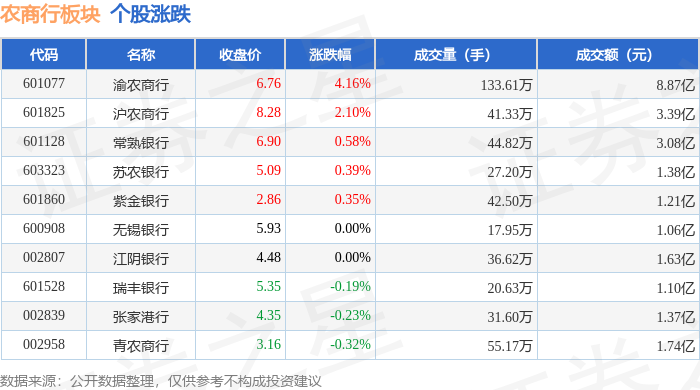
农商行板块10月13日涨2.42%,渝农商行领涨,主力资金净流入5644.17万元
Zheng Xing Xing Ye Ri Bao· 2025-10-13 12:45
Market Performance - The rural commercial bank sector increased by 2.42% on October 13, with Yunnan Rural Commercial Bank leading the gains [1] - The Shanghai Composite Index closed at 3889.5, down 0.19%, while the Shenzhen Component Index closed at 13231.47, down 0.93% [1] Individual Stock Performance - Yunnan Rural Commercial Bank (601077) closed at 6.76, up 4.16% with a trading volume of 1.3361 million shares and a transaction value of 887 million [1] - Shanghai Rural Commercial Bank (601825) closed at 8.28, up 2.10% with a trading volume of 413,300 shares and a transaction value of 339 million [1] - Jiangyin Bank (002807) and Zijin Bank (601860) showed minimal gains of 0.00% and 0.35% respectively, with transaction values of 163 million and 121 million [1] Capital Flow Analysis - The rural commercial bank sector saw a net inflow of 56.4417 million from main funds, while retail funds experienced a net outflow of 42.047 million [1] - Yunnan Rural Commercial Bank had a main fund net inflow of 47.1867 million, but retail funds saw a net outflow of 24.1221 million [2] - Zijin Bank experienced a main fund net inflow of 10.8185 million, with retail funds showing a net outflow of 1.1618 million [2]






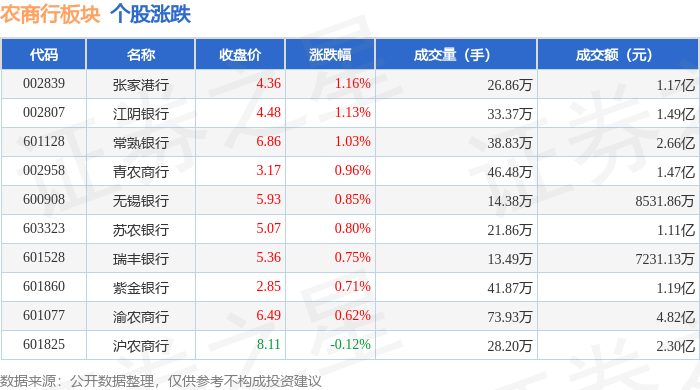
农商行板块10月10日涨0.52%,张家港行领涨,主力资金净流出179.78万元
Zheng Xing Xing Ye Ri Bao· 2025-10-10 08:46
Core Viewpoint - The rural commercial bank sector experienced a slight increase of 0.52% on October 10, with Zhangjiagang Bank leading the gains, while the overall market indices, including the Shanghai Composite Index and Shenzhen Component Index, saw declines of 0.94% and 2.7% respectively [1] Group 1: Market Performance - On October 10, the Shanghai Composite Index closed at 3897.03, down 0.94%, and the Shenzhen Component Index closed at 13355.42, down 2.7% [1] - The rural commercial bank sector's individual stock performance showed varying degrees of increase, with Zhangjiagang Bank rising by 1.16% to a closing price of 4.36 [1] Group 2: Trading Volume and Capital Flow - The trading volume for Zhangjiagang Bank was 268,600 shares, with a transaction value of 117 million yuan [1] - The rural commercial bank sector saw a net outflow of 1.7978 million yuan from main funds and a net outflow of 21.0196 million yuan from speculative funds, while retail investors contributed a net inflow of 22.8173 million yuan [1] Group 3: Individual Stock Capital Flow - For the stocks analyzed, the main capital inflow was observed in Hu Nong Bank with 16.1411 million yuan, while the largest outflow was from Changshu Bank at 13.5807 million yuan [2] - Retail investors showed a significant net inflow in Changshu Bank, amounting to 23.4478 million yuan, despite the main and speculative funds showing outflows [2]




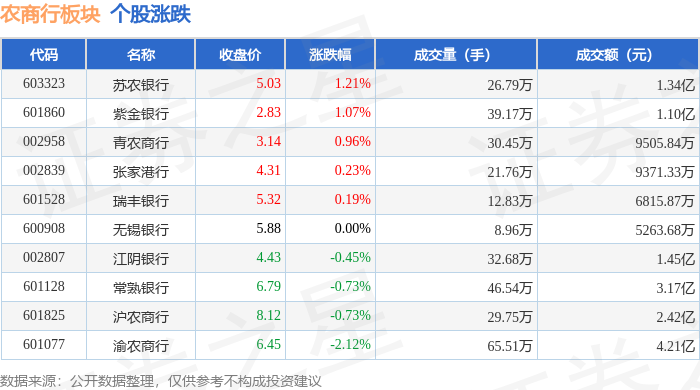
农商行板块10月9日跌0.68%,渝农商行领跌,主力资金净流出950.61万元
Zheng Xing Xing Ye Ri Bao· 2025-10-09 09:03
Core Insights - The rural commercial bank sector experienced a decline of 0.68% on October 9, with Yunnan Rural Commercial Bank leading the drop [1] - The Shanghai Composite Index closed at 3933.97, up 1.32%, while the Shenzhen Component Index closed at 13725.56, up 1.47% [1] Sector Performance - The following banks showed varying performance: - Su Nong Bank: Closed at 5.03, up 1.21% with a trading volume of 267,900 shares and a turnover of 134 million yuan [1] - Zijin Bank: Closed at 2.83, up 1.07% with a trading volume of 391,700 shares and a turnover of 110 million yuan [1] - Qing Nong Commercial Bank: Closed at 3.14, up 0.96% with a trading volume of 304,500 shares and a turnover of 95.06 million yuan [1] - Zhangjiagang Bank: Closed at 4.31, up 0.23% with a trading volume of 217,600 shares and a turnover of 93.71 million yuan [1] - Ruifeng Bank: Closed at 5.32, up 0.19% with a trading volume of 128,300 shares and a turnover of 68.16 million yuan [1] - Wuxi Bank: Closed at 5.88, unchanged with a trading volume of 89,600 shares and a turnover of 52.64 million yuan [1] - Jiangyin Bank: Closed at 4.43, down 0.45% with a trading volume of 326,800 shares and a turnover of 145 million yuan [1] - Changshu Bank: Closed at 6.79, down 0.73% with a trading volume of 465,400 shares and a turnover of 317 million yuan [1] - Hu Nong Bank: Closed at 8.12, down 0.73% with a trading volume of 297,500 shares and a turnover of 242 million yuan [1] - Yunnan Rural Commercial Bank: Closed at 6.45, down 2.12% with a trading volume of 655,100 shares and a turnover of 421 million yuan [1] Capital Flow Analysis - The rural commercial bank sector saw a net outflow of 9.51 million yuan from main funds, while speculative funds had a net inflow of 59.77 million yuan, and retail investors experienced a net outflow of 50.26 million yuan [1] - Specific capital flows for selected banks include: - Yunnan Rural Commercial Bank: Main funds net inflow of 61.64 million yuan, speculative funds net inflow of 21.83 million yuan, and retail net outflow of 83.48 million yuan [2] - Ruifeng Bank: Main funds net inflow of 4.05 million yuan, speculative funds net outflow of 1.54 million yuan, and retail net outflow of 2.51 million yuan [2] - Qing Nong Commercial Bank: Main funds net inflow of 2.37 million yuan, speculative funds net outflow of 6.20 million yuan, and retail net outflow of 3.83 million yuan [2] - Zhangjiagang Bank: Main funds net inflow of 1.55 million yuan, speculative funds net outflow of 3.13 million yuan, and retail net inflow of 1.58 million yuan [2] - Wuxi Bank: Main funds net outflow of 0.93 million yuan, speculative funds net inflow of 0.63 million yuan, and retail net inflow of 0.30 million yuan [2] - Zijin Bank: Main funds net outflow of 1.10 million yuan, speculative funds net inflow of 3.72 million yuan, and retail net outflow of 2.62 million yuan [2] - Jiangyin Bank: Main funds net outflow of 5.86 million yuan, speculative funds net outflow of 11.33 million yuan, and retail net inflow of 17.19 million yuan [2] - Hu Nong Bank: Main funds net outflow of 6.30 million yuan, speculative funds net inflow of 6.54 million yuan, and retail net outflow of 0.25 million yuan [2] - Su Nong Bank: Main funds net outflow of 22.55 million yuan, speculative funds net inflow of 20.66 million yuan, and retail net inflow of 0.19 million yuan [2] - Changshu Bank: Main funds net outflow of 42.38 million yuan, speculative funds net inflow of 28.58 million yuan, and retail net inflow of 13.80 million yuan [2]
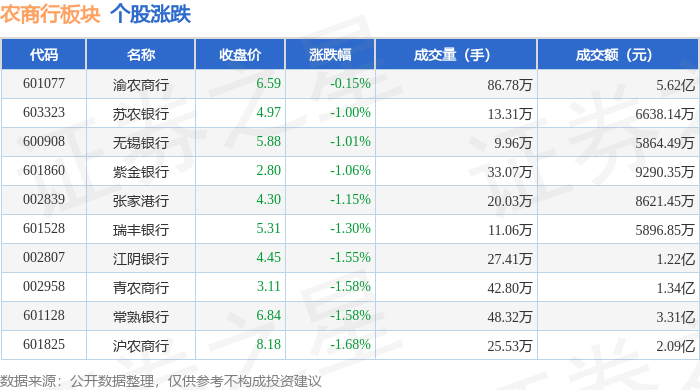
农商行板块9月30日跌1.16%,沪农商行领跌,主力资金净流出193.06万元
Zheng Xing Xing Ye Ri Bao· 2025-09-30 08:51
Market Overview - The rural commercial bank sector experienced a decline of 1.16% on September 30, with the Shanghai Rural Commercial Bank leading the drop [1] - The Shanghai Composite Index closed at 3882.78, up 0.52%, while the Shenzhen Component Index closed at 13526.51, up 0.35% [1] Individual Stock Performance - The closing prices and changes for key rural commercial banks are as follows: - Yunnan Rural Commercial Bank: 6.59, -0.15% - Jiangsu Rural Bank: 4.97, -1.00% - Wuxi Bank: 5.88, -1.01% - Zijin Bank: 2.80, -1.06% - Zhangjiagang Bank: 4.30, -1.15% - Ruifeng Bank: 5.31, -1.30% - Jiangyin Bank: 4.45, -1.55% - Qingnong Bank: 3.11, -1.58% - Changshu Bank: 6.84, -1.58% - Shanghai Rural Commercial Bank: 8.18, -1.68% [1] Capital Flow Analysis - The rural commercial bank sector saw a net outflow of 1.93 million yuan from main funds, while speculative funds had a net inflow of 38.39 million yuan, and retail investors experienced a net outflow of 36.46 million yuan [1] - Detailed capital flow for individual banks includes: - Yunnan Rural Commercial Bank: Main funds net inflow of 38.13 million yuan, retail net outflow of 62.35 million yuan - Wuxi Bank: Main funds net inflow of 7.45 million yuan, retail net outflow of 6.08 million yuan - Jiangsu Rural Bank: Main funds net inflow of 3.52 million yuan, retail net outflow of 0.29 million yuan - Ruifeng Bank: Main funds net inflow of 1.14 million yuan, retail net outflow of 2.89 million yuan - Jiangyin Bank: Main funds net inflow of 0.52 million yuan, retail net outflow of 0.55 million yuan - Shanghai Rural Commercial Bank: Main funds net inflow of 0.13 million yuan, retail net inflow of 0.12 million yuan - Zhangjiagang Bank: Main funds net outflow of 10.63 million yuan, retail net inflow of 2.61 million yuan - Zijin Bank: Main funds net outflow of 11.13 million yuan, retail net inflow of 4.80 million yuan - Qingnong Bank: Main funds net outflow of 13.84 million yuan, retail net inflow of 9.58 million yuan - Changshu Bank: Main funds net outflow of 17.22 million yuan, retail net inflow of 22.50 million yuan [2]

机构密集“踩点”银行股 息差与资产质量等成焦点
Zhong Guo Zheng Quan Bao· 2025-09-29 22:14
Core Insights - The focus of institutional research has shifted towards regional banks in economically developed areas, particularly in the Yangtze River Delta, due to their strong performance and resilience [1][2][5] Group 1: Institutional Research Activity - As of September 29, A-share listed banks have been researched 326 times this year, with over 2000 institutions participating [2] - Regional city commercial banks and rural commercial banks in the Yangtze River Delta, such as Changshu Bank and Ningbo Bank, have been the most frequently researched [2][3] - Changshu Bank reported a revenue of 6.062 billion yuan, a 10.10% year-on-year increase, and a net profit of 1.969 billion yuan, up 13.51% year-on-year [2] Group 2: Key Concerns of Institutions - Institutions are primarily concerned with the stability of net interest margins, potential risks to asset quality, and future credit allocation strategies [3][4] - Shanghai Bank aims to enhance its credit allocation to key sectors and regions, focusing on technology, green finance, and inclusive finance [4] Group 3: Investment Value of Bank Stocks - The investment logic for bank stocks is evolving from valuation recovery to deep value discovery in high-quality banks amid industry differentiation [5][6] - The banking sector is expected to benefit from increased inflows of incremental capital, particularly from insurance funds, due to its high dividend returns and stable earnings [6]


机构密集“踩点”银行股息差与资产质量等成焦点
Zhong Guo Zheng Quan Bao· 2025-09-29 20:45
Core Viewpoint - The article highlights the increasing interest of institutional investors in regional banks, particularly in the Yangtze River Delta, due to their strong performance and resilience in a developed economic region [1][2]. Group 1: Institutional Research Focus - As of September 29, 2023, A-share listed banks have been surveyed over 300 times by more than 2000 institutions, with regional banks in the Yangtze River Delta receiving significant attention [1]. - Institutions are particularly focused on net interest margin stability, potential asset quality risks, and future credit allocation strategies during their research [2][3]. Group 2: Financial Performance of Regional Banks - Changshu Bank reported a revenue of 6.062 billion yuan, a year-on-year increase of 10.10%, and a net profit of 1.969 billion yuan, up 13.51% [2]. - The bank also declared its first interim cash dividend since its listing, distributing 0.15 yuan per share, totaling 499 million yuan [2]. Group 3: Investment Trends in Banking Sector - The investment logic for bank stocks is shifting from valuation recovery to deep value discovery of high-quality banks amid industry differentiation [3]. - As of September 29, 2023, the Shenwan Primary Bank Index closed at 4000.30 points, with a year-to-date increase of 2.33%, while individual stocks like Agricultural Bank, Qingdao Bank, and Pudong Development Bank rose over 20% [4]. - Institutional investments in bank stocks have increased, with insurance funds actively purchasing shares in various banks, indicating a preference for high dividend returns and stable earnings [4].

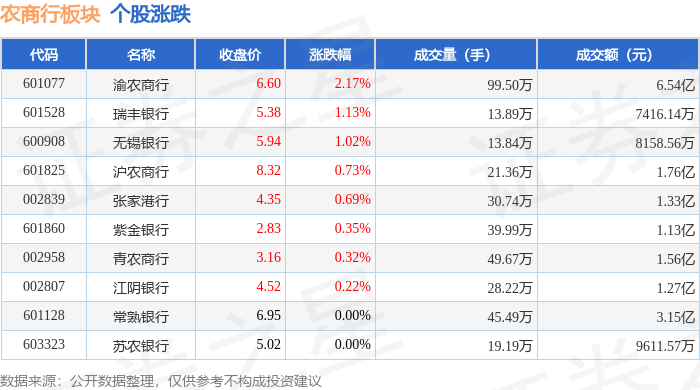
农商行板块9月29日涨0.94%,渝农商行领涨,主力资金净流出6645.88万元
Zheng Xing Xing Ye Ri Bao· 2025-09-29 08:45
Market Performance - The rural commercial bank sector increased by 0.94% on September 29, with Yunnan Rural Commercial Bank leading the gains [1] - The Shanghai Composite Index closed at 3862.53, up 0.9%, while the Shenzhen Component Index closed at 13479.43, up 2.05% [1] Individual Stock Performance - Yunnan Rural Commercial Bank (601077) closed at 6.60, with a rise of 2.17% and a trading volume of 995,000 shares, amounting to a transaction value of 654 million [1] - Other notable performers include Ruifeng Bank (601528) with a 1.13% increase, Wuxi Bank (600908) with a 1.02% increase, and Shanghai Rural Commercial Bank (601825) with a 0.73% increase [1] Capital Flow Analysis - The rural commercial bank sector experienced a net outflow of 66.4588 million from institutional investors, while retail investors saw a net inflow of 22.9898 million [1] - Specific stocks like Qingnong Bank (002958) had a net inflow of 9.1251 million from institutional investors, while Su Nong Bank (603323) had a net inflow of 613.43 million [2] Detailed Capital Flow for Selected Stocks - Yunnan Rural Commercial Bank had a significant net outflow of 50.7024 million from institutional investors, but a net inflow of 54.2507 million from retail investors [2] - Common trends show that while some banks like Zhangjiagang Bank (002839) attracted retail inflows, others like Changshu Bank (601128) faced substantial outflows from institutional investors [2]
上市银行不良出清与拨备压力观察
Guoxin Securities· 2025-09-29 02:04
Investment Rating - The industry is rated as "Outperform the Market" [2][3] Core Viewpoints - The stability of asset quality in the banking sector is attributed to the gradual clearing of non-performing loans across various sectors over the past 15 years, which has mitigated the impact on bank financial statements [1][2] - Banks have proactively adjusted their loan structures to reduce risk exposure, particularly by decreasing the proportion of loans to sectors experiencing rising non-performing loans [1][2] - The impact of non-performing loans on profit statements has been minimized due to banks' preemptive provisioning strategies, which have allowed for smoother profit reporting [1][2] - Non-credit areas of non-performing assets have also been cleared or are at a minimal level, contributing to the overall stability of bank risk profiles [1][2] Summary by Sections Non-Performing Loan Exposure and Clearing - The banking sector has experienced a 15-year process of risk resolution, with non-performing loans being gradually exposed and cleared [12] - The manufacturing and retail sectors have seen significant reductions in non-performing loans, achieving a return to levels similar to those seen in 2010 [26][30] Real Estate Sector - The real estate sector's non-performing loan ratio peaked in 2023 but has since shown signs of recovery, although it remains elevated [35][37] - The overall impact of real estate risks on bank loan portfolios is limited due to the relatively small proportion of real estate loans compared to total loans [37][38] City Investment Loans - The non-performing loan ratio for city investment loans has been declining since 2023, aided by debt reduction efforts [41][44] Retail Loans - Retail loan categories, including personal housing loans and credit card loans, are currently experiencing rising non-performing rates, indicating ongoing risk exposure [50][53] Other Loan Categories - Other loan categories, such as utilities and miscellaneous public loans, have minimal impact on overall bank risk due to their low non-performing rates [60][63] Loan Structure Adjustments - Banks have actively adjusted their loan structures in response to risk exposures, shifting focus towards lower-risk personal loans [66][68] Provisioning Strategies - Banks have utilized provisioning to smooth profit impacts from non-performing loans, with historical data indicating a capacity to release significant net profits from existing provisions [81][82] Investment Recommendations - The report suggests focusing on banks with strong asset quality and low provisioning pressure, such as Chengdu Bank and Changsha Bank, while also recommending cyclical stocks like Ningbo Bank and Changshu Bank for potential recovery [105]

上市银行“十四五回望”之资负结构与息差变迁
CMS· 2025-09-28 15:09
Investment Rating - The report maintains a recommendation for the banking industry [3] Core Insights - The report provides a comprehensive analysis of the asset-liability structure and interest margin changes of 42 A-share listed banks during the "14th Five-Year Plan" period, highlighting a shift towards corporate loans on the asset side and a stronger retail focus on the liability side [12][14] - The asset-liability structure indicates a significant increase in the proportion of corporate loans, rising from 57.02% to 63.22% from the end of 2020 to mid-2025, while the proportion of demand deposits decreased from 41.94% to 30% [12][14] - The report notes a decline in both asset yield and interest margin, with the yield on interest-earning assets dropping from 4.43% to 3.32% and the net interest margin decreasing from 2.23% to 1.53% during the same period [14][15] Summary by Sections Overall Asset-Liability Structure and Interest Margin Changes - The asset-liability structure shows an increase in loan-to-earning asset ratio from 54.19% to 56.49%, with corporate loans making up a larger share of total loans [14][15] - The average yield on interest-earning assets decreased significantly, with the loan yield falling from 5.34% to 3.82% [15] - The net interest margin for listed banks remains higher than that of commercial banks, despite a decline [14][15] Changes in Each Banking Sector's Asset-Liability Structure and Interest Margin - City commercial banks experienced a more significant increase in the proportion of corporate loans, with their interest margin narrowing less compared to other banks [18] - The report highlights that the proportion of deposits in interest-bearing liabilities for state-owned banks decreased, while it increased for rural commercial banks [18] - The decline in interest-bearing liabilities' cost rate was most pronounced in city commercial banks, leading to a smaller reduction in their interest margin [18]






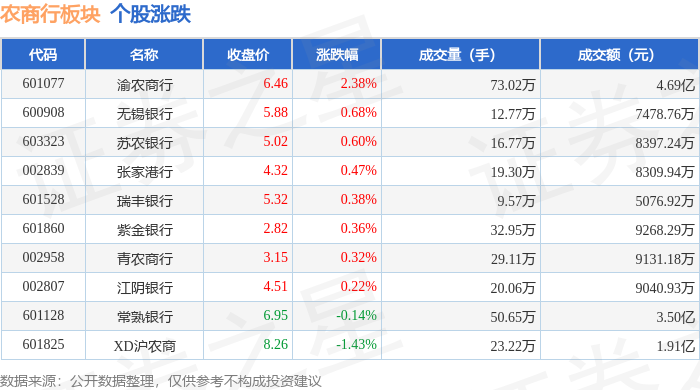
农商行板块9月26日跌0.74%,XD沪农商领跌,主力资金净流出3021.09万元
Zheng Xing Xing Ye Ri Bao· 2025-09-26 08:48
Market Overview - On September 26, the rural commercial bank sector declined by 0.74% compared to the previous trading day, with XD Hu Nong leading the decline [1] - The Shanghai Composite Index closed at 3828.11, down 0.65%, while the Shenzhen Component Index closed at 13209.0, down 1.76% [1] Individual Stock Performance - The following stocks in the rural commercial bank sector showed varying performance: - Chongqing Rural Commercial Bank (601077) closed at 6.46, up 2.38% with a trading volume of 730,200 shares [1] - Wuxi Bank (600908) closed at 5.88, up 0.68% with a trading volume of 127,700 shares [1] - Su Nong Bank (603323) closed at 5.02, up 0.60% with a trading volume of 167,700 shares [1] - Zhangjiagang Bank (002839) closed at 4.32, up 0.47% with a trading volume of 193,000 shares [1] - Ruifeng Bank (601528) closed at 5.32, up 0.38% with a trading volume of 95,700 shares [1] - Other banks like Jiangyin Bank (002807) and Changshu Bank (601128) showed minor fluctuations [1] Capital Flow Analysis - The rural commercial bank sector experienced a net outflow of 30.21 million yuan from institutional investors and 22.38 million yuan from retail investors, while retail investors saw a net inflow of 52.59 million yuan [1] - Specific capital flows for individual banks include: - Changshu Bank (601128) had a net inflow of 8.26 million yuan from institutional investors but a net outflow of 34.30 million yuan from retail investors [2] - Zijin Bank (601860) saw a net inflow of 7.99 million yuan from institutional investors [2] - Other banks like Su Nong Bank (603323) and Zhangjiagang Bank (002839) experienced significant net outflows from institutional investors [2]