
CPIC(601601)

Search documents
固德威目标价涨幅超49%,三花智控评级被调低丨券商评级观察
2 1 Shi Ji Jing Ji Bao Dao· 2026-01-09 01:20
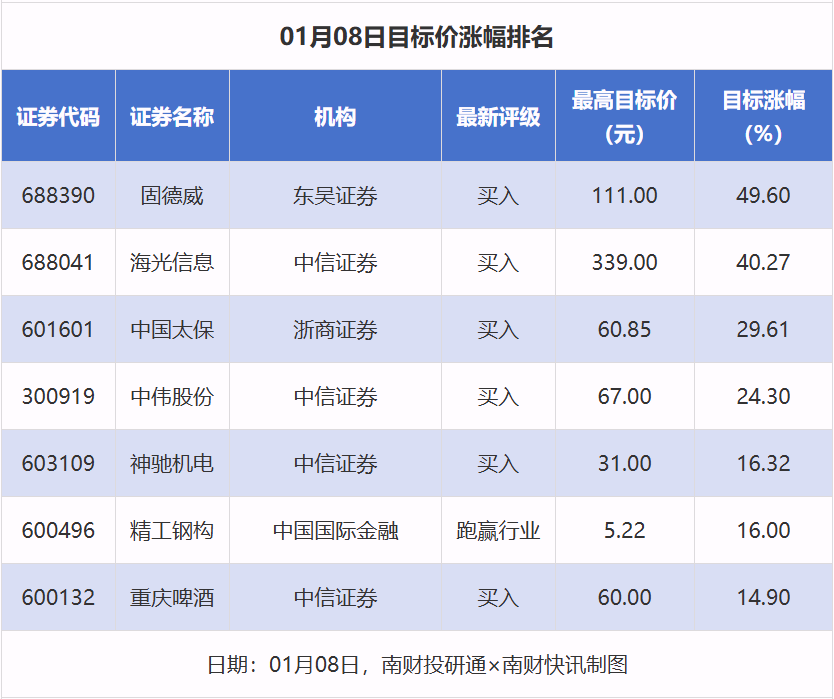
Core Viewpoint - On January 8, 2023, brokerage firms provided target prices for listed companies, with notable increases in target prices for companies in the photovoltaic equipment, semiconductor, and insurance industries, specifically GCL-Poly Energy, Haiguang Information, and China Pacific Insurance, with target price increases of 49.60%, 40.27%, and 29.61% respectively [1][2]. Group 1: Target Price Increases - GCL-Poly Energy (688390) received a target price of 111.00 yuan, reflecting a target price increase of 49.60% from Dongwu Securities [2]. - Haiguang Information (688041) has a target price of 339.00 yuan, with a target price increase of 40.27% from CITIC Securities [2]. - China Pacific Insurance (601601) has a target price of 60.85 yuan, showing a target price increase of 29.61% from Zheshang Securities [2]. Group 2: Brokerage Recommendations - On January 8, 30 listed companies received brokerage recommendations, with Jinggong Steel Structure, Helen Zhe, and China Chemical each receiving one recommendation [2]. - One company, Allwinner Technology (300458), had its rating upgraded from "Hold" to "Buy" by Zhongyou Securities [3]. Group 3: Rating Downgrades - Two companies experienced rating downgrades: Haixia Co., Ltd. (002320) had its rating lowered from "Buy" to "Hold" by Tianfeng Securities, and Sanhua Intelligent Control (002050) had its rating lowered from "Buy" to "Hold" by Northeast Securities [4]. Group 4: First Coverage - Seven companies received initial coverage on January 8, including Jieli Rigging (002342) rated "Hold" by Northeast Securities, Shenchi Electromechanical (603109) rated "Buy" by CITIC Securities, and Chenguang Co., Ltd. (603899) rated "Recommended" by Ping An Securities [5].





浙商证券浙商早知道-20260109
ZHESHANG SECURITIES· 2026-01-08 23:30
Market Overview - On January 8, the Shanghai Composite Index decreased by 0.07%, while the CSI 300 fell by 0.82%. The STAR Market 50 and CSI 1000 both increased by 0.82%, and the ChiNext Index dropped by 0.82%. The Hang Seng Index declined by 1.17% [3][4] - The best-performing sectors on January 8 were defense and military (+4.18%), media (+2%), construction and decoration (+1.76%), real estate (+1.6%), and building materials (+1.33%). The worst-performing sectors included non-bank financials (-2.81%), non-ferrous metals (-1.56%), telecommunications (-0.95%), banking (-0.89%), and food and beverage (-0.58%) [3][4] - The total trading volume for the A-share market on January 8 was 28,263 billion yuan, with net outflow of southbound funds amounting to 4.901 billion HKD [3][4] Key Recommendations - The report highlights China Pacific Insurance (601601) as a core financial asset with both offensive and defensive capabilities. The recommendation is based on the company's unique position as the only publicly listed insurance company backed by the Shanghai State-owned Assets Supervision and Administration Commission [5] - The rationale for recommending China Pacific Insurance includes the increasing strategic importance of the insurance industry, the alleviation of industry interest margin risks, and the company's transformation efforts that are expected to drive significant growth in new business value (NBV) [5] - The target price for China Pacific Insurance is set at 60.85 yuan, representing a potential upside of 27% based on a valuation of 0.9x PEV for 2026 [5] - Revenue projections for China Pacific Insurance from 2025 to 2027 are estimated at 419,626 million yuan, 462,993 million yuan, and 512,426 million yuan, with growth rates of 4%, 10%, and 11% respectively. Net profit attributable to shareholders is forecasted to be 47,769 million yuan, 57,881 million yuan, and 74,911 million yuan, with growth rates of 6%, 21%, and 29% respectively [5]
两连涨后两连跌
Ge Long Hui· 2026-01-08 20:15
Market Performance - The three major indices experienced a decline after two consecutive increases, with the Shanghai Composite Index falling by 0.07%, the Shenzhen Component Index down by 0.51%, and the ChiNext Index decreasing by 0.82% [1] - Over 3,700 stocks in the two markets declined, with a total trading volume of 2.8 trillion yuan [1] Sector Performance - The commercial aerospace sector saw a collective surge, highlighted by Luxin Venture Capital achieving 8 consecutive trading limits and Goldwind Technology securing 3 consecutive limits [3] - The brain-computer interface concept continued its strong performance, with companies like Innovative Medical, Plit, and Nanjing Panda achieving 4 consecutive limits [3] - The controllable nuclear fusion sector was active, with China First Heavy Industries, China National Machinery Industry Corporation, and China Nuclear Engineering Group achieving 2 consecutive limits [3] - The AI application sector rose, with companies such as Jiuqi Software and Baoxin Software hitting the daily limit [3] - The insurance sector opened lower and continued to decline, with an overall drop of 2.17%, including China Ping An down by 4.18% and China Life down by 2.33% [3] - Strong stocks experienced significant pullbacks, with Huayin Securities hitting the daily limit down [3] Market Sentiment - The market's two consecutive declines were influenced by macroeconomic factors, with a primary focus on cautious sentiment regarding the New Year opening [3]



2025年保险公司罚款超4.1亿:3家许可证被吊销,31张百万罚单,47人终身禁业,13人撤职,3家停新!
13个精算师· 2026-01-08 14:26
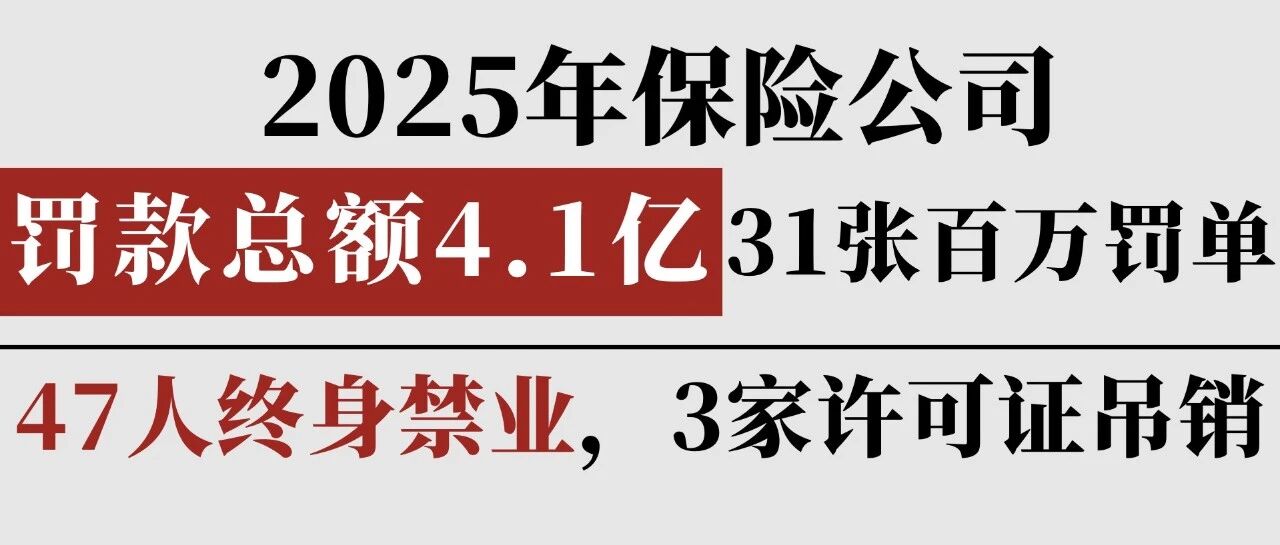
Core Points - The insurance industry faced significant penalties in 2025, with a total of over 410 million yuan in fines imposed on 134 companies, marking a historical high [3][8][10] - The regulatory environment has intensified, with 31 fines exceeding 1 million yuan and 115 individuals banned from the industry, including 47 receiving lifetime bans [8][20][24] - Major companies such as Huaxia Life and Tianan Life had their licenses revoked, indicating a shift towards stricter enforcement and accountability [11][14] Summary by Sections Penalties Overview - In 2025, the total fines for insurance companies exceeded 410 million yuan, with 2802 penalties issued, reflecting a 16% increase compared to the previous year [10][8] - A total of 31 fines were classified as "million-level," with one fine exceeding 10 million yuan and several others surpassing 5 million yuan [19][14] Regulatory Actions - The regulatory body has adopted a "responsibility to individuals" approach, resulting in 115 individuals facing various degrees of industry bans, with 47 receiving lifetime bans [20][24] - The trend of increasing penalties is evident, with the number of individuals banned doubling from the previous year [24] Company-Specific Actions - Companies such as Huaxia Life, Tianan Life, and Tianan Property had their business licenses revoked, indicating a more severe approach to regulatory compliance [11][14] - The penalties for these companies included not only fines but also the revocation of positions for responsible personnel, showcasing a comprehensive enforcement strategy [12][14] Industry Trends - The insurance sector is experiencing a shift towards high-quality development, driven by regulatory measures aimed at improving operational management and compliance [10][14] - The increase in penalties and the revocation of licenses reflect a broader trend of tightening regulations within the insurance industry [10][14]

中国太保(601601):推荐报告:攻守兼备的金融核心资产
ZHESHANG SECURITIES· 2026-01-08 11:51
Investment Rating - The investment rating for China Pacific Insurance (601601) is "Buy" (maintained) [5] Core Views - China Pacific Insurance, as the only listed insurance company backed by the Shanghai State-owned Assets Supervision and Administration Commission, is expected to benefit from its deepening transformation and forward-looking layout in the Web3 sector, potentially leading to a dual boost in performance and valuation [1] - The strategic importance of the insurance industry is increasing, with significant expectations for China Pacific Insurance's transformation in life insurance and support from the Shanghai State-owned Assets [2] - The company is positioned to experience strong growth in new business value (NBV) due to its ongoing transformation initiatives and strategic support from its major shareholder [3] - The forward-looking layout in the Web3 sector is anticipated to drive valuation increases for China Pacific Insurance [4] Summary by Relevant Sections Super Expectation Points - The strategic importance of the insurance industry has been recognized, with the release of new policies promoting high-quality transformation [2] - The risk of interest spread losses is easing, with a continuous reduction in liability costs and an expected increase in investment returns from the equity market [3] - The implementation of the "North Star Plan" is expected to significantly boost NBV, with a notable increase in the agent workforce and a substantial rise in NBV from the bancassurance channel [3] - The strategic support from the Shanghai State-owned Assets is crucial for the company's high-quality development [3] - China Pacific Insurance's proactive engagement in the Web3 sector is expected to enhance its market position [4] Financial Forecasts - Projected net profit growth rates for 2025E-2027E are 6.2%, 21.2%, and 29.4% respectively, with corresponding PEV ratios of 0.77x, 0.71x, and 0.65x [9] - The target price based on a 0.9x PEV for 2026 is set at ¥60.85, indicating a potential upside of 27% [11] Financial Summary - For 2025E, the expected operating revenue is ¥419,626 million, with a net profit of ¥47,769 million [11] - The company is expected to maintain a strong performance with a significant increase in NBV and investment income [11]
大金融板块,持续走低
Di Yi Cai Jing Zi Xun· 2026-01-08 06:52
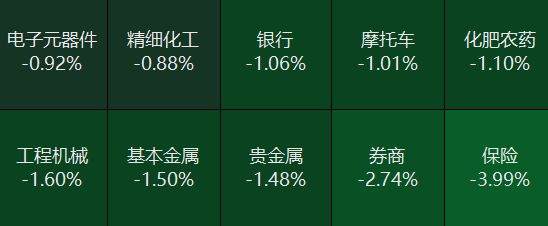
Core Viewpoint - The financial sector is experiencing a significant decline, with brokerage firms and insurance companies leading the downturn [1]. Group 1: Sector Performance - The financial sector, including brokerage and insurance, has seen notable declines, with the brokerage sector down by 2.74% and insurance down by 3.99% [2]. - Other sectors also reported losses, with engineering machinery down by 1.60% and basic metals down by 1.50% [2]. Group 2: Individual Company Performance - Huayin Securities has hit the daily limit down, falling by 10.00% to a price of 16.92 [3]. - Huashan Securities dropped by 5.58% to 7.11, while Huatai Securities fell by 4.88% to 23.99 [3]. - Other notable declines include China Ping An down by 4.63% to 70.05, and Guangfa Securities down by 4.19% to 22.19 [3]. - Several other companies, including CITIC Securities and Changjiang Securities, also experienced declines ranging from 2.57% to 3.19% [3].





2025年1-11月新疆维吾尔自治区原保险保费收入共计741.48亿元,同比增长4.09%
Chan Ye Xin Xi Wang· 2026-01-08 04:03
Group 1 - The core viewpoint of the news highlights the growth of the insurance industry in the Xinjiang Uygur Autonomous Region, with a total original insurance premium income of 74.148 billion yuan from January to November 2025, representing a year-on-year increase of 4.09% [1] - Life insurance accounted for the highest proportion of the total original insurance premium income in Xinjiang, amounting to 33.827 billion yuan, which is 45.62% of the total [1] - The report referenced is the "2026-2032 China Insurance Industry Development Analysis and Investment Prospect Forecast Report" published by Zhiyan Consulting, indicating a focus on future trends and investment opportunities in the insurance sector [1] Group 2 - The data source for the cumulative original insurance premium income statistics from 2020 to November 2025 is the National Financial Supervision Administration, organized by Zhiyan Consulting [2] - Zhiyan Consulting is recognized as a leading industry consulting firm in China, specializing in in-depth industry research reports, business plans, feasibility studies, and customized services [2]


2025年1-11月海南省原保险保费收入共计207.89亿元,同比增长2.88%
Chan Ye Xin Xi Wang· 2026-01-08 03:56
Core Viewpoint - The insurance premium income in Hainan Province for the period from January to November 2025 reached 20.789 billion, reflecting a year-on-year growth of 2.88% [1] Group 1: Insurance Premium Income - The total original insurance premium income in Hainan Province from January to November 2025 was 20.789 billion [1] - Life insurance accounted for the highest share of the total premium income, amounting to 9.512 billion, which represents 45.75% of the total [1] Group 2: Industry Analysis - The report titled "2026-2032 China Insurance Industry Development Analysis and Investment Prospect Forecast" was released by Zhiyan Consulting, a leading industry consulting firm in China [1] - Zhiyan Consulting has over a decade of experience in industry research, providing comprehensive industry research reports, business plans, feasibility studies, and customized services [1]

重磅!非车险“报行合一”最权威解释出炉:松绑“见费出单”,政策性业务满足一定条件可出单,退运险等应实时结算或2日内结算
Sou Hu Cai Jing· 2026-01-08 03:54
Core Viewpoint - The implementation of the "reporting and issuing together" policy for non-auto insurance continues to advance, with the National Financial Regulatory Administration providing detailed answers to various issues arising during the process, aiming to clarify policy implications and unify industry standards [1][2]. Group 1: Regulatory Framework - The core content of the recent notification includes that short-term health insurance is not applicable under the "reporting and issuing together" policy, with some exceptions [2]. - Insurance intermediaries collecting premiums are not considered as "reporting and issuing together" [4]. - Agricultural insurance should follow relevant regulations and execute "reporting and issuing together" [8]. Group 2: Business Scenarios and Requirements - Certain businesses, such as those involving public interest funded by government finances, may not strictly adhere to "reporting and issuing together" [8][10]. - From July 1, 2026, high-frequency, fragmented, and scenario-based internet insurance products like return freight insurance should achieve real-time settlement or periodic settlement within two natural days after issuance [9]. - Policies issued after March 1, 2026, should generally be issued after premium collection and invoicing, with allowances for companies facing difficulties in changing payment methods [12][17]. Group 3: Specific Business Types - For foreign currency or offshore RMB businesses, insurance companies can use bank transfer or other verifiable payment proofs to issue policies [5]. - In the case of RMB business, a bank acceptance bill can be considered as "reporting and issuing together" [6]. - For co-insurance, the main underwriting company can issue policies and invoices after collecting premiums, which will be regarded as "reporting and issuing together" [7]. Group 4: Payment Management - The notification specifies that for public interest businesses using government funds, insurance companies can issue policies based on signed government documents without immediate premium collection [10]. - For businesses where the government subsidizes premiums, the full premium must be collected before issuing policies [10]. - The notification emphasizes that installment payment structures should not be manipulated as competitive leverage, and the last payment should not exceed the average installment amount [12].


当人工智能遇上健康管理 健康险风险减量能否破局
Jin Rong Shi Bao· 2026-01-08 03:42
Core Insights - The insurance industry is transitioning from traditional financial compensation models to a customer-centric service model, focusing on risk reduction through proactive health management [1][4] - The establishment of the Ping An Health Management Company marks a significant step in integrating health management services with health insurance, aiming to enhance customer engagement and reduce claims [1][2] Group 1: Health Management Integration - Ping An Health has reported a service revenue of 159 million yuan in the first half of 2025, providing health management services to over 4.8 million customers, reflecting a year-on-year growth of 21.4% [2] - Other companies, such as China Pacific Insurance and China Ping An, have also established health management subsidiaries to enhance their competitive edge in the health insurance market [3][4] - Health management services are becoming a standard feature in health insurance products, even in basic insurance offerings, which now include services like health consultations and chronic disease follow-ups [2][3] Group 2: Shift from Passive to Active Management - The health insurance sector is undergoing a transformation from passive risk compensation to active health management, aiming to lower claim rates and improve customer retention [4][5] - The importance of health management is recognized as a core component for product competitiveness and sustainable industry development, especially in the context of rising health demands and clearer basic insurance roles [4][5] Group 3: Challenges and Opportunities - Despite the recognized importance of health management, low user awareness and service utilization rates remain significant challenges for the industry [5] - The Chinese government has issued guidelines to promote the integration of health insurance and health management, emphasizing the need for preventive measures and improved public understanding of health insurance [6][7] - Artificial intelligence (AI) is seen as a potential solution to enhance service delivery and efficiency in health management, with applications in personalized health interventions and dynamic assessments [6][7]