CPIC(601601)

Search documents
中国太保多元实践 共绘康养生态发展新蓝图
Jin Rong Jie· 2026-01-11 07:05
Core Insights - China Pacific Insurance (CPIC) is committed to serving national strategies and addressing the structural challenges posed by an aging population of over 300 million in China, viewing "Great Health and Elderly Care" as both a business opportunity and a social responsibility [1] Group 1: Elderly Care Initiatives - CPIC's flagship elderly care community brand, Taibao Home, has established 15 projects across 13 cities, with 14 communities already operational, serving over 3,000 long-term residents and hosting more than 280,000 visitors annually [1] - Taibao Home offers diverse services including medical care, chronic disease management, and community activities, focusing on balanced development in scale, quality, efficiency, and safety [1] Group 2: Rehabilitation and Home Care Services - Yuan Shen Rehabilitation, CPIC's specialized rehabilitation medical service brand, has developed a network with approximately 1,000 planned beds across Xiamen, Jinan, and Guangzhou, with hospitals in Xiamen and Jinan already operational [2] - The "Bai Sui Ju" service brand focuses on home care, providing a "1 housekeeper, 3 services" system to ensure safety, medical care, and companionship for the elderly [2] Group 3: Youth Health Initiatives - Qingqing Growth targets youth and young families with a health promotion plan that includes musculoskeletal health, vision protection, mental health, and weight management, leveraging partnerships with universities and hospitals [2] Group 4: Insurance Products and Services - Blue Medical Insurance has rapidly grown since its launch in 2021, serving over 3 million users and addressing healthcare accessibility and affordability issues through a comprehensive product matrix [3] - Taiyi Housekeeper has established a 24/7 online medical service system, serving over 12 million users and facilitating over 8 million consultations, enhancing diagnostic accuracy and physician efficiency through smart technology [3]

锚定“1234”战略框架,中国太保“大康养”战略启航
Guo Ji Jin Rong Bao· 2026-01-11 06:21
Core Viewpoint - China Pacific Insurance (CPIC) is advancing its "Great Health" strategy, establishing a comprehensive "Great Health" ecosystem with a focus on integrated services and insurance investment [1][2]. Group 1: Strategic Framework - CPIC has defined a "1234" strategic framework for its "Great Health" strategy, emphasizing the creation of an integrated ecosystem [1]. - The strategy includes three core approaches: growth symbiosis, scenario integration, and value co-creation [1]. Group 2: Health Insurance Development - CPIC is optimizing its health insurance product layout and enhancing the quality of health insurance business by aligning commercial insurance with medical insurance [2]. - The company is focusing on the three pillars of pension security, enhancing investment capabilities, customer coverage, and service combinations [2]. Group 3: Service Integration and Innovation - CPIC aims to deepen the integration of services with its main business by embedding services into insurance product design and enhancing customer engagement through high-frequency interactions [3]. - The company is working on a full-cycle service system to improve customer health and optimize operational costs, ultimately reducing risks [3].
给具身机器人上保险
经济观察报· 2026-01-10 08:22
Core Viewpoint - The demand for insurance has become a prerequisite for the mass sales of embodied robots, which is a significant shift in the industry [5][10]. Group 1: Market Development - The founder of an embodied robot company, Hu Lei, is optimistic about producing over 200 robots for commercial performances this year, which is more than five times the output expected in 2025 [2]. - The "Ecological Report on Humanoid Robots 2025" indicates that the industry is entering a phase of large-scale production, with leading companies expected to deliver thousands of units [3]. - The spending on embodied intelligent robots in China is projected to exceed $1.4 billion in 2025 and soar to $77 billion by 2030, with a compound annual growth rate (CAGR) of 94% [9]. Group 2: Insurance Demand - As the number of robots purchased increases, downstream companies are increasingly aware of the risks and are requesting insurance to cover potential damages and liabilities [4][10]. - Major insurance companies have begun to offer specialized insurance products for embodied robots, but they face challenges in risk assessment due to a lack of operational data from manufacturers [5][15]. - The relationship between embodied robots and insurance is likened to the necessity of car insurance for vehicles, highlighting the growing need for insurance as robots are used in various applications [12]. Group 3: Challenges in Insurance - Insurance companies are hesitant to offer mass coverage due to the absence of critical operational data, which is often withheld by manufacturers citing confidentiality [15][16]. - The uniform appearance of robots poses a risk of fraud in claims, leading insurers to limit the number of robots they cover [16]. - The rapid technological advancements in embodied robots outpace the development of insurance risk models, complicating the underwriting process [21][22]. Group 4: Solutions and Innovations - Insurance companies are exploring partnerships with robot leasing platforms to obtain necessary data while managing risks through innovative models like "insurance + leasing" [19][20]. - There is a push for dynamic risk assessment models that can adapt to the fast-paced changes in robot technology and application scenarios [22]. - Collaborative efforts between insurance companies, research institutions, and manufacturers are essential for developing a comprehensive risk database for accurate pricing and risk management [22].



【金融头条】给具身机器人上保险
Jing Ji Guan Cha Bao· 2026-01-10 04:45
Core Insights - The article highlights the significant growth and challenges in the production and insurance of embodied robots, indicating a shift towards mass production and the necessity for insurance coverage to mitigate risks associated with their use [1][2][3]. Group 1: Production and Market Growth - The founder of an embodied robot company, Hu Lei, is optimistic about producing over 200 robots for commercial performances this year, which is more than five times the expected output by 2025 [1]. - The Shanghai University of Finance and Economics reported that the embodied robot industry is entering a phase of large-scale production, with leading companies expected to deliver thousands of units [2]. - The market for embodied intelligent robots in China is projected to exceed $1.4 billion by 2025 and reach $77 billion by 2030, with a compound annual growth rate (CAGR) of 94% [8]. Group 2: Insurance Challenges - As the quantity of robots purchased increases, downstream companies are increasingly concerned about the financial risks associated with accidents, leading them to request insurance coverage for the robots [3][9]. - Major insurance companies have begun to offer specialized insurance products for embodied robots, but they face challenges in risk assessment due to a lack of operational data from manufacturers [5][12]. - The insurance market for embodied robots is currently characterized by limited coverage, with most policies only insuring a small number of units due to the need for extensive operational data that companies are reluctant to share [12][13]. Group 3: Solutions and Innovations - Insurance companies are exploring partnerships with robot leasing platforms to address data acquisition challenges and reduce moral hazard risks [15][16]. - The integration of insurance with leasing models is seen as a potential solution to enhance data sharing and risk management, allowing for better risk assessment and coverage [15][17]. - There is a push for dynamic risk modeling and intelligent underwriting management to keep pace with the rapid technological advancements in embodied robots [17][18].

研报掘金丨浙商证券:中国太保估值相比同业处于低位,攻守兼备的金融核心资产
Ge Long Hui A P P· 2026-01-10 01:27
Group 1 - The core viewpoint of the report highlights that China Pacific Insurance (CPIC) is the only publicly listed insurance company backed by the Shanghai State-owned Assets Supervision and Administration Commission, with significant potential for performance and valuation improvement due to its strategic transformation and forward-looking layout in the Web3 sector [1] - The report emphasizes the increasing strategic importance of the insurance industry, with CPIC's life insurance transformation and support from the Shanghai government expected to yield substantial growth in new business value (NBV) [1] - By 2026, there is an expectation of a systematic revaluation of RMB assets, supported by ongoing capital market reforms, which could lead to a sustained bullish trend in the Chinese equity market, benefiting the investment returns of insurance companies [1] Group 2 - CPIC's current stock price corresponds to a 2025 price-to-embedded value (PEV) of 0.67x, indicating that it remains in a historically low range compared to peers [1] - The report suggests a target price of 60.85 RMB based on a 2026 PEV of 0.9x, representing an upside potential of 27%, and recommends a "buy" rating for the stock [1]
金融行业双周报(2025/12/26-2026/1/8):2025年证券行业多项核心指标创历史新高-20260109
Dongguan Securities· 2026-01-09 12:03
Investment Ratings - Banking: Overweight (Maintain) [1] - Securities: Market Weight (Maintain) [1] - Insurance: Overweight (Maintain) [1] Core Insights - The banking sector shows a continued growth trend in social financing, with a marginal decrease in the contribution of government bonds. Corporate bonds increased by 178.8 billion yuan year-on-year, becoming the main increment in social financing. However, the demand for loans remains weak, with a year-on-year decrease of 190 billion yuan in new RMB loans in November [5][44]. - The securities industry has seen multiple core indicators reach historical highs in 2025, with total stock fund transaction volume exceeding 500 trillion yuan, a year-on-year increase of over 70%. The primary market has rebounded, with IPO and refinancing scales increasing by 95.64% and 326.17% respectively, indicating improved market liquidity and financing conditions [3][46]. - The insurance sector reported a total original premium income of 57,629 billion yuan in the first 11 months of 2025, a year-on-year growth of 7.6%. Life insurance companies saw a 9.1% increase in premium income, while property insurance companies grew by 3.9% [4][47]. Summary by Sections Market Review - As of January 8, 2026, the banking, securities, and insurance indices changed by -0.87%, +0.91%, and +1.95% respectively, while the CSI 300 index increased by +2.05%. Among 31 industries, the banking and non-banking sectors ranked 29th and 21st in performance [5][13]. Valuation Situation - As of January 8, 2026, the PB ratio for the banking sector is 0.74, with state-owned banks, joint-stock banks, city commercial banks, and rural commercial banks having PB ratios of 0.79, 0.61, 0.71, and 0.63 respectively. Notably, China Merchants Bank, Agricultural Bank of China, and Ningbo Bank have the highest valuations at 0.96, 0.95, and 0.87 [22][24]. Recent Market Indicators - The one-year MLF operation rate is 2.0%, with LPR rates at 3.0% for one year and 3.50% for five years. The average interbank borrowing rates for one day, seven days, and fourteen days are 1.33%, 1.50%, and 1.60% respectively [29][30]. Industry News - The China Banking and Insurance Regulatory Commission has released guidelines for data classification and grading in the insurance asset management industry, effective January 1, 2026, aimed at enhancing data security management standards [39][40].




ETF融资榜 | 半导体设备ETF 广发(560780)融资净买入660.27万元,居可比基金首位-20260108
Xin Lang Cai Jing· 2026-01-09 01:59
Group 1 - The semiconductor equipment ETF, Guangfa (560780.SH), experienced a decline of 1.09% on January 8, 2026, with a trading volume of 223 million yuan [1] - The fund saw a net inflow of leveraged funds totaling 6.6027 million yuan, ranking first among comparable funds [1] - Over the past two days, the total inflow of leveraged funds into the fund reached 14.2429 million yuan, placing it second among comparable funds [1] Group 2 - The fund has both onshore and offshore connection classes, specifically Class A (020639) and Class C (020640) [1]
资金风向标|8日两融余额增加158.67亿元 非银金融行业获融资净买入居首
Sou Hu Cai Jing· 2026-01-09 01:48
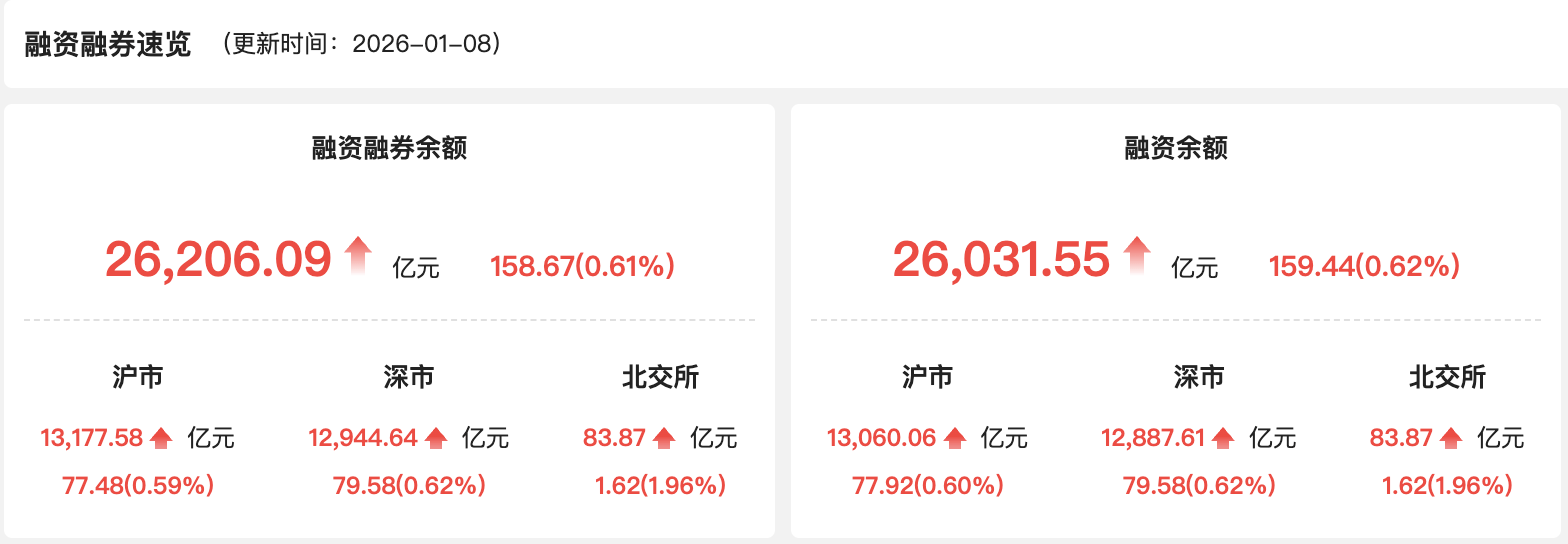
Group 1 - The total margin financing balance in A-shares reached 26,206.09 billion yuan, an increase of 158.67 billion yuan from the previous trading day, accounting for 2.57% of the A-share circulating market value [1] - The margin trading volume on that day was 3,126.04 billion yuan, a decrease of 186.28 billion yuan from the previous trading day, representing 11.05% of the total A-share trading volume [1] Group 2 - Among the 31 primary industries, 21 industries experienced net financing inflows, with the non-bank financial sector leading with a net inflow of 3.789 billion yuan [3] - Other industries with significant net financing inflows included electronics, defense and military industry, computers, electric equipment, and machinery [3] - A total of 74 individual stocks had net financing inflows exceeding 100 million yuan, with Cambrian Technology leading at 1.044 billion yuan [3][4] - Other notable stocks with high net financing inflows included China Ping An at 1.038 billion yuan, Yanshan Technology at 754.49 million yuan, and CITIC Securities at 659.88 million yuan [4]





固德威目标价涨幅超49% 三花智控评级被调低丨券商评级观察
2 1 Shi Ji Jing Ji Bao Dao· 2026-01-09 01:23
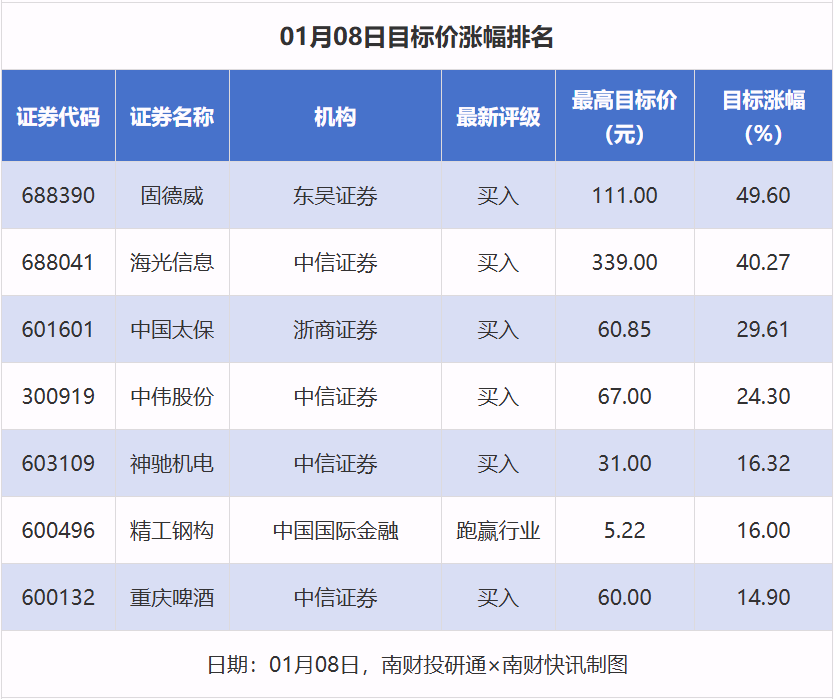
Core Insights - On January 8, 2023, brokerage firms provided target prices for listed companies, with notable increases for GCL-Poly Energy, Haiguang Information, and China Pacific Insurance, showing target price increases of 49.60%, 40.27%, and 29.61% respectively, across the photovoltaic equipment, semiconductor, and insurance industries [1][2]. Group 1: Target Price Increases - GCL-Poly Energy (688390) received a target price of 111.00 yuan, reflecting a 49.60% increase from the latest closing price [2]. - Haiguang Information (688041) has a target price of 339.00 yuan, indicating a 40.27% increase [2]. - China Pacific Insurance (601601) has a target price of 60.85 yuan, showing a 29.61% increase [2]. Group 2: Brokerage Recommendations - On January 8, 30 listed companies received brokerage recommendations, with Jinggong Steel Structure, Helen Zhe, and China Chemical each receiving one recommendation [2]. - One company, Allwinner Technology (300458), had its rating upgraded from "Hold" to "Buy" by Zhongyou Securities [3]. Group 3: Rating Downgrades - Two companies experienced rating downgrades: Haixia Co. (002320) was downgraded from "Buy" to "Hold" by Tianfeng Securities, and Sanhua Intelligent Control (002050) was downgraded from "Buy" to "Hold" by Northeast Securities [4]. Group 4: First-Time Coverage - Seven companies received first-time coverage on January 8, including Jieli Rigging (002342) rated "Hold" by Northeast Securities, and Shenchi Electromechanical (603109) rated "Buy" by CITIC Securities [5]. - Other companies receiving first-time ratings include Chenguang Co. (603899) with a "Recommended" rating, and Jinhua New Materials (920015) with a "Hold" rating [5].


资金动态20260109
Qi Huo Ri Bao Wang· 2026-01-09 01:22
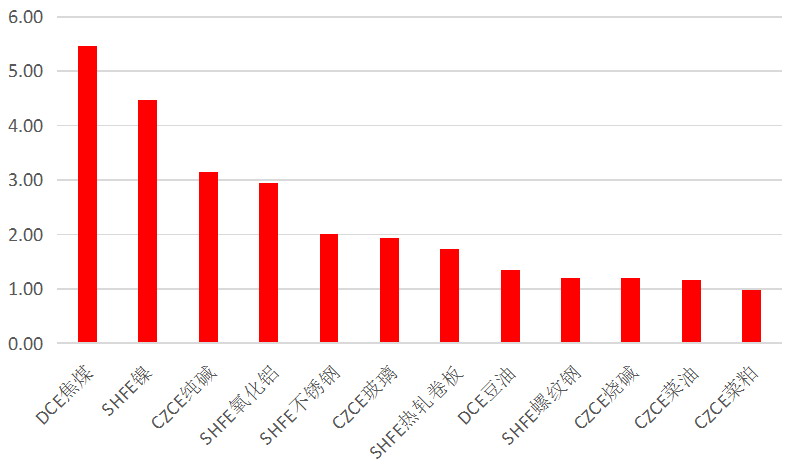
Core Viewpoint - The overall commodity futures market experienced significant capital outflow, particularly in the non-ferrous metals sector, while certain sectors like black, chemical, and agricultural products saw slight inflows [1]. Group 1: Capital Inflows - The main commodities with capital inflows included coking coal (5.46 billion), nickel (4.46 billion), soda ash (3.15 billion), alumina (2.95 billion), and stainless steel (2.01 billion) [1]. - The black, chemical, and agricultural product sectors showed a slight inflow, with notable inflows in coking coal, soda ash, stainless steel, glass, and soybean oil [1]. Group 2: Capital Outflows - The primary commodities with capital outflows were lithium carbonate (19.20 billion), gold (11.65 billion), copper (8.39 billion), aluminum (4.19 billion), and cotton (3.58 billion) [1]. - The non-ferrous metals sector experienced significant outflows, particularly in lithium carbonate, gold, copper, aluminum, polysilicon, and silver [1]. Group 3: Sector Analysis - The financial sector showed outflows, with a focus on the CSI 1000 index futures and 30-year treasury futures [1]. - The overall trend indicates a substantial outflow in the commodity futures market, with specific attention needed on the sectors experiencing both inflows and outflows [1].