PSBC(601658)

Search documents
谁能跻身全球品牌价值500强?光大银行下滑71名,民生银行降60名
Xin Lang Cai Jing· 2026-01-23 01:08
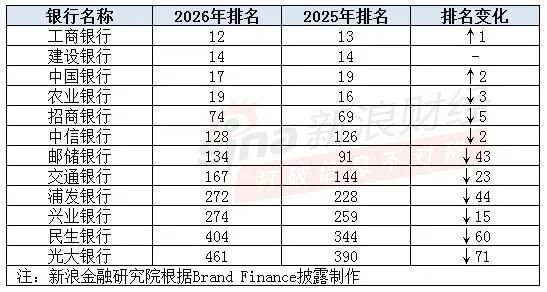
1月20日,《Brand Finance 2026年全球品牌价值500强榜单报告》在瑞士达沃斯正式发布。 具体来看,此次有多家银行进入上述榜单,包括工商银行、建设银行、中国银行、农业银 行、招商银行、中信银行、邮储银行、交通银行、浦发银行、兴业银行、民生银行、光大银 行等。与2025年榜单相比,光大银行排名下滑最多,降71个名次至461位;其次是民生银 行,降60个名次至404位。 此外,另有中国平安、中国人寿、中国人保、太平洋保险、友邦保险、保诚保险、国泰人寿 7家中国保险公司上榜。其中,保诚保险排名下滑明显,较上年排位下降117个名次。 | 排名变化 | 2026年排名 | 2025年排名 | 银行名称 | 工商银行 | 12 | 13 | 11 | | --- | --- | --- | --- | --- | --- | --- | --- | | 建设银行 | 1 d | I d | 1 | 12 | 中国银行 | 17 | 19 | | 农业银行 | 19 | J3 | 16 | 招商银行 | 74 | 69 | 1 5 | | 中信银行 | 126 | 128 | V2 | 邮储银行 | 134 ...





多家银行开启 信用卡分期贴息补申请通道
Bei Jing Shang Bao· 2026-01-23 01:05
Core Viewpoint - The new personal consumption loan interest subsidy policy aims to enhance consumer spending by expanding the scope of eligible loans and simplifying the application process for consumers [1][4]. Group 1: Policy Implementation - The Ministry of Finance, the People's Bank of China, and the financial regulatory authority jointly issued a notice to optimize the implementation of the personal consumption loan interest subsidy policy [1]. - The subsidy period for personal consumption loans is set from September 1, 2025, to December 31, 2026, while the credit card installment subsidy period is from January 1, 2026, to December 31, 2026 [1]. - Major banks, including ICBC, ABC, Bank of China, and others, have quickly responded by issuing operational guidelines and FAQs regarding the subsidy services [1][2]. Group 2: Eligibility and Application Process - Customers who have previously signed consumption loan subsidy agreements do not need to re-sign; the new policy will automatically apply to their existing loans [2]. - For credit card installment services newly included in the subsidy, banks like Postal Savings Bank and Agricultural Bank have outlined specific application paths for customers [2][3]. - Agricultural Bank requires customers to sign a supplementary agreement for credit card installment subsidies, with each card needing a separate agreement [3]. Group 3: Impact on Interest Rates - The new policy includes a 1% annual subsidy rate for credit card installments, which could lower the effective interest rate for eligible borrowers to the "2% range" after subsidies [4]. - The minimum execution interest rate for consumption loans remains at 3%, indicating potential benefits for borrowers with good credit ratings [4].




商业银行争夺“年终奖”
Jing Ji Ri Bao· 2026-01-22 22:06
Core Viewpoint - Major banks are competing for year-end bonuses by promoting exclusive investment products through digital channels, focusing on low-risk options to meet investor demand for stability and flexibility [1][2]. Group 1: Investment Strategies - Banks are shifting from selling individual products to offering comprehensive financial solutions, with features like "year-end bonus investment destinations" that allow for flexible selection across various asset classes [2]. - Financial institutions are leveraging their asset allocation capabilities to enhance customer loyalty and meet diverse needs, with tailored strategies such as "conservative + stable + progressive" approaches for year-end bonuses [2][3]. Group 2: Market Trends and Challenges - The wealth management business is becoming increasingly important for banks amid regulatory changes and pressure on interest margins, with year-end bonuses creating a unique opportunity for asset allocation [1][4]. - Banks face challenges such as product homogeneity and the risk of misleading marketing practices, which could lead to irrational decision-making among consumers [3]. Group 3: Customer-Centric Approaches - Banks are encouraged to focus on customer needs by providing clear explanations of asset logic in different market environments and enhancing financial literacy among clients [4]. - It is essential for banks to integrate internal financial data to create comprehensive customer profiles and offer dynamic, adjustable solutions while maintaining transparency regarding risks [4]. Group 4: Investor Guidance - Investors are advised to incorporate year-end bonuses into their overall wealth planning, focusing on key factors such as fund management, investment strategies, historical volatility, and fee structures to avoid impulsive decisions [4][5]. - It is recommended that investors clarify their financial needs and risk tolerance, prioritizing liquidity and safety for short-term funds while considering higher-yield products for medium to long-term investments [5].


落实个人消费贷款最新财政贴息政策
Xin Lang Cai Jing· 2026-01-22 19:12
Core Viewpoint - Major banks in China have collectively announced the implementation of the latest fiscal interest subsidy policy for personal consumption loans, aiming to enhance consumer spending and support economic recovery [1] Group 1: Policy Implementation - The implementation period for the personal consumption loan fiscal interest subsidy policy has been extended to December 31, 2026 [1] - The scope of support has been expanded to include credit card bill installment services [1] - The subsidy field has been broadened by removing the restriction on single transactions of 50,000 yuan and above [1] Group 2: Subsidy Standards - The subsidy standard has been improved by eliminating the upper limit of 500 yuan for single transaction subsidies [1] - The previous cumulative subsidy limit of 1,000 yuan for each borrower at a single institution for transactions below 50,000 yuan has been removed [1] Group 3: Existing Agreements - For loans that have already signed the "Personal Consumption Loan Fiscal Interest Subsidy Service Agreement," any consumption occurring after January 1, 2026, will automatically apply the latest fiscal interest subsidy policy without the need to re-sign the agreement [1]
今年春节无人车接力快递小哥“站岗”
Bei Jing Shang Bao· 2026-01-22 15:57
Core Viewpoint - The logistics industry is increasingly adopting unmanned vehicles to address the challenges posed by the upcoming Spring Festival, including the surge in heavy packages and rising operational costs, with companies like Jitu, Zhongtong, and JD Logistics leading the way in this transformation [1][8]. Group 1: Unmanned Vehicle Implementation - Unmanned vehicles are being deployed to assist delivery personnel, significantly reducing delivery times by over 3 hours and cutting transportation costs by 50% [1][5][7]. - Companies are scaling up the use of unmanned vehicles, with Jitu, Zhongtong, and JD Logistics integrating them into their operations for short-distance transportation tasks [8][9]. - JD Logistics has reported a 21% reduction in transportation costs and a 1-hour decrease in average delivery time since implementing unmanned vehicles [8]. Group 2: Increased Demand During Spring Festival - The Spring Festival is expected to see a notable increase in package volume, with some logistics points anticipating a rise of approximately 1,000 packages per day compared to previous years [3][4]. - The characteristics of this year's Spring Festival include a more prolonged peak period and a greater variety of larger packages, which places higher demands on logistics capabilities [3][4]. - E-commerce platforms are ramping up promotions leading into the Spring Festival, further intensifying the pressure on logistics networks to manage increased volumes effectively [3]. Group 3: Cost Management Strategies - Logistics companies are implementing flexible scheduling and human-vehicle collaboration strategies to manage the increased workload during the Spring Festival [4][6]. - Temporary hiring of drivers and workers is common during peak periods to handle the surge in package volume, leading to increased operational costs [6]. - Companies like SF Express and JD Logistics are introducing resource adjustment fees during the Spring Festival to manage the heightened demand and associated costs [6].


消费贷贴息政策升级,多家银行明确实施细则
Xin Hua Wang· 2026-01-22 14:29
Core Viewpoint - The Ministry of Finance and other departments have announced an optimization of the personal consumption loan interest subsidy policy, which aims to enhance consumer spending and support economic recovery through various measures [1]. Group 1: Policy Enhancements - The implementation period of the personal consumption loan interest subsidy policy has been extended to the end of 2026 [1]. - The scope of support has been expanded to include credit card bill installment services [1]. - Restrictions on the consumption amount have been lifted, allowing for subsidies on amounts of 50,000 yuan and above [1]. - The subsidy standards have been improved by removing the previous cap of 500 yuan per single transaction and the limit of 1,000 yuan for each borrower at the same financial institution for amounts below 50,000 yuan [1]. Group 2: Implementation and Customer Convenience - Starting from January 1, 2026, banks will provide services under the optimized subsidy policy for eligible personal consumption loan customers and credit card bill installment customers [1]. - Customers who have already applied for subsidies will not need to re-sign subsidy agreements, as transactions occurring from January 1, 2026, will automatically apply the new subsidy policy [1]. - Banks will not charge any additional fees beyond loan interest and installment-related fees during the processing of personal consumption loans and credit card bill installment subsidy services [1]. Group 3: Fraud Prevention and Compliance - Banks have issued warnings against providing false documentation or engaging in fraudulent activities to obtain subsidies [2]. - Borrowers who illegally obtain subsidy funds will face recovery actions and will be recorded in personal credit histories, with strict legal consequences [2].
保障寒潮期间金融服务,邮储银行临沂市河东支行启动“暖冬行动”
Qi Lu Wan Bao· 2026-01-22 14:07
Core Viewpoint - Postal Savings Bank of China in Linyi City has implemented emergency measures to ensure continuous financial services during extreme weather conditions, emphasizing warmth and support for customers [1][2] Group 1: Financial Support Measures - The bank has proactively reached out to agricultural, livestock, and small business clients affected by the cold wave to assess their financial needs and repayment capabilities [1] - For clients facing temporary repayment difficulties due to the weather, the bank offers convenient loan renewal services such as "no principal repayment renewal" to alleviate short-term financial pressure [1] Group 2: Safety and Service Enhancements - All branches have organized staff to clear snow and set up safety measures like anti-slip mats and de-icing agents to ensure safe access to banking services [1] - A "Warm Winter Service Area" has been established in branches, providing hot water, ginger tea, emergency medicines, and phone charging services [1] - The bank encourages customers to use online banking services to minimize travel risks during adverse weather [1] Group 3: Special Care Initiatives - The bank has formed "Warm Winter Service Teams" to create dedicated service records for elderly and special needs clients, offering door-to-door service for banking needs [2] - An example of this service includes a bank employee visiting an elderly client to assist with activating their pension card, demonstrating the bank's commitment to community service [2] - The bank will continue to monitor weather changes and customer needs, providing consistent support and warm services throughout the winter [2]
工行、农行、中行、建行、交行、邮储,集体公告
Zhong Guo Xin Wen Wang· 2026-01-22 13:23
Core Viewpoint - Major Chinese banks have collectively announced the optimization of personal consumption loan fiscal subsidy policies, extending the implementation period and expanding the support scope for consumers [1][2]. Group 1: Policy Extensions - The implementation period for the personal consumption loan fiscal subsidy policy has been extended to December 31, 2026 [2]. - Loans signed under the previous fiscal subsidy service agreement will automatically apply the latest subsidy policy for consumption occurring after January 1, 2026, without the need for re-signing agreements [1]. Group 2: Expanded Support - The support scope has been expanded to include credit card bill installment services [2]. - Restrictions on single transactions of 50,000 yuan and above have been removed, allowing for broader access to subsidies [2]. Group 3: Enhanced Subsidy Standards - The subsidy standard has been improved by removing the cap of 500 yuan on single transaction subsidies [2]. - The previous limit of 1,000 yuan on cumulative subsidies for each borrower at a single institution for transactions below 50,000 yuan has also been eliminated [2].
信用卡分期纳入贴息!六大行公告→
新华网财经· 2026-01-22 12:37
Core Viewpoint - The recent policy optimization allows credit card bill installments to enjoy interest subsidies, making them a preferred choice for consumers who typically do not apply for specific consumer loan products [2][3]. Group 1: Policy Changes - The Ministry of Finance, the Financial Regulatory Administration, and the People's Bank of China jointly issued a notice to optimize the implementation of the personal consumer loan interest subsidy policy, which includes raising the subsidy standards and extending the policy period until the end of 2026 [5]. - The subsidy standard has been improved by removing the previous limits on single transaction subsidies and cumulative subsidies for individual borrowers, while maintaining an annual cap of 3,000 yuan for each borrower at one financial institution [5]. Group 2: Credit Card Installment Subsidy - Credit card bill installment services are now included in the subsidy scope, with an annual interest subsidy rate set at 1% [8]. - To benefit from the subsidy, customers must sign a supplementary agreement with their bank for each credit card, and the subsidy will be directly deducted from the installment interest during the billing period [8]. Group 3: Bank Responses and Implementation - Various banks, including Agricultural Bank of China and Bank of Communications, have provided clear guidelines on how to apply for the credit card bill installment interest subsidy, emphasizing the need for customers to sign the supplementary agreement [8][9]. - Banks like China Bank and Postal Savings Bank have streamlined the process, allowing customers to automatically apply the new subsidy policy to transactions made after January 1, 2026, without needing to re-sign agreements [9].
工、农、中、建、交、邮储,集体公告!
中国基金报· 2026-01-22 12:31
Core Viewpoint - The article discusses the implementation of the latest fiscal interest subsidy policy for personal consumption loans by six major state-owned banks in China, following the announcement by the Ministry of Finance, the People's Bank of China, and the Financial Regulatory Bureau [2]. Group 1: Policy Optimization - The Industrial and Commercial Bank of China (ICBC) outlines four main areas of optimization for the subsidy policy: extending the policy period to the end of 2026, including credit card installment payments in the support scope, removing the restriction on consumption fields above 50,000 yuan, and raising the subsidy standards by eliminating the 500 yuan cap on single transaction subsidies and the 1,000 yuan cap for individual borrowers at the same financial institution [4]. Group 2: Implementation Details - China Construction Bank states that customers must sign a service agreement to enjoy the fiscal subsidy, allowing the bank to access transaction information to identify eligible consumption transactions. The subsidy amount will be automatically deducted from the interest due on the loan during repayment. If transactions are not automatically recognized, customers can submit receipts for manual verification [5]. - Bank of China mentions that loans already approved for subsidies will not require a new agreement, and transactions from January 1, 2026, will automatically apply the new subsidy policy [5]. - Agricultural Bank of China warns that fraudulent activities related to subsidy claims will not be subsidized, and any previously granted subsidies may be deducted or reclaimed [5]. - The Bank of Communications emphasizes adherence to market-oriented and legal principles for eligible loans and credit card installments, with violations affecting credit records and subject to legal consequences [6]. - Postal Savings Bank clarifies that no additional fees will be charged for personal consumption loans beyond the agreed interest, and any fees collected under false pretenses are considered fraud [6].