
PSBC(601658)

Search documents
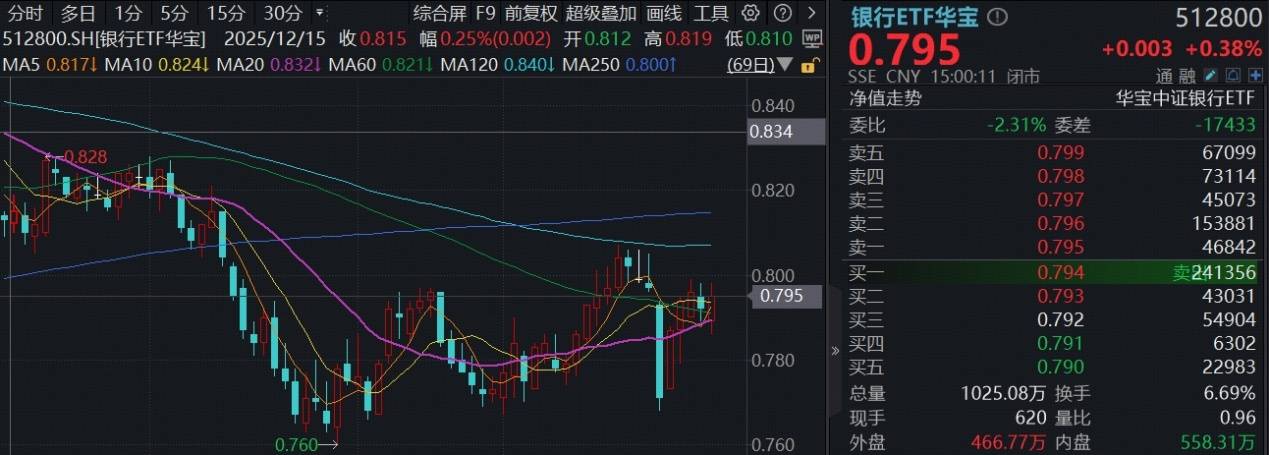
避险情绪升温,百亿银行ETF华宝(512800)向上突破,营收净利双增,工商银行涨超2%
Sou Hu Cai Jing· 2026-03-30 11:25
Core Viewpoint - The banking sector shows resilience amid geopolitical tensions, with a focus on high-dividend defensive assets attracting investor interest [3] Group 1: Market Performance - On March 30, the Shanghai Composite Index rose by 0.24% after initially dropping over 1%, while the ChiNext and Shenzhen Composite Indices fell [1] - The banking sector demonstrated defensive characteristics, with most individual stocks closing higher; Xiamen Bank led with a nearly 4% increase, and major banks like ICBC and Bank of China also saw gains [1] Group 2: Banking Sector Insights - Major state-owned banks, including ICBC, CCB, BOC, and PSBC, reported annual results showing steady asset growth and increases in both revenue and net profit [3] - Despite challenges such as narrowing net interest margins, bank management expressed optimism about stabilizing margins, which received positive market feedback [3] - According to CITIC Securities, the disclosed bank performance aligns with expectations, and future disclosures are likely to show minimal deviations from forecasts [3] Group 3: Investment Opportunities - With rising risk aversion, the banking sector is expected to benefit from increased allocation due to its defensive characteristics and potential for fundamental improvements [3] - The banking ETF (512800) has a significant scale of over 12 billion, making it the largest and most liquid among A-share banking ETFs, with an average daily trading volume exceeding 800 million since 2025 [4]



消费贷风险拐点何时出现?邮储管理层:风险防控压力依然较大,但势头良好
第一财经· 2026-03-30 09:28
Core Viewpoint - The article highlights the increasing asset quality risks in the retail banking sector, particularly focusing on the rising non-performing loan (NPL) ratios among major state-owned banks in China, with specific emphasis on Postal Savings Bank of China (PSBC) [3][4]. Group 1: Asset Quality Concerns - As of the end of 2025, PSBC reported a non-performing loan balance of 91.524 billion yuan, an increase of 11.205 billion yuan from the previous year, resulting in a non-performing loan ratio of 0.95%, up by 0.05 percentage points [4]. - The bank's attention-class loan balance reached 151.648 billion yuan, increasing by 67.32 billion yuan, with an attention-class loan ratio of 1.57%, up by 0.62 percentage points [4]. - The overdue loan ratio was reported at 1.3%, which is an increase of 0.11 percentage points compared to the previous year [4]. Group 2: Risk Management Strategies - PSBC has been actively enhancing its risk management by deepening regional and industry research, optimizing customer admission standards, and strengthening controls in key areas to mitigate risks [5]. - The bank has implemented measures to combat financial crime and illegal intermediaries, which have shown positive results in maintaining asset quality [5]. - The bank's retail business director indicated that the risk control pressure in the consumer credit sector remains significant due to ongoing challenges in consumer spending and income levels [5]. Group 3: Consumer Credit Trends - The bank's consumer loan balance reached 4.84 trillion yuan by the end of 2025, reflecting a growth of 1.53% year-on-year, with consumer loans (excluding housing loans) and personal microloans increasing by 4.7% and 5.32%, respectively [6]. - The bank's non-performing loan ratio for consumer loans was reported at 1.54%, an increase of 0.2 percentage points from the previous year [6]. - The implementation of fiscal subsidy policies has positively impacted consumer credit demand, with a significant increase in non-housing consumer loan issuance, which grew by over 20% in September 2025 [6].


光大证券晨会速递-20260330




EBSCN· 2026-03-30 03:25
Macro Analysis - Industrial enterprises' profits continued to show a strong start in January-February 2026, driven by accelerated industrial production, rising prices, and improved profit margins [1] - Profit distribution is skewed towards the midstream and upstream sectors due to rising resource prices and global capital expenditure [1] - The recovery in PPI readings is expected to support overall corporate profit recovery, although high oil prices may lead to differentiated impacts on profitability across sectors [1] Bond Market - The convertible bond market has resumed its upward trend, with investors advised to track market supply, policy rhythms, and geopolitical disturbances while making refined selections based on bond terms and underlying stock conditions [2] REITs Market - The secondary market for publicly listed REITs has continued to experience price declines for five consecutive weeks, with the CSI REITs index closing at 778.53, reflecting a return rate of -0.83% [3] Banking Sector - Qingdao Bank reported a revenue of 14.6 billion, a year-on-year increase of 8%, and a net profit of 5.2 billion, up 22%, indicating accelerated revenue and profit growth [4] - Wuxi Bank achieved a revenue of 4.8 billion, a 2% increase, and a net profit of 2.3 billion, up 2.5%, showcasing resilient profit growth driven by corporate business [5] - Industrial Bank reported a revenue of 212.7 billion, a slight increase of 0.2%, and a net profit of 77.5 billion, up 0.3%, with a focus on expanding new business areas [7] - Postal Savings Bank's revenue growth improved sequentially, with a 2% increase in revenue and a 6.6% increase in PPOP [8] Non-Banking Financials - China Pacific Insurance reported a net profit increase of 25.5%, with future non-auto insurance business expected to maintain a leading position [9] - New China Life Insurance's net profit reached 36.28 billion, a 38.3% increase, with expectations for continued growth in new business value [10] - Ping An Insurance's net profit grew by 6.5%, with a slight downward adjustment in future profit forecasts [11] - China Insurance's net profit increased by 8.8%, with expectations for stable performance in both property and life insurance segments [12] Real Estate and Property Management - Jianfa Property achieved a revenue of 3.881 billion, a 17.8% increase, with a significant rise in property management service revenue [14][15] Chemical and Semiconductor Sector - Dinglong Co. reported a revenue of 3.66 billion, a 9.66% increase, and a net profit of 720 million, up 38.32%, with expectations for continued growth in the semiconductor sector [16] Oil and Gas Sector - China National Petroleum Corporation reported total revenue of 2864.5 billion, a decrease of 2.5%, and a net profit of 157.3 billion, down 4.5%, with a focus on increasing reserves and production [17] - CNOOC's total revenue was 398.2 billion, down 5.3%, with a net profit of 122.1 billion, down 11.5%, but with a positive outlook for future profit growth [18] Utilities Sector - China General Nuclear Power Corporation reported a revenue of 756.97 billion, down 4.11%, and a net profit of 97.65 billion, down 9.9%, with an upward revision in future profit forecasts [20] Food and Beverage Sector - Haitian Flavor Industry achieved a revenue of 28.873 billion, a 7.3% increase, and a net profit of 7.04 billion, up 10.9%, indicating strong performance in the food sector [48] - Qingdao Beer reported a revenue of 32.47 billion, a 1% increase, and a net profit of 4.59 billion, up 5.6%, with a focus on maintaining strong brand advantages [51]
【邮储银行(601658.SH/1658.HK)】营收增速环比改善,储蓄代理费再调降——2025年年报点评(王一峰/董文欣)
光大证券研究· 2026-03-29 23:05
Core Viewpoint - Postal Savings Bank of China reported a revenue of 355.7 billion with a year-on-year growth of 2% and a net profit attributable to shareholders of 87.4 billion, reflecting a growth of 1.1% [4] Group 1: Revenue and Profit Growth - In 2025, the bank's revenue, PPOP, and net profit attributable to shareholders grew by 2%, 6.6%, and 1.1% year-on-year, respectively, with revenue growth showing a gradual improvement trend since Q2 2025 [5] - The main components of revenue include a 1.6% year-on-year decline in net interest income, which has narrowed by 0.5 percentage points compared to the first three quarters, and an 18.3% year-on-year increase in non-interest income, although the growth rate has slightly decreased by 1.9 percentage points [5] Group 2: Asset Growth and Loan Composition - By the end of 2025, the bank's interest-earning assets and loans grew by 10.2% and 8.2% year-on-year, respectively, maintaining a high expansion intensity [6] - The total loan increment for the year was 735.1 billion, with corporate loans contributing 85%, retail loans 10%, and bill discounting 5% [6] Group 3: Cost Management Strategies - The bank's unique "self-operated + agency" model allows for adjustments in savings agency fees, which are expected to help achieve better cost savings in 2026 [7] - The board has approved a proposal to proportionally lower the tiered fee rates for savings deposits with a term of three years or less by 3.86%, maintaining the characteristic that longer terms have lower rates [8]

银行投资观察20260329:石油冲击对流动性的影响再解析
GF SECURITIES· 2026-03-29 14:48
Core Insights - The report emphasizes the impact of oil price shocks on liquidity, suggesting that the ability to transmit cost shocks downstream will be stronger than previous oil price impacts, with expectations of nominal price increases in Q2 2026 [19][20][21] - It highlights that while medium-term demand remains optimistic, caution is advised regarding the contraction of broad liquidity in Q2 2026, particularly due to cross-border liquidity constraints and rising long-term interest rates affecting investment returns [19][21] Section Summaries 1. Current Observation - The banking sector overall declined by 0.8% during the observation period from March 23 to March 27, 2026, underperforming the Wind All A index, which fell by 0.7% [17] - State-owned banks, joint-stock banks, city commercial banks, and rural commercial banks experienced declines of -1.29%, -0.42%, -0.85%, and -0.47% respectively [17] - In contrast, H-shares of banks outperformed, with the Hang Seng Index down 1.2% while H-share banks gained 0.5% [17] 2. Investment Recommendations - The report suggests that the market's concerns regarding the demand side of the Chinese economy and cost transmission are overly pessimistic, given the supportive fiscal policies and stabilization in the real estate cycle [19] - It recommends caution regarding the contraction of liquidity in Q2 2026, emphasizing the importance of cross-border liquidity as a key variable for supporting Chinese asset liquidity [19][20] 3. Sector Performance - The banking sector's average price for convertible bonds fell by 0.67%, underperforming the convertible bond index by 1.95 percentage points [18] - The report notes that the profitability growth expectations for 2025 remain largely unchanged for seven banks, indicating stability in earnings forecasts [18] 4. Individual Stock Performance - Among A-share banks, Ping An Bank and Shanghai Rural Commercial Bank saw increases of 2.32% and 1.25% respectively, while Chongqing Bank experienced a decline of 6.55% [17] - In H-shares, Chongqing Rural Commercial Bank and Bank of China rose by 4.68% and 3.40%, while Bohai Bank and Jiangxi Bank fell by 3.45% and 1.49% respectively [17] 5. Valuation and Financial Analysis - As of March 27, 2026, the banking sector's latest price-to-earnings ratio (TTM) is 6.84X, and the price-to-book ratio is 0.67X, indicating that valuations are at historical average levels [45] - The report provides detailed financial metrics for key banks, including expected earnings per share and return on equity for 2026 and 2027, supporting the investment recommendations [9]

银行“火拼”消费贷、经营贷
第一财经· 2026-03-29 14:43
Core Viewpoint - The article highlights the rising trend of non-performing loan (NPL) ratios in personal loans across major banks, attributing this to macroeconomic changes and the ongoing adjustment in the real estate sector, while emphasizing the importance of risk management in consumer and business loans [3][10]. Group 1: Personal Loan Quality Trends - As of March 27, 2026, major banks like ICBC, CCB, and others have reported an increase in personal loan NPL ratios, with many attributing this to external macroeconomic factors [3][10]. - The personal loan NPL ratio for state-owned banks has approached 1.6%, with ICBC and CCB both reporting NPL ratios of 1.58%, marking an increase from the previous year [10][11]. - The shift in consumer demand due to the real estate market's downturn has led to a contraction in housing loans, while consumer and business loans have become focal points for banks [6][10]. Group 2: Loan Composition and Performance - By the end of 2025, CCB and ICBC's personal loan balances exceeded 9 trillion yuan, with CCB leading in housing, consumer, and credit card loans, while ICBC led in business loans by over 600 billion yuan [6][8]. - The consumer loan and business loan segments have seen significant growth, with CCB reporting nearly 30% growth in both areas, contrasting with the decline in housing loans [6][10]. - Credit card business has faced challenges, with all eight banks reporting a decline in credit card balances, particularly ICBC and Postal Savings Bank, which saw declines exceeding 10% [7][10]. Group 3: Risk Management and Future Outlook - CCB's management has emphasized the importance of optimizing credit risk management mechanisms in response to rising risks in the retail sector, indicating a focus on risk control moving forward [11][12]. - ICBC's leadership has acknowledged the short-term rise in personal loan NPL ratios but remains optimistic about long-term stability, citing strong economic fundamentals and the potential for improved asset quality through policy support [11][12]. - The article notes that while consumer and business loans are growing rapidly, the associated risks are also increasing, necessitating careful monitoring and management [10][13].


银行资负跟踪20260329:大行转贴净买入有限
GF SECURITIES· 2026-03-29 13:08
Investment Rating - The industry investment rating is "Buy" [3] Core Insights - The report indicates that large banks have limited net buying activity, with a monthly cumulative net purchase of 46.8 billion yuan as of March 26, which is a decrease of approximately 200 billion yuan month-on-month but an increase of about 50 billion yuan year-on-year. It is expected that credit issuance may slightly decline compared to March 2025, but the initial performance remains strong [7][20] - The central bank's operations included a net injection of 281.9 billion yuan through various monetary policy tools, with a focus on maintaining liquidity stability as the quarter-end approaches [16] - The report highlights that the liquidity environment is expected to tighten in April due to tax payments and annual settlement pressures, with potential increases in funding rates towards the end of the month [16][17] Summary by Sections Section 1: March Credit Performance - The data shows that the funding environment remains stable as the quarter-end approaches, with large banks gradually reducing their lending from 4.37 trillion yuan to 3.78 trillion yuan [16] - The report emphasizes the importance of monitoring the upcoming PMI data and bank annual reports for insights into future liquidity trends [23] Section 2: Central Bank Dynamics and Market Rates - The central bank conducted 4.742 trillion yuan in 7-day reverse repos, with a net injection of 281.9 billion yuan after accounting for maturing operations [16] - Market rates for various instruments, including treasury bonds and NCDs, have shown slight fluctuations, with the 1-year treasury yield at 1.25% and the average NCD issuance rate at 1.52% [17][18] Section 3: Bank Financing Tracking - The total outstanding amount of interbank certificates of deposit (NCDs) is 18.19 trillion yuan, with a weighted average issuance rate of 1.65% [21] - The report notes that there were no new issuances of commercial bank bonds during the period, and the total outstanding amount of commercial bank bonds is 3.32 trillion yuan [22]

邮储银行(601658):2025年年报点评:营收增速环比改善,储蓄代理费再调降
EBSCN· 2026-03-29 10:29
Investment Rating - The investment rating for Postal Savings Bank is "Buy" for both A-shares and H-shares, maintaining the current price of 5.06 CNY and 4.96 HKD respectively [1]. Core Insights - The bank's revenue growth has shown a quarter-on-quarter improvement, with total revenue reaching 355.7 billion CNY in 2025, a year-on-year increase of 2%. The net profit attributable to shareholders was 87.4 billion CNY, up 1.1% year-on-year [3][4]. - The bank's net interest income decreased by 1.6% year-on-year, but the decline was less severe than in previous quarters, while non-interest income grew by 18.3% year-on-year, indicating a strong performance in fee-based services [4][8]. - The bank's loan growth was primarily driven by corporate loans, which accounted for 85% of the total loan increase of 735.1 billion CNY in 2025. Retail loans showed a modest increase of 730 million CNY [5][6]. - The bank's net interest margin for 2025 was 1.66%, a slight decrease from previous quarters, reflecting ongoing pressure on interest income [7]. - A new round of adjustments to savings agency fees is expected to reduce costs significantly, with a projected decrease of 4 basis points in the comprehensive agency fee rate, leading to a reduction of 4.57 billion CNY in agency fees [11][12]. Revenue and Profitability - In 2025, the bank's revenue and profit growth rates were 2% and 1.1% respectively, with a weighted average return on equity of 8.67%, down 1.17 percentage points year-on-year [3][4]. - Non-interest income accounted for 20.8% of total revenue, an increase of 2.8 percentage points year-on-year, driven by strong performance in card services and investment banking [8]. Asset Quality and Capital Management - The non-performing loan ratio at the end of 2025 was 0.95%, a slight increase from the previous quarter, with pressure primarily from retail loans [9]. - The bank's provision coverage ratio was 227.9%, indicating a strong buffer against potential loan losses, although it decreased significantly from earlier in the year [10]. - Capital adequacy ratios showed a slight decline, with the core tier 1 capital ratio at 10.53% at the end of 2025 [10][34]. Future Outlook - The bank's earnings per share (EPS) forecasts for 2026-2028 are 0.75, 0.78, and 0.81 CNY respectively, with price-to-book (P/B) ratios for A-shares projected at 0.57, 0.53, and 0.50 for the same period [14][15].
银行业周报:基本面改善逻辑强化-20260329
ZHESHANG SECURITIES· 2026-03-29 10:28
Investment Rating - The industry rating is maintained as "Positive" [5] Core Views - The banking sector's performance is relatively stable compared to the market, with the banking index down by 0.71% this week, ranking 13th among 31 primary industries [1] - State-owned banks experienced a larger decline, with respective drops of -1.17% for state-owned banks, -0.30% for joint-stock banks, -0.88% for city commercial banks, and -0.57% for rural commercial banks [1] - The financial reports of 22 listed banks show a recovery in profitability, with average revenue and net profit growth of 2.1% and 4.9%, respectively, indicating a positive trend in earnings [3] - The average non-performing loan (NPL) ratio for these banks is 1.05%, down by 2 basis points, reflecting stable asset quality [3] Summary by Sections Industry Performance - The banking sector's index decreased by 0.71%, while the overall market index fell by 0.73%, indicating a slight underperformance [1] - The top three gainers in the banking sector were CITIC Bank (+4.39%), Ping An Bank (+2.32%), and Shanghai Rural Commercial Bank (+1.25%), while the largest decliners included Chongqing Bank (-6.55%), Xiamen Bank (-4.26%), and Agricultural Bank (-4.14%) [1][10] Financial Reports - The financial reports indicate a clear recovery trend, with 22 listed banks showing an average revenue growth of 2.1% and net profit growth of 4.9% [3] - The average net interest margin for the banks is 1.50%, with a slight decrease of 1 basis point, while some banks like Bank of Communications and China Construction Bank reported an increase in their margins [3] - The asset scale of these banks grew by 10.1% year-on-year, with a slight acceleration in growth rates [3] Investment Recommendations - The report suggests focusing on state-owned banks and certain high-dividend small and medium-sized banks, recommending major banks like Bank of Communications, Industrial and Commercial Bank, and China Construction Bank [7] - The report highlights the potential for a recovery in earnings growth for the banking sector in 2026, with an expected core revenue growth of 5% [6][7] - The average dividend yield for the banking sector is projected at 4.4%, making it an attractive investment option [6][12]


邮储银行:业绩平稳增长,非息收入亮眼-20260329
Guoxin Securities· 2026-03-29 07:50
Investment Rating - The investment rating for Postal Savings Bank (601658.SH) is "Outperform the Market" [6][3]. Core Views - The company achieved stable revenue growth in 2025, with operating income reaching 355.7 billion yuan, a year-on-year increase of 2.0%. The net profit attributable to shareholders was 87.4 billion yuan, up 1.1% year-on-year [1][3]. - The bank's total assets grew by 9.3% year-on-year to 18.68 trillion yuan, with customer deposits and loans both increasing by 8.2% [1][3]. - Non-interest income showed strong growth, with net fee income rising by 16.1% to 29.4 billion yuan, driven by increases in investment banking, wealth management, and custody services [2][3]. Financial Performance Summary - In 2025, the average net interest margin was 1.66%, down 21 basis points year-on-year, and net interest income decreased by 1.6% [2][3]. - The bank's asset quality showed slight pressure, with the non-performing loan generation rate rising to 0.46%, and the non-performing loan ratio at year-end was 0.95%, up 0.05 percentage points from the beginning of the year [3][3]. - The bank's capital adequacy ratio improved, with the core Tier 1 capital adequacy ratio at 10.53%, an increase of 0.97 percentage points from the start of the year [1][3]. Earnings Forecast and Valuation - The earnings forecast for 2026-2027 is adjusted to a net profit of 89.4 billion yuan and 91.7 billion yuan, respectively, with a projected diluted EPS of 0.69 yuan and 0.70 yuan [3][7]. - The current stock price corresponds to a PE ratio of 7.4x for 2026 and a PB ratio of 0.57x [3][7].