CSCEC(601668)

Search documents
中国建筑兴业发布中期业绩 股东应占溢利3.86亿港元 同比减少29.85%
Zhi Tong Cai Jing· 2025-08-19 04:17
Core Viewpoint - China State Construction International Holdings Limited (00830) reported a significant decline in revenue and profit for the six months ending June 30, 2025, indicating challenges in the market environment [1] Financial Performance - The company achieved a revenue of HKD 3.338 billion, representing a year-on-year decrease of 29.31% [1] - Shareholders' profit attributable to the company was HKD 386 million, down 29.85% compared to the previous year [1] - Basic earnings per share were HKD 0.1712 [1] Strategic Focus - The company plans to continue focusing on its core business of curtain walls, with a strategy aimed at deepening its presence in Hong Kong and Macau, consolidating its position in mainland China, and concentrating on key overseas markets [1] - The company aims to leverage the "Far East Curtain Wall" brand advantage and innovate technology to empower business development [1] - There is an emphasis on refined management to reduce costs and increase efficiency while proactively responding to market downturn pressures [1]
研判2025!中国不锈钢复合板行业发展历程、需求量、市场规模、重点企业及未来前景展望:智能制造和工业4.0战略推进下,不锈钢复合板规模超200亿元[图]
Chan Ye Xin Xi Wang· 2025-08-19 01:16
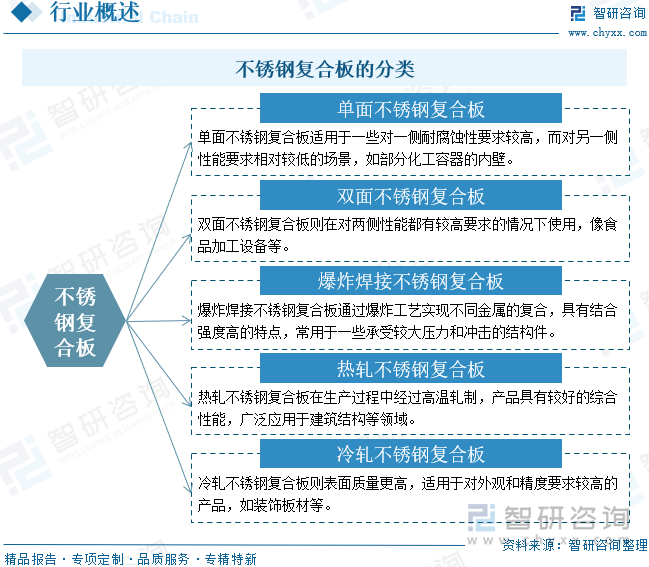
Industry Overview - The stainless steel composite plate is formed by metallurgical bonding of carbon steel base and stainless steel cladding, combining the mechanical strength of carbon steel and the corrosion resistance of stainless steel, widely used in petroleum, chemical, coking, and power equipment manufacturing [3][11] - The industry has seen significant growth, with the market size in China expected to increase from 9.5 billion yuan in 2019 to 17.95 billion yuan in 2024, representing a compound annual growth rate (CAGR) of 13.57% [17][20] Industry Development History - The development of the stainless steel composite plate industry in China began in the 1960s, initially dominated by explosive composite technology, with production scale and application range limited by technology and equipment conditions [8] - The industry entered a rapid development phase after 2015, with over 40 domestic companies capable of production, and products widely used in chemical, energy, and marine engineering sectors [8][20] Industry Chain - The upstream of the stainless steel composite plate industry includes raw materials and equipment, such as carbon steel and stainless steel, while the midstream involves the production and manufacturing processes [10] - The downstream applications encompass various sectors, including petroleum and chemical, food processing, construction, and transportation [10] Market Demand and Supply - The demand for stainless steel composite plates in China is projected to grow from 520,000 tons in 2019 to 840,000 tons in 2024, with a CAGR of 10.07% [16] - The stainless steel crude steel output in China is expected to reach 39.44 million tons in 2024, a year-on-year increase of 7.54% [11][14] Key Companies - Major players in the industry include Nanjing Steel, Taiyuan Iron and Steel, and specialized companies like Tianli Composite and Baotai Group, which focus on high-end applications and technological innovation [20][21][24] - The competitive landscape is characterized by a mix of large state-owned enterprises and specialized composite material companies, with a focus on technology and product differentiation [20] Industry Trends - The industry is moving towards high performance, with advancements in material composition and composite technology to meet the stringent demands of high-end manufacturing [26] - Efficiency improvements are a core focus, with the adoption of advanced processes like continuous rolling and automated production lines to reduce costs and production cycles [27] - Environmental trends are pushing the industry towards green manufacturing, with a shift to low-energy consumption processes and recyclable materials [28]




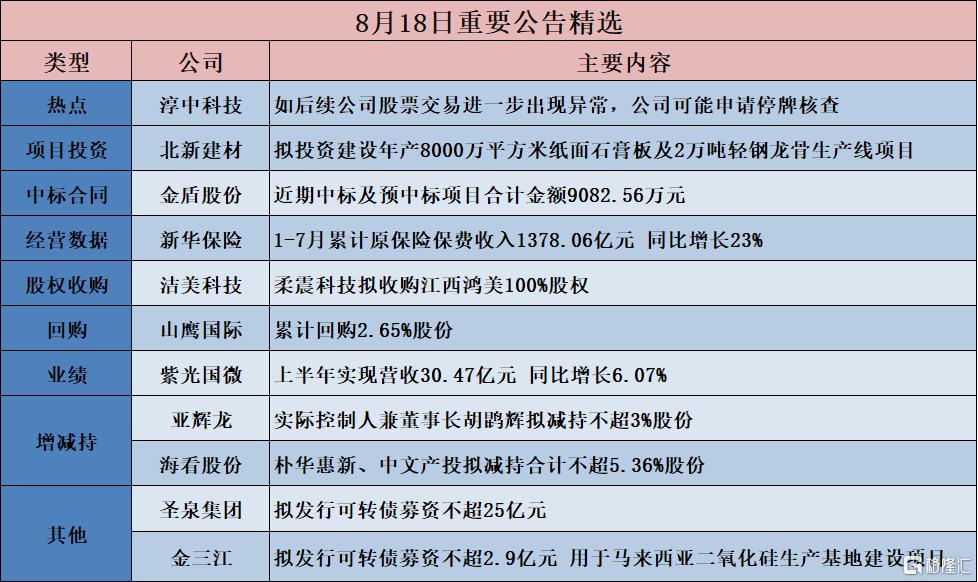
公告精选︱蔚蓝锂芯:上半年净利润3.33亿元 同比增长99.09%;淳中科技:如后续公司股票交易进一步出现异常,公司可能申请停牌核查





Ge Long Hui· 2025-08-19 00:30
Key Points - The article highlights significant announcements from various companies, including stock trading issues, project investments, contract wins, operational data, equity acquisitions, share buybacks, and financial performance [1][2]. Group 1: Company Highlights - Chunzhong Technology may apply for a trading suspension if further stock trading anomalies occur [1] - North New Building Materials plans to invest in a project to produce 80 million square meters of paper-faced gypsum board and 20,000 tons of light steel keel annually [1] - Jindun Co., Ltd. recently won contracts totaling 90.8256 million yuan [1] - Xinhua Insurance reported a cumulative original insurance premium income of 137.806 billion yuan from January to July, a year-on-year increase of 23% [1] - Jiemai Technology's subsidiary plans to acquire 100% equity of Jiangxi Hongmei [1] - Shanying International has repurchased 2.65% of its shares [1] - Unisoc achieved a revenue of 3.047 billion yuan in the first half of the year, a year-on-year increase of 6.07% [1] - Aihome's net profit for the first half of the year was 789 million yuan, with a proposed dividend of 12 yuan per share [1][2] Group 2: Financial Data - Blue Lithium Chip reported a net profit of 333 million yuan in the first half of the year, a year-on-year increase of 99.09% [2] - China Construction signed new contracts totaling 2.6798 trillion yuan from January to July, a year-on-year increase of 1.4% [1] - China Chemical's total contract amount from January to July was 224.845 billion yuan [1] Group 3: Shareholder Actions - Yahui Long's actual controller and chairman plans to reduce holdings by no more than 3% [2] - Hai Kan Co., Ltd. shareholders plan to reduce holdings by a total of no more than 5.36% [2] - Shareholders of Haichuan Intelligent plan to reduce holdings by a total of no more than 6% [2] Group 4: Other Financial Activities - Shengquan Group plans to issue convertible bonds to raise no more than 2.5 billion yuan [1][2] - Jin Sanjiang plans to issue convertible bonds to raise no more than 290 million yuan for the construction of a silica production base in Malaysia [1][2]
中国建筑股份有限公司 2025年1-7月经营情况简报
Zheng Quan Ri Bao· 2025-08-18 22:59
证券代码:601668 证券简称:中国建筑 公告编号:临2025-048 本公司董事会及全体董事保证本公告内容不存在任何虚假记载、误导性陈述或者重大遗漏,并对其内容 的真实性、准确性和完整性承担法律责任。 董事会 二〇二五年八月十八日 注:由于存在各种不确定性,上述经营指标和数据与定期报告披露的数据可能存在差异,因此相关数据 为阶段性数据,仅供参考。 中国建筑股份有限公司 现将本公司2025年1-7月主要经营情况公布如下,供各位投资者参阅。 ...
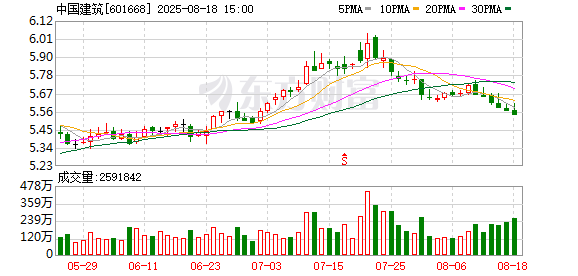
中国建筑8月18日大宗交易成交199.44万元
Zheng Quan Shi Bao Wang· 2025-08-18 14:17
两融数据显示,该股最新融资余额为41.24亿元,近5日增加3.47亿元,增幅为9.18%。(数据宝) 8月18日中国建筑大宗交易一览 | 成交量 | 成交金 | 成交价 | 相对当日 | | | | --- | --- | --- | --- | --- | --- | | (万 | 额 | 格 | 收盘折溢 | 买方营业部 | 卖方营业部 | | 股) | (万 | | 价 | | | | | 元) | (元) | (%) | | | | 36.00 | 199.44 | 5.54 | 0.00 | 华泰证券股份有限公司 | 华泰证券股份有限公司北京苏州街证券 | | | | | | 总部 | 营业部 | 注:本文系新闻报道,不构成投资建议,股市有风险,投资需谨慎。 (原标题:中国建筑8月18日大宗交易成交199.44万元) 中国建筑8月18日大宗交易平台出现一笔成交,成交量36.00万股,成交金额199.44万元,大宗交易成交 价为5.54元。该笔交易的买方营业部为华泰证券股份有限公司总部,卖方营业部为华泰证券股份有限公 司北京苏州街证券营业部。 进一步统计,近3个月内该股累计发生3笔大宗交易,合计成交金 ...
中国建筑:1月-7月新签合同总额同比增长1.4%
Zheng Quan Ri Bao· 2025-08-18 14:13
Core Viewpoint - China State Construction announced a total new contract amount of 26,798 billion yuan from January to July 2025, representing a year-on-year increase of 1.4% [2] Group 1: Contract Performance - The new contracts in the construction business amounted to 24,868 billion yuan, with a year-on-year growth of 2.1% [2] - The area of housing construction under contract was 153,131 million square meters, showing a year-on-year decrease of 1.2% [2] - The newly started construction area was 15,708 million square meters, down 8.5% year-on-year [2] - The completed construction area reached 10,366 million square meters, reflecting a year-on-year increase of 4.7% [2] Group 2: Real Estate Business - The contract sales amount in the real estate sector was 1,930 billion yuan, which is a year-on-year decline of 7.4% [2] - The contract sales area was 721 million square meters, showing a slight year-on-year decrease of 0.3% [2]
中国建筑:1-7月实现新签合同总额约人民币26798亿元,同比增长1.4%
Cai Jing Wang· 2025-08-18 11:59
Core Insights - The company reported a total new contract value of approximately RMB 26,798 billion for the period from January to July 2025, representing a year-on-year increase of 1.4% [2] Group 1: Construction Business - In the construction segment, the new contract value reached RMB 24,868 billion, showing a year-on-year growth of 2.1% [3] Group 2: Real Estate Business - In the real estate segment, the contract sales amounted to RMB 1,930 billion, reflecting a year-on-year decrease of 7.4% [3] - The contracted sales area was 7.21 million square meters, which is a slight decrease of 0.3% year-on-year [3] - The company had a land reserve of 77.83 million square meters at the end of the period, with new land acquisitions totaling 5.76 million square meters [3]
中国建筑(601668.SH)前7个月新签合同总额同比增长1.4%
智通财经网· 2025-08-18 11:18
Group 1 - The core point of the article is that China State Construction Engineering Corporation (601668.SH) reported a total new contract amount of 26,798 billion yuan for the period from January to July 2025, representing a year-on-year growth of 1.4% [1] - Among the total, the new contract amount for construction business reached 24,868 billion yuan, showing a year-on-year increase of 2.1% [1]
中国建筑: 中国建筑2025年1-7月经营情况简报
Zheng Quan Zhi Xing· 2025-08-18 10:19
Group 1 - The core viewpoint of the announcement is to provide an overview of the company's major operational performance for the first seven months of 2025, highlighting both growth and decline in various segments [1]. Group 2 - The total new contracts signed amounted to RMB 26,798 million, representing a year-on-year increase of 1.4% [1]. - In the construction business, the housing construction segment generated RMB 16,258 million, showing a slight decline of 0.4% compared to the previous year [1]. - The infrastructure segment saw a growth of 7.4%, with new contracts totaling RMB 8,533 million [1]. - The surveying and design segment experienced a decline of 7.2%, with contracts amounting to RMB 77 million [1]. - Domestic contracts totaled RMB 23,595 million, reflecting a year-on-year increase of 2.6%, while overseas contracts were RMB 1,273 million, down by 5.5% [1]. - The total construction area for housing was 153,131 thousand square meters, which is a decrease of 1.2% year-on-year [1]. - The newly started construction area for housing was 15,708 thousand square meters, showing a significant decline of 8.5% [1]. - The completed construction area for housing reached 10,366 thousand square meters, marking an increase of 4.7% compared to the previous year [1].
哪些建筑标的受益于“反内卷”?
Tianfeng Securities· 2025-08-18 10:11
Investment Rating - The industry rating is "Outperform the Market" (maintained rating) [5] Core Viewpoints - The "anti-involution" policy is transitioning from policy definition to implementation, with a focus on shifting from "price competition" to "value competition" in the construction industry [14][15] - The construction sector is expected to benefit from improved cash flow and report quality due to the optimization of supply and demand dynamics, which will enhance the dividend capacity of state-owned enterprises [15][24] - The report emphasizes the importance of technology transformation and the development of non-traditional construction businesses, such as smart cities and smart construction, as key paths for traditional construction companies [2][3] Summary by Sections 1. Traditional Low-Valuation State-Owned Enterprises - The market share of nine major state-owned construction enterprises has increased from 30.45% in 2016 to 48.9% in 2024, with a further rise to 59.89% in Q1 2025, indicating strong order acquisition capabilities [15][21] - The report highlights three dimensions for understanding the implications of "anti-involution": dividend capacity, price elasticity, and technology transformation [2][14] - Companies with strong dividend capabilities, such as China State Construction and Sichuan Road and Bridge, are recommended [2][24] 2. International Engineering Sector - The international engineering sector is expected to benefit from price elasticity due to rising expectations for resource prices, particularly in coal [3][29] - The report suggests that improvements in downstream profitability and high-quality development in industries like steel and cement will drive demand for engineering companies [3][29] 3. Steel Structure Sector - The steel structure sector is divided into manufacturing and installation, with rising steel prices benefiting manufacturing companies like Honglu Steel Construction [4][29] - The transition towards intelligent and green construction is expected to enhance the competitive advantages of leading companies in the steel structure installation segment [4][29] - Companies like Jianghe Group and Jinggong Steel Construction are highlighted for their significant growth in overseas orders [4][29] 4. Key Stock Recommendations - The report recommends several stocks based on their performance and valuation metrics, including China State Construction, China Chemical, and Honglu Steel Construction, all of which have favorable P/E ratios and dividend yields [9][25][27]