CSCEC(601668)

Search documents
四川盛世钢联国际贸易有限公司-大客户关系
Sou Hu Cai Jing· 2025-08-18 02:11
Group 1 - The key clients of Sichuan Shengshi Steel Union International Trade Co., Ltd. include major state-owned enterprises directly supervised by the State-owned Assets Supervision and Administration Commission, covering various sectors such as construction, infrastructure, and energy engineering [1] Group 2 - The core list of top ten central enterprise construction companies includes China State Construction Engineering Corporation, which has a business focus on housing construction (over 50% of global super high-rise buildings) and infrastructure [4] - China Railway Group Limited specializes in railway engineering, accounting for 66% of the national railway mileage, with a significant increase of 51.6% in overseas business [4] - China Railway Construction Corporation is responsible for 52% of the national high-speed rail mileage and has established construction standards for high-speed rail in China [4] Group 3 - China Communications Construction Company focuses on port channels and cross-sea bridges, with a new contract amount of 9910.54 billion yuan in the first half of 2025 [5] - China Power Construction Group is a leader in hydropower, with a global market share exceeding 50% in overseas hydropower [5] - China Energy Engineering Group is innovating in traditional energy upgrades and has seen a growth rate of over 30% in new energy contracts [5] Group 4 - China Metallurgical Group Corporation leads the global market share in metallurgical engineering and is advancing hydrogen metallurgy technology for low-carbon transformation [5] - China Chemical Engineering Group dominates 70% of domestic petrochemical projects and has achieved a 12.3% growth in fine chemical contracts [5] - China National Nuclear Corporation is responsible for all domestic nuclear power units and plays a special role in national defense engineering and nuclear emergency support [5] - China Aneng Construction Group specializes in water conservancy and emergency rescue tasks [6]





趋势研判!2025年中国建筑材料检测行业流程、产业链、发展规模、市场价格、竞争格局及行业发展趋势分析:规模逐渐壮大,市场规模有望增长至426.14亿元[图]
Chan Ye Xin Xi Wang· 2025-08-18 01:28
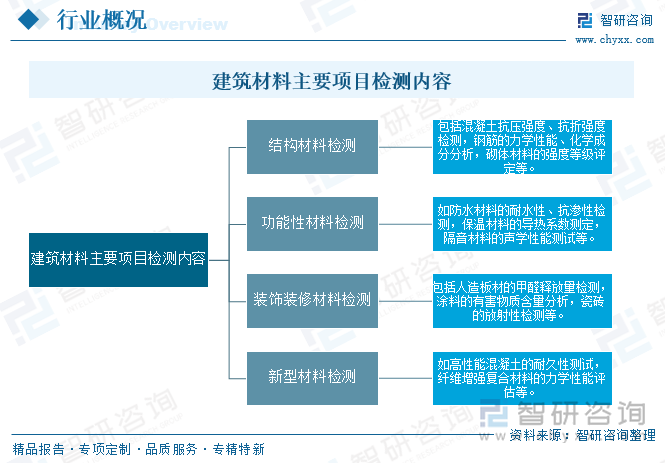
Core Insights - The construction materials testing industry is crucial for ensuring engineering safety, with 35% of construction accidents attributed to material issues [10][12]. - The market for construction materials testing in China is projected to grow significantly, with an expected report issuance of 62.21 million in 2025 and a market size of 42.614 billion yuan [10][12]. - The average price for construction materials testing is on a downward trend, decreasing from 745 yuan per report in 2019 to an estimated 685 yuan in 2025 [12]. Industry Definition and Main Content - Construction materials are defined as materials used in civil engineering, including cement, sand, stone, metals, asphalt, synthetic resins, and plastics [8]. - Testing is essential for quality control, ensuring materials meet design requirements, construction standards, and national regulations [8][10]. Current Development Status - The construction materials testing industry has evolved from simple physical and chemical tests to high-precision non-destructive testing technologies [10]. - The number of reports issued in the construction materials testing sector has increased from 25.51 million in 2016 to 58.74 million in 2024, with a market size growth from 18.241 billion yuan to 40.881 billion yuan during the same period [10][12]. Industry Chain - The upstream of the construction materials testing industry includes instruments, consumables, standard substances, data and software, and talent [14]. - The midstream consists of testing service providers, including third-party testing agencies, government laboratories, and internal company labs [14]. - The downstream serves construction companies, building material manufacturers, regulatory bodies, and ultimately property owners [14]. Competitive Landscape - The competitive landscape includes state-owned leaders, private third-party testing institutions, and international testing giants, each leveraging their strengths for differentiated positioning [17]. - Major players include the state-owned National Inspection Group, private firms like Huace Testing and Puni Testing, and international entities such as SGS and BV [17][19]. Development Trends - The industry is expected to focus on technological innovation, with an emphasis on developing intelligent and automated testing equipment to meet increasing testing demands [27]. - There is a need for a standardized database system to analyze material performance data, utilizing data analysis tools for intelligent predictions and anomaly detection [27][28]. - The construction materials testing sector is also moving towards sustainability, requiring materials that are efficient, lightweight, green, and multifunctional [29].


7月铁路、水电燃热投资高增,关注中西部区域基建投资机会
Tianfeng Securities· 2025-08-16 09:35
Investment Rating - Industry rating is maintained at "Outperform the Market" [5] Core Viewpoints - Infrastructure investment in July showed a high increase in railway and water electricity fuel investment, while overall infrastructure investment is experiencing marginal slowdown, particularly in the central and western regions [1][2] - Real estate development investment from January to July decreased by 12%, with a significant drop of 17.1% in July alone, indicating a continued weakness in the real estate sector [2] - The issuance of special bonds has accelerated, with a total of 27,775.89 billion yuan issued from January to July, representing a year-on-year increase of 56.5%, which is expected to support infrastructure investment growth in the second half of the year [1] - Cement demand is anticipated to gradually recover, with a focus on investment opportunities at relatively low points in the market, despite a 4.5% year-on-year decline in cement production from January to July [3] - The flat glass market is showing signs of improvement, with a slight increase in prices and a reduction in inventory levels, suggesting a potential recovery in demand [4] Summary by Sections Infrastructure Investment - In July, infrastructure investment growth was supported by a 21.5% year-on-year increase in water electricity fuel investment, while transportation and storage investment saw a 3.9% increase [2] - The report emphasizes the importance of focusing on major engineering projects and infrastructure investments in the central and western regions [1] Real Estate Sector - The real estate sector continues to show weakness, with significant declines in sales, new construction, and completion areas from January to July [2] - The report highlights the need for monitoring policy changes that could impact the real estate market [4] Cement and Glass Markets - Cement production decreased by 4.5% year-on-year, with a notable drop in July, but there are expectations for demand recovery as the market enters a peak season [3] - The flat glass market is experiencing a slight recovery, with improved trading conditions and reduced inventory levels [4]




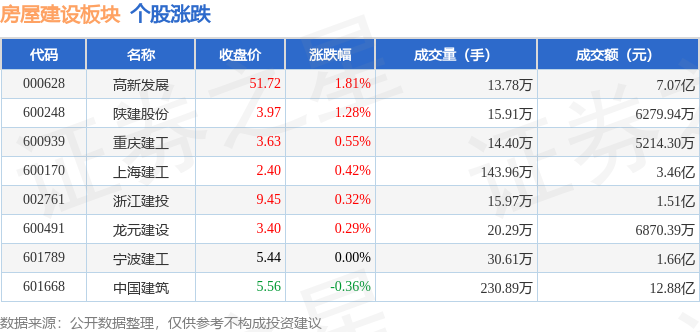
房屋建设板块8月15日跌0.1%,中国建筑领跌,主力资金净流出1.21亿元
Zheng Xing Xing Ye Ri Bao· 2025-08-15 08:44
证券之星消息,8月15日房屋建设板块较上一交易日下跌0.1%,中国建筑领跌。当日上证指数报收于 3696.77,上涨0.83%。深证成指报收于11634.67,上涨1.6%。房屋建设板块个股涨跌见下表: | 代码 | 名称 | 收盘价 | 涨跌幅 | 成交量(手) | 成交额(元) | | --- | --- | --- | --- | --- | --- | | 000628 | 高新发展 | 51.72 | 1.81% | 13.78万 | 7.07亿 | | 600248 | 陕建股份 | 3.97 | 1.28% | 15.91万 | 6279.94万 | | 600939 | 車庆建工 | 3.63 | 0.55% | 14.40万 | 5214.30万 | | 600170 | 一海建了 > | 2.40 | 0.42% | 143.96万 | 3.46亿 | | 002761 | 浙江建投 | 9.45 | 0.32% | 15.97万 | 1.51亿 | | 600491 | 龙元建设 | 3.40 | 0.29% | 20.29万 | 6870.39万 | | 601789 | 宁波建工 | ...
工程建设行业15日主力净流出1.86亿元,上海港湾、中国电建居前
Sou Hu Cai Jing· 2025-08-15 07:52
Group 1 - The engineering construction industry rose by 0.83% on August 15, with a net outflow of 186 million yuan in main funds [1] - A total of 46 constituent stocks increased in value, while 16 stocks experienced declines [1] - The stocks with the highest net outflow of main funds included Shanghai Port Construction (122 million yuan), China Power Construction (63.84 million yuan), and China State Construction (53.33 million yuan) [1] Group 2 - Notable stocks with significant net inflows included North International (7.04% increase, 72.38 million yuan), China National Machinery (4.12% increase, 56.64 million yuan), and Donghu High-tech (2.35% increase, 53.53 million yuan) [1] - The stock performance varied, with some stocks like Chengdu Road and Bridge showing a slight decline of 0.19% [1] - The overall market sentiment reflected a mixed performance among the engineering construction sector, with both gains and losses observed [1]


中国建筑兴业联手中南建筑设计院 共拓绿色建筑市场新机遇
Cai Fu Zai Xian· 2025-08-15 07:07
Core Viewpoint - The strategic cooperation between China Construction Industry Group and China South Architectural Design Institute is seen as a key move in the construction industry's transition to green and low-carbon development, aiming to seize significant market opportunities in this sector [1][5]. Group 1: Cooperation Focus - The collaboration will focus on three main areas: project development, technological innovation, and market expansion, specifically targeting BIPV, photovoltaic building materials, and high-end energy-saving curtain wall projects [2]. - The partnership aims to integrate BIPV technology with architectural aesthetics, creating a comprehensive ecosystem covering R&D, design, production, and construction [2]. Group 2: Strengths and Innovations - China Construction Industry Group's Far East Photovoltaic Facade specializes in BIPV product development, with its LIGHT series products achieving a maximum power output of 190W/m² and capable of covering the annual electricity needs of four households per 100 square meters [3]. - The LIGHT series utilizes advanced materials and aesthetic designs, overcoming traditional perceptions of photovoltaic components as unattractive, while also ensuring safety and durability against extreme weather [3]. Group 3: Industry Trends and Potential - China South Architectural Design Institute is transitioning from a traditional engineering design firm to a smart green city service provider, with significant expertise in green building technologies and standards [4]. - The collaboration is expected to accelerate the large-scale application of BIPV technology in both new constructions and renovations, providing a reference for the industry's green transformation amid increasing global attention on sustainable building practices [5].
【财经分析】多因素制约下埃及绿氢战略进展缓慢
Xin Hua Cai Jing· 2025-08-14 08:34
Core Insights - Egypt has prioritized the green hydrogen industry in its national economic development strategy, aiming for significant production and export capabilities by 2040 [2][3] - Despite favorable policies and international interest, the actual conversion of memorandums of understanding into investment agreements remains limited due to high production costs and infrastructure challenges [1][4] Group 1: Strategic Vision and Goals - Egypt aims to achieve a green hydrogen production capacity of 5.8 million tons by 2040, capturing 5% to 8% of the global hydrogen market and contributing nearly $18 billion to GDP [2] - The establishment of the National Hydrogen Committee in August 2023 is intended to oversee the implementation of the green hydrogen strategy and eliminate investment barriers [2][3] Group 2: Investment Incentives and International Participation - The Egyptian government has introduced tax incentives ranging from 33% to 55% for qualifying green hydrogen projects, along with exemptions from VAT and customs duties on imports [3] - Over 30 memorandums of understanding have been signed with international energy companies, including those from Saudi Arabia and Abu Dhabi, as well as Chinese firms like China Energy Engineering and China State Construction [3][4] Group 3: Challenges and Constraints - High production costs of green hydrogen, driven by renewable electricity and electrolyzer prices, pose a significant challenge to large-scale production [4] - The need for substantial investment in infrastructure, including dedicated pipelines and storage facilities, is critical for the development of the green hydrogen sector [4][5] - Water scarcity in Egypt complicates the production process, as electrolysis requires significant freshwater, necessitating sustainable water management strategies [6] Group 4: Opportunities for Chinese Enterprises - Chinese companies are well-positioned to leverage their expertise in renewable energy and infrastructure projects in Egypt, particularly in areas like EPC for large-scale green hydrogen production [7] - Opportunities exist in the production of related equipment, such as electrolyzers and solar panels, as well as in upgrading the electrical grid and energy storage solutions [7] - The water desalination sector presents investment opportunities for Chinese firms with expertise in desalination technology, particularly for projects related to green hydrogen [7][8]

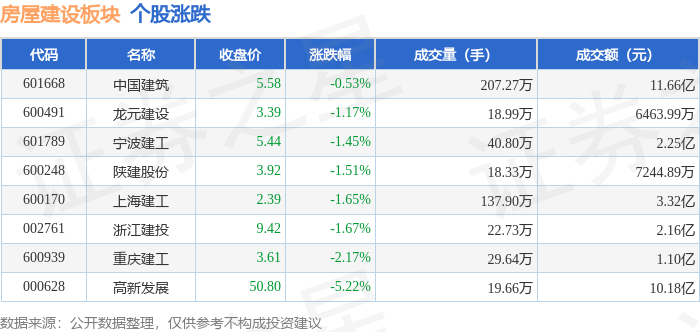
房屋建设板块8月14日跌0.92%,高新发展领跌,主力资金净流出2.65亿元
Zheng Xing Xing Ye Ri Bao· 2025-08-14 08:33
Core Viewpoint - The housing construction sector experienced a decline of 0.92% on August 14, with significant losses in high-tech development stocks, while the overall market indices also fell [1] Market Performance - The Shanghai Composite Index closed at 3666.44, down 0.46% - The Shenzhen Component Index closed at 11451.43, down 0.87% [1] Stock Performance in Housing Construction Sector - Major stocks in the housing construction sector showed the following closing prices and changes: - China State Construction: 5.58, down 0.53% - Longyuan Construction: 3.39, down 1.17% - Ningbo Construction: 5.44, down 1.45% - Shaanxi Construction: 3.92, down 1.51% - Shanghai Construction: 2.39, down 1.65% - Zhejiang Construction Investment: 9.42, down 1.67% - Chongqing Construction: 3.61, down 2.17% - High-tech Development: 50.80, down 5.22% [1] Capital Flow Analysis - The housing construction sector saw a net outflow of 265 million yuan from main funds, while retail investors contributed a net inflow of 218 million yuan [1] - The following table summarizes the capital flow for individual stocks: - Chongqing Construction: Main funds -154.59K, Retail +229.44K - Longyuan Construction: Main funds -405.18K, Retail +514.99K - Shanghai Construction: Main funds -744.12K, Retail +204.76K - Zhejiang Construction Investment: Main funds -898.62K, Retail +2545.76K - Shaanxi Construction: Main funds -944.99K, Retail +1013.90K - Ningbo Construction: Main funds -1071.98K, Retail +1086.98K - China State Construction: Main funds -5946.23K, Retail +4705.22K - High-tech Development: Main funds -1.63Z, Retail +1.19Z [2]


建筑装饰行业资金流出榜:新疆交建、北新路桥等净流出资金居前
Zheng Quan Shi Bao Wang· 2025-08-13 10:09
| 代码 | 简称 | 今日涨跌幅(%) | 今日换手率(%) | 主力资金流量(万元) | | --- | --- | --- | --- | --- | | 000065 | 北方国际 | 2.07 | 4.97 | 5778.19 | | 605289 | 罗曼股份 | 9.99 | 12.48 | 5264.23 | | 000032 | 深桑达A | 1.27 | 3.25 | 4962.28 | | 002062 | 宏润建设 | 4.93 | 10.62 | 4584.47 | | 603098 | 森特股份 | 10.04 | 2.96 | 4335.23 | | 300355 | 蒙草生态 | 3.00 | 8.64 | 3393.04 | | 300197 | 节能铁汉 | 4.07 | 4.35 | 2802.71 | | 001267 | 汇绿生态 | 2.81 | 5.40 | 2558.26 | | 601789 | 宁波建工 | 0.55 | 3.59 | 2362.29 | | 000928 | 中钢国际 | 0.76 | 2.17 | 1658.46 | | 002989 | ...


房屋建设板块8月13日跌0.62%,重庆建工领跌,主力资金净流出1.08亿元
Zheng Xing Xing Ye Ri Bao· 2025-08-13 08:41
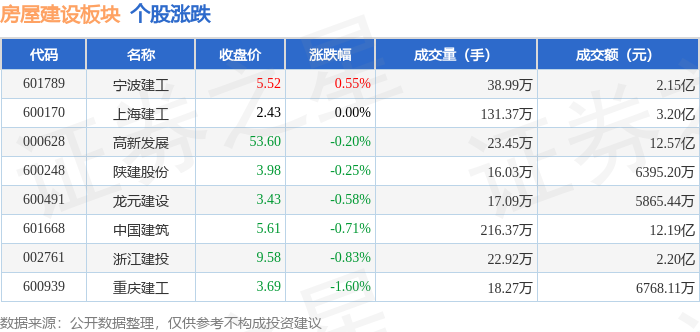
Market Overview - The housing construction sector experienced a decline of 0.62% on August 13, with Chongqing Construction leading the drop [1] - The Shanghai Composite Index closed at 3683.46, up 0.48%, while the Shenzhen Component Index closed at 11551.36, up 1.76% [1] Stock Performance - Notable stock performances in the housing construction sector included: - Ningbo Construction: Closed at 5.52, up 0.55% with a trading volume of 389,900 shares and a turnover of 215 million [1] - Shanghai Construction: Closed at 2.43, unchanged with a trading volume of 1,313,700 shares and a turnover of 320 million [1] - Chongqing Construction: Closed at 3.69, down 1.60% with a trading volume of 182,700 shares and a turnover of 67.68 million [1] Capital Flow - The housing construction sector saw a net outflow of 108 million from main funds, while retail funds experienced a net inflow of 43.63 million [1] - The detailed capital flow for selected stocks showed: - Ningbo Construction: Main funds net inflow of 23.59 million, retail funds net outflow of 1.15 million [2] - Chongqing Construction: Main funds net outflow of 4.74 million, retail funds net inflow of 8.48 million [2] - Zhejiang Construction: Main funds net outflow of 23.55 million, retail funds net inflow of 28.68 million [2]