CEB BANK(601818)

Search documents
中国光大银行打造“阳光交易+”新引擎助力实体经济提质增效
Qi Lu Wan Bao· 2025-10-22 16:19
Core Viewpoint - Everbright Bank has been enhancing its "Sunshine Financial" services, providing customized financial solutions that integrate payment, settlement, financing, credit, and investment for nearly 10,000 small and micro enterprises, effectively supporting the development of the real economy [1] Group 1: Financial Services - The bank has expanded financing channels for small and micro enterprises through "Sunshine e-Payment," addressing supply chain financing challenges [1] - Everbright Bank's Hefei branch responded quickly to a funding need for a civil project, providing precise financial support to upstream enterprises within 12 days, ensuring nearly 1,000 migrant workers could return home [1] Group 2: Technological Finance - The bank has optimized processes and integrated resources to reduce costs and improve efficiency, facilitating capital injection into the real economy [1] - The Hangzhou branch collaborated with a local leading private enterprise to implement a fully online transformation of the financing process, resulting in 571 loans amounting to nearly 300 million yuan, with same-day application and two-hour fund disbursement [1] Group 3: Future Plans - Everbright Bank plans to continue deepening its "Sunshine Financial" services and enhance its "Sunshine Trading+" comprehensive financial service system to empower industrial chain collaboration and support high-quality development of the real economy [1]

光大银行大宗交易成交326.06万元
Zheng Quan Shi Bao Wang· 2025-10-22 14:29
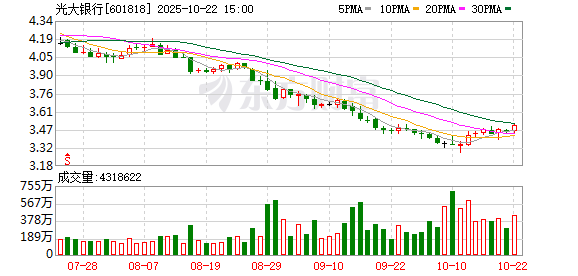
| 成交量 (万 | 成交金额 | 成交价 | 相对当日收盘折 | 买方营业部 | 卖方营业部 | | --- | --- | --- | --- | --- | --- | | | (万元) | 格 | 溢价(%) | | | | 股) | | (元) | | | | | 93.16 | 326.06 | 3.50 | 0.00 | 国泰海通证券股份有限公司成 | 国泰海通证券股份 | | | | | | 都双庆路证券营业部 | 有限公司总部 | (文章来源:证券时报网) 证券时报·数据宝统计显示,光大银行今日收盘价为3.50元,上涨1.45%,日换手率为0.93%,成交额为 15.04亿元,全天主力资金净流入5957.88万元,近5日该股累计上涨1.74%,近5日资金合计净流出1.52亿 元。 两融数据显示,该股最新融资余额为20.23亿元,近5日增加3451.08万元,增幅为1.74%。(数据宝) 10月22日光大银行大宗交易一览 光大银行10月22日大宗交易平台出现一笔成交,成交量93.16万股,成交金额326.06万元,大宗交易成交 价为3.50元。该笔交易的买方营业部为国泰海通证券股份有限公司成都 ...

光大银行10月22日现1笔大宗交易 总成交金额326.06万元 溢价率为0.00%
Xin Lang Cai Jing· 2025-10-22 10:08
炒股就看金麒麟分析师研报,权威,专业,及时,全面,助您挖掘潜力主题机会! 进一步统计,近3个月内该股累计发生1笔大宗交易,合计成交金额为326.06万元。该股近5个交易日累 计上涨1.74%,主力资金合计净流出6499.87万元。 责任编辑:小浪快报 10月22日,光大银行收涨1.45%,收盘价为3.50元,发生1笔大宗交易,合计成交量93.16万股,成交金 额326.06万元。 第1笔成交价格为3.50元,成交93.16万股,成交金额326.06万元,溢价率为0.00%,买方营业部为国泰海 通证券股份有限公司成都双庆路证券营业部,卖方营业部为国泰海通证券股份有限公司总部。 ...
股份制银行板块10月22日涨0.78%,中信银行领涨,主力资金净流出3.55亿元
Zheng Xing Xing Ye Ri Bao· 2025-10-22 08:19
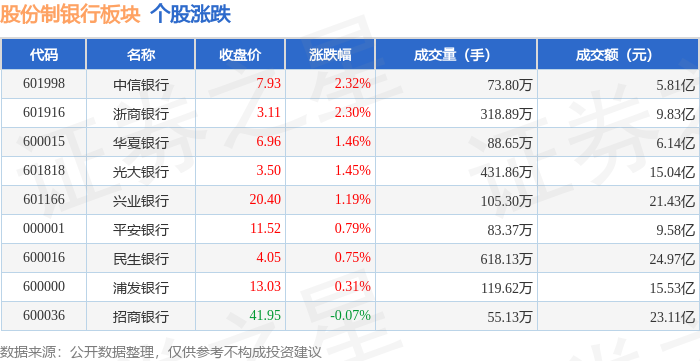
证券之星消息,10月22日股份制银行板块较上一交易日上涨0.78%,中信银行领涨。当日上证指数报收于3913.76,下跌0.07%。深证成指报收于 12996.61,下跌0.62%。股份制银行板块个股涨跌见下表: | 代码 | 名称 | 收盘价 | 涨跌幅 | 成交量(手) | 成交额(元) | | --- | --- | --- | --- | --- | --- | | 66109 | 中信银行 | 7.93 | 2.32% | 73.80万 | 5.81亿 | | 601916 | 浙商银行 | 3.11 | 2.30% | 318.89万 | 9.83亿 | | 600015 | 华夏银行 | 6.96 | 1.46% | 88.65万 | 6.14亿 | | 601818 | 光大银行 | 3.50 | 1.45% | 431.86万 | 15.04亿 | | 601166 | 兴业银行 | 20.40 | 1.19% | 105.30万 | 21.43亿 | | 000001 | 平安银行 | 11.52 | 0.79% | 83.37万 | 9.58亿 | | 600016 | 民生银行 | 4 ...




银行股涨幅扩大!
Ge Long Hui A P P· 2025-10-22 06:59
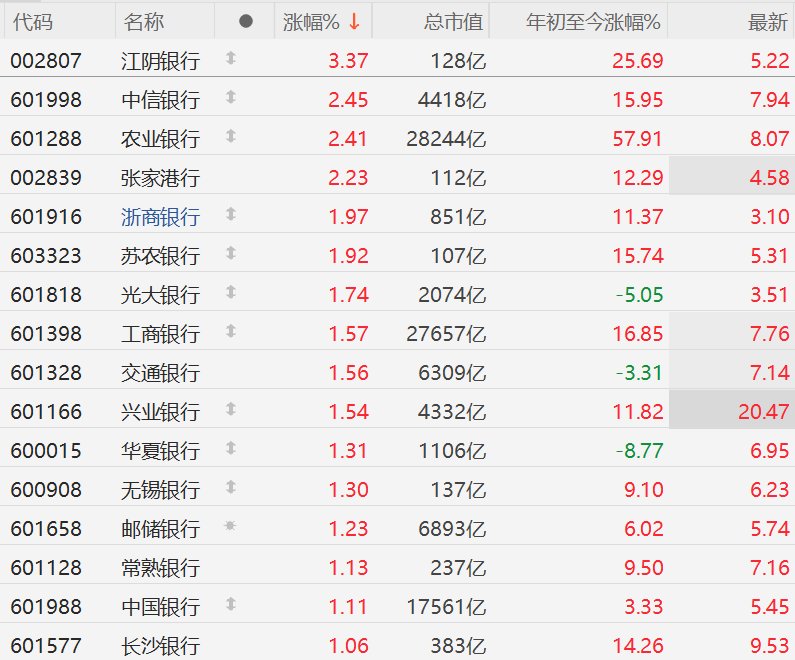
Core Insights - A-shares of bank stocks have seen significant gains, with Jiangyin Bank rising over 3%, and Agricultural Bank achieving a historical high with a 14-day consecutive increase, up nearly 58% year-to-date [1][2] Summary by Category Stock Performance - Jiangyin Bank: Increased by 3.37%, market cap at 12.8 billion, year-to-date gain of 25.69% [2] - CITIC Bank: Increased by 2.45%, market cap at 441.8 billion, year-to-date gain of 15.95% [2] - Agricultural Bank: Increased by 2.41%, market cap at 282.44 billion, year-to-date gain of 57.91% [2] - Zhangjiagang Bank: Increased by 2.23%, market cap at 11.2 billion, year-to-date gain of 12.29% [2] - Other notable banks include: - Zhejiang Commercial Bank: Increased by 1.97%, market cap at 85.1 billion, year-to-date gain of 11.37% [2] - Su Nong Bank: Increased by 1.92%, market cap at 10.7 billion, year-to-date gain of 15.74% [2] Market Trends - The overall trend indicates a strong bullish sentiment in the banking sector, with MACD golden cross signals suggesting continued upward momentum for these stocks [1]



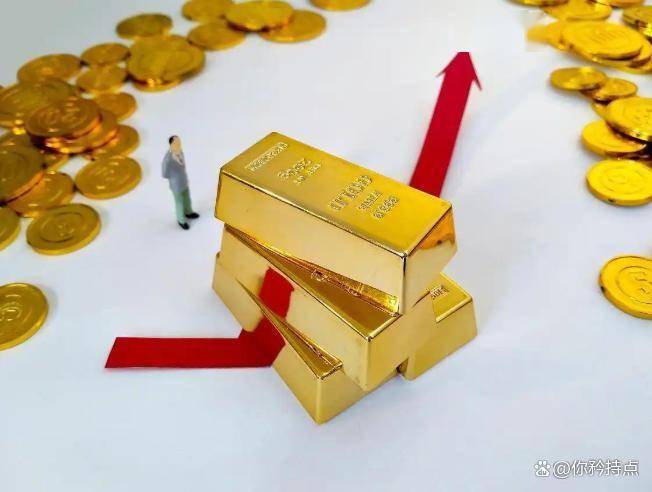
教授每年强制自己定投100克黄金,黄金定投背后的理智与疯狂
Sou Hu Cai Jing· 2025-10-22 06:32
Core Insights - The article highlights the significant rise in gold prices and the increasing interest in gold investment among different demographics, particularly intellectuals and young consumers in China [1][3][8]. Group 1: Gold Price Surge - Gold prices have recently surpassed $4,200 per ounce, leading to a corresponding increase in domestic gold jewelry prices, with notable daily increases in prices from major retailers [3][5]. - The price of gold jewelry has seen substantial increases, with examples including a rise from 1,215 RMB per gram to 1,235 RMB per gram for Chow Tai Fook jewelry [3][5]. Group 2: Investment Trends - The trend of gold investment is particularly strong among two groups: intellectuals like Professor Yu, who view gold as a long-term investment, and young consumers who see it as a combination of personal enjoyment and savings [3][4]. - A report indicates that the gold jewelry ownership rate among young consumers has increased from 37% to 62% [3]. Group 3: Banking Actions - In response to rising gold prices, major banks in China have raised the minimum purchase amounts for gold investment products, marking a shift to a "thousand yuan era" for gold investment [5][6]. - The adjustments made by banks, such as China Bank and Industrial and Commercial Bank, are seen as risk management measures in light of the soaring gold prices [6]. Group 4: Factors Driving Gold Prices - Multiple factors are contributing to the surge in gold prices, including economic uncertainty, geopolitical tensions, and expectations of a renewed interest rate cut cycle by the Federal Reserve [8][9]. - The demand for gold as a defensive asset has significantly increased, with central banks contributing to price support through substantial gold purchases [9][10]. Group 5: Investment Strategies - Professor Yu's strategy of regular gold investment has proven effective, with historical data showing that gold can serve as a hedge against inflation and market volatility [12][14]. - The article emphasizes the importance of a disciplined investment approach, as demonstrated by Professor Yu, who views gold investment as a form of forced savings rather than speculation [15][16].



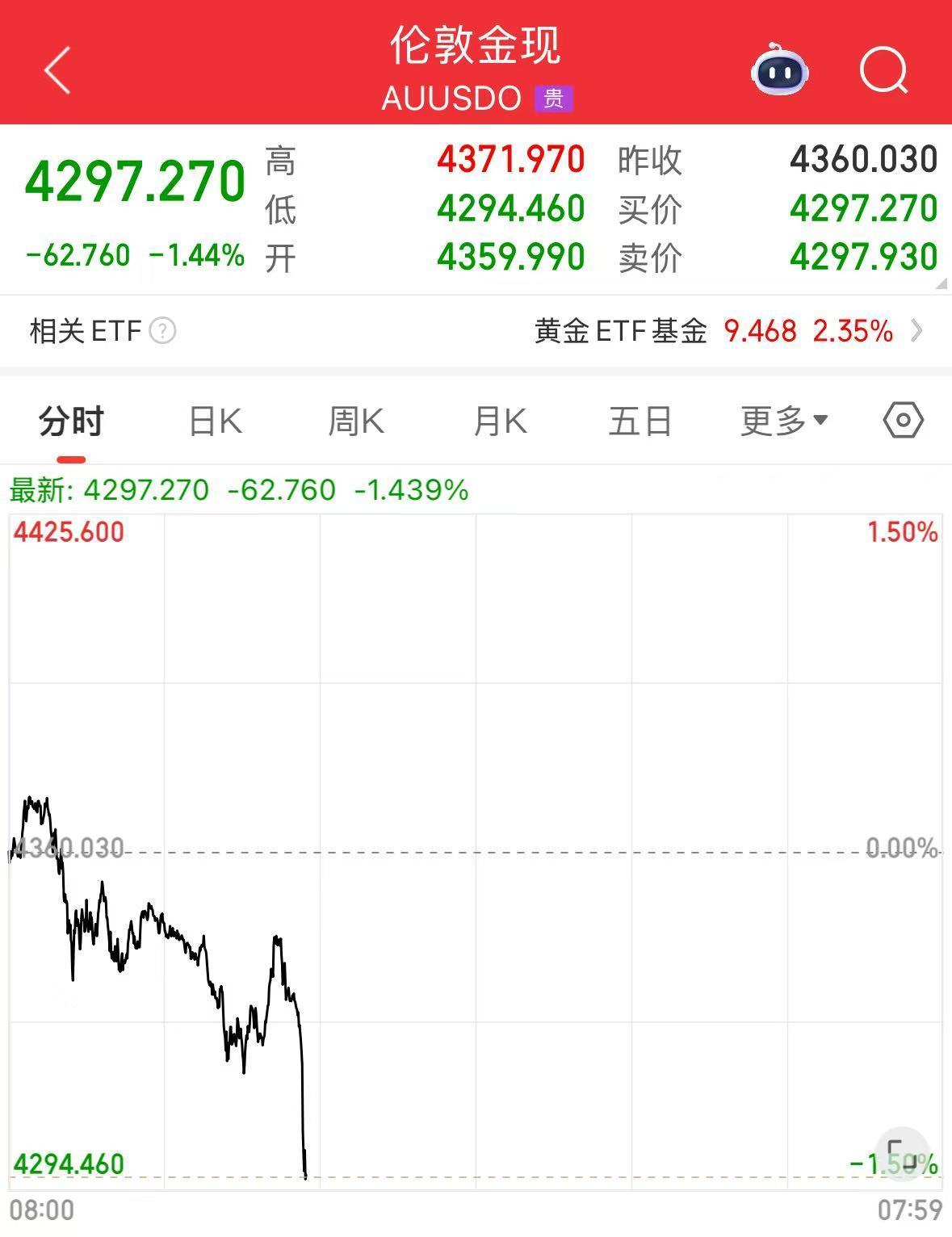
突发!金价,大跳水
Mei Ri Jing Ji Xin Wen· 2025-10-21 12:32
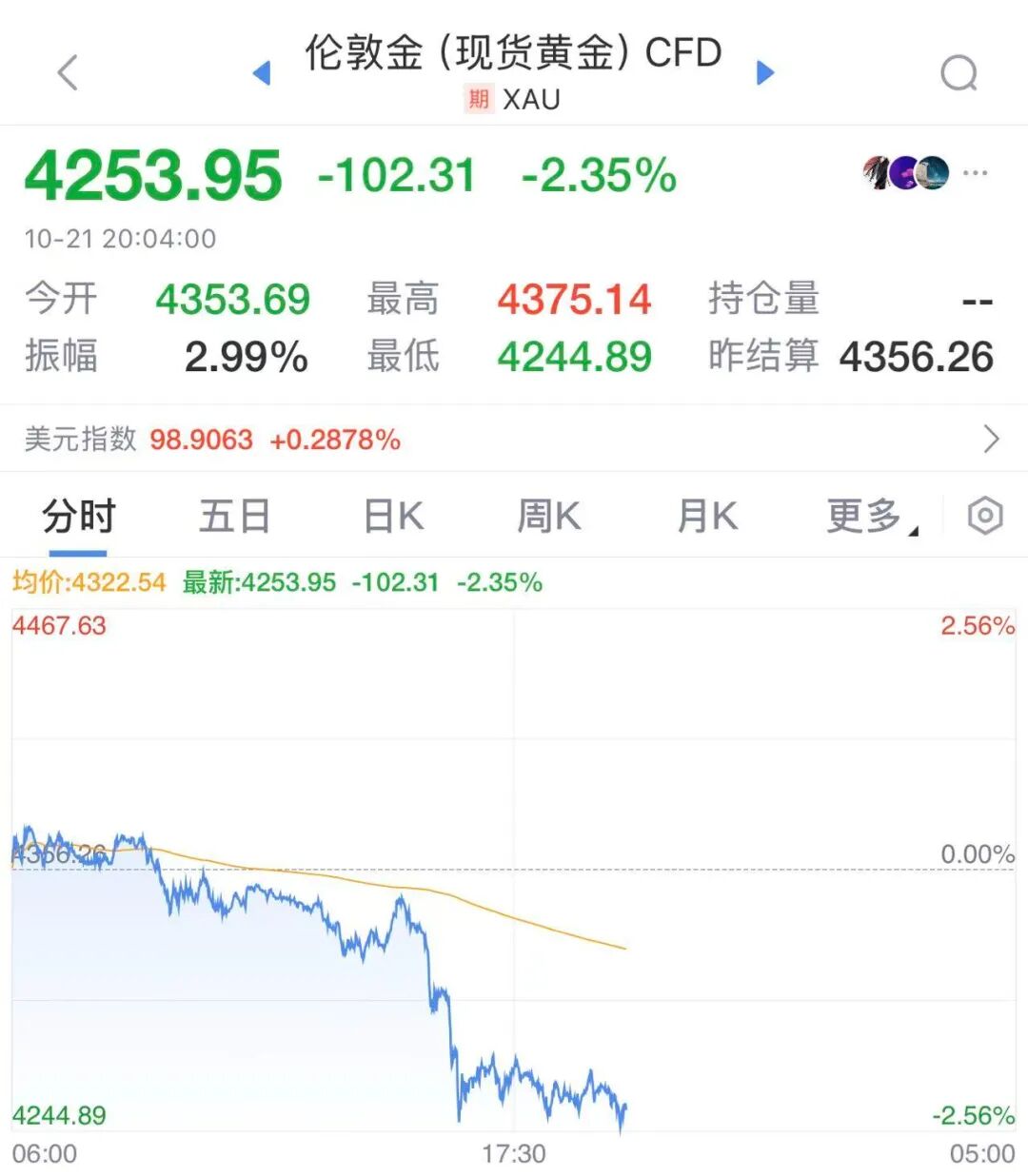
Core Viewpoint - Recent significant fluctuations in gold and silver prices have prompted financial institutions to tighten regulations on gold trading to protect investors from high leverage risks [3][5]. Group 1: Market Movements - On October 21, international gold and silver prices experienced a sharp decline, with spot gold dropping over 2% and more than $100 from its intraday high, while spot silver fell over 3% [1]. Group 2: Institutional Responses - Everbright Bank announced that starting October 20, it would gradually terminate business relationships with clients who have no positions in the Shanghai Gold Exchange's spot and deferred trading [3]. - Other banks, including Industrial Bank, China Merchants Bank, and China Construction Bank, have also issued warnings regarding the increased market risks associated with precious metals trading [5]. Group 3: Margin Adjustments - The Shanghai Gold Exchange has raised the margin requirements for gold trading contracts, effective from October 20, 2025. The standard margin for certain contracts will increase from 38% to 40%, and for silver contracts from 41% to 43% [8].


厦门金龙汽车集团股份有限公司关于2025年7-9月份委托理财情况的公告
Zhong Guo Zheng Quan Bao - Zhong Zheng Wang· 2025-10-21 10:42
Core Viewpoint - The company aims to enhance the efficiency of fund utilization and reduce financial costs through entrusted wealth management while ensuring the safety of funds [5][4]. Group 1: Overview of Entrusted Wealth Management - The total amount for entrusted wealth management is 498,900 million yuan [3]. - The entrusted wealth management products include various structured deposits linked to gold and exchange rates from multiple banks [3]. - The duration for entrusted wealth management is within one year [4]. Group 2: Purpose and Source of Funds - The purpose of the entrusted wealth management is to ensure fund safety while improving fund utilization efficiency and obtaining certain investment returns [5]. - The source of funds for the entrusted wealth management is the temporarily idle self-owned funds of the company and its subsidiaries [6]. Group 3: Risk Control and Management - The company will conduct strict evaluations and selections of wealth management products, focusing on high safety, good liquidity, and low-risk principal-protected products [7]. - The company aims to avoid investment risks associated with policy changes by selecting short-term bank wealth management products [8]. Group 4: Impact on the Company - The wealth management activities are designed to improve the efficiency of idle funds without affecting the company's main business operations, thus benefiting the overall returns for the company and its shareholders [12]. - The accounting treatment for the wealth management products will be reported under "trading financial assets" according to the new financial instrument standards issued by the Ministry of Finance [12]. Group 5: Decision-Making Process - The decision to conduct wealth management was approved by the company's board of directors and the annual general meeting, emphasizing the importance of fund safety and efficiency [14]. - Independent directors believe that using temporarily idle self-owned funds for low-risk financial institution products aligns with the interests of the company and all shareholders [14].


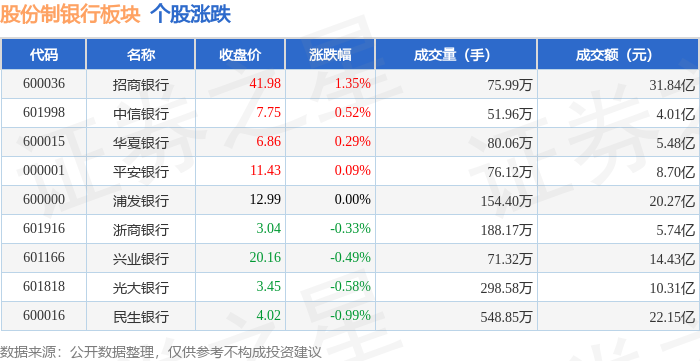
股份制银行板块10月21日涨0.33%,招商银行领涨,主力资金净流出9.73亿元
Zheng Xing Xing Ye Ri Bao· 2025-10-21 08:30
证券之星消息,10月21日股份制银行板块较上一交易日上涨0.33%,招商银行领涨。当日上证指数报收于3916.33,上涨1.36%。深证成指报收于 13077.32,上涨2.06%。股份制银行板块个股涨跌见下表: 以上内容为证券之星据公开信息整理,由AI算法生成(网信算备310104345710301240019号),不构成投资建议。 相关ETF A50ETF (产品代码: 159601) ★ 跟踪:MSCI中国A50互联互通人民币指数 | 代码 | 名称 | 收盘价 | 涨跌幅 | 成交量(手) | 成交额(元) | | --- | --- | --- | --- | --- | --- | | 600036 | 指商银行 | 41.98 | 1.35% | 75.99万 | 31.84亿 | | 661698 | 中信银行 | 7.75 | 0.52% | 51.96万 | 4.01亿 | | 600015 | 华夏银行 | 6.86 | 0.29% | 80.06万 | 5.48 Z | | 000001 | 平安银行 | 11.43 | 0.09% | 76.12万 | 8.70亿 | | 60000 ...
黄金、白银突然直线下跌,多家银行发布风险提示,金饰克价已逼近1300元
Mei Ri Jing Ji Xin Wen· 2025-10-21 08:21
Group 1: Gold Market Overview - As of October 21, the price of gold in the domestic market has seen a significant increase, with major retailers reporting higher prices per gram compared to the previous day. For instance, Lao Miao's gold jewelry is quoted at 1294 CNY per gram, up 36 CNY from 1258 CNY, while Chow Tai Fook's price is 1292 CNY, an increase of 30 CNY from 1262 CNY, and Lao Feng Xiang's price is 1290 CNY, up 32 CNY from 1258 CNY [3] Group 2: Institutional Responses to Market Volatility - Due to the recent sharp increase in gold prices, several financial institutions, including Everbright Bank, have begun to impose restrictions on gold trading. Everbright Bank announced that starting October 20, it would gradually terminate business relationships with clients who have no positions in the Shanghai Gold Exchange's spot and deferred business [5] - Other banks, such as Industrial Bank, China Merchants Bank, and China Construction Bank, have also issued warnings regarding the heightened market risks associated with precious metals. Industrial Bank advised clients to closely monitor market trends and manage their positions according to their risk tolerance [7] - China Merchants Bank emphasized the importance of monitoring position status and margin balance, recommending clients to diversify their investments to avoid heavy concentration in precious metals [9] Group 3: Margin Requirements Adjustments - The Shanghai Gold Exchange has increased the margin requirements for gold trading contracts. Effective from October 20, the standard margin ratio for various gold contracts will rise from 38% to 40%, while the margin for silver contracts will increase from 41% to 43%. Additionally, the additional margin requirement will change from 22% to 24% [11]