
CCB(601939)

Search documents
2026年国有大行、股份行怎么干?
券商中国· 2026-01-30 04:45
1月以来,银行业机构陆续召开2026年经营工作会议,总结过去一年乃至整个"十四五"时期的经营 成绩,为新的一年谋篇布局。 谈及2025年经营,"高质量发展"成为高频词。多家银行透露,各项工作"稳中有进""稳中提质",且"综合实力 迈上新台阶",为下一个五年发展打下了坚实基础。 2026年是"十五五"开局之年。多家银行强调,将加大对重点领域金融支持,做实做细金融"五篇大文章",有效 防范化解重点领域风险,支持巩固经济稳中向好态势。 其中,包括工行、建行、农行、交行在内,多家银行明确将加快推动数智化转型。"降本提质增效"等表述也出 现在工行、农行、建行、交行、平安银行的工作部署中。 工商银行:做强主业、做优质效、做大贡献 工商2026年党建暨经营管理工作会议强调,要打造一流银行、领军银行、清廉银行、现代银行,持续做强主 业、做优质效、做大贡献。 一是提升防风险成效,推动全面风险管理取得新进步,加快智能化风控平台进业务进场景。 二是提升强合规能力,确保内控管理实现新跃升,把依法合规经营打造为核心竞争力。 二要加大重点领域融资供给,助力巩固拓展经济稳中向好势头。持续加大"两重""两新"和民生、消费等领域金 融支持;进 ...








去银行办社保业务,东城区“社银合作”服务网点增至7家
Bei Jing Ri Bao Ke Hu Duan· 2026-01-30 02:42
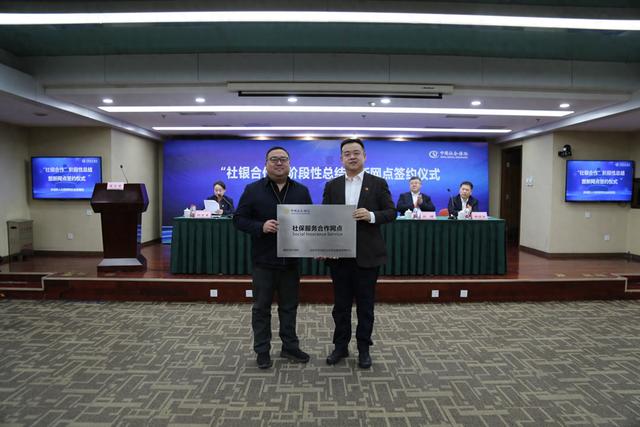
Core Viewpoint - The "Social Security and Banking Cooperation" initiative in Dongcheng District has shown significant progress, with new partnerships established and high satisfaction rates among the public [1][3]. Group 1: Initiative Overview - The "Social Security and Banking Cooperation" initiative has been operational for over 9 months, resulting in 126,100 service visits and a public satisfaction rate of 98.02% [3]. - The initiative aims to provide convenient social security services to the public while enhancing efficiency for social security and promoting development for banks [3]. Group 2: New Partnerships - Postal Savings Bank and Bank of China have recently joined the "Social Security and Banking Cooperation" network, increasing the total number of service points to 7 [1][6]. - The existing network includes Industrial and Commercial Bank of China, China Construction Bank, Bank of Communications, Beijing Bank, and Beijing Rural Commercial Bank, serving a total of 35,000 insured units and over 1.67 million insured individuals [6]. Group 3: Service Areas - The service network covers key areas along the central axis, including Zhongguancun Dongcheng Park, "Hangkongyuan" Technology Park, Dongzhimen, Wangfujing-Longfusi, Tiantan, and Yongdingmenwai [6]. - This strategic placement aims to provide high-frequency and low-risk social security services to the local population [6].

建设银行:聚焦服务中国式现代化 转换“建设”服务重心
Jin Rong Shi Bao· 2026-01-30 02:10
会议强调,要坚持守正创新、扬长补短,巩固拓展传统特色优势,补强短板弱项。加强协同联动, 推动商投行一体化、公私一体化、本外币一体化、集团一体化,提升金融服务适配性。大力服务国家高 水平科技自立自强,着力打造科技金融领军银行,扎实推进数智化转型,不断提升服务实体经济质效。 全面增强参与国际竞争能力,有力支持高水平对外开放。聚力做好县域金融服务,更好服务城乡融合发 展。构建全面主动智能敏捷的风控体系,推进风险早识别、早预警、早暴露、早处置。 1月28日至29日上午,建设银行2026年党的建设和经营管理工作会议在北京召开。建行党委书记、 董事长张金良出席并讲话,党委副书记、行长张毅主持会议并作报告和会议总结。 会议对2026年经营管理主要目标和重点工作作出安排。要求经营发展稳中求进、提质增效,统筹推 动各项业务高质量发展,增强核心竞争力和服务能力。全方位服务国家战略,支持扩大内需,推进金 融"五篇大文章"可持续发展,服务高水平对外开放,助力区域协调发展。以客户为中心,深化"圈链 群"服务模式升级,提升综合服务水平。加快推动集团数智化转型,持续提升企业级运营能力。守牢风 险合规底线,防范化解金融风险。强化人才支撑,加 ...
你的“年终奖”到账了吗?银行打响理财市场“抢收”大战
Xin Lang Cai Jing· 2026-01-30 00:54
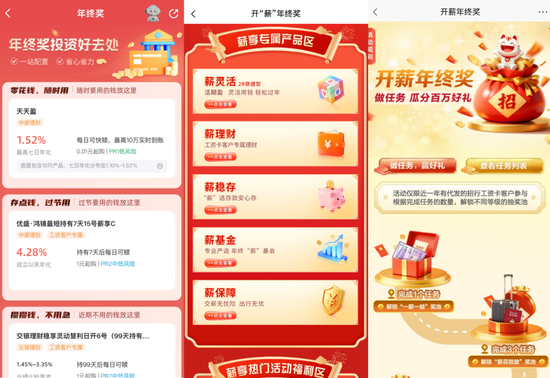
Core Viewpoint - Multiple banks are targeting the year-end bonuses of workers by launching exclusive financial products and promotional activities to attract customers [2][5][10]. Group 1: Year-End Bonus Financial Products - Several banks, including Postal Savings Bank, Bank of Communications, and China Merchants Bank, have introduced dedicated sections in their mobile banking apps for year-end bonus financial products [5][6][7]. - For example, Postal Savings Bank offers products like "Daily Earnings" with a maximum annualized rate of 1.52% and a low-risk product with an annualized rate of 4.28% [6]. - China Merchants Bank has a "Year-End Bonus" section that includes tasks for customers to unlock rewards, specifically targeting customers with salary accounts [7]. Group 2: Asset Allocation Strategies - Some banks are providing asset allocation strategies for year-end bonuses, suggesting a breakdown of funds into categories such as daily expenses, safety nets, stable investments, and growth investments [8]. - For instance, the Guangdong branch of China Construction Bank recommends allocating 10%-20% for daily expenses, 5%-10% for safety, 40%-60% for stable investments, and 10%-20% for growth [8]. Group 3: Market Trends and Data - As of the end of 2025, the total scale of the bank wealth management market reached 33.29 trillion yuan, an increase of 11.15% from the beginning of the year, with the number of investors growing by 14.37% [12][13]. - The report indicates that low-risk and medium-low-risk products dominate the market, with 95.73% of the total wealth management products falling into these categories [14]. - In 2025, wealth management products generated a total return of 730.3 billion yuan for investors, with an average yield of 1.98% [14].


工商银行、建设银行、农业银行、中国银行,最新部署
券商中国· 2026-01-29 23:33
Core Viewpoint - The four major state-owned banks in China have held meetings to outline their operational strategies for 2026, emphasizing high-quality development and risk management while aligning with national strategies and supporting domestic demand expansion [1][4]. Group 1: Business Focus and Strategy - Bank of China (BOC) highlighted the importance of global advantages, aiming to enhance global layout, product service capabilities, and compliance management [2]. - Agricultural Bank of China (ABC) emphasized its commitment to serving rural areas and supporting comprehensive rural revitalization, focusing on credit allocation to key sectors such as agriculture and rural development [2]. - China Construction Bank (CCB) aims to strengthen collaboration across various banking sectors and enhance financial service adaptability, particularly in supporting national technological self-reliance [3]. Group 2: Support for National Strategy and Domestic Demand - Industrial and Commercial Bank of China (ICBC) and ABC stressed the integration of investments in both physical and human capital, with a focus on expanding credit and bond investments to support domestic demand and innovation [4]. - CCB reiterated its commitment to supporting national strategies and expanding domestic demand while promoting sustainable development in financial services [4]. Group 3: Risk Management and Technology - All four banks emphasized the role of technology in risk prevention and management, with BOC focusing on credit risk control and proactive trend monitoring [5][6]. - ICBC plans to accelerate the implementation of an intelligent risk control platform to manage risks effectively across key sectors [6]. - ABC aims to mitigate credit risks in local government debt and real estate while maintaining high asset quality through enhanced technological resilience [6]. - CCB is focused on building a comprehensive and proactive risk control system to ensure early identification and management of risks [6].

多家银行调整个人客户上金所延期合约保证金比例
Zheng Quan Ri Bao Zhi Sheng· 2026-01-29 17:05
1月21日,邮储银行发布《关于再次调整我行个人客户上海黄金交易所延期合约保证金比例的通知》 称,自北京时间2026年1月22日收盘清算时起,该行将对代理个人上金所业务(包括黄金延期合约和白 银延期合约)的交易保证金比例进行调整。其中:Ag(T+D)、Au(T+D)、Au(T+N1)、Au (T+N2)、mAu(T+D)合约保证金比例均从80%调整为120%。事实上,这已是邮储银行在一个月内 第三次对该行个人客户上金所延期合约保证金比例进行调整。 本报记者 杨洁 近期,多家银行发布调整个人客户上海黄金交易所(以下简称"上金所")延期合约保证金比例的通知。 1月28日,建设银行发布通知称,自2026年1月29日(星期四)收盘清算时起,Au(T+D)、mAu (T+D)、Au(T+N1)、Au(T+N2)、NYAuTN06、NYAuTN12、Ag(T+D)合约的保证金比例从 44%调整为60%。 建设银行官方客服对记者表示,近期国内外贵金属价格波动加剧,市场风险提升,为顺应市场变化,保 护投资者权益,该行对个人客户上金所延期合约交易保证金比例进行调整,并提示投资者做好仓位控 制,理性投资。 工商银行1月27日发布通 ...
打造金融文化品牌 赋能城市发展
Qi Lu Wan Bao· 2026-01-29 16:33
Core Viewpoint - The Construction Bank of Dezhou is committed to building the "Dexin Culture" brand during the 14th Five-Year Plan period, focusing on warm financial services to win public trust and achieve leadership in credit issuance, customer service capabilities, business innovation, and corporate culture construction, while looking forward to the 15th Five-Year Plan to inject financial vitality into high-quality development in Dezhou [1][6]. Group 1: Cultural and Service Initiatives - The "Dexin Culture" emphasizes values such as "Party building, integrity for the people, innovation, and steady progress," serving as a guide for the bank's actions and permeating every service and practice [2]. - The bank has established a "Rayong Station," recognized as the "Most Beautiful Labor Service Station," providing facilities for outdoor workers and acting as a safe haven for the community [2]. - The bank's volunteers regularly engage in community outreach, providing financial education and support to the elderly and vulnerable groups, extending financial services to every corner of society [2][3]. Group 2: Financial Support and Community Impact - The bank's first secretary in the village has successfully built a standardized drying field and grain storage facility, addressing local agricultural challenges and creating job opportunities for villagers [3]. - The bank has introduced high-value crops and established a local brand, enhancing the economic situation of the community and ensuring that financial services are accessible within the village [3]. Group 3: Financial Performance and Achievements - During the 14th Five-Year Plan, the bank reported a loan balance of 49.5 billion yuan by the end of December 2025, with corporate loans exceeding 24.7 billion yuan, leading in local growth [5]. - The bank serves 2.58 million individual customers and 47,000 corporate clients, with inclusive loans surpassing 6 billion yuan and agricultural loans exceeding 12.8 billion yuan, earning recognition as the "Most Responsible Bank" and "Most Influential Bank" in Dezhou [5]. - The bank has been recognized for its innovation, having launched a new credit model for special operating rights, with total loans amounting to 2.1 billion yuan, and has maintained a high standard in risk management for five consecutive years [5]. Group 4: Future Development Plans - Looking ahead to the 15th Five-Year Plan, the bank aims to empower the real economy, focusing on integrating financial services with local development needs, particularly in key sectors like new energy and high-end manufacturing [6][7]. - The bank plans to enhance its "Dexin Culture" brand, focusing on services for the elderly and new citizens, while continuing to optimize risk management and asset quality [7].

四大行集中召开2026年经营管理工作会议 有哪些看点?
证券时报· 2026-01-29 15:10
Group 1 - The core viewpoint of the article emphasizes the strategic focus of China's major state-owned banks on enhancing their business strengths and aligning with national strategies for economic growth and risk management [1][5][7] - The Bank of China highlighted the importance of high-quality development through a correct performance outlook, global advantages, and effective risk management [3][10] - Agricultural Bank of China stressed its commitment to supporting rural revitalization and urban-rural integration by directing financial resources towards key areas such as agriculture and rural development [3][6] Group 2 - China Construction Bank aims to enhance collaborative efforts across various banking sectors, focusing on technology-driven financial services and supporting national technological independence [4][7] - Industrial and Commercial Bank of China emphasized the integration of investments in both physical and human capital, with a focus on expanding domestic demand and supporting small and medium enterprises [6][11] - All four major banks underscored the role of technology in risk prevention and management, with specific strategies to address credit risks and enhance overall asset quality [9][10][11] Group 3 - The banks are committed to implementing intelligent risk control systems to proactively identify and manage risks, ensuring stability in asset quality [8][11][12] - The emphasis on supporting national strategies and expanding domestic demand is a common theme across the banks, reflecting a unified approach to economic development [5][6][7] - The focus on enhancing financial services for rural areas and integrating urban and rural development is a priority for Agricultural Bank of China, aligning with broader national goals [3][4][6]

“金融智能体”上线——建行新版手机银行:能预见 更懂你
Xin Hua Wang· 2026-01-29 11:33
当金融服务的边界被科技不断拓展,手机银行已不仅是交易的窗口,更成为承载亿级用户信赖与生活期 待的"智慧伴侣"。近日,中国建设银行正式发布新版手机银行,这不仅是一次产品的迭代升级,更是贯 彻落实关于"进一步增强服务国家建设能力、防范金融风险能力、参与国际竞争能力"的要求,并将"三 个能力"建设成果转化为数字化服务效能的具体体现。 新版手机银行通过一场由内而外的系统性革新,致力于在金融机构数字化征程中刻下新的坐标,为数字 经济高质量发展注入金融动能。 省时省心 让繁琐少一步 "放大镜"的另一焦点,落在基础技术能力的精进上。通过自研OCR插件,对竖版银行卡、模糊图片的识 别率大幅提升,还支持对非结构化文本(例如打印/影印不成格式的大段信息、手写体)进行识别。在 性能层面,通过对启动链路、代码结构的深度优化,以及鸿蒙等原生系统能力的融合,实现了"秒开"级 响应与近乎"零卡顿"的流畅运行,即便在折叠屏、多窗口等复杂环境下也能保持稳定高效。 主动防御 让安心深一度 安全,是金融服务的生命线,也是一切温暖体验的基石。建行新版手机银行致力于打造一面智能、动 态、隐形的"守护盾",在提供便捷的同时,塑造值得托付的安心感。 这面 ...
建设银行青岛市分行原党委书记、行长郝子建接受纪律审查和监察调查
Bei Jing Shang Bao· 2026-01-29 11:19
北京商报讯(记者 宋亦桐)1月29日,中央纪委国家监委网站显示,据中央纪委国家监委驻中国建设银 行纪检监察组、北京市纪委监委消息:中国建设银行青岛市分行原党委书记、行长郝子建涉嫌严重违纪 违法,目前正接受中央纪委国家监委驻中国建设银行纪检监察组纪律审查和北京市朝阳区监察委员会监 察调查。 ...