
BANK OF CHINA(601988)

Search documents
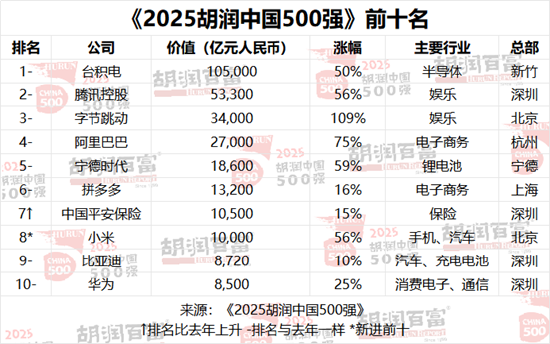
2025胡润中国500强:最具价值国企前三名为农业银行、工商银行、国家电网
Xin Lang Cai Jing· 2026-02-05 03:06
Core Insights - The "2025 Hurun China 500" report highlights TSMC as the highest-valued private enterprise in China, with a valuation increase of 3.5 trillion RMB, reaching 10.5 trillion RMB [1][4] - Tencent follows as the second highest, with a valuation growth of 1.9 trillion RMB, totaling 5.3 trillion RMB [1][4] - ByteDance ranks third, increasing its value by 1.8 trillion RMB to 3.4 trillion RMB [1][4] - Xiaomi enters the top ten for the first time, with a valuation increase of 357 billion RMB, reaching 1 trillion RMB [1][4] Top Ten Private Enterprises - TSMC: Valuation of 105,000 million RMB, growth of 50% [2][5] - Tencent: Valuation of 53,300 million RMB, growth of 56% [2][5] - ByteDance: Valuation of 34,000 million RMB, growth of 109% [2][5] - Alibaba: Valuation of 27,000 million RMB, growth of 75% [2][5] - CATL: Valuation of 18,600 million RMB, growth of 59% [2][5] - Pinduoduo: Valuation of 13,200 million RMB, growth of 16% [2][5] - Ping An Insurance: Valuation of 10,500 million RMB, decline of 15% [2][5] - Xiaomi: Valuation of 10,000 million RMB, growth of 56% [2][5] - BYD: Valuation of 8,720 million RMB, growth of 10% [2][5] - Huawei: Valuation of 8,500 million RMB, growth of 25% [2][5] Top Ten State-Owned Enterprises - Agricultural Bank: Valuation of 202,000 million RMB [3][6] - Industrial and Commercial Bank: Valuation of 274,000 million RMB [3][6] - State Grid: Valuation of 266,000 million RMB [3][6] - China National Railway Group: Valuation of 224,000 million RMB [3][6] - China Construction Bank: Valuation of 203,000 million RMB [3][6] - Kweichow Moutai: Valuation of 182,000 million RMB [3][6] - China Petroleum: Valuation of 176,000 million RMB [3][6] - Bank of China: Valuation of 170,000 million RMB [3][6] - China Mobile: Valuation of 175,000 million RMB [3][6] - CITIC Group: Valuation of 156,000 million RMB [3][6]





中国银行助力摩根士丹利再次成功发行熊猫债
Jin Rong Shi Bao· 2026-02-05 01:24
本报讯 记者赵萌报道 近日,中国银行作为主承销商,成功协助摩根士丹利在中国银行间市场发行 26亿元熊猫债。本次发行是摩根士丹利第三次"亮相"中国债券市场,中国银行参与全部三期发行,累计 协助融资66亿元人民币,充分彰显了国际发行人对中国市场的坚定信心和高度认可。 据了解,2025年7月,中国银行协助引进摩根士丹利进入中国债券市场,成功发行首单美资发行人 熊猫债,为国际优质发行人提供了有价值的实践范例,吸引更多境外主体关注并参与中国债券市场。截 至目前,中国银行已服务来自亚洲、欧洲、北美洲、非洲、南美洲发行人来华发行熊猫债。中国银行将 继续依托全球化服务网络和跨境金融优势,以丰富的项目经验和独特的市场视角协助各类发行主体进入 中国市场,开拓投融资新渠道,为提升人民币国际影响力、推动高水平对外开放贡献更大力量。 责任编辑:袁浩 ...


大健康国际(02211)股东将股票由招银国际证券转入中国银行(香港) 转仓市值527.40万港元
智通财经网· 2026-02-05 00:22
Core Insights - The recent stock transfers of Da Health International (02211) indicate significant shareholder activity, with multiple large transactions occurring in January and early February 2023 [1] Group 1: Stock Transfers - On February 4, shareholders transferred shares worth HKD 5.274 million from Zhaoyin International Securities to Bank of China (Hong Kong), representing 5.30% of the total [1] - On January 20, 30.44 million shares were deposited into Yue Shang International Securities, with a market value of HKD 39.268 million [1] - On January 26, shares worth HKD 50.983 million were transferred to Zhaoyin International Securities, accounting for 12.43% of the total [1] - On January 28, shares valued at HKD 30.354 million were moved from Futu Securities International Hong Kong to Baoxin Securities [1] - On January 29, a transfer of shares worth HKD 85.515 million occurred from Yue Shang International Securities to HSBC Hong Kong, representing 14.68% of the total [1]
大健康国际股东将股票由招银国际证券转入中国银行(香港) 转仓市值527.40万港元
Zhi Tong Cai Jing· 2026-02-05 00:21
Core Insights - The recent stock transfers of Da Health International (02211) indicate significant shareholder activity, with multiple large transfers occurring in January and early February [1] Group 1: Stock Transfers - On February 4, a shareholder transferred shares from China Merchants International Securities to Bank of China (Hong Kong), with a market value of HKD 5.274 million, representing 5.30% of the total shares [1] - On January 20, 30.44 million shares were deposited into Yue Shang International Securities, with a market value of HKD 39.268 million [1] - On January 26, shares were transferred to China Merchants International Securities, with a market value of HKD 50.983 million, accounting for 12.43% of the total shares [1] - On January 28, shares were moved from Futu Securities International Hong Kong to Baoxin Securities, with a market value of HKD 30.354 million [1] - On January 29, shares were transferred from Yue Shang International Securities to HSBC Hong Kong, with a market value of HKD 85.515 million, representing 14.68% of the total shares [1]
中国银行累计为超60万户客户提供财政贴息服务
Xin Hua Cai Jing· 2026-02-04 14:00
Core Insights - The article highlights the implementation of a fiscal subsidy policy for personal consumption loans by a major Chinese bank, which has benefited over 600,000 customers [2]. Group 1: Loan Services and Coverage - The bank has expanded its loan coverage to meet diverse financing needs, including home purchases, vehicle financing, education, cultural tourism, healthcare, and daily consumption [2]. - The focus is on key demographics such as new citizens and recent graduates, with efforts to enhance service efficiency and broaden loan accessibility [2]. Group 2: Technological Integration - The bank leverages technology by introducing a "Consumer Loan Subsidy" section in its mobile banking app, which integrates functions like subsidy signing, inquiry, and automatic deduction [2]. - This technological enhancement aims to reduce the cost of consumer loans for residents [2].
中国银行董事长葛海蛟与沙特央行副行长塔拉勒·阿尔胡穆德举行工作会谈
Xin Lang Cai Jing· 2026-02-04 12:25
Core Viewpoint - The meeting between the chairman of Bank of China and the deputy governor of the Saudi Central Bank highlights the potential for enhanced cooperation between China and Saudi Arabia, particularly in the context of China's ongoing efforts to expand its global economic engagement during the "14th Five-Year Plan" period [1][2]. Group 1: Strategic Cooperation - Bank of China views the Middle East, especially Saudi Arabia, as a crucial area for global development, having established a comprehensive service network in Saudi Arabia, UAE, Qatar, and Bahrain [1][2]. - The bank aims to leverage financial resources to align the Belt and Road Initiative with Saudi Arabia's Vision 2030, enhancing services in RMB clearing and cross-border investment [1][2]. Group 2: Economic Partnership - Saudi Arabia is China's largest trading partner, with bilateral investments increasing annually, indicating significant potential for economic cooperation [1][2]. - The Saudi Central Bank expresses support for Bank of China's operations in Saudi Arabia, emphasizing the importance of compliance and stable management while seizing opportunities in financial markets and fintech [1][2].
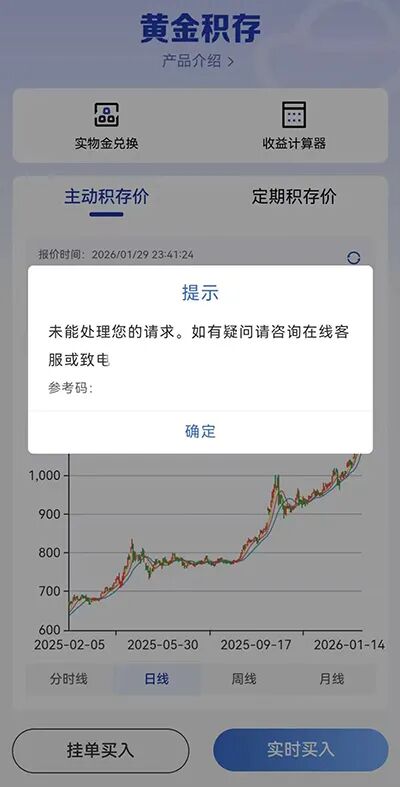
“密码按烂了都买不进”,金价暴跌,年轻人抄底黄金却被“拒之门外”
Hua Xia Shi Bao· 2026-02-04 11:49
Core Viewpoint - The recent surge in trading demand for gold accumulation products has overwhelmed the banking system's capacity, leading to transaction failures and delays, which are attributed to operational issues rather than systemic market risks [1][5][6]. Group 1: Trading Demand and Market Behavior - There has been a significant increase in trading activity for gold accumulation products, driven by fluctuations in gold prices, which has exceeded the banks' operational capabilities [1][6]. - Investors have reported difficulties in executing trades during periods of high demand, with many experiencing failed transactions and system overloads [5][6]. - The current trading frenzy is characterized by a mix of speculative behavior and a lack of available trading platforms, leading to frustration among investors [4][5]. Group 2: Bank Responses and Policy Adjustments - Several banks have raised the minimum purchase amounts for gold accumulation products in response to the increased trading volume and associated risks [7][8]. - Banks are likely to implement stricter trading limits, adjust transaction fees, and enhance their product offerings to manage the surge in demand and mitigate risks [6][9]. - Risk assessment requirements for investors have been tightened, with banks now requiring a risk tolerance evaluation before allowing participation in gold accumulation activities [8][9]. Group 3: Future Outlook and Recommendations - Analysts predict that the growth rate of gold accumulation products will slow down, shifting the focus from scale to quality in the industry [9]. - There is a call for improved risk education and information disclosure from banks to help investors make informed decisions based on their risk tolerance [9]. - The market is expected to evolve towards more standardized and differentiated products, potentially including structured products linked to gold for various risk profiles [9].



金融“活水”浇灌科创“良田”,中行助力上海打造国际一流营商环境
Zhong Guo Jin Rong Xin Xi Wang· 2026-02-04 11:32
据介绍,"G60惠系列"以"分层分类、精准滴灌、全链协同、生态共建"为核心设计思路,锚定科创小微 企业从初创、成长到成熟的全生命周期差异化需求,以及产业链上下游协同发展的关键环节,创新打 造"G60惠新贷""G60惠才贷""G60惠质贷""G60惠链贷""G60惠跨境""G60惠服务"六大专属产品,设 置"G60托举模式"满足科创企业高质量增长需求。通过构建"债权融资+跨境撮合+综合服务"三位一体的 金融支持体系,中行为长三角G60科创走廊科创小微企业提供全生命周期、全产业链综合金融服务,有 效破解小微企业"融资难、融资贵"问题。 上海某汽车电子有限公司正是受益于"G60惠系列"的企业之一。该企业成立于2006年,是一家深耕汽车 电子真空泵、真空度传感器、传感器及霍尔传感器芯片工程应用设计研发和生产的"专精特新"中小企 业,业务范围覆盖长三角G60科创走廊九城市,入选"G60科创走廊一类重点扶持企业"与松江区"2025年 度智能制造示范工厂"名单。 转自:新华财经 近日,上海发布《上海市加快打造国际一流营商环境行动方案(2026年)》,提出要便利融资服务,完 善支持小微企业融资协调工作机制,帮助解决小微企业实 ...
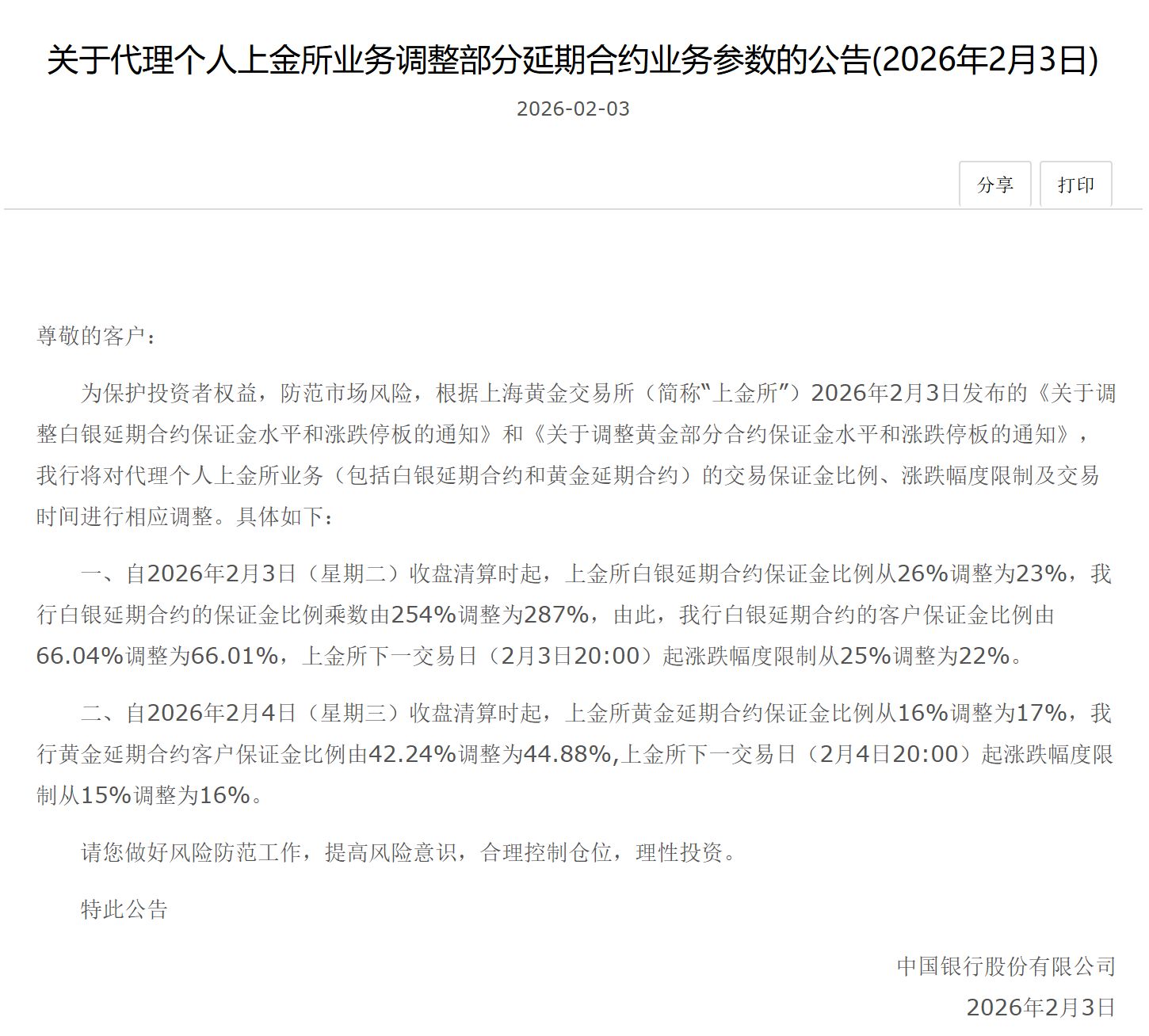
防范市场风险,中国银行调整金银延期合约保证金比例 业内:投资者尽量避免持仓过节
Mei Ri Jing Ji Xin Wen· 2026-02-04 11:29
Core Viewpoint - The adjustments in margin ratios for gold and silver deferred contracts by the Bank of China aim to protect investor interests and mitigate market risks amid recent volatility in the precious metals market [1][2][5]. Group 1: Margin Ratio Adjustments - Starting from February 4, 2026, the margin ratio for the Shanghai Gold Exchange (SGE) gold deferred contracts will increase from 16% to 17% [1][5]. - The Bank of China's margin ratio for gold deferred contracts will rise from 42.24% to 44.88% [1][5]. - For silver deferred contracts, the margin ratio will decrease from 26% to 23%, while the Bank of China's margin ratio will adjust from 66.04% to 66.01% [2][5]. Group 2: Market Volatility and Analysis - Recent fluctuations in the precious metals market have seen gold prices open at 1096 yuan per gram on February 4, with a rise of over 6%, following a drop exceeding 13% on February 2 [1][7]. - Analysts suggest that the recent price adjustments do not indicate a trend reversal, as the long-term bullish logic for gold and silver remains intact [7][8]. - Factors contributing to the recent volatility include geopolitical tensions and market reactions to potential changes in U.S. monetary policy, particularly regarding the nomination of Kevin Warsh as the new Federal Reserve Chair [7][8]. Group 3: Investor Recommendations - Analysts recommend that investors avoid holding positions over the holiday period and maintain a cautious outlook on the precious metals market for February [9].
泸天化:股东中国银行泸州分行及其一致行动人累计减持公司股份817.94万股,减持计划实施完毕
Mei Ri Jing Ji Xin Wen· 2026-02-04 11:24
Group 1 - The company, Luzhou Laojiao, announced on February 4, 2026, that it received a notification from its major shareholder, Bank of China, regarding the completion of a share reduction plan [1] - As of February 3, 2026, the total shares reduced amounted to 8.1794 million, representing approximately 0.522% of the company's total share capital [1]
