BANK OF CHINA(601988)

Search documents
又一国有大行浙江省分行原行长落马
第一财经· 2025-12-31 13:18
Core Viewpoint - The article discusses the ongoing anti-corruption efforts within China's financial sector, highlighting the recent investigation of Cheng Jun, the president of Bank of China Zhejiang Branch, for serious violations of discipline and law, marking a significant trend in the scrutiny of high-ranking officials in state-owned banks [3][4]. Group 1: Investigations and Trends - Cheng Jun is the 211th central-level official investigated in 2025, a decrease from 257 in 2024, indicating a tightening of scrutiny on high-ranking officials [3]. - Cheng is the fifth former president of a state-owned bank's Zhejiang branch to be investigated in recent years, following several others who faced similar allegations of serious violations [4]. - In 2025, a total of 65 central management officials were investigated, surpassing the 58 from the previous year, while 722 provincial management officials were also scrutinized [5]. Group 2: Broader Anti-Corruption Efforts - The 20th Central Commission for Discipline Inspection's fourth plenary session emphasized the importance of deepening anti-corruption efforts in 2025, which is seen as a crucial year for the completion of the 14th Five-Year Plan [5]. - In 2024, disciplinary bodies across the country investigated 73 provincial-level and above officials, 4,348 bureau-level officials, 35,000 county-level officials, and 121,000 township-level officials, reflecting a comprehensive approach to tackling corruption [5].





又一国有大行浙江省分行行长落马
第一财经网· 2025-12-31 13:14
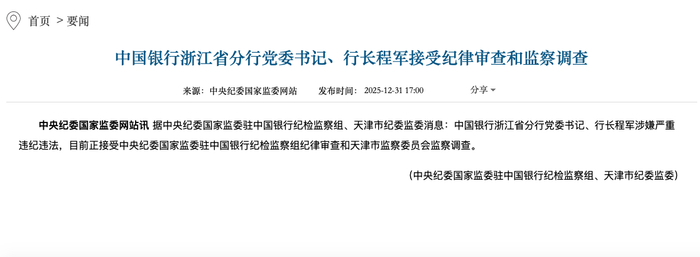
Core Insights - In 2025, a total of 65 central management cadres were investigated, an increase from 58 in the previous year, indicating a continued focus on anti-corruption efforts [4] - The investigation of Cheng Jun, the Party Secretary and President of the Bank of China Zhejiang Branch, marks him as the 211th central-level cadre under investigation in 2025 [1] - The trend shows a decrease in the number of investigations of central-level cadres from 257 in 2024 to 211 in 2025, reflecting a tightening of scrutiny [1] Group 1 - Cheng Jun is the fifth former president of a state-owned bank's Zhejiang branch to be investigated in the past year, following several high-profile cases [3] - Other notable figures investigated include former senior experts and deputy directors from financial regulatory bodies, highlighting a broader crackdown on financial misconduct [4] - The Central Commission for Discipline Inspection emphasized the importance of deepening anti-corruption efforts as part of the "14th Five-Year Plan" [4] Group 2 - In 2024, national disciplinary inspection agencies reported investigations involving 73 provincial-level and above cadres, 4,348 departmental-level cadres, and 35,000 county-level cadres [4] - The disciplinary actions taken included 73 provincial-level and above cadres, and 38,38 departmental-level cadres were punished, indicating a robust enforcement of regulations [4] - The ongoing efforts aim to provide strong support for the modernization of China through strict governance [4]
又一国有大行浙江省分行原行长落马
Di Yi Cai Jing· 2025-12-31 13:13
Core Insights - In 2025, a total of 65 central management cadres were investigated, an increase from 58 in the previous year, indicating a continued focus on anti-corruption efforts [2][4] - The investigation of Cheng Jun, the Party Secretary and President of Bank of China Zhejiang Branch, marks him as the 211th central-level cadre under investigation in 2025 [1][2] - The trend shows a decrease in the number of investigations of central-level cadres compared to 2024, where 257 were investigated, reflecting a potential shift in enforcement focus [1][2] Group 1 - Cheng Jun is the fifth former president of a state-owned bank's Zhejiang branch to be investigated in the past year, highlighting ongoing scrutiny in this sector [3] - Other notable figures investigated include former leaders from China Construction Bank, Agricultural Bank of China, and Industrial and Commercial Bank of China, all for "serious violations of discipline and law" [3] - The Central Commission for Discipline Inspection emphasized the need for high-quality development in disciplinary inspection and supervision work to support the modernization of China [2][3] Group 2 - In 2024, national disciplinary inspection agencies filed cases against 73 provincial-level and above cadres, 4,348 departmental-level cadres, 35,000 county-level cadres, and 121,000 township-level cadres [4] - Disciplinary actions taken included 73 provincial-level and above cadres, 3,838 departmental-level cadres, 31,000 county-level cadres, and 112,000 township-level cadres [4]
程军,任上被查!
中国基金报· 2025-12-31 13:10
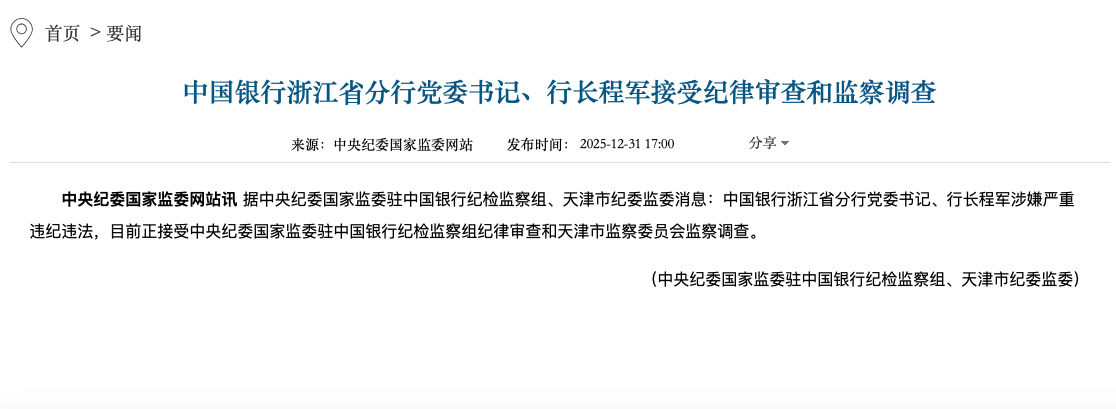
Group 1 - The core point of the article is the investigation of Cheng Jun, the Party Secretary and President of the Zhejiang Branch of Bank of China, for serious violations of discipline and law [2] - Cheng Jun has been under disciplinary review and investigation by the Central Commission for Discipline Inspection and the Tianjin Municipal Supervisory Committee [2] - Cheng Jun has recently participated in public activities, including a visit to Tongkun Group and a work exchange at Hangzhou Iron and Steel Group [2] Group 2 - Cheng Jun is a member of the Communist Party and a senior economist, holding dual master's degrees in economics from Renmin University of China and the University of Manchester [2] - He has held various positions within the Bank of China system, including General Manager of the International Settlement Department and Trade Finance Department at the head office, as well as President of the Johannesburg and Singapore branches [2] - In 2024, Cheng Jun was appointed as the Party Secretary of the Zhejiang Branch and later became the President of the same branch in July [2]


六大行集体官宣,事关数字人民币
Zhong Guo Zheng Quan Bao· 2025-12-31 12:28
Core Viewpoint - The announcement by six major banks in China regarding interest payments on digital RMB wallet balances marks a significant transition from "digital cash (M0)" to "digital deposit currency," indicating a shift in the nature of liabilities from the central bank to commercial banks [1][2] Group 1: Announcement Details - Starting from January 1, 2026, the six major banks will pay interest on the balances of real-name digital RMB wallets at the rate of the current deposit interest rate [1] - The current deposit interest rate for the Bank of Communications is set at 0.05% [1] - Balances in type four personal wallets will not earn interest, and specific interest rate standards can be checked through the bank's official website, mobile banking app, or physical branches [1] Group 2: Implications and Effects - This move enhances user willingness to hold digital RMB, promoting its adoption and dissemination [2] - It incorporates banking institutions into the reserve requirement framework, improving monetary statistics and macroeconomic regulation [2] - Establishing this mechanism is a crucial step towards the maturity of digital RMB, maintaining a dual-layer operational structure while achieving functional upgrades [2]



中行、工行、农行、建行、交行、邮储银行集体官宣:这笔钱要计利息!
Mei Ri Jing Ji Xin Wen· 2025-12-31 12:20
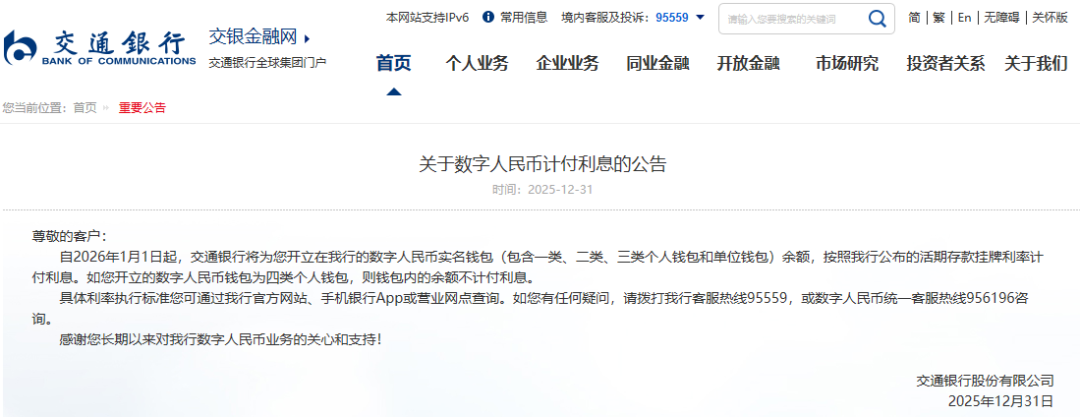
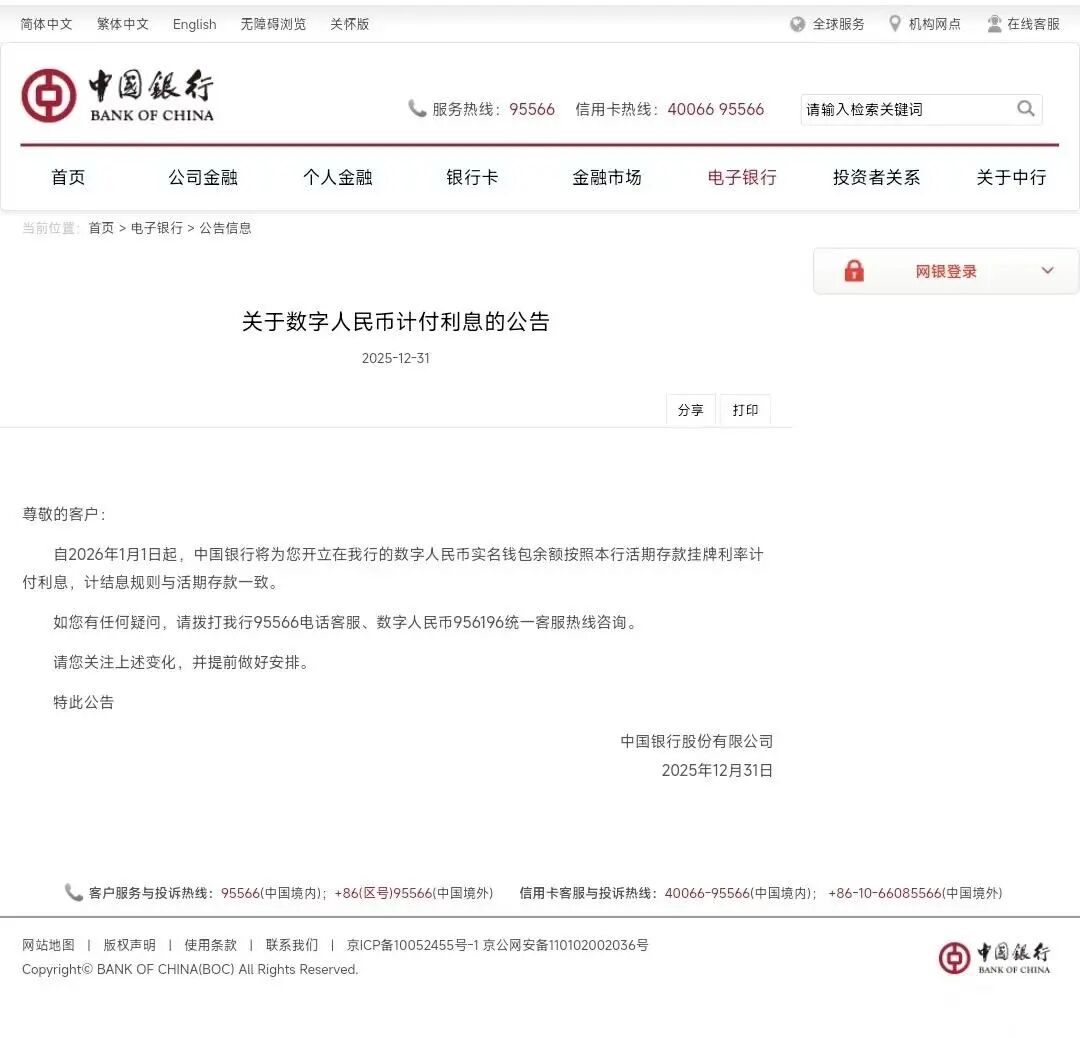
Core Viewpoint - Starting from January 1, 2026, six major state-owned banks in China will begin to pay interest on the balances of digital RMB real-name wallets at the same rate as their current deposit rates, following the same interest calculation rules as regular savings accounts [1][10]. Group 1: Announcement Details - The six banks involved are the Bank of China, Industrial and Commercial Bank of China, Agricultural Bank of China, China Construction Bank, Bank of Communications, and Postal Savings Bank [1]. - The current interest rate for regular savings accounts is noted to be 0.05% [10]. - Interest will be calculated quarterly, with the interest credited to accounts on the 21st of each quarter's last month [10]. Group 2: Wallet Types and Interest Eligibility - Digital RMB wallets are categorized into four types: Type 1, Type 2, and Type 3 are real-name wallets eligible for interest, while Type 4 is an anonymous wallet that does not earn interest [10][12]. - Type 1 wallets require in-person verification and must be linked to a domestic bank account, while Type 2 and Type 3 wallets can be opened remotely with varying identification requirements [12][13][14]. - The new definition of digital RMB indicates a shift from being classified as M0 (cash) to being recognized as a form of deposit currency, allowing for interest accrual [11][12].

商业银行综合竞争力评价报告发布 助力银行业高质量发展
Zhong Guo Jing Ji Wang· 2025-12-31 11:55
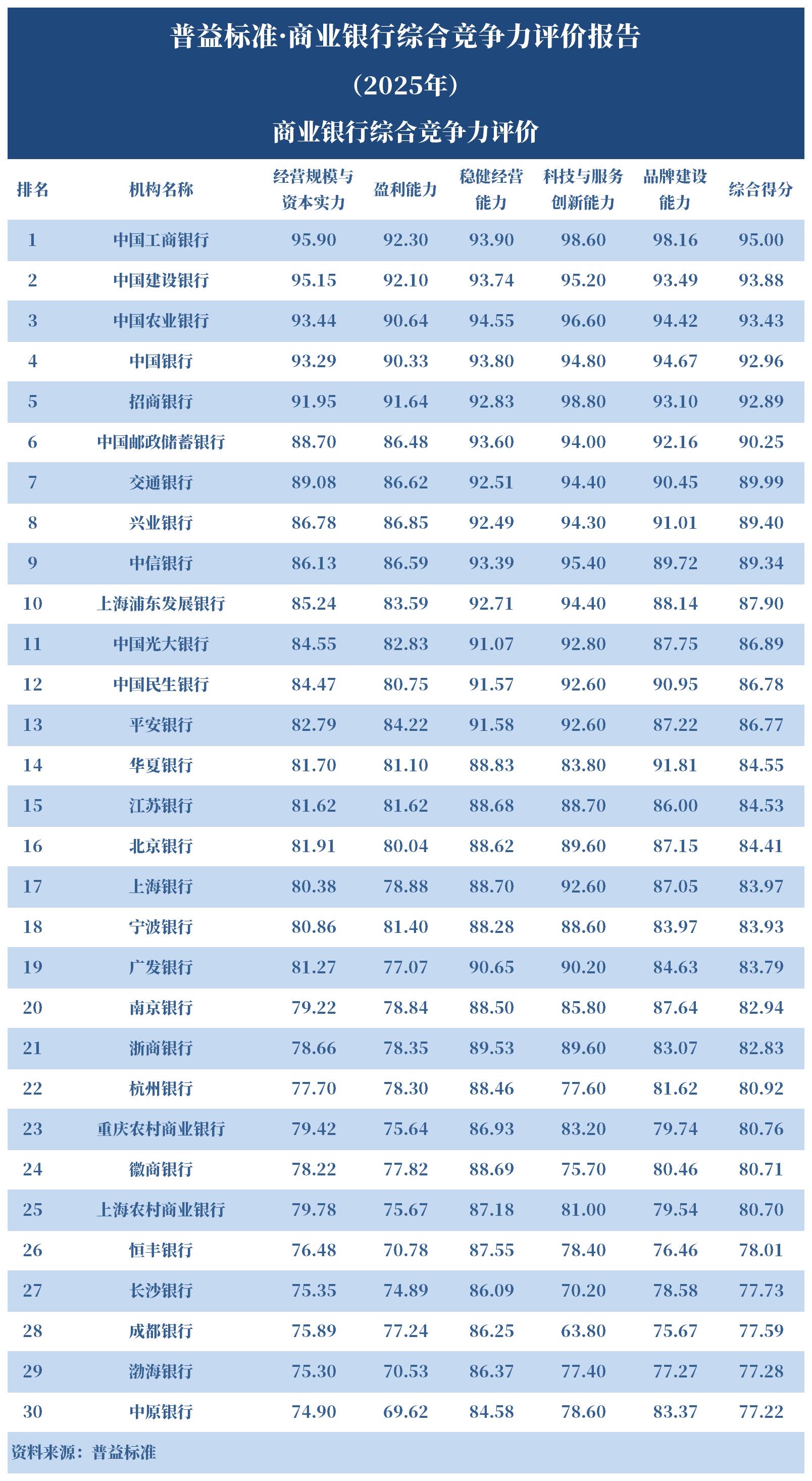
Core Insights - The operating logic of commercial banks is undergoing a profound transformation, facing challenges such as narrowing net interest margins and diverse risk sources, while also seizing strategic opportunities from digital transformation and service model upgrades [1] - The "Comprehensive Competitiveness Evaluation Index System for Commercial Banks" was officially released, aiming to provide a scientific and comprehensive measure of banks' real performance and competitive status in the context of high-quality development [1] Group 1: Evaluation Framework - The evaluation system includes five core modules: operational scale and capital strength, profitability, sound operational capability, technological and service innovation capability, and brand building capability [1] - This framework covers the entire chain from resource support to performance output, risk control compliance to innovation-driven growth, and short-term operations to long-term value [1] Group 2: High-Quality Development - Experts emphasize that high-quality development for commercial banks must move beyond reliance on asset scale growth, focusing instead on stable, endogenous growth under capital constraints [2] - Banks are encouraged to optimize their asset structures and allocate credit resources to strategic national priorities and high-quality customer segments [2] Group 3: Profitability Challenges - The narrowing of net interest margins has become a new normal, necessitating the construction of more resilient and diversified profit models [2] - Banks should strategically accelerate the development of wealth management, investment banking, and transaction finance, which have lower capital consumption and higher customer stickiness [2] Group 4: Technology Investment Evaluation - There is an unprecedented scale of investment in technology resources within the banking sector, requiring a mechanism to evaluate the conversion of technology input into business value [3] - A comprehensive evaluation mechanism should consider the impact of technology on internal management efficiency and external business benefits [3] Group 5: Competitiveness Rankings - The rankings of commercial banks based on their operational scale, profitability, and sound operational capability have been published, with the Industrial and Commercial Bank of China leading in all three categories [4][5][6] - The top five banks in terms of operational scale and capital strength are: 1. Industrial and Commercial Bank of China - 95.90 2. China Construction Bank - 95.15 3. Agricultural Bank of China - 93.44 4. Bank of China - 93.29 5. China Merchants Bank - 91.95 [4][5]
银行业季度观察报(2025年第2期)
Lian He Zi Xin· 2025-12-31 11:54
Investment Rating - The report maintains a stable outlook for the banking industry, indicating a controlled decline in net interest margins and stable asset quality [4][7]. Core Insights - The banking sector in China has shown steady development in the first three quarters of 2025, with stable credit asset quality and sufficient provisions and capital [4][22]. - The People's Bank of China is expected to continue implementing a moderately loose monetary policy, ensuring ample liquidity in the banking system [4][22]. - The report highlights the challenges faced by commercial banks due to a declining net interest margin and the need for active management of asset quality [7][27]. Summary by Sections Industry Data - As of Q3 2025, the non-performing loan (NPL) rate for commercial banks was 1.52%, a slight increase from the previous year, while the ratio of attention loans decreased to 2.20% [9][27]. - The total amount of non-performing loans reached 35,224.78 billion yuan, with a provision coverage ratio of 207.15% [9][28]. - The net profit for commercial banks in the first three quarters of 2025 was 18,702.58 billion yuan, reflecting a 7.19% decrease year-on-year [9][31]. Regulatory Policies - The People's Bank of China has introduced measures to optimize the financial services for the real estate sector, although the market remains sluggish [8][12]. - Ongoing reforms for small and medium-sized banks are aimed at enhancing their risk resistance and operational quality [8][12]. Bond Issuance Statistics - By December 15, 2025, 100 commercial banks issued a total of 227 financial bonds, raising 14,566 billion yuan, a 44.38% increase from the previous year [15][16]. - The issuance of tier-2 capital bonds totaled 8,727.60 billion yuan, while perpetual bonds raised 8,218 billion yuan, indicating a diverse funding strategy among banks [15][17]. Credit Quality and Profitability - The report notes that while the asset quality remains stable, there are pressures from the real estate market and external trade uncertainties that could affect repayment capabilities [7][27]. - The net interest margin for commercial banks was recorded at 1.42% in Q3 2025, with a trend of narrowing expected to slow down [30][31].
工行、农行、中行、建行、交行、邮储,集体宣布
2 1 Shi Ji Jing Ji Bao Dao· 2025-12-31 11:49
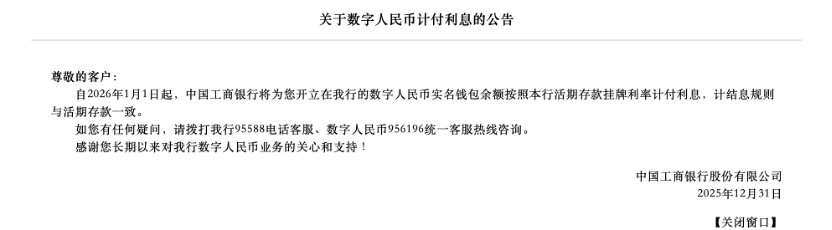
Core Viewpoint - The digital renminbi will officially end its "interest-free era" as major state-owned banks announce that starting January 1, 2026, the balance in real-name digital renminbi wallets will earn interest based on the current deposit rate [1][4][5]. Group 1: Digital Renminbi Interest Policy - Six major state-owned banks, including ICBC, ABC, BOC, CCB, Bank of Communications, and Postal Savings Bank, will implement interest payments on digital renminbi wallet balances according to the current deposit rate [1][4]. - The interest payment policy is a result of the People's Bank of China's recent action plan aimed at enhancing the management and service system for digital renminbi [4][5]. - The new interest mechanism marks the transition of digital renminbi from a "digital cash" to a "digital deposit currency" [5][8]. Group 2: Digital Renminbi Overview - Digital renminbi is a legal digital currency issued by the People's Bank of China, applicable in various scenarios such as transportation, dining, shopping, and public services [6]. - The pilot program for digital renminbi has expanded from select cities to entire provinces, with applications in both consumer and governmental sectors [6]. - As of November 2025, digital renminbi has processed 3.48 billion transactions totaling 16.7 trillion yuan, with 230 million personal wallets opened [7]. Group 3: Future Implications of Interest Payments - The introduction of interest payments changes the liability nature of digital renminbi, making it a liability of commercial banks rather than the central bank, thus aligning it more closely with traditional bank deposits [8]. - This shift is expected to enhance the monetary elasticity of digital renminbi, allowing it to support credit activities and deposit expansion mechanisms [8]. - The future digital renminbi will be a modern digital payment and circulation tool, regulated by the central bank and possessing attributes of commercial bank liabilities [8].
工行、农行、中行、建行、交行、邮储,集体宣布
21世纪经济报道· 2025-12-31 11:44
Core Viewpoint - The digital renminbi will officially end its "interest-free era" as major state-owned banks announce that starting January 1, 2026, the balance in real-name digital renminbi wallets will earn interest based on the current deposit rate [1][4][10]. Group 1: Digital Renminbi Interest Policy - Six major state-owned banks, including ICBC, ABC, BOC, CCB, BOCOM, and PSBC, will implement interest payments on digital renminbi wallet balances according to the current deposit rate starting January 1, 2026 [1][4]. - The interest will be calculated based on the People's Bank of China's regulations for current deposits, with interest credited quarterly [3][4]. - The introduction of this interest policy is part of the People's Bank of China's action plan to enhance the management and service system for digital renminbi [4][10]. Group 2: Transition to Digital Deposit Currency - The implementation of the interest policy marks the transition of digital renminbi from a "digital cash" model to a "digital deposit currency" model [10]. - Previously, digital renminbi was classified as M0, similar to cash, and did not earn interest, limiting its attractiveness compared to bank deposits [10]. - With the new policy, digital renminbi will be treated as a liability of commercial banks, allowing it to support credit activities and deposit expansion mechanisms, thus enhancing its monetary elasticity [10][11]. Group 3: Current Status and Future Prospects - As of November 2025, digital renminbi has processed 3.48 billion transactions with a total transaction amount of 16.7 trillion yuan [8]. - The digital renminbi is being tested in various scenarios, including daily consumption and government services, and is expanding into cross-border payment initiatives [7][8]. - The future digital renminbi will be a modern digital payment and circulation tool, supported by the central bank and possessing attributes of commercial bank liabilities [10][11].