CNCB(601998)

Search documents
非银化增长,波动率加大
KAIYUAN SECURITIES· 2025-11-19 06:38
Investment Rating - Investment rating: Positive (maintained) [1] Core Views - The current credit growth continues to slow down, and social financing growth is also declining from high levels. Although policies are in place to support the market, their impact on demand recovery has not yet been reflected due to time lags. The retail risk for listed banks has increased but remains manageable, supported by substantial provisioning and stable dividend policies, which together form a "stable anchor" for the "dividend revaluation" logic of banks. The banks' advantages in capital markets, wealth management, and investment banking create a "growth sail" for differentiated valuations. Bank valuations are still at historically low levels, and medium to long-term funds have the potential for allocation, making increased allocation to the banking sector a favorable choice under the "high cut low" and balanced allocation strategy. It is recommended to invest in state-owned banks as they still offer good value compared to risk-free interest rates. Specific recommendations include CITIC Bank, benefiting from China Construction Bank, Agricultural Bank of China, China Merchants Bank, Jiangsu Bank, Chongqing Bank, Hangzhou Bank, and Chongqing Rural Commercial Bank [7]. Summary by Sections Deposit and Loan Growth - The deposit and loan growth rates for small and medium-sized banks continued to recover, with the national large banks' deposit-loan growth rate difference at -1.31% at the end of October, a decrease of 0.33 percentage points from the end of September. The four major banks' deposit-loan growth rate difference narrowed by 0.02 percentage points to -2.10%. Small and medium-sized banks recorded a deposit-loan growth rate difference of 3.74%, an increase of 0.08 percentage points [3][4]. Deposit Structure - In October, both large and small banks saw an acceleration in deposit growth, with large banks and small banks' deposit growth rates at 7.40% and 9.33%, respectively, increasing by 0.16 and 0.22 percentage points month-on-month. However, corporate deposits faced pressure, with both large and small banks experiencing negative growth in corporate deposits for the month. The increase in deposits was primarily driven by non-bank contributions, indicating a trend of "deposit migration" [4][5]. Credit Demand and Supply - The overall credit volume and structure remain poor, with small and medium-sized banks increasing lending. The total loans from deposit-taking financial institutions to residents and enterprises saw a year-on-year decrease. The credit growth is under pressure due to unfulfilled demand and other factors, including banks completing most of their annual credit targets in the first three quarters and a lack of actual credit demand conversion from policy measures [6]. Investment Recommendations - Given the current environment, increasing allocation to the banking sector is recommended as it presents a favorable opportunity for investors. The report emphasizes the potential of state-owned banks and suggests specific banks for investment based on their performance and market conditions [7].



中信银行涨2.02%,成交额2.52亿元,主力资金净流入1509.11万元
Xin Lang Cai Jing· 2025-11-19 05:37
中信银行所属申万行业为:银行-股份制银行Ⅱ-股份制银行Ⅲ。所属概念板块包括:低市盈率、破净 股、长期破净、中特估、中字头等。 截至9月30日,中信银行股东户数12.58万,较上期增加6.11%;人均流通股403402股,较上期减少 7.52%。2025年1月-9月,中信银行实现营业收入0.00元;归母净利润533.91亿元,同比增长3.02%。 分红方面,中信银行A股上市后累计派现1843.03亿元。近三年,累计派现634.59亿元。 机构持仓方面,截止2025年9月30日,中信银行十大流通股东中,中国证券金融股份有限公司位居第四 大流通股东,持股10.19亿股,持股数量较上期不变。香港中央结算有限公司位居第六大流通股东,持 股3.40亿股,相比上期减少3221.36万股。银华富裕主题混合A(180012)位居第十大流通股东,持股 9993.24万股,相比上期减少6.77万股。 11月19日,中信银行盘中上涨2.02%,截至13:04,报8.08元/股,成交2.52亿元,换手率0.08%,总市值 4496.13亿元。 资金流向方面,主力资金净流入1509.11万元,特大单买入3739.94万元,占比14.84 ...
89股连续5日或5日以上获主力资金净买入
Zheng Quan Shi Bao Wang· 2025-11-19 03:22
Core Viewpoint - As of November 18, a total of 89 stocks in the Shanghai and Shenzhen markets have experienced net buying from major funds for five consecutive days or more, indicating strong investor interest in these stocks [1] Group 1: Stocks with Significant Net Buying - The stocks with the longest consecutive net buying days are CITIC Bank and Galaxy Microelectronics, both having recorded net buying for 15 consecutive trading days [1] - Other notable stocks with significant net buying days include Lianrui New Materials, Suzhou Kedah, Hexin Instruments, Aidi Te, Mingxin Xuteng, Kaidi Co., Jiangsu Bank, and Tongling Co. [1]


中国银行股价创新高
Di Yi Cai Jing Zi Xun· 2025-11-19 02:53
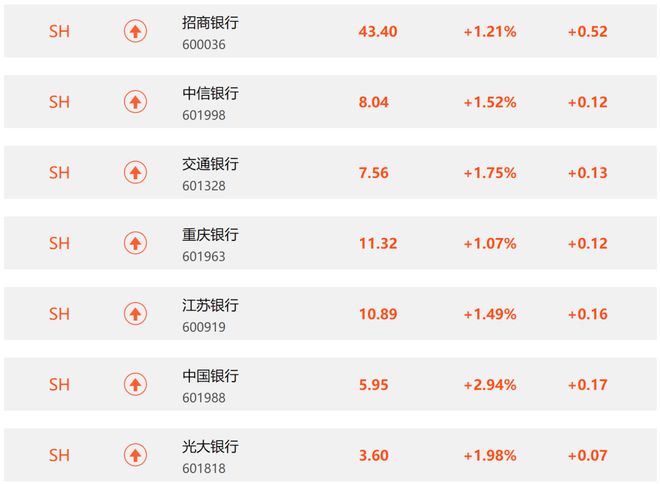
Core Points - Bank stocks experienced a volatile rise on November 19, with notable gains among several banks [1] - China Bank's stock price reached a new high, increasing by over 2% [1] Group 1: Stock Performance - China Bank's stock rose by 2.94%, reaching a price of 5.95 [2] - Everbright Bank's stock increased by 1.98%, with a price of 3.60 [2] - Jiangsu Bank's stock saw a rise of 1.49%, priced at 10.89 [2] - Traffic Bank's stock rose by 1.75%, reaching 7.56 [2] - Chongqing Bank's stock increased by 1.07%, priced at 11.32 [2] - CITIC Bank's stock rose by 1.52%, with a price of 8.04 [2] - China Merchants Bank's stock increased by 1.21%, priced at 43.40 [2]





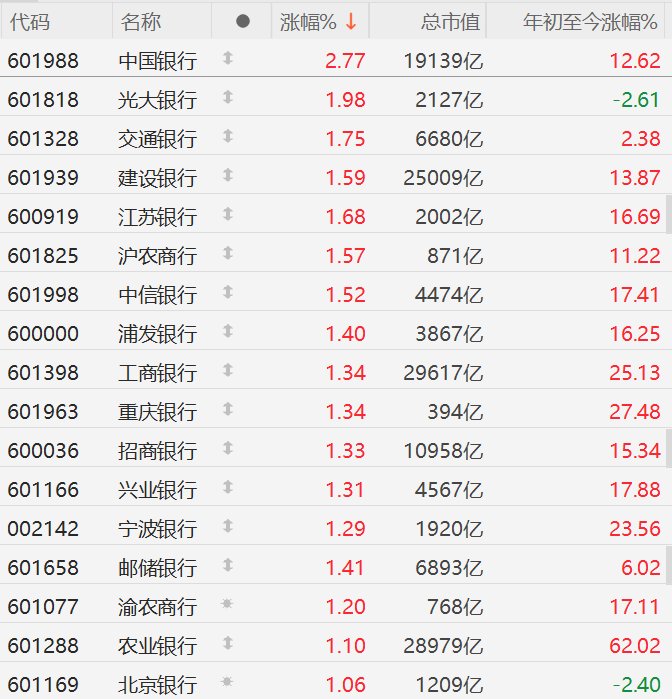
又有银行股创新高!中国银行涨近3%创历史新高
Ge Long Hui A P P· 2025-11-19 02:34
Core Insights - The A-share market saw a collective rise in bank stocks, with notable increases in China Bank, which rose nearly 3%, and other banks like Everbright Bank, Bank of Communications, and Agricultural Bank of China also showing gains of over 1% [1] Summary by Category Stock Performance - China Bank increased by 2.77%, reaching a total market capitalization of 191.39 billion, with a year-to-date increase of 12.62% [2] - Everbright Bank rose by 1.98%, with a market cap of 21.27 billion and a year-to-date decline of 2.61% [2] - Bank of Communications saw a 1.75% increase, with a market cap of 66.80 billion and a year-to-date increase of 2.38% [2] - Agricultural Bank of China increased by 1.10%, with a market cap of 289.79 billion and a year-to-date increase of 62.02% [2] - Other banks such as Construction Bank, Jiangsu Bank, and Industrial and Commercial Bank of China also reported gains, with year-to-date increases ranging from 15.34% to 25.13% [2] Historical Performance - China Bank reached a new historical high, following similar achievements by Agricultural Bank and Industrial and Commercial Bank [1]

银行股震荡走高,中国银行涨近2%
Mei Ri Jing Ji Xin Wen· 2025-11-19 02:34
Core Viewpoint - Bank stocks experienced fluctuations but ultimately rose, with notable gains in several major Chinese banks on November 19 [1]. Group 1: Stock Performance - China Bank saw an increase of nearly 2% [1]. - Other banks that performed well include Everbright Bank, Jiangsu Bank, Transportation Bank, Chongqing Bank, Citic Bank, and China Merchants Bank, which had significant gains [1].
广发中证A50交易型开放式指数证券投资基金基金份额发售公告
Shang Hai Zheng Quan Bao· 2025-11-18 18:07
Group 1 - The fund name is "Guangfa CSI A50 Exchange-Traded Open-Ended Index Fund" with a launch date from November 27, 2025, to December 10, 2025 [1][12] - The fund type is a stock-type, index-type securities investment fund, operating as an exchange-traded open-ended fund [2][12] - The initial fundraising target is capped at 2 billion RMB, excluding interest and subscription fees [4][15] Group 2 - The fund is managed by Guangfa Fund Management Co., Ltd., and the custodian is CITIC Bank Co., Ltd. [3][57] - The fund is open to individual investors, institutional investors, qualified foreign investors, and other investors permitted by laws and regulations [4][16] - Subscription fees will not exceed 0.80% of the subscription amount [8][26] Group 3 - Subscription methods include online cash subscription and offline cash subscription, with specific requirements for each [25][31] - The online subscription requires a minimum of 1,000 shares per transaction, while offline subscriptions must be at least 50,000 shares when processed through the fund manager [6][31] - The fund's subscription period is from November 27, 2025, to December 10, 2025, with the possibility of adjustments based on sales conditions [5][21] Group 4 - The fund's assets will be held in a dedicated account during the fundraising period, and no withdrawals are allowed until the fundraising concludes [13][52] - If the fundraising does not meet the required conditions, the fund manager is responsible for returning the funds to investors within 30 days, along with interest [55][56] - The fund will be listed for trading after the fundraising period, and unregistered shares can only be traded in the secondary market [18][22]
科力远:为储能电站项目公司提供担保
Mei Ri Jing Ji Xin Wen· 2025-11-18 10:59
每经AI快讯,11月18日,科力远公告,公司为鄂尔多斯市鸾星新能源科技有限公司在中信银行贷款本 金5.25亿元及相关的利息及实现债权费用等提供担保。 ...

玻色量子中标中信银行信用卡中心量子计算服务采购项目
Xin Lang Cai Jing· 2025-11-18 10:20
Core Insights - The article reports that Beijing Boson Quantum Technology Co., Ltd. has won a bid for a quantum computing service procurement project as announced by the official website of CITIC Financial Holdings' electronic procurement system [1] Group 1 - The procurement project is related to quantum computing services [1] - The announcement was made on November 18 [1] - The bid win indicates a significant step for Beijing Boson Quantum in the quantum computing sector [1]
申万宏源:险资密集增配银行已验证趋势 期待2026年行业基本面新变化
Zhi Tong Cai Jing· 2025-11-18 08:25
Core Viewpoint - The report from Shenwan Hongyuan indicates a significant trend of long-term capital, represented by insurance funds, increasingly allocating to the banking sector, with a potential inflow space of approximately 600 billion yuan if 40% of new funds are allocated to bank stocks [1][2]. Group 1: Capital Inflow and Allocation - The unprecedented low interest rate environment is driving incremental capital towards dividend sectors, with the banking sector offering superior value. The current banking index dividend yield is about 4.3%, significantly higher than the ten-year government bond yield, making it an attractive investment option [1]. - Assuming that 40% of the new capital is allocated to OCI and 40% to bank stocks, this could lead to a potential inflow of around 600 billion yuan. Additionally, public fund reforms are expected to increase capital allocation to underrepresented sectors, with bank stock holdings in public funds dropping to a near ten-year low of 1.74% in Q3 2025, suggesting an additional potential inflow of over 370 billion yuan if allocations align with the CSI 300 [2]. Group 2: Expected Changes in Banking Fundamentals - The central bank has explicitly stated its support for stabilizing net interest margins, linking this to the expansion of monetary policy's counter-cyclical adjustment space. It is anticipated that by 2026, bank interest margins may reverse their downward trend and show a slight year-on-year increase, with banks that can improve deposit costs expected to perform better than their peers [3]. - The importance of "high provisioning" is becoming more pronounced as banks' provisioning capacity is gradually consumed. While systemic risks from real estate and platforms may ease, risks in retail sectors still require provisioning. Focus should be on banks with low non-performing loans and high loan-to-deposit ratios, as well as those with clear asset quality improvements [3]. - Some small and medium-sized banks may face revenue growth challenges due to high base pressures in their capital market operations, with reduced non-interest income growth and declining financial investment yields [3]. Group 3: Capital Focus and Investment Recommendations - Bank capital is becoming a focal point, with banks that have strong internal capital generation or substantial reserves being better positioned for stable lending and dividends. External financing remains challenging, making convertible bonds a scarce resource [4]. - The banking sector is entering a new cycle of stable profitability, with long-term capital inflows ongoing. If the macro environment sees a gradual recovery in PPI and marginal increases in long-term interest rates, this will create favorable operating conditions for banks. Even under economic pressure, banks with clear risk thresholds and stable dividend expectations remain attractive dividend assets [5]. - The report recommends focusing on a dual strategy of "leading banks (state-owned and China Merchants Bank) as the foundation" and "bottom-tier joint-stock banks and quality city commercial banks as the performers." Leading banks are expected to see valuation recovery, while quality small and medium-sized banks with improving fundamentals are likely to exhibit stock price elasticity in response to economic recovery [5].