Keli Sensing Technology (Ningbo) (603662)

Search documents
柯力传感:公司传感器芯片外采
Zheng Quan Ri Bao Zhi Sheng· 2025-12-08 14:10
证券日报网讯 12月8日,柯力传感在互动平台回答投资者提问时表示,公司传感器芯片外采。公司参股 企业——宁波米德方格半导体技术有限公司(简称"米德方格")专注于高性能、高品质传感器、模拟芯 片及混合信号集成电路的设计、销售。后续传感器部分芯片将由米德方格供应。 (编辑 任世碧) ...

柯力传感:部分高端型号已内置气密检测传感器,可实现泄漏实时报警
Zheng Quan Ri Bao Wang· 2025-12-08 13:41
证券日报网讯12月8日,柯力传感(603662)在互动平台回答投资者提问时表示,公司传感器产品的外 壳主体结构采用不锈钢材质,核心焊接工艺为先进的激光焊接与氩弧焊接,确保了极高的气密性。此 外,部分高端型号已内置气密检测传感器,可实现泄漏实时报警。 ...
人形机器人明年交付量有望迎来爆发 多只业绩高增长概念股已大幅回撤
Zheng Quan Shi Bao Wang· 2025-12-03 08:13
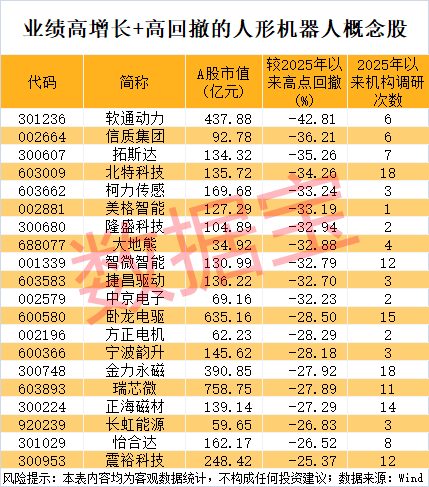
Group 1 - The Chinese humanoid robot industry chain has formed a complete layout, with multiple A-share listed companies making breakthroughs in various segments [1] - Several listed companies have entered the mass supply stage, and the delivery volume is expected to see a significant increase next year [1] - In the first three quarters of this year, humanoid robot concept stocks with a year-on-year net profit growth of 20% (including turning losses into profits) have seen 36 stocks retreat over 20% from their annual highs as of December 3 [1] Group 2 - Among the 36 humanoid robot concept stocks, five have a rolling price-to-earnings ratio below 30 times, including Zhongding Co., Huaqin Technology, Changhong Energy, Mingke Precision, and Jihong Co. [1] - The market capitalization of several companies has significantly decreased from their peak values, with Softcom Power down 42.81%, Xinzhi Group down 36.21%, and Tuosida down 35.26% [2] - The number of institutional research visits for these companies varies, with Softcom Power receiving 6 visits and Tuosida receiving 7 visits [2]





柯力传感跌2.02%,成交额1.11亿元,主力资金净流出1374.47万元
Xin Lang Cai Jing· 2025-12-02 05:45
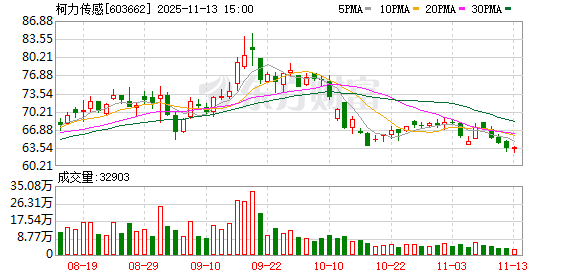
Core Viewpoint - The stock price of Keli Sensor has experienced a decline of 4.76% this year, with a recent drop of 2.02% on December 2, 2023, indicating potential market volatility and investor sentiment concerns [1] Company Overview - Keli Sensor Technology Co., Ltd. was established on December 30, 2002, and went public on August 6, 2019. The company specializes in the research, production, and sales of strain sensors and instruments, as well as providing various system integration services [2] - The main revenue composition includes: 48.70% from mechanical sensors and instruments, 41.12% from industrial IoT and system integration, and 5.02% from other services [2] Financial Performance - As of September 30, 2023, Keli Sensor reported a revenue of 1.082 billion yuan, representing a year-on-year growth of 17.72%, and a net profit attributable to shareholders of 254 million yuan, reflecting a growth of 33.29% [3] - The company has distributed a total of 453 million yuan in dividends since its A-share listing, with 251 million yuan distributed in the last three years [4] Shareholder Information - As of September 30, 2023, the number of shareholders decreased by 1.47% to 62,900, with an average of 4,467 circulating shares per person, which increased by 1.50% [3] - Notable institutional shareholders include Hong Kong Central Clearing Limited, which increased its holdings by 1.3078 million shares, and new entrants like E Fund National Robot Industry ETF [4]
国产六维力传感器市场进一步集中,头部厂商市占率已超70%
Huan Qiu Wang· 2025-11-28 01:00
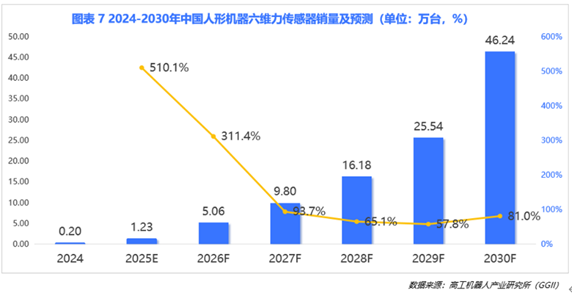
Core Insights - The humanoid robot industry in China is experiencing rapid growth, particularly in the six-dimensional force sensor market, which is crucial for real-time precision force control [1][2] - By 2025, the shipment volume of six-dimensional force sensors in China is expected to reach 12,300 units, representing a year-on-year increase of 510.1% [2] - The market is becoming increasingly concentrated, with leading companies capturing over 70% of the market share [2] Industry Overview - The six-dimensional force sensor is considered a top-tier product in the force sensor field, essential for humanoid robots to achieve precise force control [5] - These sensors are primarily installed in the wrists and ankles of humanoid robots to facilitate delicate operations and stable movement on uneven surfaces [5] - Future developments may see these sensors integrated into the fingertips of dexterous hands to enhance fine motor skills [5] Market Dynamics - Domestic companies are becoming market leaders due to their high cost-performance ratio, customization capabilities, and rapid response services [5] - Key players in the six-dimensional force sensor market include companies like Blue Dot Touch, Keli Sensor, Kunwei Technology, and Amperon, with Blue Dot Touch holding a market share of 72.6% in the first three quarters of 2025 [5] - The industry has seen eight financing events since 2025, indicating strong interest from the capital market in this sector [5] Future Projections - The shipment volume of six-dimensional force sensors is projected to grow approximately 40 times by 2030, exceeding 460,000 units [2] - Optimistically, the market could reach a scale of over 100 billion yuan by 2035 as humanoid robots penetrate consumer scenarios [2] - According to Morgan Stanley, the number of human-like robots could surpass 1 billion by 2050, with China aiming to solidify its leading position in this field [2]
电子皮肤行业深度报告:实现机器柔性触觉,感知世界触手可及
Shanxi Securities· 2025-11-21 05:18
Investment Rating - The report maintains an investment rating of "B" for the electronic skin industry, indicating a leading position in the market [1]. Core Insights - The electronic skin is a key tactile sensing system for humanoid robots, enabling them to interact with their environment through pressure and temperature sensing [13]. - The market for electronic skin is projected to reach $756 million by 2030, driven by the increasing demand for humanoid robots [4]. - The industry faces three major barriers: materials, manufacturing processes, and algorithms, which are critical for establishing competitive advantages [24][32]. Summary by Sections 1. Electronic Skin: Key to Humanoid Robot Interaction - Electronic skin mimics natural skin functions and is essential for humanoid robots to perceive their surroundings [13]. - The technology can be categorized into resistive, capacitive, and piezoelectric types, with resistive sensors being the most common in humanoid robots [2][21]. 2. Domestic Enterprises Accelerating Layout - Overseas companies dominate the high-end market, holding approximately 57.1% of the global flexible tactile sensor market share [4][41]. - Domestic companies are rapidly closing the technology gap, supported by favorable policies and manufacturing capabilities, with firms like Fulei New Materials and Hanwei Technology emerging as key players [5][46]. 3. Key Companies to Watch - Fulei New Materials has completed pilot production and is supplying small batches to leading clients in the dexterous hand sector [5]. - Hanwei Technology has established partnerships with nearly 30 robot manufacturers and is expanding its production capacity [5]. - Keli Sensor and other companies are also making strides in the electronic skin sector, focusing on multi-physical sensors and flexible tactile sensors [5][46].




柯力传感:构筑传感器“产业森林”,开拓人形机器人新市场
Di Yi Cai Jing· 2025-11-14 10:44
Core Insights - The sensor industry is crucial for bridging the physical and digital worlds, with significant advancements in technology and market growth in China [1][2] - Keli Sensor has established a strong market position in weighing sensors and is actively expanding into non-mechanical sensor fields through strategic investments [2][3] - The rise of humanoid robots emphasizes the importance of sensors, which are essential for perception and decision-making in robotics [4][5] Industry Overview - The Chinese sensor market is projected to grow from 364.47 billion yuan in 2023 to 554.72 billion yuan by 2026, with a compound annual growth rate (CAGR) exceeding 15% [2] - Keli Sensor has maintained a market share leadership for 14 years, achieving over 40% gross margin by focusing on high-end applications in metallurgy, chemicals, and logistics [2] Company Strategy - Keli Sensor's competitive advantages include technological innovation, market-driven principles, and ecosystem collaboration [2] - The company has diversified its product offerings by developing new mechanical sensors and investing in non-mechanical sensor companies, establishing a comprehensive sensor "industry forest" [3][5] - Keli Sensor's investments in seven companies and stakes in two others have laid a solid foundation for expanding into non-mechanical sensor markets [3] Humanoid Robot Market - The humanoid robot sector is rapidly evolving, with significant potential for disruptive innovation, driven by advancements in AI, high-end manufacturing, and new materials [4] - Sensors account for approximately 30% of the cost of humanoid robots, indicating a growing demand for intelligent sensors as the market expands [5] - Keli Sensor is focusing on developing sensors specifically for humanoid robots, including six-dimensional force sensors and torque sensors for joints [5][6] Technological Requirements - The main types of sensors needed for humanoid robots include vision, touch, force/torque, posture (IMU), and position (encoder) sensors [6] - Humanoid robots require sensors that can operate in unstructured environments, necessitating high precision, durability, and cost-effectiveness [6] - The integration of multiple sensor technologies is essential for enhancing the intelligence and operational capabilities of humanoid robots [6]
柯力传感:在人形机器人传感系统领域取得实质性突破
Zheng Quan Ri Bao· 2025-11-13 17:06
Core Insights - The company reported a revenue of 1.082 billion yuan for the first three quarters of the year, representing a year-on-year growth of 17.72%, and a net profit of 254 million yuan, up 33.29% year-on-year [2] Business Development - The company has focused on the "sensor forest" strategy and the core direction of robot sensors, consolidating its advantages in the high-end sensor field and industrial synergy [2] - The humanoid robot sector has become a focal point for investors, with the company making significant progress in sensor systems for humanoid robots since 2025 [2][3] Strategic Investments - The company has completed several strategic investments in various enterprises, including Shanghai Kepler Robot Co., Beijing Tashan Technology Co., and Wuxi Beimi Sensor Technology Co. [2] Technological Advancements - The company has developed a comprehensive robot sensing solution system centered around six-dimensional force sensors, integrating tactile and IMU capabilities [3] - Key technologies mastered include structural decoupling, algorithm decoupling, and high-speed sampling and communication, with the six-dimensional force sensor achieving linear accuracy better than 0.3% FS and crosstalk accuracy better than 2% FS [3] Customer Engagement - The company has sent samples to over 50 domestic humanoid, collaborative, and industrial robot companies, with nearly 1,000 units of six-dimensional force sensors shipped and some clients moving from sample verification to small batch orders [4] - The company aims to leverage its experience in strain gauge sensors to meet the market demand driven by the rapid development of the robotics industry [3][4] Market Strategy - The company plans to deepen its "market-oriented" strategy, establishing partnerships with leading robot companies to transition from sample validation to large-scale procurement, thereby driving future growth [5]
“未来20” 2025调研实录:柯力传感 ,打造智能感知的产业森林
Di Yi Cai Jing· 2025-11-12 12:05
Core Insights - The company is a leader in the field of mechanical sensors in China, having built a vibrant "sensor industry forest" through continuous technological expansion and industrial integration [1] Company Overview - The company has transitioned from being a professional leader to an ecosystem builder in the sensor industry [1] - The interview features Ye Fangzhi, the Deputy General Manager and Secretary of the Board, discussing the company's growth journey [1]
上市公司买私募“看中”13家管理人,出手超8亿元赚了吗?
Xin Lang Cai Jing· 2025-11-09 23:44
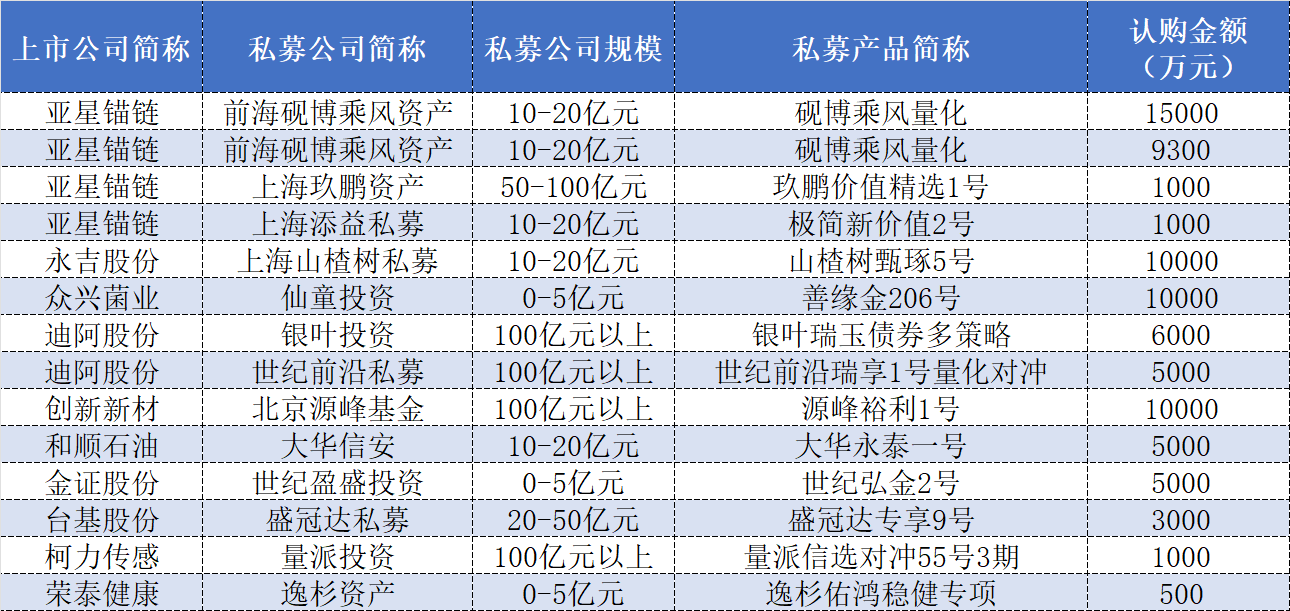
Core Viewpoint - A-share listed companies are actively subscribing to private equity products, with a total subscription amount reaching 818 million yuan as of November 7 this year [1]. Subscription Overview - Ten listed companies have disclosed their subscription or continued subscription to private equity products, involving a total of 13 private equity firms [1]. - The private equity firms are categorized by management scale: four firms have over 10 billion yuan, four firms are in the 1-2 billion yuan range, three firms are in the 0-500 million yuan range, one firm has 5-10 billion yuan, and one firm has 2-5 billion yuan [1]. Notable Subscriptions - Yaxing Anchor Chain (601890.SH) has made the largest investment, with a total subscription amount of 263 million yuan across three private equity products this year [2][3]. - Yongji Co., Ltd. (603058.SH) has invested 100 million yuan in the "Shanzha Tree Zhenzhu 5" product, showing a history of multiple investments in this product since 2020 [4]. - Zhongxing Junye (002772.SZ) extended the investment period for the "Shanyuan Jin 206" product, which it initially subscribed to for 100 million yuan in 2021 [5]. Preference for Large Private Equity Firms - Diya Co., Ltd. (301177.SZ) and Innovation New Materials (600361.SH) prefer large private equity firms, with Diya investing 60 million yuan in two products from firms with over 10 billion yuan in management scale [6]. - Other companies like Heshun Petroleum (603353.SH) and Jinzhen Co., Ltd. (600446.SH) have also made significant investments in various private equity products this year [6]. Historical Performance and Returns - Companies have reported past performance and returns from their private equity investments, such as Yangguang Lighting (600261.SH) redeeming portions of its investments and realizing significant returns [8]. - Yongji Co., Ltd. reported a total investment return of 121 million yuan from the "Shanzha Tree Zhenzhu 5" product in 2021, but saw a decline in investment returns in 2022 due to reduced gains from private equity redemptions [8].