
XHW(603888)

Search documents
文化传媒板块部分活跃




Mei Ri Jing Ji Xin Wen· 2025-11-10 06:29
Group 1 - The cultural media sector showed significant activity on November 10, with Xinhua Net surging over 7% [1] - People's Daily increased by more than 4%, indicating positive market sentiment [1] - Other stocks such as Jishi Media, Chuanwang Media, CITIC Publishing, Wireless Media, and Huanrui Century also experienced gains [1]
新华网三评网购乱象:隐形捆绑、平台调价霸权、AI模特滥用
Cai Jing Wang· 2025-11-10 03:12
Group 1 - The core viewpoint of the articles highlights the various deceptive practices in online shopping platforms, including hidden fees and price manipulation, which undermine consumer trust and regulatory effectiveness [1][2][3] Group 2 - The first article discusses the issue of hidden fees in online ticket purchasing, where consumers often end up paying more than expected due to additional charges that are not clearly disclosed [1] - The second article addresses the unauthorized price adjustments made by platforms, which disrupt the pricing autonomy of merchants and negatively impact both merchants and consumers [2] - The third article focuses on the misuse of AI models in e-commerce, where businesses create misleading representations of products, leading to consumer dissatisfaction and potential legal repercussions [3]


新华网财经观察丨微短剧产业进阶
Xin Hua Wang· 2025-11-10 02:21
Core Insights - The micro-short drama market is projected to exceed 50 billion yuan in 2024, with significant growth expected this year compared to last year [2] - The industry is transitioning from a "traffic-oriented" model to a "value-oriented" model, emphasizing quality over quantity [4] Group 1: Quality Enhancement - The industry has shifted from being a "cost-effective" space to a "quality-centric" one, where high-quality content is essential for survival [5] - The production costs for quality micro-short dramas have increased significantly, from approximately 50,000 yuan in 2022 to 1.5 million yuan currently [5] - User expectations have risen, leading to a strong willingness to pay for high-quality content, which drives the industry's transformation towards premium offerings [5][7] Group 2: Cross-Industry Integration - The "micro-short drama+" model is creating multiplier effects across various industries, enhancing content's value beyond mere entertainment [8] - Successful case studies include collaborations with brands like Dicos and Pizza Hut, integrating product features into storylines to achieve significant exposure [8] - The integration of long and short formats is becoming crucial, with platforms developing strategies to extend IP lifecycles and maximize user value [8][10] Group 3: Technological Empowerment - AI is becoming a vital tool for enhancing quality and efficiency in micro-short drama production, with estimates suggesting a 50% increase in planning efficiency and a 30% reduction in production costs [11] - The application of AI in content creation and user engagement is reshaping the production process, making it a core component of the creative economy [11] Group 4: Cultural Resonance - The market is evolving from superficial emotional expressions to deeper emotional connections with audiences, reflecting a shift in user demands [12] - Works that portray nuanced emotional experiences are gaining popularity, indicating a trend towards content that resonates on a personal level [12][14] Group 5: Global Expansion - The micro-short drama industry is entering a "global localization" phase, with companies establishing local teams and platforms in over 200 countries [15] - The range of themes is diversifying, moving from traditional genres to urban, suspense, and realism, making micro-short dramas effective cultural carriers in global markets [15]

新华网三评之三:滥用AI模特有可能触碰法律红线
Xin Hua She· 2025-11-09 03:09
Core Viewpoint - The misuse of AI models in e-commerce is leading to significant discrepancies between advertised products and actual items received by consumers, potentially violating consumer rights and trust [2][3]. Group 1: Misuse of AI Technology - Some merchants are abusing AI technology to create misleadingly perfect images of products, which do not accurately represent the actual items [2]. - The overuse of AI models to present "flawless" images can result in a breach of consumer rights and a loss of trust in the brand [2]. Group 2: Legal Implications - The implementation of the "Artificial Intelligence Generated Synthetic Content Identification Measures" aims to curb the misuse of technology and protect consumer rights [3]. - Existing laws, such as the Consumer Rights Protection Law and the E-commerce Law, explicitly restrict false advertising and related practices [3]. Group 3: Consumer Expectations - Consumers expect to receive products that match the images they see online, emphasizing the importance of product quality and genuine service over artificially created perfection [3].
新华网财经观察丨“全勤生”的进博之约
Xin Hua Wang· 2025-11-08 03:55
Core Points - The 8th China International Import Expo (CIIE) is being held in Shanghai from November 5 to 10, with participation from 155 countries and regions, showcasing 4,108 foreign enterprises [2] - 170 companies and 27 institutions have been consistent participants over the years, demonstrating their commitment to the Chinese market and the benefits of China's ongoing opening-up [2][3] - The expo has evolved beyond a simple trade fair to become a platform for foreign companies to showcase their strength and long-term commitment in China, reflecting their confidence in the Chinese market [2] Group 1: Company Participation and Perspectives - Qualcomm's booth emphasizes collaboration with Chinese partners, showcasing the integration of 5G and AI technologies, highlighting ongoing innovation [5] - Siemens views the expo as a platform for deep interaction between China and the world, aiming to integrate AI into industrial applications to enhance digitalization and decarbonization efforts in China [8] - Sanofi has consistently participated in the expo, seeing it as a bridge for cooperation and a testament to China's expanding openness [6] Group 2: Innovation and Market Dynamics - ABB's local R&D efforts in China have led to significant innovations, showcasing the country's potential as a hub for global innovation [11] - Varian Medical's participation illustrates the expo's role as an accelerator for global innovation, enabling rapid market entry for advanced technologies in China [12] - Bayer emphasizes China's role as a core market for global innovation, with the expo facilitating faster access for innovative products [13] Group 3: Economic Environment and Future Outlook - The 14th Five-Year Plan emphasizes expanding institutional openness and maintaining a multilateral trade system, which is expected to attract more foreign investment [14] - General Electric acknowledges improvements in China's business environment and the increasing openness to foreign investment, reinforcing confidence in long-term development in China [16] - AstraZeneca's ongoing commitment to the Chinese market reflects the company's strategy to leverage opportunities and enhance health outcomes in China [17]

新华网三评之二:擅自替商家调价,是一种“霸权”行为
Xin Hua She· 2025-11-08 03:52
Core Viewpoint - The article discusses the issue of online travel agencies (OTAs) and platforms unilaterally adjusting prices, which is viewed as a form of "hegemony" that undermines the autonomy of merchants and negatively impacts consumer experience [1][2] Group 1: Impact on Merchants - Merchants are expressing frustration over the loss of pricing autonomy, leading to uncontrolled costs and profits [1] - Some platforms exploit their dominant market position to unilaterally raise prices or force merchants into low-price promotions, often without notifying them [1][2] - This behavior can result in merchants selling at a loss or setting artificially high prices, which can drive away customers [1] Group 2: Consumer Consequences - While consumers may occasionally benefit from lower prices, the long-term effects of platform price adjustments can lead to reduced product quality and service as merchants try to recover losses [2] - The fluctuating prices create a poor consumer experience, as the same products or services can vary significantly in price [1] Group 3: Legal and Ethical Considerations - The article highlights that such practices violate e-commerce laws that prohibit platforms from unreasonably restricting transaction prices of merchants [2] - The actions of these platforms disrupt fair competition in the market, undermining the foundational principles of a healthy business ecosystem [2] Group 4: Call for Fair Practices - The article advocates for platforms to respect the pricing autonomy of merchants and the right of consumers to be informed, emphasizing the need for integrity in market operations [2] - A balanced ecosystem requires platforms to act as facilitators rather than price manipulators, fostering trust and mutual benefit among all parties involved [2]
新华网三评之一:“管不住”的套路,“够不着”的监管
Xin Hua She· 2025-11-07 09:02
Core Points - The article discusses the deceptive practices of online ticketing platforms that lure consumers with low prices but add hidden fees, leading to higher actual costs for consumers [2][3] - It highlights the challenges of regulatory oversight, as many platforms are based in major cities but operate nationwide, complicating enforcement and consumer protection [3] Group 1: Deceptive Practices - Online ticketing platforms often include additional services like "refund protection" in the guise of low prices, which ultimately results in higher costs for consumers [2][3] - Consumers face difficulties in avoiding these hidden charges due to tactics such as default selections for add-ons and small print disclosures [3] Group 2: Regulatory Challenges - Local regulatory bodies struggle to enforce rules against these platforms due to jurisdictional issues, leading to a lack of effective deterrence against deceptive practices [3] - There is a call for breaking down regional barriers in regulation to ensure that platforms can be held accountable regardless of their headquarters location [3] Group 3: Recommendations for Improvement - The article suggests that regulations should be updated to specifically address "low-price inducement" and "hidden bundling," with clear penalties to discourage such practices [3] - It emphasizes the need for simplifying the complaint process for consumers who fall victim to these tactics, ensuring they have a viable path for recourse [3]
新华网视评|拿AI编造案例当诉讼依据,荒唐!
Xin Hua She· 2025-11-06 08:15
Core Viewpoint - The misuse of AI in legal proceedings poses a significant threat to judicial integrity and professional standards, as demonstrated by a recent case where AI-generated false references were submitted to a court [1] Group 1: Legal Implications - A recent case in Beijing revealed that a plaintiff's representative submitted two AI-generated false case references, which were not verified before being presented in court [1] - The judge criticized the behavior as a disruption to judicial order, emphasizing the potential erosion of public trust in the legal system if such practices continue [1] Group 2: Professional Standards - The incident highlights the risks of AI misuse in specialized fields such as law, medicine, and finance, where professional integrity is crucial [1] - The court is now required to expend additional resources to verify information, leading to a waste of judicial resources [1] Group 3: Technology and Ethics - While AI can be a useful tool, it should not be an excuse for negligence or a lack of due diligence in professional practices [1] - The power of technology must not undermine professional ethics and standards [1]
数字媒体板块11月4日跌0.16%,国脉文化领跌,主力资金净流出2.65亿元



Zheng Xing Xing Ye Ri Bao· 2025-11-04 08:48
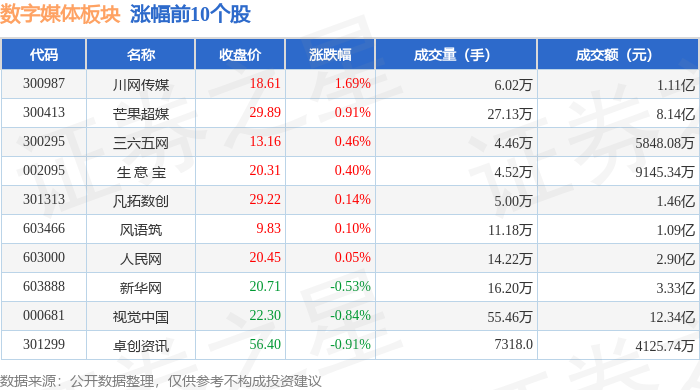
Market Overview - The digital media sector experienced a decline of 0.16% on November 4, with Guomai Culture leading the drop [1] - The Shanghai Composite Index closed at 3960.19, down 0.41%, while the Shenzhen Component Index closed at 13175.22, down 1.71% [1] Stock Performance - Notable stock performances include: - Chuanwang Media (300987) closed at 18.61, up 1.69% with a trading volume of 60,200 shares and a turnover of 111 million yuan [1] - Mango Super Media (300413) closed at 29.89, up 0.91% with a trading volume of 271,300 shares and a turnover of 814 million yuan [1] - Guomai Culture (600640) closed at 14.24, down 1.39% with a trading volume of 142,300 shares and a turnover of 202 million yuan [2] Capital Flow - The digital media sector saw a net outflow of 265 million yuan from institutional investors, while retail investors contributed a net inflow of 290 million yuan [2][3] - Specific stock capital flows indicate: - Mango Super Media had a net inflow of 31.62 million yuan from institutional investors [3] - Guomai Culture experienced a net outflow of 29.33 million yuan from institutional investors [3] Summary of Individual Stocks - The following stocks had significant movements: - Visual China (000681) closed at 22.30, down 0.84% with a trading volume of 554,600 shares and a turnover of 1.234 billion yuan [2] - ST Fanli (600228) closed at 6.50, down 1.07% with a trading volume of 159,300 shares and a turnover of 105 million yuan [2] - Zhi De Mai (300785) closed at 35.20, down 1.26% with a trading volume of 65,000 shares and a turnover of 227 million yuan [2]
新华网国际看点|今年APEC会议有哪些成果?专家梳理出三大亮点
Xin Hua She· 2025-11-04 08:32
Core Viewpoint - The APEC meeting in South Korea emphasized the need for enhanced cooperation amid global economic challenges and protectionism, signaling a positive outlook for both APEC and the world economy [1] Group 1: APEC Meeting Outcomes - The meeting resulted in the adoption of the "Gyeongju Declaration," which sends a strong message for increased collaboration [1] - Chinese representatives highlighted the importance of inclusive economic globalization and proposed a clear path for the Asia-Pacific community through the "Five Common" initiatives [1] Group 2: China's Role and Future Outlook - China is set to take on the role of APEC host, coinciding with the start of its "14th Five-Year Plan," which is expected to inject greater vitality into the development of the Asia-Pacific region through high-quality growth and openness [1]