SDF(605006)

Search documents
玻璃玻纤业CFO群体观察:北玻股份夏冰在任13年 九鼎新材韩秀华最高学历大专
Xin Lang Zheng Quan· 2025-08-07 04:14
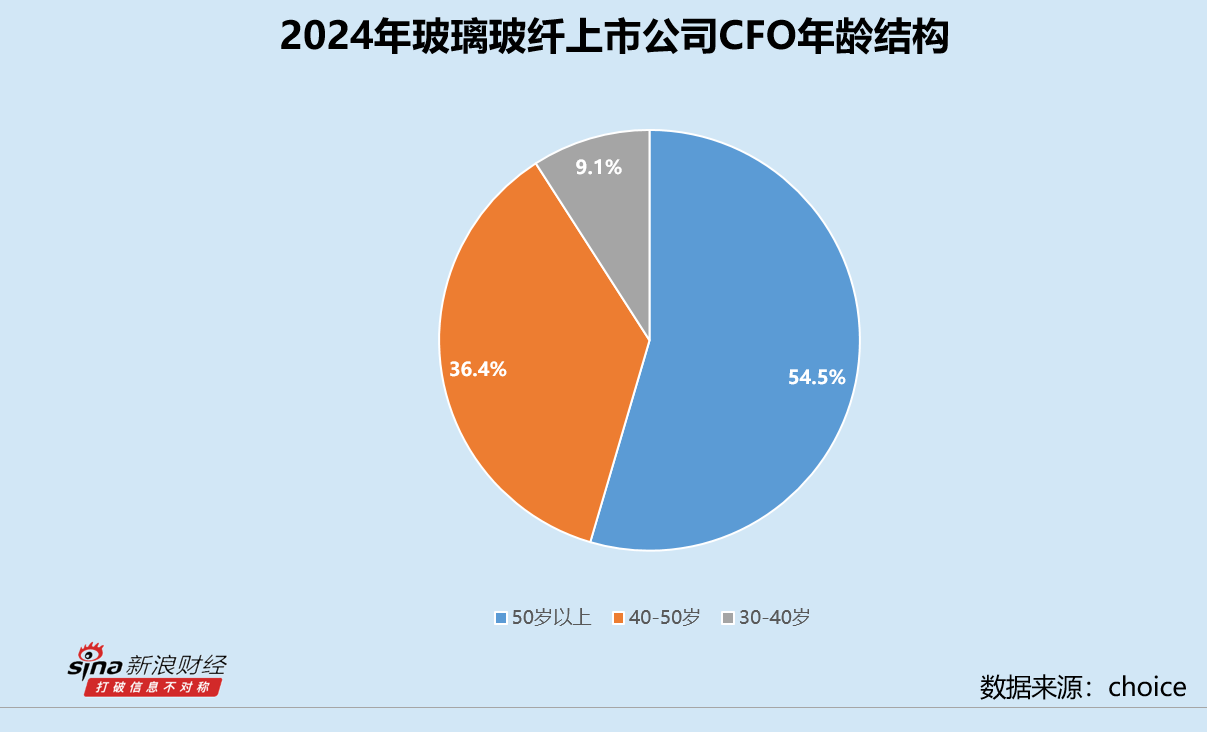
Core Insights - The report highlights the significant role of CFOs in listed companies, with the total salary for CFOs in A-share companies reaching 4.27 billion yuan in 2024, averaging 814,800 yuan per year [1][8]. Salary Overview - The average salary for CFOs in the glass and fiber industry is 1.26 million yuan, which is 1.64 times higher than the average salary in the construction materials sector, with a year-on-year increase of 18.5% [8]. - The highest-paid CFO is Du Hai from Qibin Group, earning 3.44 million yuan, while the lowest is Liu Zhengqi from Zaiseng Technology, with a salary of 273,100 yuan [9][10]. Demographics - The average age of CFOs in the glass and fiber sector is 49.27 years, with 54.5% being over 50 years old [1]. - Male CFOs dominate the field, comprising 66.7% of the total, with an average age of 48.57 years, while female CFOs account for 33.3% with an average age of 50.50 years [1]. Tenure and Education - Most CFOs in the glass and fiber industry have a short tenure, with 50% serving between 1-3 years, and 33.3% between 3-5 years [3]. - Approximately 66.7% of CFOs hold a bachelor's degree, while 25% have a master's degree and 8.3% have an associate degree [6]. Salary by Gender and Education - Male CFOs earn an average of 1.31 million yuan, which is 1.11 times higher than their female counterparts [9]. - CFOs with a master's degree have the highest average salary at 1.56 million yuan, while those with a bachelor's and associate degrees earn 1.23 million yuan and 602,300 yuan, respectively [9].


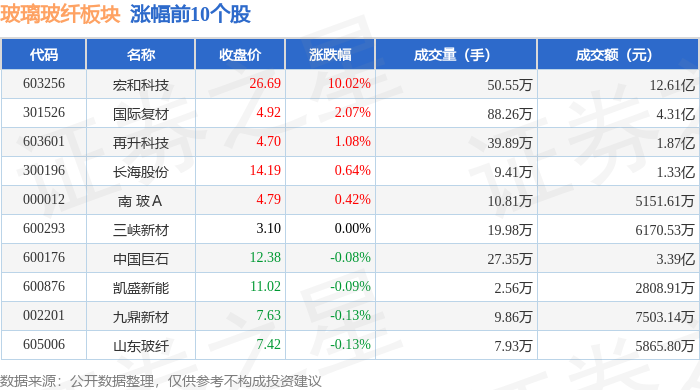
玻璃玻纤板块8月6日涨0.71%,宏和科技领涨,主力资金净流出4245.56万元
Zheng Xing Xing Ye Ri Bao· 2025-08-06 08:48
证券之星消息,8月6日玻璃玻纤板块较上一交易日上涨0.71%,宏和科技领涨。当日上证指数报收于 3633.99,上涨0.45%。深证成指报收于11177.78,上涨0.64%。玻璃玻纤板块个股涨跌见下表: 从资金流向上来看,当日玻璃玻纤板块主力资金净流出4245.56万元,游资资金净流出1.1亿元,散户资金 净流入1.53亿元。玻璃玻纤板块个股资金流向见下表: | 代码 | 名称 | 主力净流入(元) | 主力净占比 游资净流入 (元) | | 游资净占比 散户净流入 (元) | | 散户净占比 | | --- | --- | --- | --- | --- | --- | --- | --- | | 603256 宏和科技 | | 1.32 Z | 10.47% | -5476.44万 | -4.34% | -7731.53万 | -6.13% | | 300196 | 长海股份 | 975.74万 | 7.35% | 209.69万 | 1.58% | -1185.43万 | -8.93% | | 301526 国际复材 | | 845.57万 | 1.96% | -748.41万 | -1.74% | ...


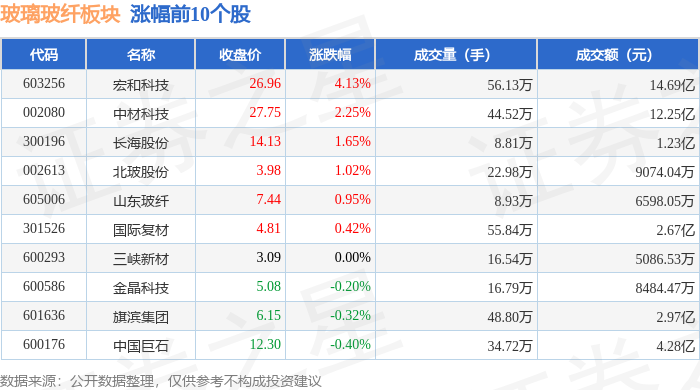
玻璃玻纤板块8月4日涨0.69%,宏和科技领涨,主力资金净流出2.73亿元
Zheng Xing Xing Ye Ri Bao· 2025-08-04 08:30
从资金流向上来看,当日玻璃玻纤板块主力资金净流出2.73亿元,游资资金净流入3352.15万元,散户资 金净流入2.4亿元。玻璃玻纤板块个股资金流向见下表: | 代码 | 名称 | 收盘价 | 涨跌幅 | 成交量(手) | 成交额(元) | | | --- | --- | --- | --- | --- | --- | --- | | 603256 | 宏和科技 | 26.96 | 4.13% | 56.13万 | | 14.69 Z | | 002080 | 中材科技 | 27.75 | 2.25% | 44.52万 | | 12.25亿 | | 300196 | 长海股份 | 14.13 | 1.65% | ● 8.81万 | | 1.23亿 | | 002613 | 北玻股份 | 3.98 | 1.02% | ﯾﺎ ﮨﮯ 22.98万 | | 9074.04万 | | 605006 | 山东坡纤 | 7.44 | 0.95% | 8.93万 | | 6598.05万 | | 301526 | 国际复材 | 4.81 | 0.42% | 55.84万 | | 2.67亿 | | 600293 | 三峡新材 ...


建筑材料行业跟踪周报:PMI走弱,需求侧等待新政策-20250804
Soochow Securities· 2025-08-04 02:28
Investment Rating - The report maintains an "Accumulate" rating for the construction materials industry [1] Core Views - The construction materials sector is experiencing weak demand, with the PMI showing a decline. The market is awaiting new policies to stimulate demand [4] - The report highlights that the cement market is facing challenges due to adverse weather conditions, leading to a low average shipment rate of less than 45% in key regions. However, the overall price decline has slowed down, indicating potential stabilization in the near term [11][18] - The report suggests that the supply-side consensus on self-discipline within the industry is strengthening, which may lead to better profitability compared to the previous year [11] - The report recommends focusing on cyclical industries that may benefit from policy support, particularly in cement and glass sectors, and highlights specific companies such as Huaxin Cement, Conch Cement, and others as potential investment opportunities [4][11] Summary by Sections 1. Industry Trends - The construction materials sector has seen a decline of 2.31% in the past week, underperforming against the Shanghai Composite Index [4] - The report notes that the cement price is currently at 339.7 RMB/ton, down 1.0 RMB/ton from the previous week and down 42.5 RMB/ton year-on-year [19][20] 2. Bulk Construction Materials Fundamentals and High-Frequency Data 2.1 Cement - The average cement shipment rate is reported at 44.7%, with a slight increase of 1.7 percentage points from the previous week, but a decrease of 2.0 percentage points year-on-year [26] - The report anticipates that cement prices will stabilize in the short term, despite current weak demand [11][18] 2.2 Glass - The average price of float glass is reported at 1295.3 RMB/ton, which is an increase of 56.7 RMB/ton from the previous week but a decrease of 175.7 RMB/ton year-on-year [4] - The report indicates that the glass industry is expected to see a supply-side contraction, which may improve the supply-demand balance in the short to medium term [14] 2.3 Fiberglass - The report highlights that the market for electronic fiberglass products is evolving, with a clear trend towards high-end products, which are expected to see increased penetration and value growth [12] - The profitability of ordinary fiberglass remains resilient, with ongoing demand in sectors like wind power and thermoplastics [12] 3. Industry Dynamics Tracking - The report discusses the impact of government policies aimed at stimulating domestic demand, particularly in the housing market, which is expected to improve the outlook for construction materials [15] - The report emphasizes the importance of companies that are exploring new business models and enhancing their supply chain efficiency [15]


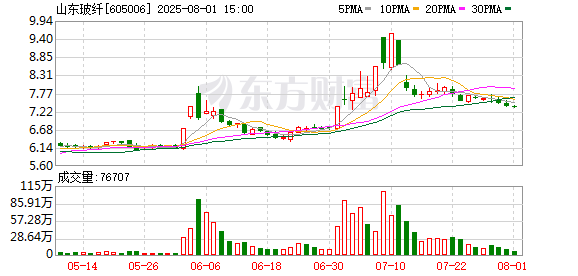
山东玻纤集团股份有限公司关于以集中竞价交易方式回购股份的进展公告
Zhong Guo Zheng Quan Bao - Zhong Zheng Wang· 2025-08-01 23:13
Group 1 - The company approved a share repurchase plan using its own funds, with a budget between RMB 50 million and RMB 100 million, and a maximum repurchase price of RMB 5.41 per share, valid for 12 months from the board's approval date [1] - The company adjusted the source of repurchase funds from "own funds" to "own funds and self-raised funds," while other aspects of the repurchase plan remained unchanged [2] - As of July 31, 2025, the company repurchased 6,220,980 shares, accounting for 1.0182% of the total share capital, with a total expenditure of RMB 29,988,522.56, at prices ranging from RMB 4.08 to RMB 5.30 per share [3] Group 2 - The company will adhere to relevant regulations and make repurchase decisions based on market conditions, ensuring timely information disclosure regarding the progress of the share repurchase [4]

山东玻纤:7月份未回购公司股份
Zheng Quan Ri Bao· 2025-08-01 14:09
Group 1 - The company Shandong Glass Fiber announced on the evening of August 1 that it did not repurchase its shares through the Shanghai Stock Exchange trading system via centralized bidding by July 2025 [2]
山东玻纤(605006) - 山东玻纤集团股份有限公司关于以集中竞价交易方式回购股份的进展公告
2025-08-01 09:47
证券代码:605006 证券简称:山东玻纤 公告编号:2025-055 山东玻纤集团股份有限公司 关于以集中竞价交易方式回购股份的进展公告 本公司董事会及全体董事保证本公告内容不存在任何虚假记载、误导性陈述 或者重大遗漏,并对其内容的真实性、准确性和完整性承担法律责任。 重要内容提示: | 回购方案首次披露日 | 2024/8/28 | | | | | | | --- | --- | --- | --- | --- | --- | --- | | 回购方案实施期限 | 2024 年 年 月 | 8 | 月 | 27 | 日~2025 | 8 26 日 | | 预计回购金额 | 5,000万元~10,000万元 | | | | | | | 回购用途 | □减少注册资本 √用于员工持股计划或股权激励 | | | | | | | | □用于转换公司可转债 | | | | | | | | □为维护公司价值及股东权益 | | | | | | | 累计已回购股数 | 6,220,980股 | | | | | | | 累计已回购股数占总股本比例 | 1.0182% | | | | | | | 累计已回购金额 | 29,98 ...
山东玻纤(605006.SH):已回购1.0182%公司股份
Ge Long Hui A P P· 2025-08-01 09:39
格隆汇8月1日丨山东玻纤(605006.SH)公布,截至2025年7月31日,公司通过上海证券交易所交易系统以 集中竞价交易方式回购公司股份622.01万股,占公司总股本的比例为1.0182%,回购成交的最高价为 5.30元/股,最低价为4.08元/股,支付的资金总额为人民币2998.85万元(不含印花税、交易佣金等交易 费用)。 ...
玻璃玻纤板块8月1日涨0.02%,宏和科技领涨,主力资金净流出2.62亿元
Zheng Xing Xing Ye Ri Bao· 2025-08-01 08:42
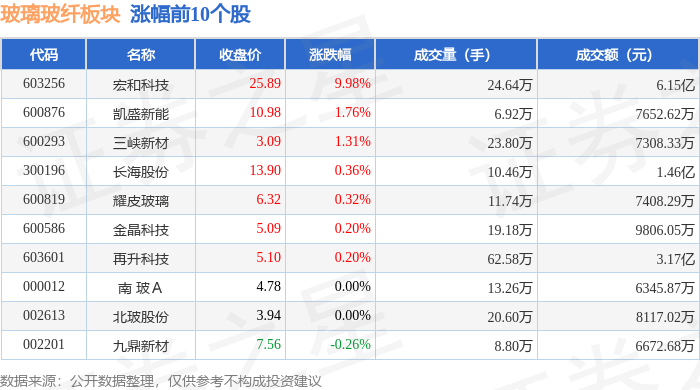
Market Overview - On August 1, the glass and fiberglass sector rose by 0.02% compared to the previous trading day, with Honghe Technology leading the gains [1] - The Shanghai Composite Index closed at 3559.95, down 0.37%, while the Shenzhen Component Index closed at 10991.32, down 0.17% [1] Stock Performance - Honghe Technology (603256) closed at 25.89, up 9.98% with a trading volume of 246,400 shares and a turnover of 615 million yuan [1] - Other notable stocks included: - Kaisheng New Energy (600876) at 10.98, up 1.76% [1] - Sanxia New Material (600293) at 3.09, up 1.31% [1] - Changhai Co., Ltd. (300196) at 13.90, up 0.36% [1] - Yao Pi Glass (600819) at 6.32, up 0.32% [1] Capital Flow - The glass and fiberglass sector experienced a net outflow of 262 million yuan from institutional investors and 117 million yuan from speculative funds, while retail investors saw a net inflow of 379 million yuan [2] - The capital flow for individual stocks showed: - Honghe Technology had a net inflow of 49.1 million yuan from institutional investors [3] - Sanxia New Material had a net inflow of 7.7 million yuan from institutional investors [3] - Kaisheng New Energy had a net inflow of 6.5 million yuan from institutional investors [3]

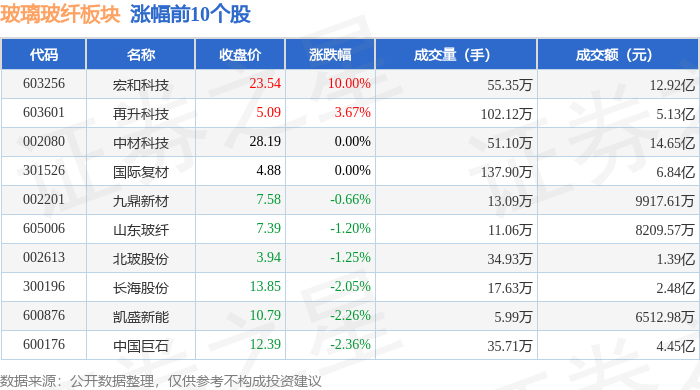
玻璃玻纤板块7月31日跌0.37%,三峡新材领跌,主力资金净流入3360.56万元
Zheng Xing Xing Ye Ri Bao· 2025-07-31 08:32
Group 1 - The glass and fiberglass sector experienced a decline of 0.37% on July 31, with Sanxia New Material leading the drop [1] - The Shanghai Composite Index closed at 3573.21, down 1.18%, while the Shenzhen Component Index closed at 11009.77, down 1.73% [1] - Key stocks in the glass and fiberglass sector showed varied performance, with Honghe Technology rising by 10.00% to a closing price of 23.54 [1] Group 2 - The main capital flow in the glass and fiberglass sector showed a net inflow of 33.61 million yuan, while retail investors contributed a net inflow of 20.8 million yuan [2] - The sector saw a net outflow of 241 million yuan from speculative funds [2] - Notable stock performances included Sanxia New Material, which closed at 3.05 with a decline of 3.48%, and Jinjing Technology, which closed at 5.08, down 3.24% [2]