
TRINA(688599)

Search documents
透视“风光储”财报:风电、储能“回春”,光伏还在“挣扎”
2 1 Shi Ji Jing Ji Bao Dao· 2025-05-05 02:08
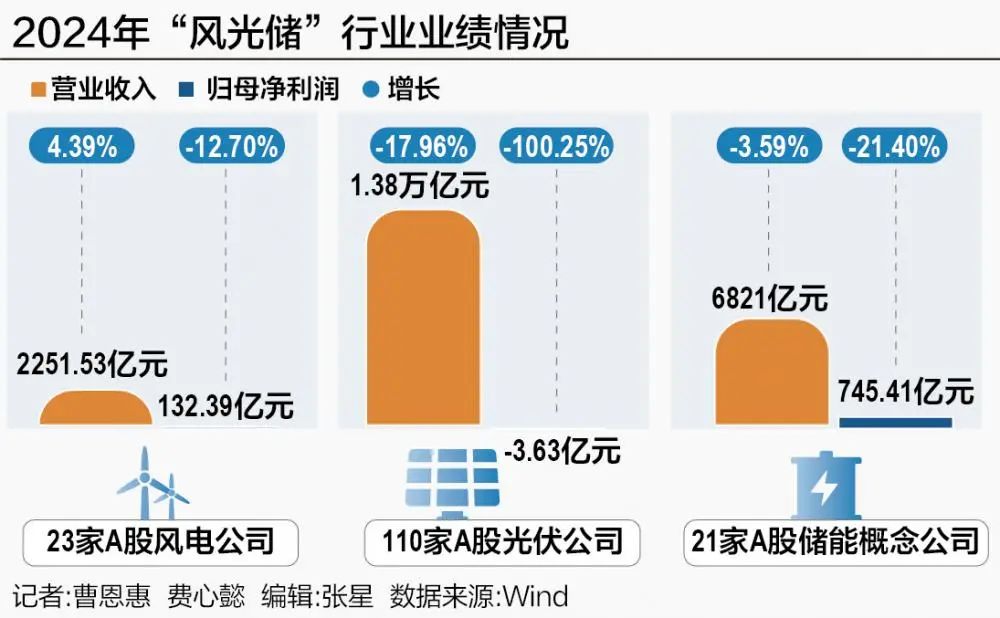
Group 1: Wind Power Industry - The wind power industry in China is experiencing a recovery in performance from Q4 2024 to Q1 2025, with some companies exceeding expectations [3] - In 2024, 23 A-share wind power companies reported a total revenue of 225.15 billion yuan and a net profit of 13.24 billion yuan, showing a revenue increase of 4.39% but a net profit decline of 12.70% year-on-year [3] - In Q1 2025, these companies achieved a total revenue of 47.58 billion yuan and a net profit of 4.22 billion yuan, indicating growth compared to Q1 2024 [3] - Goldwind Technology reported a revenue of 9.47 billion yuan in Q1 2025, a 35.72% increase year-on-year, and a net profit of 568 million yuan, up 70.84% [4] - The recovery in wind turbine prices and expansion into overseas markets have positively impacted the performance of wind power manufacturers [4][6] Group 2: Solar Power Industry - The solar power industry faced significant challenges in 2024, with 110 A-share solar companies reporting a total revenue of approximately 1.38 trillion yuan, a decrease of 17.96% year-on-year, and a net profit of approximately -363 million yuan, a decline of 100.25% [8] - In Q1 2025, these companies reported a total revenue of 279.14 billion yuan, with a net profit of approximately 4.74 billion yuan, indicating a significant drop compared to Q1 2024 [8] - Major integrated solar companies like TCL Zhonghuan, Longi Green Energy, and Tongwei reported substantial losses, with net profits of -9.82 billion yuan, -8.62 billion yuan, and -7.04 billion yuan respectively [8] - Despite the overall downturn, companies involved in solar energy storage have shown resilience, with notable performances from companies like Sungrow Power and Canadian Solar [9] Group 3: Energy Storage Industry - The energy storage industry saw a decline in overall performance in 2024, with 21 A-share companies reporting a total revenue of 682.1 billion yuan, a decrease of 3.59%, and a net profit of 74.54 billion yuan, down 21.4% year-on-year [12] - In Q1 2025, these companies reported a total revenue of 158.07 billion yuan, a year-on-year increase of 12.39%, and a net profit of 21.03 billion yuan, up 34% [13] - The profitability in the energy storage sector is increasingly concentrated among leading companies like CATL and Sungrow, which have reported significant profit increases [13] - The energy storage market is undergoing transformation, with a shift in focus from domestic to overseas markets for higher profit margins [14][15]






透视“风光储”财报:风电、储能“回春”,光伏还在“挣扎”
21世纪经济报道· 2025-05-04 08:22
Core Viewpoint - The renewable energy sectors, including wind power, solar energy, and energy storage, are experiencing cyclical fluctuations, with varying performance across different segments. While wind and energy storage companies are maintaining profitability, solar companies are facing significant challenges, particularly in 2024 and early 2025 [1]. Wind Power Industry - The domestic wind power industry showed a recovery from Q4 2024 to Q1 2025, with 23 A-share wind power companies achieving a total revenue of 225.15 billion yuan and a net profit of 13.24 billion yuan in 2024, reflecting a revenue growth of 4.39% but a net profit decline of 12.70% [5]. - In Q1 2025, these companies reported a revenue of 475.75 billion yuan and a net profit of 4.22 billion yuan, indicating growth compared to Q1 2024 [5]. - Goldwind Technology reported a revenue of 9.47 billion yuan in Q1 2025, a year-on-year increase of 35.72%, with a net profit of 568 million yuan, up 70.84% [6]. - The recovery in wind turbine prices and expansion into overseas markets have contributed to improved performance for wind turbine manufacturers, including previously loss-making companies [7]. Solar Energy Industry - The solar energy sector faced unprecedented challenges in 2024, with 110 A-share solar companies reporting a total revenue of approximately 1.38 trillion yuan, a year-on-year decrease of 17.96%, and a net profit of approximately -3.63 billion yuan, down 100.25% [9]. - In Q1 2025, these companies reported a total revenue of 279.14 billion yuan, with a net profit of approximately 47.44 billion yuan, indicating a significant decline compared to Q1 2024 [9]. - A total of 46 A-share solar companies reported negative net profits in 2024, with leading integrated companies like TCL Zhonghuan, Longi Green Energy, and Tongwei Co. facing the largest losses [10]. - Companies with energy storage businesses, such as Sungrow Power Supply, showed resilience, with notable profit growth driven by their storage segments [11]. Energy Storage Industry - The energy storage sector experienced a downturn in 2024 but showed signs of recovery in Q1 2025, with 21 A-share companies reporting a total revenue of 6.82 billion yuan, a decrease of 3.59%, and a net profit of 745.41 million yuan, down 21.4% [15]. - In Q1 2025, these companies achieved a total revenue of 1.58 billion yuan, a year-on-year increase of 12.39%, and a net profit of 210.33 million yuan, up 34% [15]. - The profitability in the energy storage sector is increasingly concentrated among leading companies, with firms like CATL and Sungrow Power Supply reporting significant profit increases [16]. - The Chinese market remains the largest for energy storage installations, driven by domestic policies and growing overseas demand [17].

上游不赚钱,2025年天合光能重点布局下游应用市场
Jing Ji Guan Cha Wang· 2025-05-01 10:09
Core Viewpoint - Trina Solar reported a significant decline in revenue and profit for 2024, with a focus on transitioning from a photovoltaic product manufacturer to a smart energy solution provider, emphasizing downstream applications in the photovoltaic market [1][6]. Financial Performance - In 2024, Trina Solar's revenue was 80.282 billion yuan, a year-on-year decrease of 29.20% - The net profit attributable to shareholders was -3.443 billion yuan, a decline of 162.25% - The net profit excluding non-recurring items was -5.232 billion yuan, down 190.91% - For Q1 2025, the net profit was -1.32 billion yuan [1]. Business Strategy - Trina Solar's strategy focuses on system solutions and digital energy services, which generated approximately 20 billion yuan in revenue, accounting for 25% of total revenue with high gross margins [1][6]. - The company plans to enhance its production capacity for silicon wafers, battery cells, and modules from 55/75/95 GW to 60/105/120 GW, maintaining flexibility between self-production and outsourcing [5]. Market Dynamics - The "136 Document" issued by the National Development and Reform Commission and the National Energy Administration aims to promote high-quality development in the renewable energy sector, impacting distributed power stations [2][6]. - Trina Solar is adapting to market changes by potentially outsourcing components when prices are low, ensuring a strategy of "moderate integration" to avoid capacity burdens during supply fluctuations [3][4]. Industry Context - The photovoltaic industry faced significant price declines in 2024, with polysilicon prices dropping over 39%, silicon wafer prices down over 50%, and module prices decreasing by over 29% [4]. - Major competitors in the industry, such as JinkoSolar and LONGi Green Energy, also reported substantial losses, indicating a challenging market environment [3]. Future Outlook - Trina Solar aims for a year-on-year growth of no less than 20% in its system solutions and digital energy services business [7]. - The company has approximately 24.4 billion yuan in inventory, with expectations of significant reductions as the market for photovoltaic installations ramps up [7].

天合光能储能倍增 探路光伏行业破局“内卷外堵”
Xin Hua Cai Jing· 2025-05-01 08:11
Core Insights - The photovoltaic industry in China is rapidly developing, with a cumulative installed capacity of 887 million kilowatts by the end of 2024, solidifying its position as the second-largest power source domestically [2] - Companies are facing challenges such as supply-demand imbalance and intense competition, leading to a general decline in profitability and increased losses across the industry [2] - Trina Solar is leading the industry in standardizing component sizes and promoting a friendly photovoltaic ecosystem, achieving over 170 GW in shipments of its 210 components in 2024 [2][3] Industry Developments - The demand for flexible adjustment resources in the power system is increasing due to the large-scale integration of new energy sources, prompting leading companies to accelerate the integration of solar and storage solutions [3] - Trina Solar's energy storage capacity saw over 100% growth in 2024, with a shipment volume of 4.3 GWh, doubling from 2023, and it aims to ship between 8 GWh and 10 GWh in the current year [3] Technological Advancements - The industry is actively pursuing next-generation photovoltaic technologies, with Trina Solar leading in perovskite solar cell patents, holding 481 patents and ranking first globally [4] - Trina Solar's self-developed 210 mm large-area perovskite-silicon tandem solar cells achieved a maximum efficiency of 31.1%, setting new world records in both efficiency and component power [4] Strategic Shifts - Trina Solar has transitioned from a photovoltaic product manufacturer to a comprehensive solution provider for photovoltaic and energy storage, focusing on new growth areas such as smart microgrids and green hydrogen production [5][6] - The company aims to enhance its market position by increasing the proportion of new business and shifting from price competition to value creation, thereby building a green and low-carbon energy supply system for end users [6]
特朗普下“死手”,祭出3521%关税狠招,王毅强硬发声,美国人听听清
Sou Hu Cai Jing· 2025-05-01 06:05
Core Viewpoint - The Trump administration's imposition of high tariffs on solar products from four Southeast Asian countries, particularly Cambodia at 3521%, is causing significant disruption in the international market and is seen as an attempt to protect the U.S. solar industry while inadvertently harming it [1][3][4]. Group 1: Tariff Impact - The tariffs are highly targeted, with Vietnam facing a 395.5% tariff, Thailand 375.2%, Malaysia 34.4%, and Cambodia facing severe penalties for non-cooperation in investigations [3]. - The U.S. solar industry has a rigid demand for affordable solar products, and the tariffs are expected to increase production costs for U.S. solar developers, contradicting the intended protective measures [3][6]. Group 2: Supply Chain Dynamics - The U.S. has seen a significant drop in solar product imports from Malaysia, Cambodia, Thailand, and Vietnam, while imports from countries like Laos and Indonesia have increased, indicating a shift in global solar trade dynamics [6]. - The tariffs are likely to disrupt the long-standing reliance of U.S. manufacturers on foreign supply chains, particularly affecting those who depend on imported components [6][9]. Group 3: Geopolitical Context - The tariffs are perceived as an attempt to sever the indirect supply chain from China through Southeast Asia, as China dominates global solar product shipments [4][9]. - Southeast Asian countries are unlikely to choose between the U.S. and China, as their economies are deeply intertwined with Chinese supply chains, particularly in electronics [6][9]. Group 4: Regional Economic Cooperation - The completion of the China-Laos railway has enhanced regional economic ties, with Laos experiencing a 127% increase in exports to China, demonstrating the benefits of reduced logistics costs and tariff pressures [7]. - The Regional Comprehensive Economic Partnership (RCEP) and the upgraded China-ASEAN Free Trade Area are facilitating zero tariffs on 95% of goods, allowing Southeast Asian countries to pivot towards China despite U.S. tariffs [9].


专访天合光能助理副总裁、集团风控兼ESG管理负责人吴肖:将企业ESG投入视为支撑业务增长的投资
2 1 Shi Ji Jing Ji Bao Dao· 2025-04-30 09:35
Core Viewpoint - The article discusses the increasing importance of ESG (Environmental, Social, and Governance) disclosures for listed companies in China, highlighting the first ESG-linked loan agreement between Trina Solar and Industrial Bank as a significant step in this direction [1][7]. Group 1: ESG Disclosure Requirements - The China Securities Regulatory Commission (CSRC) has guided the three major stock exchanges to enforce mandatory ESG reporting for 457 A-share companies, indicating a shift towards standardized and regulated ESG disclosures [3]. - The implementation of ESG guidelines is expected to increase the costs associated with sustainability disclosures in the short term, particularly for complex data like Scope 3 emissions, but will ultimately lead to better compliance and international competitiveness [3][4]. Group 2: ESG Governance Structure - Trina Solar has established a comprehensive ESG governance framework that includes various levels of management, ensuring clear responsibilities and oversight for ESG initiatives [4]. - The company faces challenges in integrating ESG goals with operational objectives, emphasizing the need to view ESG investments as essential for future business growth [4]. Group 3: Environmental Focus Areas - Trina Solar prioritizes eight key environmental issues, including compliance, clean technology opportunities, and climate change response, setting specific metrics for carbon emissions and resource usage [5]. - The company employs a dynamic monitoring mechanism to track the effectiveness of its ESG initiatives and evaluates performance at the end of the year [5]. Group 4: Supply Chain and Collaboration - The industry is increasingly recognizing the importance of ESG, with downstream customers influencing upstream suppliers to adopt ESG standards [6]. - Trina Solar incorporates ESG criteria into its supplier selection process, aiming to enhance sustainability across its supply chain [6]. Group 5: Green Finance and ESG-linked Loans - The partnership with Industrial Bank for an ESG-linked loan is seen as a model for future financial products, reflecting the value of Trina Solar's ESG performance and resulting in lower financing costs [7][8]. - The company plans to integrate ESG targets into its annual work plans, ensuring continuous improvement in ESG performance [8]. Group 6: International Market and Compliance - As global markets emphasize energy security and sustainability, Trina Solar is adapting to stringent ESG requirements from international clients, particularly in Europe [9]. - Compliance with various EU regulations, such as the Carbon Border Adjustment Mechanism and the Corporate Sustainability Reporting Directive, is crucial for Chinese solar companies aiming to enter overseas markets [10][11]. Group 7: Enhancing International Competitiveness - To enhance international competitiveness, Trina Solar aims to align its ESG practices with global standards and actively participate in the development of these standards [11]. - Achieving recognized certifications for low-carbon products will provide Trina Solar with a competitive edge in securing international projects and orders [11].

天合光能(688599) - 天合光能股份有限公司关于不向下修正“天23转债”转股价格的公告
2025-04-30 08:46
| 证券代码:688599 | 证券简称:天合光能 | 公告编号:2025-050 | | --- | --- | --- | | 转债代码:118031 | 转债简称:天 23 转债 | | 天合光能股份有限公司 关于不向下修正"天 23 转债"转股价格的公告 本公司董事会及全体董事保证本公告内容不存在任何虚假记载、误导性陈 述或者重大遗漏,并对其内容的真实性、准确性和完整性依法承担法律责任。 重要内容提示: 一、 可转换公司债券基本情况 (一)发行上市概况 经中国证券监督管理委员会出具的《关于同意天合光能股份有限公司向不 特定对象发行可转换公司债券注册的批复》(证监许可〔2023〕157 号),同意 公司向不特定对象发行 8,864.751 万张可转换公司债券,每张面值 100 元,募 集资金总额为人民币 886,475.10 万元,期限自发行之日起六年,即自 2023 年 2 月 13 日至 2029 年 2 月 12 日。经上海证券交易所自律监管决定书([2023]33 号)文同意,公司 886,475.10 万元可转换公司债券已于 2023 年 3 月 15 日起在 上海证券交易所挂牌交易,债券简称 ...
抢抓新赛道引领龙头企业“链”上发力
Si Chuan Ri Bao· 2025-04-29 22:02
Core Insights - By 2024, Shifang's industrial output value is expected to exceed 80 billion yuan, maintaining over 50% of GDP from industrial added value and over 90% from industrial tax revenue [1][2] Group 1: Industrial Development - Shifang has implemented 53 technological transformation projects in 2024, completing digital upgrades for 110 key industrial enterprises and promoting large-scale equipment updates for 67 companies [1] - Traditional advantageous industries such as food and beverage, and equipment manufacturing achieved an output value of 44.75 billion yuan, with a year-on-year growth of 5.4% [1] Group 2: New Industry Initiatives - Shifang is focusing on new materials and low-altitude economy, leveraging leading enterprises to drive development, with significant projects like XINWANGDA and Trina Solar successfully established in the past three years [1][2] - The introduction of a 38GW monocrystalline pulling rod project, along with a 40GW photovoltaic crucible project and a 20GW high-efficiency solar cell production project, has formed a crystalline silicon photovoltaic industry cluster [2] Group 3: Infrastructure and Regional Cooperation - Shifang is constructing the only A1-class general airport in the Chengdu metropolitan area to support industrial manufacturing, with local equipment manufacturing industries complementing the low-altitude economy [2] - Collaborative agreements with Chengdu Pengzhou have led to the establishment of the Sichuan Pengshi Agricultural Development Co., with plans for 10 key projects totaling over 1 billion yuan in investment [2]

天合光能(688599) - 天合光能股份有限公司第三届监事会第十三次会议决议公告
2025-04-29 16:46
| 证券代码:688599 | 证券简称:天合光能 | 公告编号:2025-040 | | --- | --- | --- | | 转债代码:118031 | 转债简称:天 23 转债 | | 天合光能股份有限公司 第三届监事会第十三次会议决议公告 本公司监事会及全体监事保证公告内容不存在任何虚假记载、误导性陈述 或者重大遗漏,并对其内容的真实性、准确性和完整性依法承担法律责任。 一、监事会会议召开情况 天合光能股份有限公司(以下简称"公司")第三届监事会第十三次会议 于 2025 年 4 月 28 日以现场结合通讯方式召开,本次会议由监事会主席张银华 先生主持,会议应参加表决监事 3 人,实际参加表决监事 3 人,本次会议的召 集、召开符合《公司法》等法律法规和《公司章程》的有关规定。 二、监事会会议审议情况 经与会监事投票表决,审议通过了如下决议: (一)审议通过《关于公司 2024 年度监事会工作报告的议案》 表决结果:3 票同意,0 票反对,0 票弃权。 本议案尚需提交股东会审议。 (二)审议《关于公司监事 2024 年度薪酬确认及 2025 年度薪酬方案的议 案》 具体内容详见公司同日披露于上海证券 ...
天合光能(688599) - 天合光能股份有限公司2024年度利润分配方案公告
2025-04-29 16:45
| 证券代码:688599 | 证券简称:天合光能 | | 公告编号:2025-042 | | --- | --- | --- | --- | | 转债代码:118031 | 转债简称:天 23 | 转债 | | 天合光能股份有限公司 2024 年度利润分配方案公告 本公司董事会及全体董事保证公告内容不存在任何虚假记载、误导性陈述 或者重大遗漏,并对其内容的真实性、准确性和完整性依法承担法律责任。 重要内容提示: 一、利润分配方案内容 经容诚会计师事务所(特殊普通合伙)审计,截至 2024 年 12 月 31 日,公 司母公司报表中期末未分配利润为人民币-1,838,384,447.00 元。2024 年度,公 司归属于母公司所有者的净利润为-3,443,219,977.05 元。根据《中华人民共和 国公司法》等法律、法规、规范性文件及《天合光能股份有限公司章程》(以下 简称"《公司章程》")的相关规定,鉴于公司母公司报表中期末未分配利润和 2024 年归属于母公司所有者的净利润为负,截至目前公司不存在可供分配的利润,并 根据行业发展情况、公司发展阶段、公司实际经营情况等各方面因素,公司决定 2024 年度不 ...