
Moore Threads Technology(688795)

Search documents
国产AI芯片告别“草莽时代”
财联社· 2025-12-30 01:35
Capital Market Trends - In 2025, the domestic AI chip industry is characterized as reaching a "coming-of-age" stage, with companies like Moer Thread and Muxi Co. successfully listed on the STAR Market, indicating a significant shift driven by policy, capital, and demand [1][2] - The current capabilities of domestic AI chips in inference computing and system-level optimization are now sufficient to meet core industry needs, marking a transition from mere hardware performance to a focus on software and ecosystem development [1][5] Competitive Landscape - The competition in the AI chip market is evolving from a single dominant player to a multi-tiered structure, with various segments developing around inference power and industry customization [4][10] - Despite the entry of NVIDIA's H200 chip, which poses a competitive threat, it is viewed as a strategic move that does not fundamentally disrupt the domestic AI chip market's core areas such as government and finance [3][4] Technological Innovations - The emergence of models like DeepSeek has shifted the focus from merely stacking parameters to enhancing the software ecosystem, indicating that hardware alone is insufficient without a robust software framework [5][6] - The industry is witnessing a split in focus: one side emphasizes high-performance training capabilities, while the other prioritizes cost-effective inference solutions, reflecting a significant change in market dynamics [6][7] Future Outlook - Looking ahead to 2026, the emphasis will be on scaling inference capabilities, with predictions indicating that the growth rate of inference power will surpass that of training power [10] - The market is transitioning from a focus on purchasing chips to acquiring comprehensive computing services, necessitating a shift towards integrated solutions that combine chips, systems, and software [10][11]


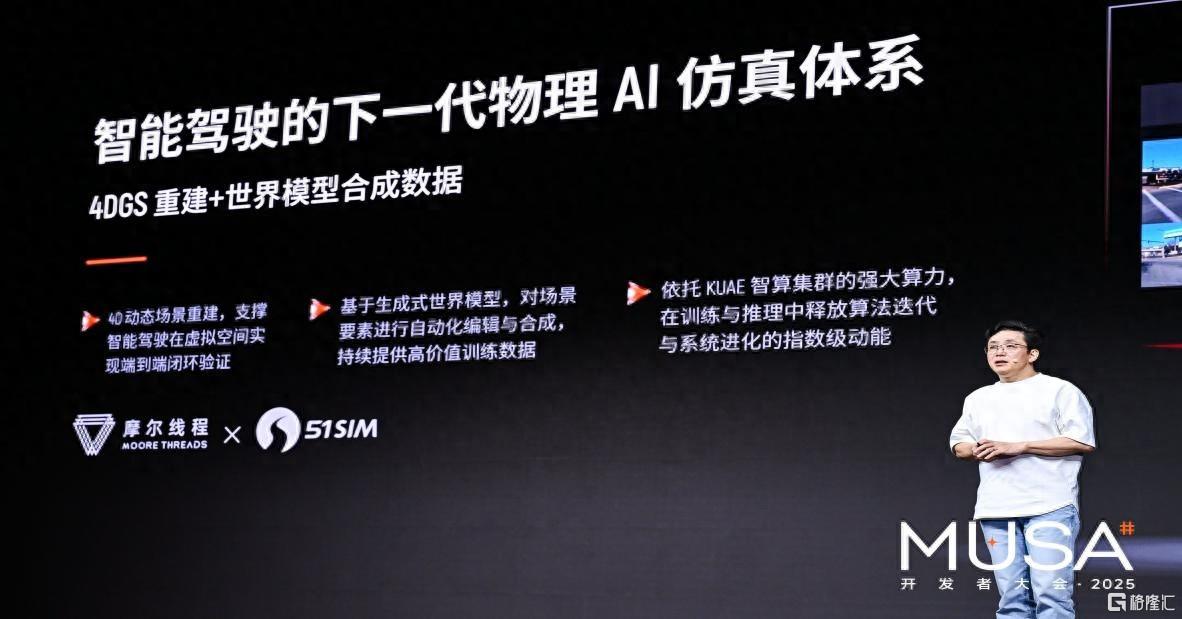
五一视界与摩尔线程深度合作,押注机器人测试训练无限可能
Ge Long Hui· 2025-12-30 01:19
Core Insights - The collaboration between Moore Threads and 51WORLD focuses on building a next-generation physical AI simulation system based on the KUAE intelligent computing cluster [1][3] - The partnership aims to leverage large-scale domestic GPU computing power and advanced simulation and world model technologies for end-to-end intelligent driving and embodied intelligence applications [3][4] Group 1: Collaboration and Technology - Moore Threads and 51WORLD are developing a physical AI simulation system that transitions from manual modeling to AI-generated simulations, addressing the limitations of traditional simulation methods [3] - The new simulation framework, based on "4DGS reconstruction + generative world models," aims to enhance the efficiency and effectiveness of AI simulations, requiring unprecedented computational resources [3] Group 2: Application and Market Impact - The physical AI simulation system has already been successfully applied in the intelligent driving sector, supporting the closed-loop validation of end-to-end driving algorithms [4] - Future plans include expanding the application of this technology to broader physical AI scenarios, aiming to create a replicable and scalable development path for physical AI [4] Group 3: Capital and Strategic Positioning - Moore Threads is a strategic shareholder in 51WORLD, providing strong support as the latter aims to become the first publicly listed company in the Physical AI sector by December 30, 2025, on the Hong Kong Stock Exchange [4] - The capital collaboration is expected to accelerate technology development and market expansion, enhancing the synergy between domestic GPU and Physical AI industry chains [4]
2025年A股新股上市首日平均涨超250%
21世纪经济报道· 2025-12-29 11:54
Core Viewpoint - The A-share IPO market in 2025 shows a "low at the beginning, high at the end" trend, with significant growth in the number of IPOs and fundraising amounts, particularly after the introduction of new policies aimed at supporting technology innovation [1][3]. Summary by Sections IPO Market Overview - As of December 29, 2025, a total of 244 IPO applications were accepted by the three major exchanges, with 80% (180 companies) submitted after the "618 new policy" announcement [1]. - The number of new listings reached 111, a 12.12% increase from the previous year, with total fundraising amounting to 125.32 billion yuan, a 96.25% increase year-on-year [1]. Fundraising and Company Listings - The total fundraising from new listings was 1253.24 billion yuan, with the Shanghai Stock Exchange leading at 432.28 billion yuan, followed by the Science and Technology Innovation Board at 353.05 billion yuan [4]. - The ChiNext and Science and Technology Innovation Board accounted for 45.05% and 47.72% of the total number of listings and fundraising, respectively, indicating a strong focus on technology innovation [3]. Notable IPOs - Major IPOs included Huadian New Energy, which raised 181.71 billion yuan, and other significant listings such as Moer Thread and Muxi Co., which raised 80 billion yuan and 41.97 billion yuan, respectively [5][6]. - The top ten fundraising IPOs included four from the Science and Technology Innovation Board and three from the Shanghai Stock Exchange [4]. Performance of New Stocks - New stocks had an impressive average first-day increase of 256.77%, with no stocks experiencing a drop below their issue price [15]. - Notable performers included Dapeng Industrial, which saw a first-day increase of 1211.11%, and Muxi Co. with a 692.95% increase [16][18]. Underwriting and Sponsorship - Major securities firms dominated the underwriting market, with CITIC Securities leading by sponsoring 13 IPOs and earning 11.39 billion yuan in underwriting fees [9][10]. - The total underwriting fees for the 111 new stocks amounted to 62.33 billion yuan, reflecting the lucrative nature of the IPO market this year [9]. Sector Analysis - The computer, communication, and other electronic equipment manufacturing sectors led in IPO numbers with 20 companies and a total fundraising of 340.03 billion yuan [7]. - The specialized equipment manufacturing sector followed with 14 companies and 86.35 billion yuan raised, indicating a robust interest in technology-related industries [7].

看2026|摩尔线程周苑:让国产算力从“可用”走向“好用”
Xin Jing Bao· 2025-12-29 09:16
Core Viewpoint - The enthusiasm in China's capital market is being fueled by the rise of "domestic GPUs," with companies like Moore Threads making significant strides in the industry and contributing to a broader transformation driven by autonomous computing [2] Group 1: Industry Trends and Developments - The central economic work conference for 2026 emphasizes "innovation-driven" growth and the cultivation of new economic drivers, particularly in the context of AI and domestic chip development [2] - The GPU industry is transitioning from "single-point breakthroughs" to "systematic challenges and ecosystem building," indicating progress in overcoming critical technological barriers [5][6] - The first MUSA Developer Conference (MDC 2025) highlighted the importance of building a developer ecosystem around the MUSA architecture, which aims to compete with NVIDIA's CUDA [5] Group 2: Company Strategy and Positioning - Moore Threads aims to enhance its core competitiveness through a strategy centered on a full-function GPU and the MUSA architecture, focusing on comprehensive computing capabilities from cloud to edge [6] - The company plans to increase R&D investment and foster collaboration between academia and industry to accelerate the development of the domestic GPU sector [6][7] - The recent release of the "Huagang" architecture, which boasts a tenfold performance improvement over previous generations, exemplifies the company's commitment to technological advancement [6] Group 3: Policy and Market Opportunities - The central government's focus on "AI+" and the promotion of core technology independence presents significant strategic opportunities for companies like Moore Threads [8][10] - The concept of "new momentum" in the intelligent computing sector includes building a self-sufficient technology base, integrating AI into various industries, and fostering a collaborative ecosystem centered around developers [10] Group 4: Regional Development and Ecosystem - The national strategy for regional integration is seen as a way to maximize resource advantages and create unprecedented collaborative opportunities for the domestic computing industry [11] - Moore Threads aims to position itself as a foundational player in Beijing's integrated circuit industry, leveraging the city's rich resources and supportive policies [12][14] - The company advocates for enhancing the resilience of the integrated circuit supply chain and promoting collaborative innovation across the Beijing-Tianjin-Hebei region [16][18]

摩尔线程周苑:扩大北京新一代信息技术产业集群优势
Xin Jing Bao· 2025-12-29 08:52
Core Viewpoint - The article discusses the upcoming five-year plan for China's economy, emphasizing the importance of innovation and the development of new driving forces, particularly in the context of the domestic GPU industry and its role in the broader economic landscape [1][3][7]. Group 1: Economic Context and Policy Direction - The Central Economic Work Conference highlighted the need for steady progress and quality improvement in economic work for 2026, focusing on stabilizing employment, enterprises, markets, and expectations [1]. - The conference outlined eight key tasks for 2026, including the acceleration of innovation-driven development and the cultivation of new economic drivers [3][7]. Group 2: GPU Industry and Company Strategy - The domestic GPU industry is experiencing a transformation, with companies like Moer Thread making significant strides, as evidenced by its recent listing on the STAR Market [3]. - Moer Thread aims to establish a comprehensive computing power platform through its MUSA architecture, focusing on full-stack development and continuous innovation [5][6]. - The company emphasizes the importance of building a developer ecosystem, which is crucial for the competitive landscape of the GPU industry [4][6]. Group 3: Technological and Ecological Development - Moer Thread's strategy includes a commitment to open-source innovation and empowering developers, which is seen as essential for creating a robust AI ecosystem [6][8]. - The company is expanding its product offerings from data centers to edge and endpoint solutions, thereby broadening its market reach and validating its technology in real-world applications [6][9]. Group 4: Regional Development and Industry Positioning - Moer Thread positions itself as a key player in Beijing's integrated circuit industry, benefiting from the city's rich resources and supportive policies [9][10]. - The company advocates for enhanced collaboration across the entire supply chain and the establishment of a resilient integrated circuit industry in Beijing [11].

看2026|摩尔线程周苑:扩大北京新一代信息技术产业集群优势
Bei Ke Cai Jing· 2025-12-29 08:40
Group 1 - The core message emphasizes the importance of innovation and the development of new driving forces in China's economy as it transitions into the "15th Five-Year Plan" period, with a focus on enhancing quality and efficiency [3][5][19] - The central economic work conference highlighted the need to stabilize employment, businesses, and market expectations while promoting effective qualitative improvements and reasonable quantitative growth [3][5] - The upcoming five-year journey starting in 2026 is seen as a critical period for economic development, with a call for collaboration among regulatory bodies, scholars, and leading entrepreneurs to interpret policy trends and changes [4][5] Group 2 - The domestic GPU industry is experiencing a surge, with companies like Moore Threads successfully entering capital markets, indicating a significant shift towards self-reliant computing capabilities [5][16] - Moore Threads aims to establish a comprehensive computing power platform through its MUSA architecture, focusing on continuous innovation and development across various applications, including AI and scientific computing [16][18] - The company is committed to fostering a developer ecosystem by hosting events and creating platforms to lower barriers for developers, which is crucial for building a robust AI ecosystem [17][24] Group 3 - The strategic focus of Moore Threads includes enhancing its core competitiveness through a full-stack GPU approach, emphasizing independent architecture and continuous R&D investment [16][20] - The company recognizes the significance of regional integration in fostering innovation, particularly in areas like Beijing, which boasts a complete integrated circuit industry chain [21][22] - Moore Threads plans to leverage its position in Beijing to contribute to the development of the new generation of information technology and the AI ecosystem, aligning with national policies [23][26] Group 4 - Recommendations for optimizing the integrated circuit industry ecosystem in Beijing include strengthening the entire supply chain, enhancing application-driven technology iterations, and fostering an open innovation environment for talent development [28][29][30] - The company believes that collaborative efforts across design, manufacturing, and application sectors will enhance the resilience and self-sufficiency of the integrated circuit industry [28] - By promoting real-world applications and feedback, Moore Threads aims to accelerate the maturity of domestic chips and AI models, driving innovation and industry growth [29]

摩尔线程12月26日获融资买入2.47亿元,融资余额16.38亿元
Xin Lang Cai Jing· 2025-12-29 01:38
Group 1 - The core viewpoint of the news is that Moer Technology's stock experienced a decline of 1.84% on December 26, with a trading volume of 2.371 billion yuan and a net financing buy of -125 million yuan [1] - As of December 26, the total margin trading balance for Moer Technology is 1.638 billion yuan, which accounts for 9.03% of its circulating market value [1] - Moer Technology's main business involves the research, design, and sales of GPUs and related products, with revenue composition being 70.75% from clusters, 17.74% from graphics cards, 9.05% from all-in-one machines, 2.41% from others, and 0.05% from chips [1] Group 2 - As of December 5, the number of shareholders for Moer Technology reached 39,200, an increase of 45515.12% compared to the previous period [2] - For the period from January to September 2025, Moer Technology reported a revenue of 785 million yuan, representing a year-on-year growth of 181.99%, while the net profit attributable to the parent company was -724 million yuan, showing a year-on-year increase of 18.71% [2]
每周股票复盘:摩尔线程(688795)完成上市工商变更
Sou Hu Cai Jing· 2025-12-27 17:20
Group 1 - The core point of the news is that Moer Technology has undergone significant changes, including an increase in registered capital and a transition to a publicly listed company [1][3] - As of December 26, 2025, Moer Technology's stock closed at 617.3 yuan, down 7.05% from the previous week, with a total market capitalization of 290.148 billion yuan, ranking 5th in the semiconductor sector and 43rd in the A-share market [1] - The company held its 15th board meeting on December 26, 2025, where it approved the change of registered capital from 400,028,217 yuan to 470,028,217 yuan and the change of company type from "non-listed limited company" to "listed limited company" [1][3] Group 2 - Moer Technology's articles of association were published in December 2025, establishing the company as a permanent limited liability company with a registered capital of 470,028,217 yuan [2] - The company was approved for registration by the China Securities Regulatory Commission on October 29, 2025, and completed its initial public offering of 70,000,000 shares, listing on the Sci-Tech Innovation Board on December 5, 2025 [2][3] - The revised articles of association outline shareholder rights and obligations, the powers of the shareholders' meeting, responsibilities of the board and independent directors, requirements for senior management, financial accounting systems, and profit distribution policies [2]
地方融资平台转型新模式:城投+产投+上市公司
Zhong Guo Jing Ying Bao· 2025-12-26 18:44
Group 1 - The core viewpoint of the articles emphasizes the "City Investment + Industrial Investment + Listed Companies" model as a new approach for local financing platforms in China, aimed at fostering new productive forces and developing emerging industries over the next five years [1][4] - By 2025, the model is expected to facilitate mergers and acquisitions of listed companies, which will help local investment platforms strengthen their financial base and support local economic transformation [1][4] - Local governments view the acquisition of listed companies as a means to introduce new industries and enhance local industrial chains, thereby attracting more enterprises and boosting GDP, tax revenue, and employment [1][2] Group 2 - The establishment of companies like Moer Thread and Muxi Co., which are referred to as "domestic Nvidia" and "domestic AMD," respectively, marks a significant breakthrough for domestic GPU enterprises in the capital market [1] - Local state-owned assets are increasingly focusing on emerging and future industries, with government support fostering the "City Investment + Industrial Investment + Listed Companies" model [2] - The investment strategies of local financing platforms include direct investments, strategic shareholding, and collaboration across regions to attract listed companies and form industrial clusters [3][4] Group 3 - The "City Investment + Industrial Investment + Listed Companies" model is seen as a practical example for local state-owned enterprises to address debt pressures and traditional business bottlenecks through mergers and acquisitions [3][4] - The approach involves selecting high-potential targets in sectors like new materials and semiconductor integrated circuits, emphasizing the importance of business integration and governance to enhance company value post-acquisition [4] - The model aims to mitigate financial risks while ensuring stable operations for city investment platforms and driving local economic development [4][5] Group 4 - Recent statistics indicate that from July 2023 to July 2025, local state-owned assets participated in the control acquisition of 28 listed companies, with a notable focus on the semiconductor industry [5] - Analysts suggest that local financing platforms should avoid blindly chasing trends and instead align investments with local resources and industry strengths to prevent significant losses [5][6] - The life sciences sector is projected to grow significantly, with estimates suggesting the Chinese life and health industry could reach between 29 trillion to 38 trillion yuan by 2030, highlighting the potential for innovation and investment in this area [6] Group 5 - The modern consulting perspective indicates a shift in fiscal models from land development to a mixed approach combining land revitalization and industrial development, emphasizing the need for city investment platforms to focus on industry-driven strategies [7] - The integration of various resources across government, industry, academia, and finance is crucial for overcoming challenges in the biopharmaceutical sector and achieving strategic transformation from generic to innovative drugs [6][7]
摩尔线程(688795) - 摩尔线程公司章程
2025-12-26 10:32
摩尔线程智能科技(北京)股份有限公司 第二条 公司系依照《公司法》等法律法规成立的股份有限公司。 公司由摩尔线程智能科技(北京)有限责任公司整体变更设立的方式设立,公 司在北京市海淀区市场监督管理局注册登记,取得营业执照(统一社会信用代码: 91110108MA01RWUG4Y)。 第三条 公司于 2025 年 10 月 29 日经中国证券监督管理委员会 (以下简称" 中 国证监会")同意注册,首次向社会公众发行人民币普通股 70,000,000 股,于 2025 年 12 月 5 日在上海证券交易所科创板上市。 第四条 公司中文名称:摩尔线程智能科技(北京)股份有限公司:英文名称 Moore Threads Technology Co., Ltd.。 程 2025 年 12 月 目 录 | 第一章 总则 1 | | --- | | 第二章 经营宗旨和范围 2 | | 第三章 股份 . | | 第一节 股份发行 . | | 第二节 股份增减和回购 | | 第三节 股份转让 . | | 第四章 股东及股东会 7 | | 第一节 股东 . | | 第二节 控股股东和实际控制人 . | | 第三节 股东会的一般规定 ...