ZTE(000063)

Search documents
美国突然下手,数百万中国产品被下架
Xin Lang Cai Jing· 2025-10-18 10:24
Core Viewpoint - The recent "Operation Clean Carts" initiated by the FCC targets Chinese-manufactured electronic products on cross-border e-commerce platforms, significantly impacting companies like Huawei, ZTE, Hikvision, and Dahua [2][4][5]. Regulatory Actions - The FCC has begun removing millions of Chinese electronic products from major platforms like Amazon and eBay, with over 5 million items worth more than $1 billion affected, particularly in the security and smart home sectors [4][11]. - The FCC's actions are part of a broader strategy to enhance scrutiny over Chinese technology, extending from brand-level regulations to supply chain transparency, affecting the entire electronic manufacturing ecosystem [6][10]. Supply Chain Implications - The new regulations indicate that any components associated with blacklisted companies could trigger product removals, shifting the focus from just the sellers to the entire supply chain [5][11]. - The FCC's decision to revoke certifications from 15 Chinese testing labs has led to increased costs and longer certification periods for exporters, with costs rising by 30% to 50% and delays of 2 to 3 months [10][11]. Market Impact - The crackdown has immediate repercussions on the North American cross-border e-commerce market, with significant financial implications for both Chinese and local brands that rely on Chinese components [11][12]. - The U.S. market for surveillance equipment is substantial, with approximately 30 million units shipped annually, of which around 20 million are sourced from mainland China, representing nearly 70% market share [12]. Corporate Responses - In response to regulatory pressures, Chinese companies are adjusting their overseas strategies by enhancing local data management and diversifying into emerging markets like Southeast Asia and South America [16][18]. - Companies are also optimizing supply chain management by establishing traceability systems and improving product certification processes to mitigate risks associated with compliance [16][18]. Future Outlook - The FCC's actions represent a comprehensive test of the Chinese manufacturing export model, with the ability of companies to maintain supply chain stability and adapt to regulatory changes being crucial for their long-term competitiveness in the global security and smart home markets [18].




2025年1-4月中国光电子器件产量为5967亿只(片、套) 累计增长2.3%
Chan Ye Xin Xi Wang· 2025-10-18 02:33
Core Viewpoint - The report highlights a slight decline in the production of optoelectronic devices in China for April 2025, with a year-on-year decrease of 0.6%, while the cumulative production from January to April 2025 shows a growth of 2.3% compared to the previous year [1]. Industry Overview - The production of optoelectronic devices in China is projected to reach 162.3 billion units (pieces, sets) by April 2025 [1]. - Cumulative production from January to April 2025 is reported at 596.7 billion units (pieces, sets) [1]. Companies Mentioned - Listed companies in the optoelectronic sector include ZTE Corporation (000063), FiberHome Technologies Group (600498), Hengtong Optic-Electric Co., Ltd. (600487), Yangtze Optical Fibre and Cable Joint Stock Limited Company (601869), Unisplendour Corporation Limited (000938), TeFang Information (000070), OptoTech (002281), NewEase (300502), Zhongji Xuchuang (300308), and Huagong Tech (000988) [1]. Research Report - The report titled "2025-2031 China Optoelectronic Device Industry Market Survey Research and Future Trend Forecast" is published by Zhiyan Consulting, a leading industry consulting firm in China [1]. - Zhiyan Consulting has been engaged in industry research for over a decade, providing comprehensive industry research reports, business plans, feasibility studies, and customized services [1].




资金情绪持续谨慎市场出现风格切换迹象
Zhong Guo Zheng Quan Bao· 2025-10-17 20:19
Market Overview - On October 17, the A-share market experienced a broad decline, with major indices such as the Shanghai Composite Index, Shenzhen Component Index, and ChiNext Index falling by 1.95%, 3.04%, and 3.36% respectively [2][4] - The total market turnover was 1.95 trillion yuan, marking a slight increase of 57 billion yuan from the previous trading day, but it has been below 2 trillion yuan for two consecutive days [2][4] - A total of 602 stocks rose, while 4,783 stocks fell, indicating a significant market downturn [2] Sector Performance - The sectors leading the decline included power equipment, electronics, and machinery, with respective drops of 4.99%, 4.17%, and 3.69% [3][5] - Defensive sectors such as banking, coal, and public utilities showed relative strength, with the banking sector seeing stocks like Xiamen Bank and Qingdao Bank rising over 2% [3][5] - The technology growth sector faced significant selling pressure, with notable declines in electronic, media, and automotive industries, which fell by 7.14%, 6.27%, and 5.99% respectively [5] Capital Flow - The market has shown signs of style rotation, with dividend-paying sectors gaining strength while technology growth stocks have been under pressure [5][8] - Main capital outflows were observed, with over 790 billion yuan leaving the market on October 17 alone, and a total of 5 consecutive days of net outflows [5][7] - The A-share market's total market capitalization decreased by 2.56 trillion yuan to 113.02 trillion yuan as of October 17 [7] Market Sentiment and Future Outlook - Analysts attribute the market's adjustment to a combination of external shocks, internal concerns, and technical factors, with global market conditions, particularly in the U.S., impacting investor sentiment [4][8] - Despite short-term volatility, the core drivers of the market remain unchanged, with expectations of continued favorable liquidity trends [8] - The upcoming disclosure of Q3 earnings reports is anticipated to create opportunities for valuation adjustments and structural rebalancing in the market [8]



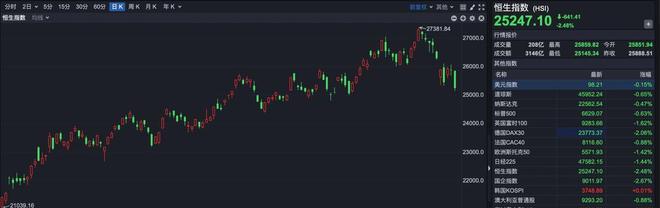
【港股收盘快报】港股恒指跌2.48% 科指跌4.05% 科网股全线下挫 芯片股大跌 中兴通讯跌...
Xin Lang Cai Jing· 2025-10-17 12:32
Core Viewpoint - The Hong Kong stock market experienced a significant decline on October 17, with all three major indices falling sharply, indicating a bearish sentiment in the market [1] Group 1: Index Performance - The Hang Seng Index dropped by 2.48%, closing at 25,247.10 points [1] - The Hang Seng Tech Index fell by 4.05% [1] - The China Enterprises Index decreased by 2.67% [1] Group 2: Sector Performance - Technology stocks saw widespread declines, with Baidu, Alibaba, Meituan, and Kuaishou each falling over 4% [1] - Notable declines in other tech stocks included Netease, Xiaomi, Lenovo, Bilibili, and JD.com, which all dropped more than 3%, while Tencent fell over 1% [1] - Chip stocks experienced significant losses, with ZTE Corporation declining by more than 12% [1] - Apple-related stocks also faced pressure, with Hon Teng falling over 10% [1] - Power equipment stocks weakened, highlighted by Harbin Electric's drop of over 9% [1]
【17日资金路线图】电子板块净流出约307亿元居首 龙虎榜机构抢筹多股
Zheng Quan Shi Bao· 2025-10-17 12:25
Market Overview - The A-share market experienced an overall decline on October 17, with the Shanghai Composite Index closing at 3839.76 points, down 1.95%, the Shenzhen Component Index at 12688.94 points, down 3.04%, and the ChiNext Index at 2935.37 points, down 3.36% [1] - The total trading volume in the A-share market was 19546.8 billion yuan, an increase of 57.97 billion yuan compared to the previous trading day [1] Capital Flow - The main capital outflow from the A-share market was 794.56 billion yuan, with a net outflow of 215.38 billion yuan at the opening and 167.89 billion yuan at the close [1][2] - The CSI 300 index saw a net capital outflow of 266.27 billion yuan, while the ChiNext and STAR Market experienced net outflows of 281.06 billion yuan and 31.15 billion yuan, respectively [3][4] Sector Performance - The electronics sector led the outflow with a net capital outflow of 307.08 billion yuan, followed by the power equipment sector with 290.13 billion yuan, the automotive sector with 176.03 billion yuan, and the computer sector with 167.08 billion yuan [5][6] - The overall performance of various sectors showed significant declines, with the electronics sector down 3.73%, power equipment down 4.50%, and automotive down 3.09% [6] Institutional Activity - Institutional investors showed interest in several stocks, with Tianji Co. seeing a net buy of 209.34 million yuan, while stocks like Yingwei Ke experienced significant net selling [9][10] - The latest institutional ratings indicated a bullish outlook for stocks such as Zhongxing Communications and Gujing Gongjiu, with target price increases of 45.79% and 92.55%, respectively [11]
主力资金 | 尾盘资金追捧8股
Zheng Quan Shi Bao· 2025-10-17 11:09
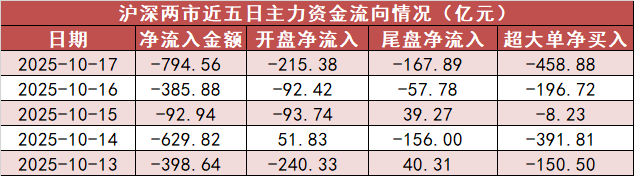
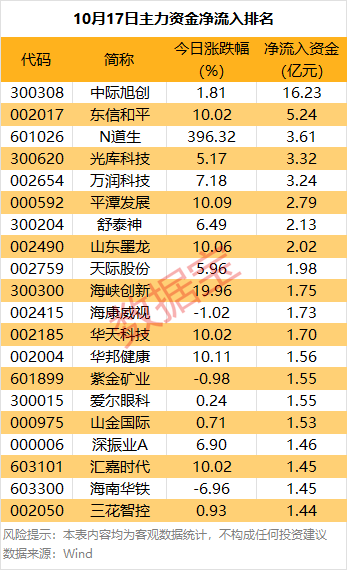
Market Overview - On October 17, the main funds in the Shanghai and Shenzhen markets experienced a net outflow of 794.56 billion yuan, with the ChiNext index seeing a net outflow of 281.06 billion yuan and the CSI 300 index a net outflow of 266.27 billion yuan [1][4]. Industry Performance - All 31 first-level industries in the Shenwan classification saw declines, with the power equipment industry leading the drop at 4.99%. The power, machinery equipment, and automotive industries all fell by over 3.5% [1]. - The only industry to receive net inflows was the retail trade sector, which saw a net inflow of 159.74 million yuan [1]. Fund Flow Analysis - The electronics industry faced the largest net outflow, amounting to 179.55 billion yuan, followed by the power equipment and computer industries, each with net outflows exceeding 76 billion yuan [1]. - A total of 43 stocks experienced net outflows exceeding 3 billion yuan, with 10 stocks seeing outflows over 10 billion yuan [5]. Notable Stocks - Zhongji Xuchuang, a leader in optical modules, had a net inflow of 16.23 billion yuan, closing up 1.81%. The company holds over 30% market share in the 800G optical module sector and has secured nearly 60% of relevant orders from major cloud players like Microsoft and Amazon for 2025, with order schedules extending into Q1 2026 [1]. - Dongxin Peace saw a net inflow of 5.24 billion yuan, closing at the daily limit. The company is well-positioned in the eSIM market following recent approvals for eSIM mobile service trials by major telecom operators [2][3]. Outflow Leaders - BYD led the net outflows with 18.55 billion yuan, followed by ZTE with 18.15 billion yuan, and Sungrow Power Supply with 16.79 billion yuan [4][5].


加仓抄底?
第一财经· 2025-10-17 11:01
Core Viewpoint - The A-share market is currently dominated by risk-averse logic, with defensive sectors like precious metals and gas leading the gains, while growth sectors such as technology and new energy are experiencing significant corrections [4][5]. Market Performance - The ChiNext index has seen a larger decline compared to the Shanghai Composite and Shenzhen Component indices due to deep adjustments in technology and new energy sectors [4]. - The total trading volume in the two markets reached 1.94 trillion yuan, reflecting a mild increase of 0.36%, but overall market sentiment remains cautious and risk-averse [5]. Fund Flow - There is a net outflow of institutional funds, while retail investors are showing net inflows [6]. - Institutions are reallocating funds towards defensive sectors such as precious metals, gas, and textiles, while heavily selling off semiconductor, photovoltaic, and new energy vehicle stocks [7]. Investor Sentiment - Retail investor sentiment is at 75.85%, indicating a significant level of engagement in the market [8]. - A survey shows that 30.85% of investors are increasing their positions, while 15.55% are reducing their holdings, with 53.60% choosing to hold their positions [11].

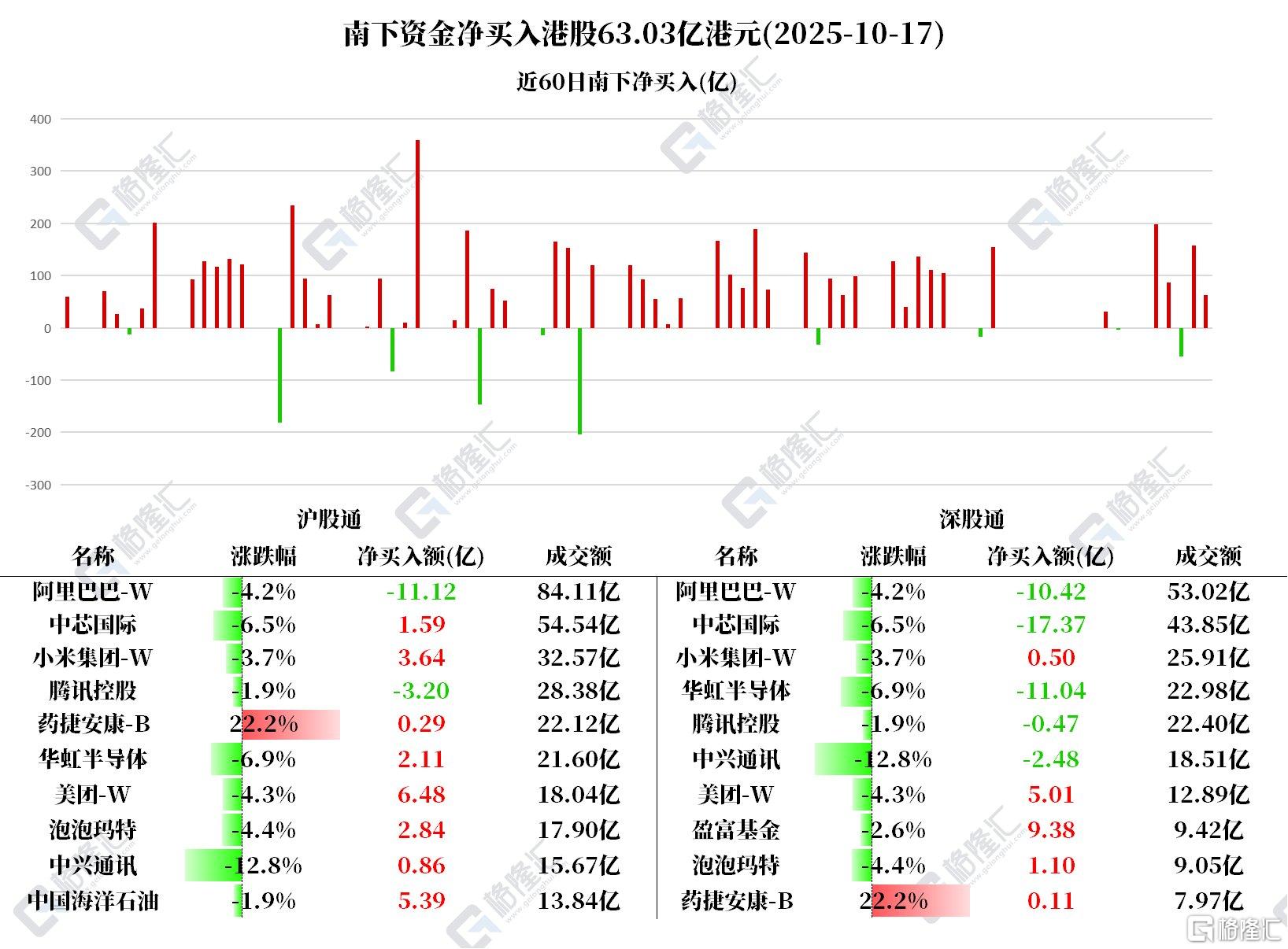
资金动向 | 北水抛售阿里超21亿港元,连续10日加仓小米!
Ge Long Hui· 2025-10-17 10:44
Core Insights - Southbound funds net bought Hong Kong stocks worth 6.303 billion HKD on October 17, with significant purchases in Meituan, the Tracker Fund, and CNOOC, while Alibaba and SMIC saw substantial net sell-offs [1][4]. Group 1: Stock Performance - Meituan saw a net buy of 1.149 billion HKD, with a price increase of 4.3% [1][4]. - Xiaomi Group had a net buy of 414 million HKD, with a price decrease of 3.7% [1][4]. - Alibaba experienced a net sell of 2.153 billion HKD, with a price drop of 4.2% [1][4]. - SMIC faced a net sell of 1.578 billion HKD, with a price decline of 6.5% [1][4]. - Continuous net buying of Xiaomi for 10 days totals 7.40256 billion HKD, and 4 days for Pop Mart totals 1.46812 billion HKD [4]. Group 2: Company Developments - Meituan announced a "Service Retail Assistance Fund" plan, allocating 1.2 billion HKD to support over 120,000 quality service retailers [6]. - Xiaomi's founder highlighted AI models as a future trend in smart connected vehicles, emphasizing the integration of various sensors for enhanced user interaction [6]. - UBS maintains a "Buy" rating for Pop Mart, predicting that upcoming sales data and new product launches will act as short-term catalysts [7]. - Alibaba's revenue forecast for FY26Q2 is 126.9 billion CNY, with a year-on-year growth of 11.6% [7]. - Semiconductor companies like SMIC and Huahong Semiconductor are facing market concerns about AI investment bubbles, but overall sentiment remains optimistic [8]. Group 3: Regulatory and Market Environment - The FCC has removed millions of Chinese electronic products from major e-commerce platforms, affecting companies like ZTE [9]. - The market is closely monitoring the FCC's potential expansion of bans on devices containing components from blacklisted companies [9].




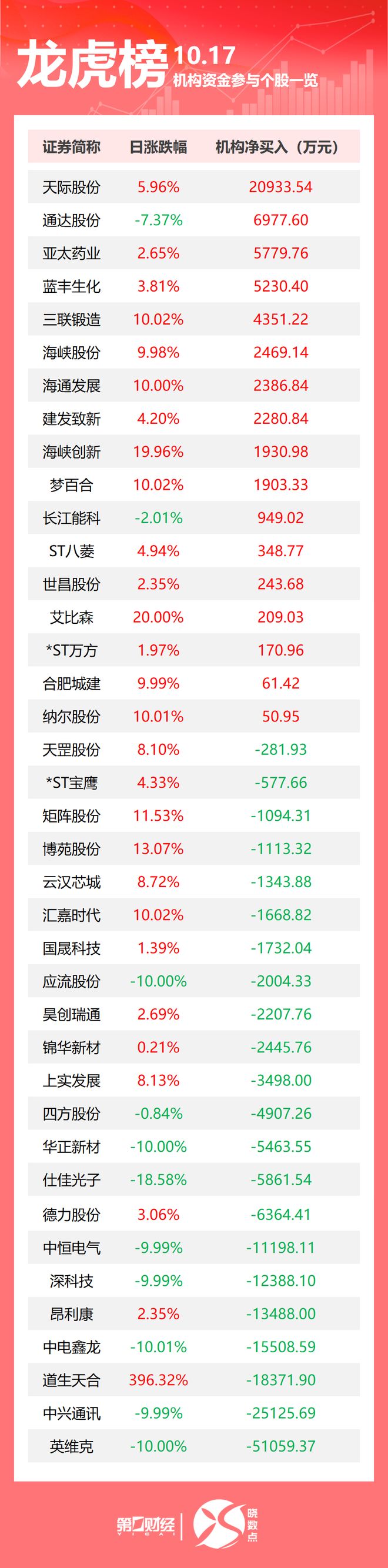
龙虎榜丨机构今日买入这17股,抛售中兴通讯2.51亿元


Di Yi Cai Jing Zi Xun· 2025-10-17 10:37
Core Insights - On October 17, a total of 39 stocks were involved in institutional trading, with 17 stocks showing net buying and 22 stocks showing net selling [1] Institutional Net Buying - The top three stocks with the highest net buying by institutions were: - Tianji Co., Ltd. with a net buying amount of 209 million yuan - Tongda Co., Ltd. with a net buying amount of 69.78 million yuan - Asia-Pacific Pharmaceutical with a net buying amount of 57.79 million yuan [1][2] Institutional Net Selling - The top three stocks with the highest net selling by institutions were: - Invech with a net outflow of 511 million yuan - ZTE Corporation with a net outflow of 251 million yuan - Daosheng Tianhe with a net outflow of 184 million yuan [1][4]
港股速报|港股全线下挫 中兴通讯H股跌超12%
Mei Ri Jing Ji Xin Wen· 2025-10-17 10:19
Market Overview - The Hong Kong stock market experienced a significant decline, with the Hang Seng Index closing at 25,247.10 points, down 641.41 points, representing a drop of 2.46%, marking the lowest closing since September 5 [1] - The Hang Seng Technology Index closed at 5,760.38 points, down 243.18 points, a decrease of 4.05%, with a cumulative decline of over 14% since the peak on October 2 [3] Company Performance - ZTE Corporation's H-shares (00763.HK) fell over 12%, with an intraday maximum drop of 14%, while its A-shares (000063.SZ) closed at the daily limit down [5] - Other tech stocks also faced declines, with Baidu, Alibaba, Meituan, and Kuaishou dropping over 4%, and Xiaomi and Bilibili down over 3% [9] Sector Performance - All sectors in the Wind Hong Kong secondary industry index declined, with semiconductors, hardware equipment, and defense industries experiencing the largest drops [7] - Notable declines in new consumption concept stocks included Weilian Meishi (09985.HK) and Blukoo (00325.HK), both down over 6%, while Nayuki Tea (02150.HK) and Pop Mart (09992.HK) fell over 4% [8] Capital Flow - As of market close, southbound funds recorded a net inflow of over 6.3 billion HKD into Hong Kong stocks [10] Market Outlook - Short-term outlook for the Asia-Pacific market appears bleak due to increased uncertainty in news, leading to heightened risk aversion. The market may continue to experience volatility in the absence of positive catalysts [12] - In the medium to long term, the initiation of a rate-cutting cycle by the Federal Reserve may lead to a "double easing" effect in China and the U.S., potentially driving sustained inflows into Hong Kong stocks and fostering a slow bull market trend [12]