SHUNXIN AGRICULTURE(000860)

Search documents
顺鑫农业(000860) - 2025 Q4 - 年度业绩预告
2026-01-29 10:05
证券代码:000860 证券简称:顺鑫农业 公告编号:2026-001 | 项 | 目 | 本报告期 | | | 上年同期 | | | --- | --- | --- | --- | --- | --- | --- | | 归属于上市公司 股东的净利润 | | 亏损:11,600 | 万元- | 18,800 万元 | 盈利:23,117.11 | 万元 | | | | 比上年同期下降:150.18%-181.33% | | | | | | 扣除非经常性损 益后的净利润 | | 亏损:11,600 | 万元– | 18,800万元 | 盈利:24,567.77 | 万元 | | | | 比上年同期下降:147.22%-176.52% | | | | | | 基本每股收益 | | 亏损:0.1564 元/股–0.2534 元/股 | | | 盈利:0.3116 | 元/股 | 二、与会计师事务所沟通情况 三、业绩变动原因说明 报告期内,白酒行业持续深度调整,市场竞争激烈。公司白酒业务面临较大 压力,销量同比减少,影响公司整体业绩水平。在此背景下,公司围绕"产品焕 新"开展系列工作,推出"金标牛轻口味白酒"等新品 ...

“老登股”大反攻!白酒板块全线飘红,泸州老窖等18股封板
2 1 Shi Ji Jing Ji Bao Dao· 2026-01-29 08:49
(文章来源:21世纪经济报道) 消息面上,飞天茅台价格节前连续上涨,整箱批价突破1600元。第三方报价平台显示,1月29日,2026 年原箱茅台价格单瓶价格上涨20元为1610元/瓶,回升到1600元以上,散瓶的价格保持在1570元/瓶,前 几日茅台的批价还稳定在1550元/瓶左右。记者在"i茅台"平台看到,1499元的普茅连续第29天在多次秒 空后显示售罄。 1月29日,A股三大指数涨跌不一,沪指窄幅震荡,上证50指数涨超1%,创业板指冲高回落,科创50指 数跌超3%。从板块来看,白酒板块午后爆发,成分股全线飘红,金种子酒、皇台酒业、迎驾贡酒、金 徽酒、水井坊、酒鬼酒、舍得酒业、泸州老窖等18股涨停,顺鑫农业、贵州茅台、古井贡B等涨超5%。 ...




白酒股拉升,全线飘红
Di Yi Cai Jing· 2026-01-29 05:49
| 名称 | | 现价 涨跌幅 | 涨跌 | | --- | --- | --- | --- | | 营导演业 | 14.48 | 10.03% | 1.32 | | 泸州老窖 | 120.97 | 7.11% | 8.03 | | 酒鬼酒 | 55.33 | 7.06% | 3.65 | | 古井贡酒 | 133.00 | 5.57% | 7.02 | | 実得漫』 | 57.12 | 5.62% | 3.04 | | 水井坊 | 40.28 | 5.53% | 2.11 | | 贵州茅台 | 1386.98 | 4.78% | 63.29 | | 金徽酒 | 20.45 | 4.44% | 0.87 | | 山西汾酒 | 168.07 | 4.20% | 6.78 | | 天佑德酒 | 9.21 | 3.25% | 0.29 | | 顺鑫农业 | 14.89 | 2.97% | 0.43 | | 今世缘 | 33.18 | 2.98% | 0.96 | | 五粮液 | 103.59 | 2.87% | 2.89 | 消息面上,飞天茅台价格节前连续上涨,整箱批价突破1600元。第三方报价平台显示,1月29日 ...


白酒股拉升,全线飘红
第一财经· 2026-01-29 05:43
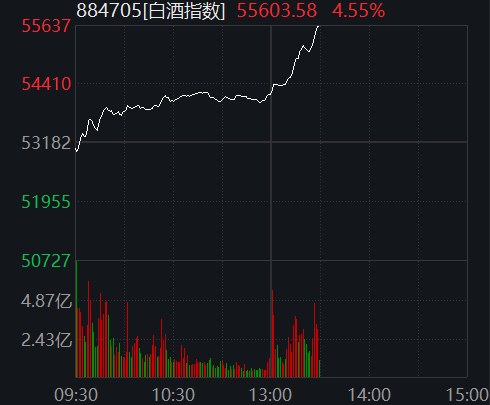
1月29日,白酒股午后持续拉升,截至发稿,白酒指数涨超4%,个股全线飘红。 消息面上, 飞天茅台价格节前连续上涨,整箱批价突破1600元。 第三方报价平台显示,1月29日, 2026年原箱茅台价格单瓶价格上涨20元为1610元/瓶,回升到1600元以上,散瓶的价格保持在1570 元/瓶,前几日茅台的批价还稳定在1550元/瓶左右。记者在"i茅台"平台看到,1499元的普茅连续第 29天在多次秒空后显示售罄。 编辑丨瑜见 | 名称 | | 现价 涨跌幅 ▼ | 涨跌 | | --- | --- | --- | --- | | 量台酒业 | 14.48 | 10.03% | 1.32 | | 泸州老窖 | 120.97 | 7.11% | 8.03 | | 酒鬼酒 | 55.33 | 7.06% | 3.65 | | 古井贡酒 | 133.00 | 5.57% | 7.02 | | 舍得酒』 | 57.12 | 5.62% | 3.04 | | 水井坊 | 40.28 | 5.53% | 2.11 | | 贵州茅台 | 1386.98 | 4.78% | 63.29 | | 金徽酒 | 20.45 | 4.44% ...

白酒板块1月28日跌0.79%,*ST岩石领跌,主力资金净流出12.38亿元
Zheng Xing Xing Ye Ri Bao· 2026-01-28 08:58
证券之星消息,1月28日白酒板块较上一交易日下跌0.79%,*ST岩石领跌。当日上证指数报收于 4151.24,上涨0.27%。深证成指报收于14342.9,上涨0.09%。白酒板块个股涨跌见下表: 从资金流向上来看,当日白酒板块主力资金净流出12.38亿元,游资资金净流入13.56亿元,散户资金净流 出1.18亿元。白酒板块个股资金流向见下表: | 代码 | 名称 | 主力净流入 (元) | 主力净占比 游资净流入 (元) | | 游资净占比 散户净流入(元) | | 散户净占比 | | --- | --- | --- | --- | --- | --- | --- | --- | | 000568 泸州老窖 | | 1.07 Z | 6.89% | -6686.18万 | -4.29% | -4056.45万 | -2.60% | | 600809 山西汾酒 | | 7464.03万 | 5.95% | 1.05亿 | 8.38% | -1.80亿 | -14.33% | | 000995 | 皇台酒业 | 2633.56万 | 12.95% | -253.88万 | -1.25% | -2379.67万 ...



白酒股拉升,古井贡酒、舍得酒业涨超2%
Ge Long Hui A P P· 2026-01-28 06:04
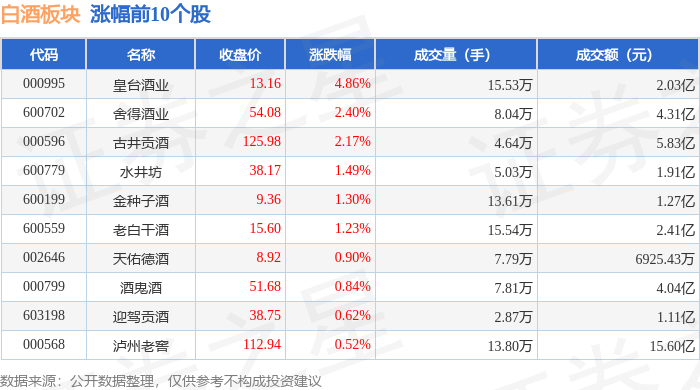
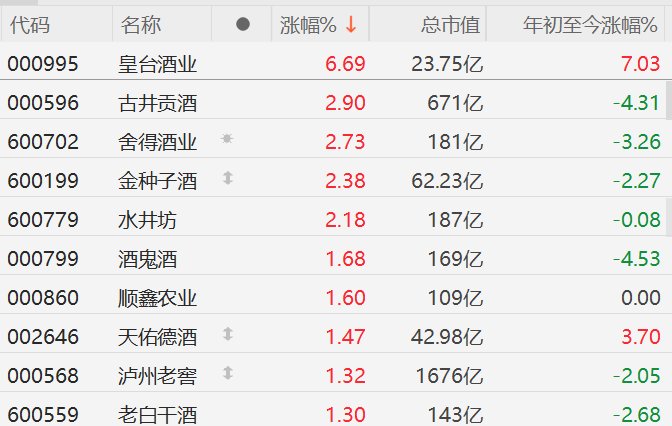
Core Viewpoint - The A-share market has seen a rise in liquor stocks, with notable increases in several companies, indicating positive market sentiment in the sector [1]. Group 1: Stock Performance - Huangtai Liquor Industry (000995) increased by 6.69%, with a total market capitalization of 2.375 billion [2] - Gujing Gongjiu (000596) rose by 2.90%, with a market cap of 67.1 billion, but has a year-to-date decline of 4.31% [2] - Shede Liquor (600702) saw a 2.73% increase, with a market cap of 18.1 billion and a year-to-date decline of 3.26% [2] - Jinzongzi Liquor (600199) increased by 2.38%, with a market cap of 6.223 billion and a year-to-date decline of 2.27% [2] - Shuijingfang (600779) rose by 2.18%, with a market cap of 18.7 billion and a year-to-date change of -0.08% [2] - Jiugui Liquor (000799) increased by 1.68%, with a market cap of 16.9 billion and a year-to-date decline of 4.53% [2] - Shunxin Agriculture (000860) rose by 1.60%, with a market cap of 10.9 billion and no change year-to-date [2] - Tianyoude Liquor (002646) increased by 1.47%, with a market cap of 4.298 billion and a year-to-date increase of 3.70% [2] - Luzhou Laojiao (000568) saw a 1.32% increase, with a market cap of 167.6 billion and a year-to-date decline of 2.05% [2] - Laobaigan Liquor (600559) increased by 1.30%, with a market cap of 1.43 billion and a year-to-date decline of 2.68% [2] Group 2: Market Signals - The MACD golden cross signal has formed, indicating a positive trend for these stocks [1].


酒价内参1月28日价格发布 习酒君品下跌3元/瓶
Xin Lang Cai Jing· 2026-01-28 01:35
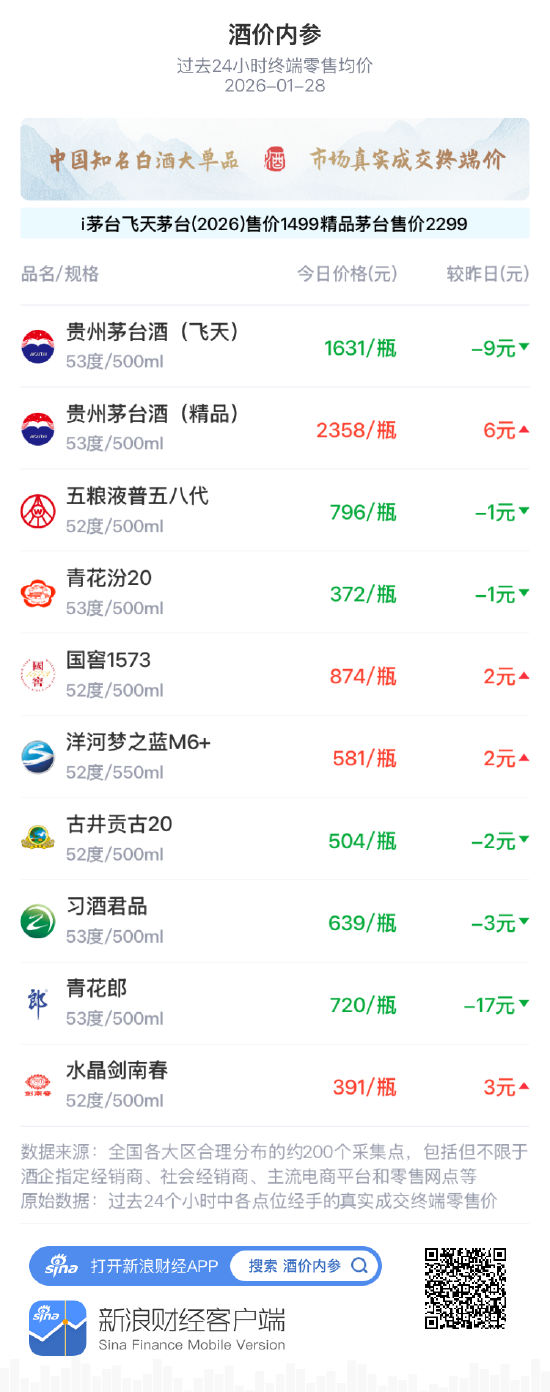
Core Viewpoint - The Chinese liquor market is experiencing a mixed trend in retail prices, with the average price of the top ten liquor products showing a decline, indicating potential market volatility and shifts in consumer demand [1][5]. Price Trends - As of January 28, the total retail price for a package of the top ten liquor products is 8866 yuan, down 20 yuan from the previous day, marking a new low in the past five days [1]. - The market shows four price increases and six decreases today, with premium Moutai leading the increase by 6 yuan per bottle, while Qinghua Lang saw a significant drop of 17 yuan per bottle [1][4]. Market Dynamics - The introduction of the iMoutai platform selling Moutai at 1499 yuan per bottle and premium Moutai at 2299 yuan per bottle has begun to influence market prices, reflecting a magnetic effect on retail prices [5]. - The A-share liquor sector has seen a decline, with the China Securities White Liquor Index dropping to 8293.16 points, the lowest since September 19, 2024, and the sector has experienced a continuous six-year decline [5]. Stock Performance - Within the liquor sector, 20 constituent stocks have averaged a decline of nearly 8.5% over the past 11 trading days, with a median drop of 6.6% [5]. - Six stocks have seen declines exceeding 10%, representing nearly 30% of the sector's total stocks, including Shanxi Fenjiu and Yanghe Brewery [5]. Financing Activity - Despite the market downturn, there is a trend of increased investment from financing clients, with Guizhou Moutai seeing a net purchase of 3.166 billion yuan over the last ten trading days, reaching a new high in financing balance [5].
酒价内参1月28日价格发布 精品茅台领涨6元/瓶
Xin Lang Cai Jing· 2026-01-28 01:17
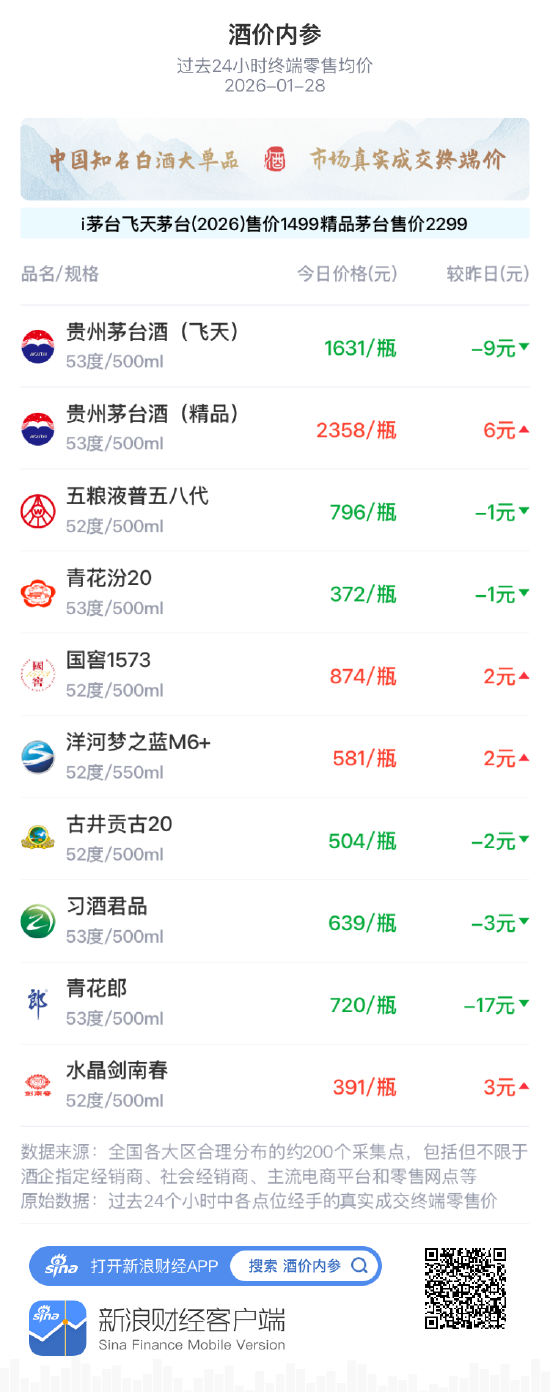
新浪财经"酒价内参"重磅上线 知名白酒真实市场价尽在掌握 新浪财经"酒价内参"过去24小时收集的数据显示,中国白酒市场十大单品的终端零售均价在1月28日呈 放量分化走势。如果十大单品各取一瓶整体打包售卖,今日总售价为8866元,较昨日下跌20元,创近五 日以来价格新低。今日市场四涨六跌:上涨端,精品茅台领涨6元/瓶;水晶剑南春上涨3元/瓶;国窖 1573和梦之蓝M6+均上涨2元/瓶。下跌端,青花郎显著回调17元/瓶,调整幅度居前,此前该酒品曾五 连涨获利回吐压力日增;飞天茅台终端零售价受i茅台平台常态化供应影响,环比下跌9元/瓶;习酒君 品和古井贡古20分别下跌3元/瓶、2元/瓶;青花汾20和五粮液均微跌1元/瓶,走势相对平稳。 | 2 | 习酒君品 | 639/瓶 | -3元' | | --- | --- | --- | --- | | | 53度/500ml | | | | 北 | 青花郎 | 720/瓶 | -17元▼ | | | 53度/500ml | | | | 100 | 水晶剑南春 | 391/瓶 | 3元 ▲ | | | 52度/500ml | | | "酒价内参"的每日数据源自全国各大区均有 ...
白酒板块1月27日跌0.56%,*ST岩石领跌,主力资金净流出3.86亿元
Zheng Xing Xing Ye Ri Bao· 2026-01-27 08:49
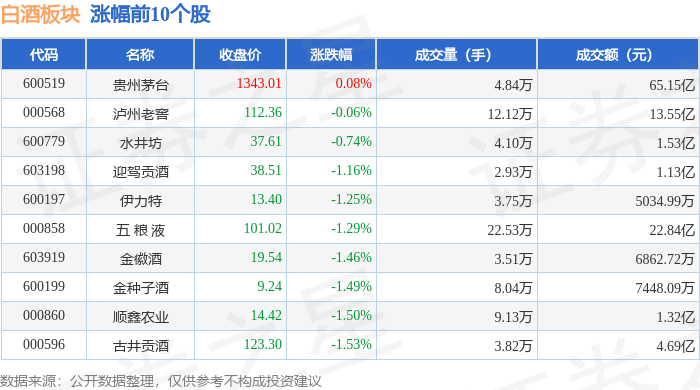
Core Viewpoint - The liquor sector experienced a decline of 0.56% on January 27, with *ST Rock leading the drop, while the Shanghai Composite Index rose by 0.18% and the Shenzhen Component Index increased by 0.09% [1]. Group 1: Liquor Sector Performance - The closing prices and performance of key liquor stocks showed mixed results, with Kweichow Moutai slightly up by 0.08% at 1343.01, while several others like Wuliangye and Luzhou Laojiao saw declines of 1.29% and 0.06% respectively [1]. - The total trading volume for Kweichow Moutai was 48,400 hands, with a transaction value of 6.515 billion yuan, while Wuliangye had a trading volume of 225,300 hands and a transaction value of 2.284 billion yuan [1]. Group 2: Capital Flow Analysis - The liquor sector saw a net outflow of 386 million yuan from institutional investors and 289 million yuan from retail investors, while retail investors had a net inflow of 675 million yuan [2]. - Specific stocks like Kweichow Moutai experienced a net inflow of 39.8 million yuan from institutional investors, while *ST Rock had a net outflow of 68,400 yuan [3]. Group 3: ETF Performance - The Food and Beverage ETF (product code: 515170) tracked the sub-index of the food and beverage industry, showing a decline of 2.01% over the past five days, with a price-to-earnings ratio of 19.31 times [5]. - The Consumer ETF (product code: 510630) tracked the main consumer industry index, with a decline of 1.52% over the past five days and a price-to-earnings ratio of 20.22 times [6].
78元的牛栏山找到了40岁的岳云鹏,能挽回年轻人的心吗?
Sou Hu Cai Jing· 2026-01-27 05:09
Core Viewpoint - Niulanshan is facing a significant operational crisis, with declining sales and profits, prompting a strategic shift towards younger consumers through the launch of new products like the 36-degree Jinbiao Niulanshan [1][2][3] Company Overview - Niulanshan, a representative of Beijing-style light aroma liquor, has seen its flagship product "Bai Niu Er" sales drop significantly, with revenue from its parent company Shunxin Agriculture declining from 102.25 billion yuan in 2021 to 70.41 billion yuan in 2024 [2] - The company has historically relied on low-priced products, with "Bai Niu Er" achieving sales of 8.4 billion bottles at its peak, but is now struggling with a brand perception tied to low pricing [1][2] Market Dynamics - The Chinese liquor market is undergoing a transformation characterized by stable overall volume, structural upgrades, and increased differentiation, with light bottle liquor experiencing growth despite overall market slowdowns [3][4] - Young consumers, particularly those born in the 1990s and 2000s, are becoming the primary market force, favoring lighter, more personalized drinking experiences over traditional heavy drinking [3][4] Competitive Landscape - The light bottle liquor market has become highly competitive, with established brands and new entrants vying for market share, making it difficult for Niulanshan to maintain its previous distribution and pricing strategies [4][6] - The implementation of new national standards for liquor has further complicated the market, pushing consumers towards pure grain liquor and away from lower-quality options [6] Strategic Response - Niulanshan's introduction of the Jinbiao Chen Neng product aims to address its declining sales by appealing to younger consumers and enhancing its product structure, with a price point of 78 yuan [2][7] - The company is focusing on brand rejuvenation by leveraging celebrity endorsements and engaging in marketing strategies that resonate with younger demographics [7][8] Future Outlook - The potential for Niulanshan's transformation is supported by its strong brand heritage and extensive distribution network, which can facilitate the introduction of new products [10][11] - The company aims to redefine its brand image from a low-cost option to a quality product that resonates with younger consumers, which is essential for its long-term sustainability [12][13]