Zhong Ke San Huan Co., Ltd.(000970)

Search documents
中科三环股价跌5.05%,前海开源基金旗下1只基金重仓,持有393.03万股浮亏损失306.56万元
Xin Lang Cai Jing· 2025-10-14 06:12
Group 1 - Zhongke Sanhuan experienced a decline of 5.05% on October 14, with a stock price of 14.67 yuan per share, a trading volume of 1.136 billion yuan, a turnover rate of 6.22%, and a total market capitalization of 17.835 billion yuan [1] - The company, Beijing Zhongke Sanhuan High Technology Co., Ltd., was established on July 23, 1999, and listed on April 20, 2000. Its main business involves the research, development, production, and sales of rare earth permanent magnets and new magnetic materials, with 95.18% of revenue coming from magnetic material sales and 4.82% from other sources [1] Group 2 - The Qianhai Kaiyuan Fund has a significant holding in Zhongke Sanhuan, with the Qianhai Kaiyuan Hong Kong-Shenzhen Core Resource Mixed A Fund (003304) holding 3.9303 million shares, representing 6.05% of the fund's net value, making it the sixth-largest holding. The estimated floating loss today is approximately 3.0656 million yuan [2] - The Qianhai Kaiyuan Hong Kong-Shenzhen Core Resource Mixed A Fund was established on October 17, 2016, with a current size of 289 million yuan. Year-to-date returns are 95.86%, ranking 46 out of 8162 in its category, while the one-year return is 102.32%, ranking 82 out of 8015. Since inception, the fund has achieved a return of 454.23% [2] - The fund manager, Wu Guoqing, has been in position for 10 years and 23 days, managing assets totaling 5.333 billion yuan. The best return during his tenure is 416.86%, while the worst return is -29.94% [2]

稀土:金属牛市旗手的潜力
2025-10-13 01:00
Summary of Rare Earth Industry Conference Call Industry Overview - The conference call focuses on the rare earth industry, particularly the implications of recent regulatory changes in China and the competitive landscape with the US and Europe [1][3][4]. Key Points and Arguments - **Chinese Regulatory Changes**: China has implemented stricter controls on rare earth exports through announcements 56 and 61, shifting from resource management to dual control over technology and supply chains to counter Western restrictions in the semiconductor and military sectors [1][3]. - **US and European Initiatives**: The US Department of Defense has partnered with MP Company and French firms to develop a self-sufficient rare earth supply chain, aiming to reduce reliance on Chinese pricing [3][4]. Goldman Sachs has released a report favoring neodymium prices, indicating a bullish outlook for the market [3]. - **Pricing Dynamics**: Rare earth prices are primarily influenced by supply and their strategic metal status rather than solely by demand. Historical data shows that price increases are not strictly limited by demand fluctuations [1][7]. The upcoming fourth quarter is expected to support price stability due to traditional consumption peaks and domestic demand recovery [7]. - **Market Demand**: There is a strong domestic demand for rare earth materials, particularly in the electric vehicle and optical communication sectors, which is expected to drive future growth [6]. Important but Overlooked Content - **Investment Recommendations**: Investors are advised to focus on traditional leading companies such as China Rare Earth, Northern Rare Earth, Shenghe Resources, and Guangsheng Nonferrous, as well as new entrants in the smelting sector like Huahong Technology [1][8]. Additionally, companies in the magnetic materials sector such as Jinli Permanent Magnet, Ningbo Yunsheng, Zhenghai Magnetic Materials, and Zhongke Sanhuan are highlighted as beneficiaries of increasing downstream orders [9]. - **Price Forecasts**: The price of heavy and medium rare earth oxides, such as dysprosium oxide, is projected to rise from approximately 7 million yuan per ton to around 10 million yuan per ton [2][9]. Conclusion - The rare earth industry is undergoing significant changes due to regulatory actions in China and strategic moves by the US and Europe. The focus on supply chain independence and the anticipated price increases present both opportunities and risks for investors in this sector.


中美贸易摩擦或再度升级,我国稀土出口管制趋严且首次覆盖半导体或对海外芯片制程产生约束
HUAXI Securities· 2025-10-12 13:29
Investment Rating - Industry rating: Recommended [3] Core Insights - The recent announcements from the Ministry of Commerce and the General Administration of Customs have implemented stricter export controls on rare earth elements, particularly affecting the semiconductor industry and potentially impacting overseas chip manufacturing processes [1][10][16] - China dominates global rare earth supply, holding approximately 48.41% of the world's rare earth reserves and producing 68.54% of the total output [12][14] - The new export controls cover all 12 types of medium and heavy rare earth elements, marking a significant expansion in the scope of regulation [2][4] Summary by Sections Export Control Measures - The recent announcements (2025 No. 56 and 57) include export controls on rare earth equipment and raw materials, specifically targeting key technologies in rare earth mining, refining, and manufacturing [1][2] - The controls also extend to any downstream products that utilize Chinese rare earth technologies, requiring export licenses for a wide range of applications [5][10] Strategic Importance of Rare Earths - Rare earth elements are critical in various industries, including defense and semiconductor manufacturing, where they enhance material properties and performance [6][7] - The military applications of rare earths are significant, with advanced weapon systems heavily reliant on these materials [6] Semiconductor Industry Impact - The new regulations are the first to explicitly cover the semiconductor sector, which may lead to increased scrutiny and delays in overseas chip production [10][11] - Rare earths are essential for high-performance materials in semiconductor manufacturing, particularly as technology advances towards smaller transistor sizes [7][10] Renewable Energy Sector - Rare earths play a crucial role in the renewable energy sector, particularly in electric vehicle motors and wind turbine generators, with rare earth permanent magnets accounting for over 80% of the electric motor market share [11][12] Global Supply Chain Dynamics - The report highlights that while the U.S. is attempting to rebuild its rare earth supply chain, China's control over the entire rare earth industry chain remains unchallenged in the short term [15][16] - The overall completeness of the rare earth supply chain in the West is still lacking, with many projects facing delays and challenges [14][15]


趋势2025!中国储氢合金行业基本原理、技术路线、产业链全景、技术创新及未来发展前景分析:资源优势巩固行业地位,创新引领打开市场空间[图]
Chan Ye Xin Xi Wang· 2025-10-02 03:40
Core Insights - Hydrogen storage alloys are critical materials in the hydrogen energy industry due to their high safety, volumetric hydrogen density, and long-cycle stability [1][2] - China has established a complete hydrogen storage alloy industry chain driven by rare earth resources and strong policies, featuring upstream resource monopolization, midstream technological iteration, and downstream diverse applications [1][8] - The global hydrogen storage alloy market is dominated by rare earth-based alloys, with rapid iterations of magnesium-based, titanium-based, and solid-state materials [1][9] Industry Overview - Hydrogen storage alloys (HSA) are special functional materials capable of reversible absorption and release of hydrogen under normal conditions, forming metal hydrides for safe and efficient hydrogen storage [2][3] - The main hydrogen storage methods include high-pressure gas storage, low-temperature liquid storage, and solid-state storage using hydrogen alloys, each with its advantages and disadvantages [5][6] Technological Development - Current mainstream hydrogen storage methods are compared, highlighting solid-state hydrogen storage alloys as the leading technology due to their safety and volumetric density [5][6] - The preparation methods for hydrogen storage alloys significantly influence their microstructure and hydrogen absorption performance, with various techniques available [7] China's Industry Background - Hydrogen is a key carrier for building a new energy system and achieving carbon neutrality, with hydrogen storage alloys being essential materials supported by national strategies and policies [8] - The Chinese government has implemented comprehensive policies to promote the hydrogen energy industry, including standards for solid-state hydrogen storage alloys [8] Industry Chain Structure - The Chinese hydrogen storage alloy industry chain features upstream resource monopolization, midstream technological advancements, and diverse downstream applications, with companies like Xiamen Tungsten and China Rare Earth Group leading the midstream [8][9] - The industry is characterized by close cooperation among upstream, midstream, and downstream enterprises, forming a collaborative innovation model [8] Global and Domestic Market Analysis - The global hydrogen storage alloy industry is at a critical juncture of technological breakthroughs and large-scale applications, with a projected market size of $440 million by 2030 [9] - China's hydrogen storage alloy sector has seen significant advancements in technology and enterprise layout, focusing on high capacity, low working temperature, and long cycle life [9][10] Future Trends - The future of China's hydrogen storage alloy industry will focus on technological innovation, industry integration, and international competition [11][12][14] - Technological innovation will lead to performance upgrades, with a focus on developing new multi-component alloy systems and optimizing kinetic performance [11] - Industry integration will involve increased mergers and acquisitions, creating industry leaders and enhancing overall competitiveness [12] - In international competition, Chinese enterprises will leverage their scale and resource advantages while addressing high-end technology gaps through increased R&D investment [14]


金属新材料板块9月30日涨1.84%,铂科新材领涨,主力资金净流出1.89亿元
Zheng Xing Xing Ye Ri Bao· 2025-09-30 08:42
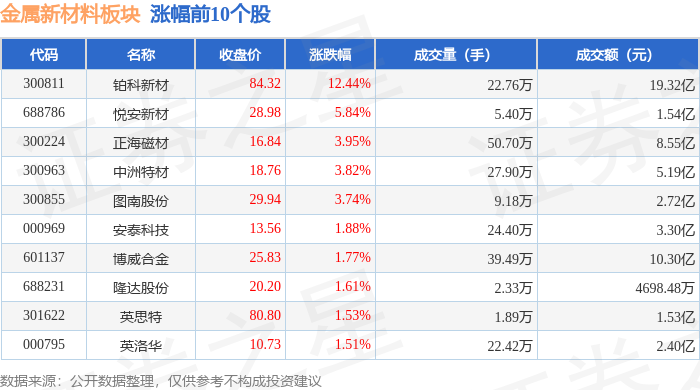
Market Performance - The metal new materials sector increased by 1.84% on September 30, with Placo New Materials leading the gains [1] - The Shanghai Composite Index closed at 3882.78, up 0.52%, while the Shenzhen Component Index closed at 13526.51, up 0.35% [1] Stock Performance - Placo New Materials (300811) closed at 84.32, with a rise of 12.44% and a trading volume of 227,600 shares, amounting to 1.93 billion yuan [1] - Other notable performers included: - Yuenan New Materials (688786) at 28.98, up 5.84% [1] - Zhenghai Aomaterials (300224) at 16.84, up 3.95% [1] - Zhongzhou Special Materials (300963) at 18.76, up 3.82% [1] - Tunan Co., Ltd. (300855) at 29.94, up 3.74% [1] Capital Flow - The metal new materials sector experienced a net outflow of 189 million yuan from institutional investors and 83.30 million yuan from speculative funds, while retail investors saw a net inflow of 272 million yuan [2] - Specific stock capital flows included: - Zhenghai Magnetic Materials (300224) with a net inflow of 101 million yuan from institutional investors [2] - Zhongzhou Special Materials (300963) with a net inflow of 39.82 million yuan from institutional investors [2] - An Tai Technology (000969) with a net inflow of 15.40 million yuan from institutional investors [2]




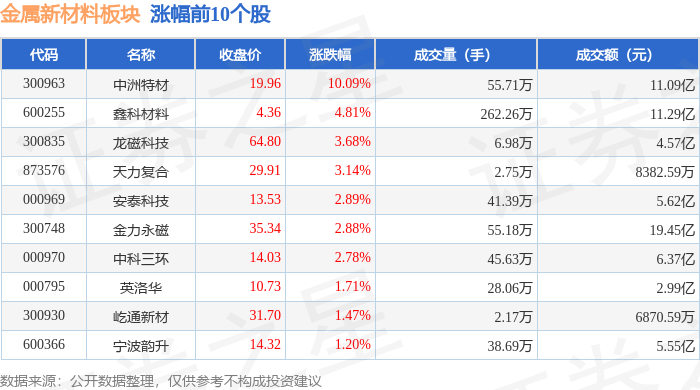
金属新材料板块9月25日涨1.05%,中洲特材领涨,主力资金净流入5亿元
Zheng Xing Xing Ye Ri Bao· 2025-09-25 08:38
Group 1 - The metal new materials sector increased by 1.05% on September 25, with Zhongzhou Special Materials leading the gains [1] - The Shanghai Composite Index closed at 3853.3, down 0.01%, while the Shenzhen Component Index closed at 13445.9, up 0.67% [1] - Zhongzhou Special Materials had a closing price of 19.96, with a rise of 10.09% and a trading volume of 557,100 shares [1] Group 2 - The metal new materials sector saw a net inflow of 500 million yuan from main funds, while retail investors experienced a net outflow of 350 million yuan [2] - The trading data indicates that Zhongzhou Special Materials had a net inflow of 28.48 million yuan from main funds, but a net outflow of 24.72 million yuan from retail investors [3] - The overall trading volume for the sector was significant, with Zhongzhou Special Materials contributing to a total transaction value of 1.11 billion yuan [1][2]

中科三环涨2.05%,成交额2.46亿元,主力资金净流入2187.13万元
Xin Lang Cai Jing· 2025-09-25 03:52
Core Viewpoint - Zhongke Sanhuan's stock price has shown significant fluctuations, with a year-to-date increase of 34.59% and a recent decline over the past 20 days of 11.89, indicating volatility in investor sentiment and market conditions [1][2]. Group 1: Stock Performance - As of September 25, Zhongke Sanhuan's stock price was 13.93 yuan per share, with a market capitalization of 16.935 billion yuan [1]. - The stock has experienced a trading volume of 246 million yuan and a turnover rate of 1.47% [1]. - The stock has been on the "龙虎榜" (a list of stocks with significant trading activity) once this year, with a net buy of 135 million yuan on August 15 [1]. Group 2: Financial Performance - For the first half of 2025, Zhongke Sanhuan reported operating revenue of 2.922 billion yuan, a year-on-year decrease of 11.17%, while net profit attributable to shareholders was 43.993 million yuan, a year-on-year increase of 160.82% [2]. - Cumulatively, the company has distributed 1.54 billion yuan in dividends since its A-share listing, with 206 million yuan distributed in the last three years [3]. Group 3: Shareholder Structure - As of June 30, 2025, Zhongke Sanhuan had 121,100 shareholders, with an average of 10,039 shares held per shareholder, a slight decrease of 0.16% [2]. - Major shareholders include Hong Kong Central Clearing Limited, which holds 24.948 million shares, a decrease of 16.095 million shares from the previous period [3]. - New entrants among the top ten shareholders include Huaxia CSI 1000 ETF, holding 5.293 million shares, and Jinying Technology Innovation Stock A, holding 5.18 million shares [3].
中科三环(000970.SZ):产品应用于机器人领域已有多年,目前主要应用于工业机器人
Ge Long Hui· 2025-09-22 08:24
Core Viewpoint - The company has been involved in the robotics sector for many years, primarily focusing on industrial robots, and is now looking to explore opportunities in the humanoid robot market [1] Company Summary - The company has a long-standing application of its products in the robotics field, specifically in industrial robots [1] - The company is committed to monitoring developments in the humanoid robot sector and is actively engaging with relevant clients to seize potential market opportunities [1]
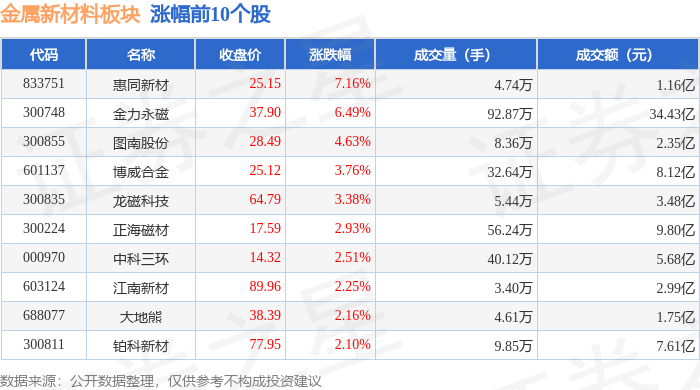
金属新材料板块9月17日涨1.95%,惠同新材领涨,主力资金净流入2.87亿元
Zheng Xing Xing Ye Ri Bao· 2025-09-17 08:42
Market Overview - On September 17, the metal new materials sector rose by 1.95%, with Huitong New Materials leading the gains [1] - The Shanghai Composite Index closed at 3876.34, up 0.37%, while the Shenzhen Component Index closed at 13215.46, up 1.16% [1] Top Performers - Huitong New Materials (Code: 833751) closed at 25.15, up 7.16% with a trading volume of 47,400 shares and a transaction value of 116 million [1] - Jinli Permanent Magnet (Code: 300748) closed at 37.90, up 6.49% with a trading volume of 928,700 shares and a transaction value of 344.3 million [1] - Tunan Co., Ltd. (Code: 300855) closed at 28.49, up 4.63% with a trading volume of 83,600 shares and a transaction value of 235 million [1] Underperformers - Shenzhen New Star (Code: 603978) closed at 20.51, down 3.93% with a trading volume of 161,500 shares [2] - Youyan Powder Materials (Code: 688456) closed at 51.93, down 3.83% with a trading volume of 38,200 shares [2] - Zhongzhou Special Materials (Code: 300963) closed at 18.36, down 1.98% with a trading volume of 115,100 shares [2] Capital Flow - The metal new materials sector saw a net inflow of 287 million from institutional investors, while retail investors experienced a net outflow of 234 million [2][3] - Major stocks like Jinli Permanent Magnet and Boweitai Gold saw significant net inflows from institutional investors, indicating strong institutional interest [3] Summary of Individual Stock Performance - Jinli Permanent Magnet had a net inflow of 221 million from institutional investors, while retail investors saw a net outflow of 174 million [3] - Boweitai Gold had a net inflow of 46.73 million from institutional investors, with retail investors experiencing a net outflow of 1.94 million [3] - Zhenghai Magnetic Materials had a net inflow of 45.98 million from institutional investors, while retail investors saw a net outflow of 4.52 million [3]


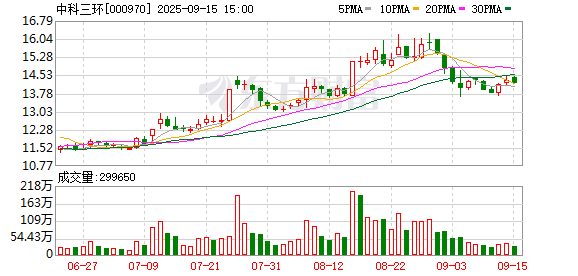
中科三环最新股东户数环比下降7.65%
Zheng Quan Shi Bao Wang· 2025-09-15 09:01
Group 1 - The core point of the article highlights that Zhongke Sanhuan has experienced a decrease in the number of shareholders, with a total of 120,902 shareholders as of September 10, which is a reduction of 10,019 shareholders compared to the previous period, representing a 7.65% decline [2] - The company's stock price closed at 14.18 yuan, down 0.84%, and has seen a cumulative decline of 10.54% since the concentration of shares began, with 4 days of increase and 7 days of decrease in the trading period [2] - According to the semi-annual report, Zhongke Sanhuan achieved an operating income of 2.922 billion yuan in the first half of the year, a year-on-year decrease of 11.17%, while net profit reached 43.9931 million yuan, a year-on-year increase of 160.82%, with basic earnings per share of 0.0366 yuan and a weighted average return on equity of 0.68% [2]