
Bank Of Lanzhou(001227)

Search documents
城商行板块9月15日跌0.85%,西安银行领跌,主力资金净流出7.97亿元
Zheng Xing Xing Ye Ri Bao· 2025-09-15 08:43
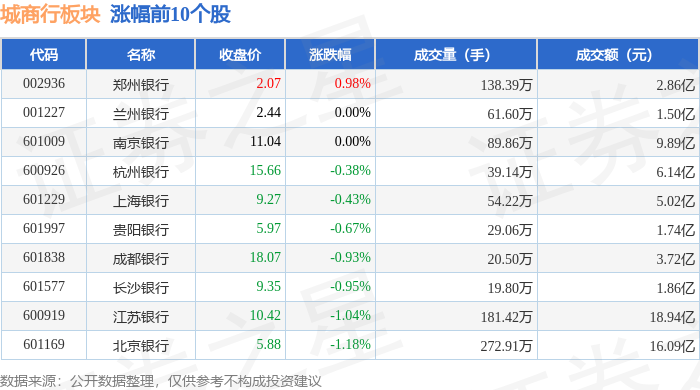
Market Overview - On September 15, the city commercial bank sector declined by 0.85% compared to the previous trading day, with Xi'an Bank leading the decline [1] - The Shanghai Composite Index closed at 3860.5, down 0.26%, while the Shenzhen Component Index closed at 13005.77, up 0.63% [1] Individual Bank Performance - Zhengzhou Bank closed at 2.07, up 0.98% with a trading volume of 1.38 million shares and a transaction value of 286 million yuan [1] - Xi'an Bank closed at 4.19, down 1.87% with a trading volume of 438,000 shares and a transaction value of 184 million yuan [2] - The highest decline was observed in Chengdu Bank, which closed at 18.07, down 0.93% [1] Capital Flow Analysis - The city commercial bank sector experienced a net outflow of 797 million yuan from institutional investors, while retail investors saw a net inflow of 348 million yuan [2] - The main capital inflow and outflow for individual banks varied, with Hangzhou Bank seeing a net inflow of 61.64 million yuan from institutional investors [3] - Conversely, Suzhou Bank experienced a net outflow of 11.76 million yuan from institutional investors [3]




中国银行业正迎来重要拐点
2 1 Shi Ji Jing Ji Bao Dao· 2025-09-13 00:27
Core Viewpoint - The banking industry is facing a critical turning point as net interest margins have fallen below non-performing loan ratios, indicating a dual pressure of shrinking income and rising risk [1][4][5] Group 1: Financial Indicators - As of Q1 2025, the non-performing loan ratio for commercial banks was 1.51%, while the net interest margin was 1.43%, marking the lowest net interest margin since 2005 [1][5] - By Q2 2025, the net interest margin further declined to 1.42%, with the non-performing loan ratio rising to 1.49% [1] - Over 20% of the 42 listed banks reported net interest margins lower than their non-performing loan ratios, highlighting a concerning trend in the industry [1][6] Group 2: Industry Response - In response to these challenges, banks are shifting towards middle-income business models, with a notable resurgence in insurance and banking (银保) business, which accounted for over 50% of income for the first time in 15 years [2][21] - Major banks like China Merchants Bank and Ping An Bank reported over 40% year-on-year growth in insurance income [2] Group 3: Asset and Liability Management - The continuous decline in net interest margins is attributed to a combination of low asset yields and rigid liability costs, exacerbated by insufficient effective credit demand and external pressures from bond market financing [10][12] - Banks are adjusting their asset-liability strategies to cope with narrowing margins, focusing on optimizing their loan structures and reducing costs [13] Group 4: Asset Quality and Risk - The total non-performing loan balance for commercial banks was reported at 34,342 billion yuan in Q2 2025, with a slight decrease from Q1 [15] - The provision coverage ratio improved to 211.97%, indicating enhanced risk mitigation capabilities [15] - However, the non-performing loan generation rate and overdue loan rates are on the rise, suggesting ongoing pressure on asset quality [17][19] Group 5: Middle-Income Business Growth - The middle-income business segment is showing signs of recovery, with non-interest income growing by 6.97% year-on-year in the first half of 2025, reversing a downward trend [21][22] - The insurance business is becoming a key growth driver, with banks leveraging their networks to enhance insurance sales [23]




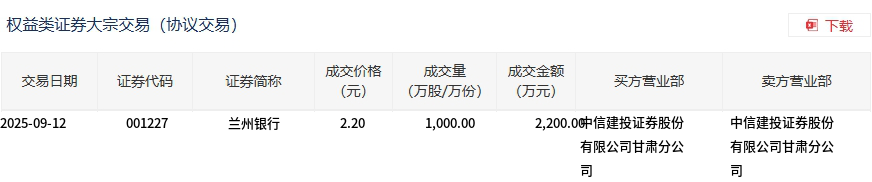
兰州银行今日大宗交易折价成交1000万股,成交额2200万元
Xin Lang Cai Jing· 2025-09-12 08:52
Summary of Key Points Core Viewpoint - On September 12, Lanzhou Bank executed a block trade of 10 million shares, amounting to 22 million yuan, which represented 12.36% of the total trading volume for the day. The transaction price was 2.20 yuan, reflecting a discount of 9.84% compared to the market closing price of 2.44 yuan [1]. Group 1 - The block trade involved 10 million shares of Lanzhou Bank [1]. - The total transaction value was 22 million yuan [1]. - The transaction price was 2.20 yuan, which is lower than the market closing price [1]. Group 2 - The block trade accounted for 12.36% of the total trading volume on that day [1]. - The discount of 9.84% indicates a significant deviation from the market price [1].
中小行半年报:有银行房地产不良率超21%
Di Yi Cai Jing· 2025-09-11 12:52
Core Insights - The operating conditions of small and medium-sized banks in China have shown significant differentiation and competition, with new changes emerging in their performance during the first half of the year [2][5]. Group 1: Performance of Listed Banks - As of mid-2023, the total asset scale of 42 A-share listed banks reached approximately 321 trillion yuan, with 27 city commercial banks and rural commercial banks accounting for about 36 trillion yuan, an increase of over 3 trillion yuan compared to the end of last year [3]. - City and rural commercial banks have seen their share of total assets among listed banks rise from less than 11% at the end of last year to approximately 11.21% [4]. - Jiangsu Bank has overtaken Beijing Bank to become the new leader among city commercial banks, with an asset scale of 4.79 trillion yuan, growing at a rate of 21.16%, the highest among all listed banks [5][6]. Group 2: Financial Metrics - Jiangsu Bank reported revenue of 448.64 billion yuan and a net profit of 202.38 billion yuan for the first half of the year, with growth rates of 7.08% and 8.05% respectively, while Beijing Bank's revenue and net profit growth were only 1.02% and 1.12% [5][6]. - The net interest margin (NIM) among listed banks shows significant variation, with the highest being 2.58% for Changshu Bank and the lowest at 1.08% for Xiamen Bank [9][10]. - The overall NIM for commercial banks was reported at 1.42%, with city commercial banks at 1.37% and rural commercial banks at 1.58% [9]. Group 3: Asset Quality and Risks - The non-performing loan (NPL) ratio for city and rural commercial banks remains a critical risk factor, with the highest NPL ratio reported at 1.81% for Lanzhou Bank, and several banks exceeding 1.7% [10][12]. - Qingnong Bank's NPL ratio for real estate loans surged from 7.17% to 21.32%, indicating significant risk exposure in this sector [12][13]. - The report highlights that personal loans and loans to the real estate sector are primary areas of risk exposure for banks [12]. Group 4: Non-Listed Banks - Non-listed small and medium-sized banks have also experienced changes, with some rural commercial banks seeing significant declines in asset scale, such as Ningbo Yinzhou Rural Commercial Bank, which dropped by 15.45% [14]. - The reliance on financial investments has increased among banks, particularly rural commercial banks, with some reporting financial investments constituting over 45% of their total assets [14][15].



兰州银行营收降1年半 行长履新后不良率A股银行仍最高
Zhong Guo Jing Ji Wang· 2025-09-10 23:17
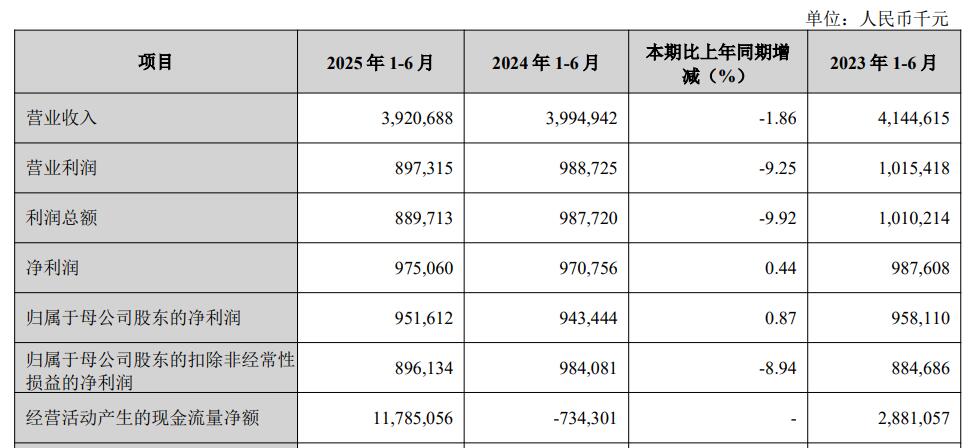
Core Viewpoint - Lanzhou Bank reported a decline in operating income for the first half of 2025, while net profit showed a slight increase, indicating mixed financial performance amidst ongoing challenges in the banking sector [1][2]. Financial Performance - Operating income for the first half of 2025 was 3.92 billion yuan, a decrease of 1.86% compared to the same period in 2024 [2]. - Net profit attributable to shareholders was 0.95 billion yuan, reflecting a year-on-year increase of 0.87% [1][2]. - Net profit excluding non-recurring items was 0.90 billion yuan, down 8.94% year-on-year [1][2]. - The net cash flow from operating activities was 11.78 billion yuan, a significant improvement from -0.73 billion yuan in the previous year [1][2]. Asset Quality - As of June 30, 2025, the non-performing loan (NPL) ratio was 1.81%, a slight decrease of 0.02 percentage points from the beginning of the year [3]. - Lanzhou Bank has consistently reported the highest NPL ratio among 42 listed banks in A-shares for the periods ending in 2024 and 2025 [3]. Regulatory Compliance - The liquidity ratio stood at 72.61%, well above the regulatory requirement of 25% [3]. - The liquidity coverage ratio was 130.09%, exceeding the minimum requirement of 100% [3]. - The provision coverage ratio was 207.89%, significantly above the required 140% [3]. Management Changes - In March 2025, Liu Min was appointed as the new president of Lanzhou Bank, following the departure of the previous president [5]. Historical Context - In 2022, Lanzhou Bank reported an operating income of 7.45 billion yuan, a decline of 4.92% year-on-year [4]. - The bank's operating income increased to 8.02 billion yuan in 2023, marking a growth of 7.59% [4]. - In 2024, the operating income was 7.85 billion yuan, a decrease of 2.02% compared to the previous year [4].
股票行情快报:兰州银行(001227)9月10日主力资金净买入1395.61万元
Sou Hu Cai Jing· 2025-09-10 14:10
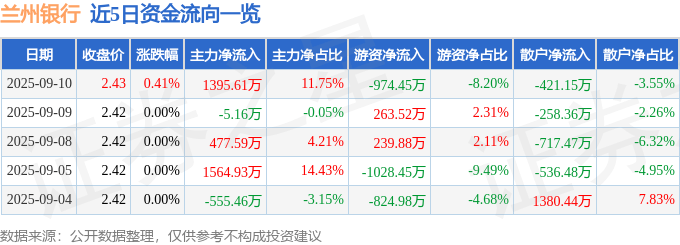
Core Viewpoint - Lanzhou Bank (001227) shows a slight increase in stock price and mixed capital flow data, indicating potential investor interest but also some outflows from retail investors [1][2]. Group 1: Stock Performance - As of September 10, 2025, Lanzhou Bank's stock closed at 2.43 yuan, up by 0.41% with a turnover rate of 1.16% and a trading volume of 489,200 shares, resulting in a transaction value of 119 million yuan [1]. - The capital flow data for September 10 indicates a net inflow of 13.96 million yuan from institutional investors, accounting for 11.75% of the total transaction value, while retail investors experienced a net outflow of 4.21 million yuan, representing 3.55% of the total [1][2]. Group 2: Financial Metrics - Lanzhou Bank's total market capitalization is 13.841 billion yuan, with a net asset value of 36.021 billion yuan and a net profit of 0.952 billion yuan, ranking 36th, 34th, and 39th respectively in the banking industry [3]. - The bank's price-to-earnings ratio (P/E) is 7.27, while the industry average is 5.9, placing it 36th in the industry ranking [3]. - The net profit margin stands at 24.87%, significantly lower than the industry average of 39.55%, ranking 41st in the sector [3]. Group 3: Recent Financial Performance - For the first half of 2025, Lanzhou Bank reported a main operating income of 3.921 billion yuan, a year-on-year decrease of 1.86%, while the net profit attributable to shareholders was 0.952 billion yuan, up by 0.87% [3]. - In Q2 2025, the bank's single-quarter main operating income was 1.884 billion yuan, down by 6.85%, and the net profit attributable to shareholders was 0.393 billion yuan, a decline of 1.18% [3].
兰州银行股份有限公司2025年半年度业绩说明会问答实录
Quan Jing Wang· 2025-09-10 03:01
Core Viewpoint - Lanzhou Bank has successfully held its 2025 semi-annual performance briefing, highlighting significant growth in assets and a commitment to maintaining a stable financial position while enhancing service offerings to customers and supporting local enterprises [1][2]. Financial Performance - As of June 30, 2025, Lanzhou Bank's total assets reached 509.742 billion yuan, marking a 4.82% increase from the beginning of the year, officially entering the medium-sized bank category [1][3]. - The bank's liquidity ratio stood at 72.61%, slightly up from the end of 2024, reflecting a stable operational strategy [1][2]. - The deposit interest rate decreased by 25 basis points compared to the beginning of the year, with a reduction of 31 basis points year-on-year, indicating effective cost control measures [1][2]. Customer Engagement and Product Innovation - Lanzhou Bank has actively engaged with the community through its sponsorship of the Lanzhou Marathon, launching themed financial products and services to enhance customer experience [1][2]. - The bank has introduced various financial products tailored for small and micro enterprises, including online credit products to facilitate easier access to financing [3][4]. Risk Management and Asset Quality - The non-performing loan ratio was reported at 1.81% as of June 30, 2025, a slight decrease from the beginning of the year, with a provision coverage ratio of 207.89% [2][3]. - The bank employs a comprehensive risk management strategy, utilizing advanced technologies for risk identification and mitigation [2][3]. Strategic Initiatives - Lanzhou Bank is implementing a "1363" strategic plan aimed at becoming a respected and distinctive bank, focusing on digitalization, green finance, and customer-centric services [3][4]. - The bank has initiated the development of its "14th Five-Year Plan," outlining future growth directions and objectives [3][4]. Shareholder Returns - The bank has maintained a stable dividend policy, with a cumulative dividend distribution of 2.398 billion yuan since its listing, reflecting a cash dividend ratio of approximately 33.49% [2][4]. - The board has been authorized to determine the 2025 interim profit distribution plan, indicating a commitment to returning value to shareholders [4].
不良率A股上市银行最高!兰州银行将如何提升资产质量?回应来了
Bei Ke Cai Jing· 2025-09-07 10:23
Core Viewpoint - Lanzhou Bank has the highest non-performing loan (NPL) ratio among A-share listed banks, reaching 1.81%, exceeding the average of 1.76% for domestic city commercial banks, a situation that has persisted for three consecutive quarters [1]. Group 1: Asset Quality Improvement Measures - The bank plans to enhance asset quality through four main strategies: maintaining a prudent risk preference, improving the intelligent risk control system using big data and AI, increasing efforts in non-performing asset recovery, and strengthening the overall risk management mechanism [3][4]. - The bank aims to adhere to the principle of substance over form in asset quality management, benchmarking against excellent listed banks [4]. Group 2: Financial Performance - As of June 2025, Lanzhou Bank's total assets reached 509.742 billion yuan, marking a 4.82% increase from the beginning of the year and officially entering the medium-sized bank category [5]. - The bank's asset scale breakthrough reflects its enhanced capital strength and market position, as well as its improved ability to serve the regional economy [6]. Group 3: Market Position and Future Goals - As the largest local legal bank in Gansu Province, Lanzhou Bank holds a significant market share in deposits and loans within the province and city, indicating its important role in the local financial system [7]. - The bank plans to focus more on asset quality, profitability efficiency, and optimizing business structure, aiming to convert scale advantages into quality and development advantages while deepening local advantages through digitalization and specialized operations [7].
本周聚焦:2025上半年银行确认了多少金融资产处置收益?OCI浮盈有多少?
GOLDEN SUN SECURITIES· 2025-09-07 08:20
Investment Rating - The report maintains an "Increase" rating for the banking sector, indicating a positive outlook for the industry [1]. Core Insights - In the first half of 2025, the contribution of financial asset disposal gains from AC and OCI accounts to revenue reached 5.2%, an increase of 2.9 percentage points compared to 2024 [1][2]. - The investment income growth rate for 42 listed banks was 23.6%, with AC, OCI, and TPL gains showing year-on-year growth rates of 134.7%, 79.0%, and -8.4% respectively [1]. - The report highlights that the increase in disposal gains does not necessarily indicate a significant increase in asset disposal scale, as market conditions and strategies vary among banks [2]. Financial Asset Disposal Gains - The contribution of AC and OCI financial asset disposal gains to revenue was 5.2%, up 2.9 percentage points from 2024, with AC asset disposal gains contributing 2.6% [2]. - Among different types of banks, rural commercial banks had the highest contribution from AC and OCI disposal gains, reaching 11.0%, an increase of 6.2 percentage points from 2024 [2]. - Specific banks such as Jiangyin Bank, Sunong Bank, and Zijin Bank had high disposal gain ratios relative to their revenue, at 28.9%, 26.7%, and 22.7% respectively [2]. OCI Floating Profit Situation - The overall OCI floating profit decreased compared to the end of the previous year, accounting for 12.6% of the estimated profit for 2025 [3]. - Major state-owned banks like CCB and ABC reported significant OCI floating profits, with balances exceeding 30 billion [3]. - The average contribution of OCI floating profits to profits for city and rural commercial banks was notably high, with Ningbo Bank's ratio reaching 35% [3][6]. Sector Trends - The banking sector is expected to benefit from expansionary policies aimed at stabilizing the economy, with a focus on real estate and consumer spending [7]. - The report suggests a focus on banks with improving fundamentals, such as Ningbo Bank, and those with dividend strategies like Jiangsu Bank and Chengdu Bank [7]. - Attention is also drawn to banks with potential convertible bond conversion expectations, including Shanghai Bank and Industrial Bank [7].





兰州银行高管回应不良贷款率为何高于同业,将从四方面着手压降
Xin Lang Cai Jing· 2025-09-05 11:53
Core Viewpoint - Lanzhou Bank's high non-performing loan (NPL) ratio is attributed to strict asset quality management, and the bank plans to implement four key measures to reduce this ratio in the future [3]. Group 1: Non-Performing Loan Management - As of mid-2023, Lanzhou Bank's NPL ratio stands at 1.81%, exceeding the average of 1.76% among 17 A-share listed city commercial banks [3]. - The bank's management attributes the high NPL ratio to its rigorous asset quality management practices, which align with those of leading listed banks [3]. - The four measures to improve asset quality include: 1. Maintaining a prudent risk appetite and enhancing monitoring of key sectors and potential risk clients 2. Improving the intelligent risk control system using big data and AI for better risk identification and early intervention 3. Increasing efforts in the recovery and disposal of non-performing assets through various methods 4. Strengthening the overall risk management mechanism across all lending stages [3]. Group 2: Dividend Policy and Shareholder Returns - Lanzhou Bank plans to maintain a stable dividend policy, with a projected dividend payout ratio of 30.47% for 2024, slightly down from 30.56% in 2023 [4]. - The bank has distributed a total of 2.398 billion yuan in dividends since its listing, which is 1.18 times the funds raised during the IPO, with an average annual dividend ratio of 33.49% [4]. - The board has been authorized to determine the specific mid-term profit distribution plan for 2025, which will be announced later [4]. Group 3: Future Strategic Planning - As of mid-2023, Lanzhou Bank's total assets have surpassed 500 billion yuan, reaching 509.7 billion yuan, marking its entry into the medium-sized bank category [5]. - The bank's chairman emphasized that this milestone reflects enhanced capital strength and market position, as well as improved service capabilities for the regional economy [5]. - Future strategic goals include focusing on asset quality, profitability, and optimizing business structure, leveraging digitalization and specialized operations to deepen local advantages [5].