Bank Of Lanzhou(001227)

Search documents
兰州银行(001227) - 兰州银行股份有限公司关于赎回2020年无固定期限资本债券的公告
2025-12-25 11:03
证券代码:001227 证券简称:兰州银行 公告编号:2025-056 截至本公告日,经国家金融监督管理总局甘肃监管局同意,本行已行使赎回 权,全额赎回了本期债券。 特此公告。 兰州银行股份有限公司董事会 2025年12月25日 兰州银行股份有限公司 关于赎回 2020 年无固定期限资本债券的公告 本行及董事会全体成员保证公告内容的真实、准确和完整,没有虚假记载、 误导性陈述或者重大遗漏。 2020年12月,兰州银行股份有限公司(以下简称"本行")在全国银行间债券 市场发行了规模为人民币50亿元的无固定期限资本债券(以下简称"本期债券")。 根据本期债券募集说明书相关条款的规定,本期债券设有发行人赎回权,发行人 有权在本期债券第5个计息年度的付息日,即2025年12月25日赎回本期债券。 ...
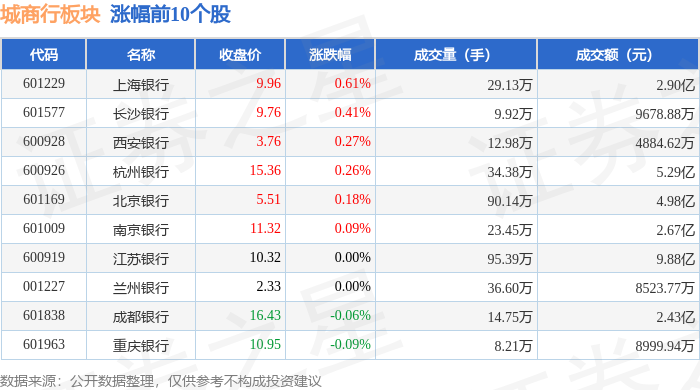
城商行板块12月25日涨0.07%,上海银行领涨,主力资金净流出1.11亿元
Zheng Xing Xing Ye Ri Bao· 2025-12-25 09:14
Market Performance - The city commercial bank sector increased by 0.07% compared to the previous trading day, with Shanghai Bank leading the gains [1] - The Shanghai Composite Index closed at 3959.62, up 0.47%, while the Shenzhen Component Index closed at 13531.41, up 0.33% [1] Individual Stock Performance - Shanghai Bank (601229) closed at 9.96, up 0.61% with a trading volume of 291,300 shares and a transaction value of 290 million [1] - Other notable performers include: - Changsha Bank (601577) at 9.76, up 0.41% [1] - Xi'an Bank (600928) at 3.76, up 0.27% [1] - Hangzhou Bank (600926) at 15.36, up 0.26% [1] - Beijing Bank (601169) at 5.51, up 0.18% [1] Capital Flow Analysis - The city commercial bank sector experienced a net outflow of 111 million from institutional investors, while retail investors saw a net inflow of 121 million [2] - The overall capital flow indicates a mixed sentiment, with institutional investors withdrawing funds while retail investors are increasing their positions [2] Detailed Capital Flow by Bank - Hangzhou Bank (600926) had a net inflow of 38.46 million from institutional investors, but a net outflow of 43.46 million from speculative funds [3] - Beijing Bank (601169) saw a net inflow of 23.41 million from institutional investors, with a net outflow of 18.77 million from speculative funds [3] - Guizhou Bank (601997) had a significant net inflow of 22.19 million from institutional investors, but a net outflow of 36.07 million from retail investors [3]


村镇银行加速瘦身提质:年内超200家村镇银行“消失” 兰州银行一年内三度“村改支”
Mei Ri Jing Ji Xin Wen· 2025-12-24 15:04
11月,兰州银行(SZ001227)股东大会审议通过该行收购庆城县金城村镇银行设立支行的议案。记者梳理发现,这至少是该行自2024年以来第四次对旗 下村镇银行进行吸收合并。 图片来源:公告截图 2025年,我国村镇银行改革化险进入深水区。多地城商行频频出手,通过"收购+分支行改建"模式整合旗下村镇银行,标志着"村改支"已成为行业重组的 主流路径。 与此同时,工商银行等国有大行也首次下场参与,超200家村镇银行被批复合并或批复解散。这场由政策驱动与风险化解双轮驱动的结构性改革,正重塑 着农村金融版图,在"减量"的同时力求"提质",为乡村振兴战略注入更稳健的金融活水。 兰州银行今年多次"村改支" 兰州银行自2024年起加快了整合旗下村镇银行的步伐。2024年初,公司股东大会上,审议通过了拟收购永靖县金城村镇银行和甘肃西固金城村镇银行并设 立支行的相关议案。 2024年12月,国家金融监督管理总局批准了兰州银行收购合水县金城村镇银行和甘肃西固金城村镇银行的申请。 图片来源:网页截图 收购完成后,两家村镇银行解散法人资格,新设为兰州银行的分支机构,包括合水支行、山丹街支行等。 2025年8月,兰州银行再次完成对陇南市 ...
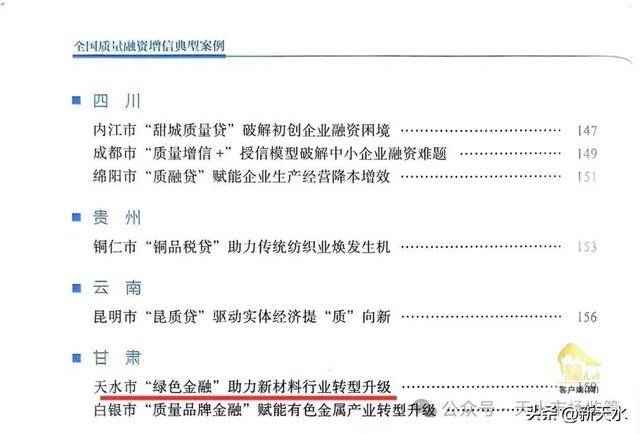
天水一案例入选全国质量融资增信典型案例
Sou Hu Cai Jing· 2025-12-23 09:09
Group 1 - The core viewpoint of the article highlights the successful inclusion of the case "Green Finance Supporting the Transformation and Upgrading of the New Materials Industry in Tianshui City" in the national quality financing credit enhancement typical case list, showcasing the practical measures taken by the Lanzhou Bank Tianshui Branch in implementing quality financing credit enhancement work [1] - The case involves Gansu Huajian New Materials Co., Ltd., which faced dual challenges of cash flow shortages and lack of long-term capital support for green transformation. The Lanzhou Bank Tianshui Branch designed a loan scheme linked to sustainable development performance indicators, effectively addressing the company's financing needs [3] - The loan of 10 million yuan was successfully issued in less than a month, helping the company reduce financing costs and alleviate financial pressure, thus achieving a dual empowerment of "financial water" and sustainable development for the enterprise [3] Group 2 - Since the beginning of this year, the Tianshui Market Supervision Bureau has collaborated with the People's Bank of China Tianshui Branch and other departments and financial institutions to explore a "cooperative bank + quality enterprises + precise credit" linkage model, providing low-threshold, low-cost credit support for quality-advantaged enterprises lacking traditional collateral [6] - As of now, 12 financial institutions, including Lanzhou Bank Tianshui Branch, have processed financing credit enhancement services for 30 quality-efficient enterprises, with a total financing amount of nearly 1.6 billion yuan and a credit enhancement quota of 1.2 billion yuan, effectively stimulating the endogenous motivation for quality improvement and innovative development among market entities [6]
兰州银行(001227) - 兰州银行股份有限公司2026年日常关联交易预计额度的公告
2025-12-22 11:15
证券代码:001227 证券简称:兰州银行 公告编号:2025-055 兰州银行股份有限公司 2026 年日常关联交易预计额度的公告 本行及董事会全体成员保证公告内容的真实、准确和完整,没有虚假记载、 误导性陈述或者重大遗漏。 (二)预计日常关联交易类别和金额 为进一步强化关联交易管理,提升关联交易管理水平,根据《银行保险机构 关联交易管理办法》《深圳证券交易所股票上市规则》等的规定,兰州银行股份 有限公司(以下简称"本行")对 2026 年预计发生的部分关联方的日常关联交易 进行了合理预计。该预计额度及交易内容均基于与相关客户的合作基础或未来业 务拓展需要,具体如下: 一、日常关联交易基本情况 (一)日常关联交易概述 本行的关联交易是指本行或者本行控股子公司与本行关联方之间发生的转 移资源或义务的事项,主要包括贷款、同业借款、票据融资等授信类业务以及资 产转让、提供服务、存款等非授信类业务。 2025 年 12 月 12 日,本行第六届董事会第六次会议之风险管理及关联交易 控制委员会会议审议通过了《兰州银行股份有限公司 2026 年日常关联交易预计 额度的议案》。 2025 年 12 月 13 日,本行 2 ...
兰州银行:12月19日召开董事会会议
Mei Ri Jing Ji Xin Wen· 2025-12-22 11:15
Group 1 - The core point of the article is that Lanzhou Bank announced the convening of its sixth board meeting to discuss the expected amount of daily related transactions for 2026 [1] - For the first half of 2025, Lanzhou Bank's revenue composition shows that interest income accounted for 197.73%, while non-interest income accounted for 4.99% [1] - As of the report date, Lanzhou Bank's market capitalization is 13.2 billion yuan [1] Group 2 - The article highlights a significant increase in sales for the new energy heavy truck sector, with November sales experiencing a year-on-year growth of 178% [1] - The demand for new energy heavy trucks is so high that customers are directly urging manufacturers for orders, indicating a supply shortage [1] - This surge in demand is described as a rare occurrence in the past decade [1]
兰州银行(001227) - 兰州银行股份有限公司第六届董事会第六次会议决议公告
2025-12-22 11:15
证券代码:001227 证券简称:兰州银行 公告编号:2025-054 兰州银行股份有限公司 第六届董事会第六次会议决议公告 本行及董事会全体成员保证公告内容的真实、准确和完整,没有虚假记载、 误导性陈述或者重大遗漏。 兰州银行股份有限公司(以下简称"本行")第六届董事会第六次会议通知以 电子邮件方式于 2025 年 12 月 9 日发出,会议于 2025 年 12 月 19 日以书面传签 方式召开。本次会议应参与表决董事 9 名,实际参与表决董事 9 名。会议的召开 符合《中华人民共和国公司法》《深圳证券交易所股票上市规则》和《兰州银行 股份有限公司章程》(以下简称《公司章程》)的规定,合法有效。 一、会议审议情况 会议审议通过了以下议案: (一)审议通过了《兰州银行股份有限公司 2026 年日常关联交易预计额度 的议案》 本议案已经本行董事会风险管理及关联交易控制委员会、2025 年第二次独 立董事专门会议审议通过,全体独立董事一致同意该事项并同意提交董事会审议。 《兰州银行股份有限公司 2026 年日常关联交易预计额度的公告》同日在巨 潮资讯网(http://www.cninfo.com.cn)披露,供 ...
10.3亿元市值限售股今日解禁


Ge Long Hui A P P· 2025-12-17 23:44
Core Viewpoint - On December 18, a total of 5 companies had their restricted shares unlocked, with a total unlock volume of 129 million shares, amounting to a market value of 1.03 billion yuan based on the latest closing price [1] Summary by Category Unlock Volume - The companies with the highest unlock volumes are Antong Holdings, Shengye Electric, and Junxin Co., with unlock shares of 100 million, 16.275 million, and 7.1961 million shares respectively [1] Unlock Market Value - In terms of unlock market value, Shengye Electric, Antong Holdings, and Junxin Co. lead with market values of 450 million yuan, 403 million yuan, and 112 million yuan respectively [1] Unlock Ratio - The companies with the highest unlock ratios relative to their total share capital are Shengye Electric, Antong Holdings, and Guangzi International, with unlock ratios of 20.05%, 2.37%, and 1.21% respectively [1]
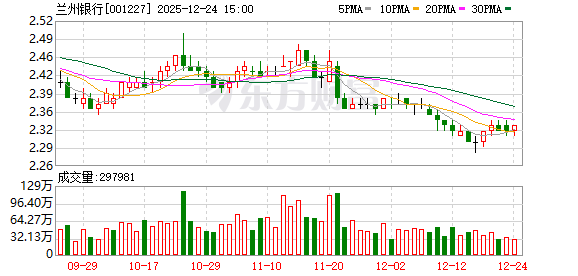
股票行情快报:兰州银行(001227)12月15日主力资金净卖出1967.50万元
Sou Hu Cai Jing· 2025-12-15 14:52
Core Viewpoint - Lanzhou Bank (001227) reported a stable stock price of 2.32 yuan as of December 15, 2025, with a slight increase of 0.0% and a trading volume of 384,200 hands, totaling a transaction amount of 89.148 million yuan [1]. Financial Performance - For the first three quarters of 2025, Lanzhou Bank's main revenue was 5.923 billion yuan, a year-on-year decrease of 2.14% [2]. - The net profit attributable to shareholders was 1.504 billion yuan, showing a year-on-year increase of 0.65% [2]. - The net profit after deducting non-recurring items was 1.425 billion yuan, reflecting a year-on-year increase of 2.39% [2]. - In Q3 2025, the bank's single-quarter main revenue was 2.003 billion yuan, down 2.67% year-on-year [2]. - The single-quarter net profit attributable to shareholders was 553 million yuan, up 0.28% year-on-year [2]. - The single-quarter net profit after deducting non-recurring items was 529 million yuan, with a significant year-on-year increase of 29.71% [2]. - The bank's debt ratio stood at 92.2%, with investment income reported at 1.351 billion yuan [2]. Capital Flow Analysis - On December 15, 2025, the net outflow of main funds was 19.675 million yuan, accounting for 22.07% of the total transaction amount [1]. - The net inflow of speculative funds was 12.0265 million yuan, representing 13.49% of the total transaction amount [1]. - The net inflow of retail funds was 7.6485 million yuan, making up 8.58% of the total transaction amount [1].

城商行板块12月12日跌0.23%,杭州银行领跌,主力资金净流出908.98万元
Zheng Xing Xing Ye Ri Bao· 2025-12-12 09:12
Core Points - The city commercial bank sector experienced a decline of 0.23% on December 12, with Hangzhou Bank leading the drop [1] - The Shanghai Composite Index closed at 3889.35, up 0.41%, while the Shenzhen Component Index closed at 13258.33, up 0.84% [1] Summary by Category Stock Performance - Hangzhou Bank closed at 15.12, down 0.92% with a trading volume of 543,600 shares and a transaction value of 824 million yuan [2] - Qilu Bank closed at 5.63, down 0.71% with a trading volume of 1,165,000 shares and a transaction value of 657 million yuan [2] - Qingdao Bank closed at 4.58, down 0.65% with a trading volume of 370,100 shares and a transaction value of 169 million yuan [2] - Chongqing Bank closed at 10.84, down 0.64% with a trading volume of 118,200 shares and a transaction value of 129 million yuan [2] - Chengdu Bank closed at 16.35, down 0.49% with a trading volume of 390,900 shares and a transaction value of 642 million yuan [2] - Lanzhou Bank closed at 2.32, down 0.43% with a trading volume of 529,700 shares and a transaction value of 123 million yuan [2] - Xiamen Bank closed at 7.56, down 0.26% with a trading volume of 358,000 shares and a transaction value of 270 million yuan [2] - Ningbo Bank closed at 27.72, down 0.25% with a trading volume of 215,400 shares and a transaction value of 596 million yuan [2] - Changsha Bank closed at 9.48, down 0.21% with a trading volume of 321,800 shares and a transaction value of 306 million yuan [2] - Jiangsu Bank closed at 10.39, down 0.19% with a trading volume of 1,989,400 shares and a transaction value of 2.066 billion yuan [2] Capital Flow - The city commercial bank sector saw a net outflow of 9.0898 million yuan from institutional investors, while retail investors contributed a net inflow of 230 million yuan [4] - Speculative funds experienced a net outflow of 2.21 billion yuan [4]