IFLYTEK(002230)

Search documents
胡润发布中国AI企业50强,前10有7家芯片公司
Guan Cha Zhe Wang· 2026-01-19 07:38
Core Insights - The 2025 Hurun China AI Companies Top 50 report highlights the rapid growth and prominence of AI chip companies in China, with the top three companies being Cambricon, Moore Threads, and Muxi, all of which are AI chip-related firms [1][2][6] Group 1: Company Performance - Cambricon ranks first with a valuation of 630 billion RMB, experiencing a 165% increase from the previous year. In Q3 2025, the company reported revenue of 1.727 billion RMB, a year-on-year growth of 1332.52%, and a net profit of 567 million RMB, marking its fourth consecutive profitable quarter [1][6] - Moore Threads, established in 2020, ranks second with a valuation of 310 billion RMB. The company achieved a revenue of 785 million RMB in the first three quarters of 2025, a 182% increase compared to the previous three years combined, although it reported a net loss of 724 million RMB [1][2] - Muxi ranks third with a valuation of 250 billion RMB, reporting revenue of 1.236 billion RMB in the first three quarters of 2025, a 453.52% year-on-year increase, while its net loss narrowed to 346 million RMB [2][6] Group 2: Industry Trends - The report indicates a significant increase in the number of AI chip companies on the list, with 14 firms represented, an increase of 9 from the previous year. This growth is attributed to the tightening of high-end AI chip export controls by the U.S., prompting domestic companies to accelerate their capabilities [6][7] - The AI user base in China is substantial, with 515 million users reported by mid-2025, indicating that nearly 40% of the population are users of generative AI [6] - The top 50 list features a total of 14 companies in the computing hardware sector, the largest category, followed by 11 in data analysis and decision-making, and 8 each in content generation, visual recognition, and autonomous driving [3][4] Group 3: Market Position - The combined market value of the top three Chinese computing power companies is approximately 1.2 trillion RMB, which is only 4% of Nvidia's market value, suggesting a significant gap that may narrow in the next five years as China's computing power industry advances [7] - Major cities dominate the list, with Beijing leading with 19 companies, followed by Shanghai with 14, indicating that over 80% of the listed companies are based in first-tier cities [4]



AI 与半导体双爆发!寒武纪领衔 AI 50 强!首发中国独角兽毕业榜
是说芯语· 2026-01-19 06:46
Core Insights - The report highlights the top 50 AI companies in China for 2025, with a focus on their valuations and industry distribution [1][10]. Group 1: Company Rankings - Cambricon leads the list with a valuation of 630 billion RMB, marking a 165% increase from the previous year [1][3]. - Moore Threads ranks second with a valuation of 310 billion RMB, while Muxi holds the third position at 250 billion RMB [1][3]. - The top 10 list is dominated by AI chip-related companies, with seven out of ten positions occupied by firms such as Horizon Robotics and Rockchip [1][3]. Group 2: Geographic Distribution - Over 60% of the listed companies are based in Beijing and Shanghai, with Beijing contributing 19 companies and Shanghai 14 [1][5]. - Shenzhen has six companies on the list, while Guangzhou has four, indicating a concentration of AI firms in major urban centers [1][5]. Group 3: Industry Segmentation - The report categorizes companies into various segments, with 14 companies in the computing hardware sector, an increase of nine from last year [2][6]. - Data analysis and decision-making companies account for 11 firms, up by four, while content generation, visual recognition, and autonomous driving each have eight companies represented [2][6]. Group 4: Youngest Companies - The youngest companies on the list, established in 2023, include "The Dark Side of the Moon" and "Bai Chuan Intelligent," both valued between 150-220 million RMB [7]. - Other young entrants include "Zero One Everything" and "Yuan Shen," showcasing the emergence of new players in the AI sector [7].
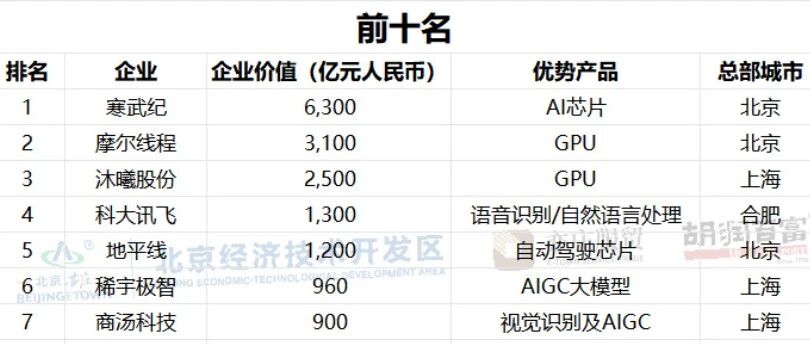
中国人工智能50强榜单出炉!寒武纪、摩尔线程、沐曦股份位列前三
Zheng Quan Shi Bao· 2026-01-19 04:53
Core Insights - The "2025 Hurun China AI Companies Top 50" report highlights the increasing valuation and significance of AI companies in China, particularly in the AI chip sector [1][6] - The threshold for inclusion in the list has risen significantly, indicating a growing market and competition within the AI industry [1] Valuation and Rankings - The average value of listed companies is 54 billion RMB, which is 2.4 times higher than the previous year [1] - The top ten companies have a valuation threshold of 73 billion RMB, more than three times the previous year's 22 billion RMB [1] - The top three companies are all AI chip-related, with Cambrian Technology leading at 630 billion RMB, followed by Moore Threads at 310 billion RMB, and Muxi Technology at 250 billion RMB [4][5] Company Performance - Cambrian Technology reported a revenue of 2.88 billion RMB in the first half of 2025, a 43-fold increase year-on-year [4] - Moore Threads achieved a revenue of 780 million RMB in the first three quarters of 2025, marking a 182% year-on-year growth [5] - Muxi Technology has focused on high-end GPU development and is among the first to achieve full domestic production [5] Geographic Distribution - Beijing leads with 19 companies on the list, followed by Shanghai with 14, indicating a concentration of AI talent and resources in major cities [7] - Over 80% of the listed companies are based in first-tier cities, showcasing their importance in the AI sector [7] Industry Trends - The number of AI chip companies on the list has increased to 14, up by 9 from the previous year, driven by domestic demand due to U.S. export controls [6] - The AI sector is reshaping wealth distribution in China, with notable increases in the wealth of key figures in the industry [9]

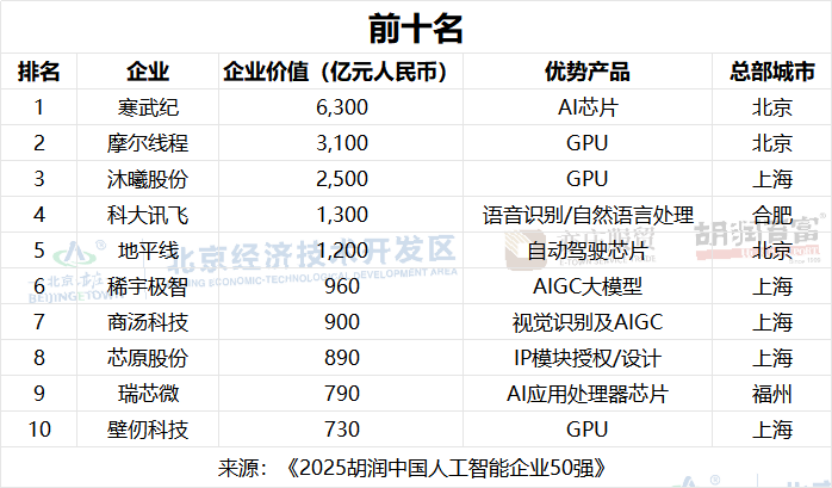
《2025胡润中国人工智能企业50强》重磅发布 寒武纪以6300亿价值位居榜首
Zhi Tong Cai Jing· 2026-01-19 04:51
Core Insights - The 2025 Hurun China AI Companies Top 50 list highlights the growth and valuation of AI-focused companies in China, with a significant increase in the number of AI chip companies due to tightening U.S. export controls on high-end AI chips [1][2] Company Rankings - Cambricon leads the list with a valuation of 630 billion RMB, marking a 165% increase from the previous year [1][2] - Moore Threads ranks second with a valuation of 310 billion RMB, achieving a 182% year-on-year revenue growth [3] - Muxi ranks third with a valuation of 250 billion RMB, recognized as one of the first high-end GPU companies to achieve full domestic production [3] - iFlytek, a leader in intelligent voice technology, ranks fourth with a valuation of 130 billion RMB [4] - Horizon Robotics ranks fifth with a valuation of 120 billion RMB, focusing on automotive AI chips [4] Market Trends - The list shows a total of 21 non-listed companies, with the entry threshold raised to 9.5 billion RMB, an increase of 3.5 billion RMB from last year [1] - The average valuation of listed companies is 54 billion RMB, which is 2.4 times higher than the previous year [1] - The number of AI chip companies on the list has increased to 14, up from 5 last year, indicating a shift towards domestic AI chip production [1] Geographic Distribution - Beijing leads with 19 companies on the list, followed by Shanghai with 14, and Shenzhen with 6, indicating a concentration of AI talent and resources in first-tier cities [1] Sector Breakdown - The majority of companies on the list are focused on AI chip hardware, with 14 companies in this category, reflecting the growing importance of AI infrastructure [5] - Other sectors include data analysis and decision-making with 11 companies, and content generation with 8 companies [5]
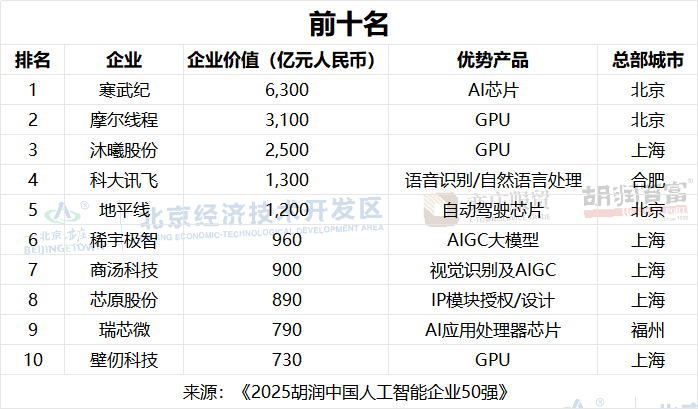
中国人工智能50强榜单出炉!寒武纪、摩尔线程、沐曦股份位列前三
证券时报· 2026-01-19 04:46
Core Insights - The article discusses the release of the "2025 Hurun China AI Companies Top 50" list, highlighting the significant growth in valuations and the increasing importance of AI companies in China [1]. Group 1: AI Companies Overview - The list features 50 companies focused on AI computing power or algorithms, with a minimum valuation of 9.5 billion RMB, an increase of 3.5 billion RMB from the previous year [1]. - The average value of the listed companies is 54 billion RMB, which is 2.4 times higher than last year [1]. - The top ten companies have a minimum valuation of 73 billion RMB, more than three times the previous year's threshold of 22 billion RMB [1]. Group 2: Leading Companies - Cambricon Technologies ranks first with a valuation of 630 billion RMB, focusing on AI core processor chip development, achieving a revenue of 2.88 billion RMB in the first half of 2025, a 43-fold increase year-on-year [4][6]. - Moore Threads, established in 2020, ranks second with a valuation of 310 billion RMB and reported a revenue of 780 million RMB in the first three quarters of 2025, a 182% year-on-year increase [5]. - Muxi Co., Ltd. ranks third with a valuation of 250 billion RMB, specializing in full-stack GPU development [6]. Group 3: Industry Trends - The AI chip sector shows a significant valuation advantage over other fields, with 14 AI chip companies making the list, an increase of 9 from the previous year [6]. - The concentration of AI companies is primarily in first-tier cities, with Beijing leading with 19 companies, followed by Shanghai with 14, indicating a strong urban cluster effect in the AI sector [8]. - The article notes that AI is reshaping China's wealth landscape, with notable increases in the wealth of individuals in the AI sector, such as Chen Tian Shi of Cambricon, whose wealth grew by nearly 150 billion RMB [10].


晨会纪要-20260119
Guoxin Securities· 2026-01-19 01:35
Group 1: Outdoor Apparel Industry - The outdoor footwear and apparel industry has maintained rapid growth since 2021, with a CAGR of 25.3% for outdoor apparel and 18.4% for outdoor footwear, projected to grow by 24.5% and 16.3% year-on-year in 2025 respectively [24][26] - Online sales of outdoor footwear are growing faster than apparel, with outdoor footwear online sales growth maintaining over 40%, while certain apparel categories like jackets and sun-protective clothing are experiencing slower growth [24][26] - Key outdoor brands such as Kailas and Berghaus are showing strong momentum, while brands like The North Face are underperforming; the market is becoming more diversified with new brands emerging [25][26] Group 2: AI Application in Computing Industry - Major international companies are focusing on AI application in vertical scenarios, with OpenAI and Anthropic launching healthcare-focused AI models, enhancing compliance and professional services [28] - Domestic companies are also advancing in AI applications, with Alibaba upgrading health services and Tencent providing comprehensive support for mini-programs, indicating a strong push towards AI integration [28] - The market for AI applications is expected to see significant growth, with predictions indicating that the GEO market will reach $24 billion globally by 2026, driven by high consumer trust in AI applications in China [30][32] Group 3: Public Utilities Industry - The public utilities sector, including electricity, gas, and water, is characterized by its "essential" nature, with stable long-term growth prospects [32] - The transition to low-carbon energy sources is accelerating, with the share of clean energy consumption expected to reach 28.6% of total energy consumption by 2024, up 2.2 percentage points year-on-year [32][33] - There is a growing trend of overseas funds over-allocating to the public utilities sector, with significant increases in holdings by institutional investors in this industry [33]




品牌工程指数 上周涨0.6%
Zhong Guo Zheng Quan Bao· 2026-01-18 21:37
Core Viewpoint - The market experienced fluctuations last week, but the overall trend remains positive with a low probability of systemic risks in 2026, driven by favorable macro policies and industry factors [1][4]. Market Performance - The China National Brand Index rose by 0.60% to 2059.78 points last week, while the Shanghai Composite Index fell by 0.45% and the Shenzhen Component Index increased by 1.14% [2]. - Notable performers included Changdian Technology, which surged by 17.51%, and Huazhong Microelectronics, which rose by 17.36% [2]. Year-to-Date Performance - Year-to-date, Anji Technology has increased by 38.85%, leading the gains, followed by Zhongwei Company at 38.29% and Changdian Technology at over 30% [3]. - Other significant gainers include Huazhong Microelectronics and Keda Xunfei, which rose by 29.02% and 26.67%, respectively [3]. Investment Strategy - Market sentiment has shown considerable volatility, but the impact on liquidity is minimal, primarily affecting short-term emotions [4]. - As annual performance forecasts begin to be disclosed, sectors with strong earnings support are expected to attract more attention from investors [4]. - The investment strategy emphasizes structural selection as key, with expectations of more industries entering a performance realization phase due to domestic policy support [4].



品牌工程指数上周涨0.6%
Zhong Guo Zheng Quan Bao· 2026-01-18 20:45
Group 1 - The core index of the National Brand Engineering Index rose by 0.60% last week, closing at 2059.78 points, with strong performances from stocks like Changdian Technology, China Resources Microelectronics, and Glodon [1][2] - The market experienced fluctuations, with the Shanghai Composite Index down by 0.45%, while the Shenzhen Component Index and the ChiNext Index rose by 1.14% and 1.00% respectively [1] - Year-to-date, stocks such as Anji Technology and Zhongwei Company have shown significant gains, with Anji Technology up by 38.85% and Zhongwei Company up by 38.29% [2] Group 2 - Market sentiment has been volatile, with regulatory policies leading to a decrease in speculative trading, but the actual impact on market liquidity is minimal [2] - Starstone Investment indicates that there are still many opportunities in the market, particularly as domestic policies drive supply-demand balance and price recovery, leading to more industries entering the performance realization phase [3] - Looking ahead to 2026, the overall market is expected to trend upwards due to positive macroeconomic policies and industry factors, although increased volatility and operational challenges are anticipated [3]
未来的机会在这里!任泽平带你看前沿科技
泽平宏观· 2026-01-18 16:05
Core Insights - The article emphasizes the importance of practical learning experiences in the field of investment and technology, highlighting the value of direct engagement with leading companies and experts in various industries [2][7][19]. Schedule Overview - The schedule for 2026 includes visits to major tech companies and universities, such as NVIDIA, Tesla, and Stanford University, focusing on cutting-edge technologies and innovations [3][4][5]. - Specific events include closed-door research meetings on AI and technology trends, as well as visits to companies like Huawei, BYD, and others in the robotics and AI sectors [18][19][57]. Company Engagement - The program aims to connect entrepreneurs with top executives and scientists to gain insights into strategic decisions and technological advancements [7][19]. - Participants will explore various sectors, including AI, robotics, and new energy, through hands-on experiences and discussions with industry leaders [19][57]. Learning Philosophy - The initiative promotes a philosophy of "reading extensively and traveling widely," encouraging participants to learn from real-world applications and innovations in technology [2][38]. - The focus is on fostering a mindset of long-term thinking and ethical business practices among entrepreneurs [2][40].





【数智周报】 谷歌DeepMind CEO:中国的AI模型仅落后美国几个月;DeepSeek开源相关记忆模块Engram;微软在人工智能上的支出将达到5...
Tai Mei Ti A P P· 2026-01-18 02:38
Group 1 - Keda Xunfei's Chairman Liu Qingfeng stated that the domestic AI infrastructure has taken initial shape, with domestic large models matching international standards despite having half the parameters [2] - Michael Burry warned that the era of tech giants earning huge profits with minimal investment is ending, primarily due to AI, and investors should focus on Return on Invested Capital (ROIC) rather than revenue growth [3] - A BlackRock survey revealed that while investors are optimistic about AI, they are shifting their investment focus towards energy and infrastructure suppliers, with only one-fifth considering large US tech companies as attractive investment opportunities [4] Group 2 - Demis Hassabis, CEO of Google DeepMind, indicated that Chinese AI models are only a few months behind those in the US and Western countries, with significant advancements made by Chinese developers [5] - DeepSeek released a new paper on conditional memory, significantly improving model performance in various tasks, and has open-sourced a related memory module [6] - Wang Xiaochuan, CEO of Baichuan Intelligent, mentioned that the company has 3 billion yuan on hand and may initiate an IPO plan in 2027 [7] Group 3 - Zhiyu and Huawei launched the first domestically trained multimodal SOTA model on local chips, achieving a full training process on the Ascend Atlas 800T A2 device [8] - Kuaishou announced that Keling AI's revenue exceeded $20 million in December 2025, with an annual recurring revenue (ARR) of $240 million [9] - Yongyou Network projected a net loss of 1.3 to 1.39 billion yuan for 2025, although it expects to reduce losses compared to the previous year [10] Group 4 - JD.com and Lenovo deepened their "hybrid AI" cooperation, launching new products at CES 2026, with a focus on strategic collaboration around smart devices and services [11] - Alibaba's Qianwen app integrated with various services, allowing users to order food and book flights through AI, marking a significant upgrade in functionality [12] - Alipay and partners released China's first AI commercial agreement, aimed at creating a universal language for AI tasks across platforms [13] Group 5 - Yunhai Medical launched the "YunJian AI Spirit," a product that reduces long-term costs for users by offering unlimited access to traditional Chinese medicine infrared algorithms [14] - Zhiyuan purchased thousands of hours of robot training data for various tasks [15] - Meituan released the open-source "ReThink" model, achieving state-of-the-art performance in several benchmarks [16] Group 6 - Teslian introduced the upgraded T-Cluster 512 super node architecture, designed for high-performance AI model training, with a total computing power exceeding 500 PFlops [17] - Keda Xunfei launched a marketing AI platform based on the "SuperAgent" framework, enhancing efficiency in marketing strategies [18] - The first domestically trained text-to-image model was released by Zhiyu and Huawei, completing the entire training process on local chips [19] Group 7 - Tencent Cloud ADP launched the first "AI-native Widget," enhancing task delivery experiences through natural language interaction [20] - Anthropic implemented stricter measures to prevent third-party tools from bypassing rate limits, affecting several developer projects [21] - Google announced a partnership with Walmart to expand AI model shopping capabilities, allowing direct transactions through its AI application [22] Group 8 - Mark Zuckerberg initiated the "Meta Compute" project, aiming to build substantial AI infrastructure by 2030, with a focus on collaboration with governments [23] - Meta plans to lay off hundreds of employees in its Reality Labs department, shifting focus from the metaverse to AI [24] - Alphabet's market value surpassed $4 trillion for the first time, joining a select group of companies [24] Group 9 - Nvidia and Eli Lilly will jointly invest $1 billion to establish an AI drug laboratory over the next five years [26] - The US relaxed export controls on Nvidia's H200 chips to China, potentially impacting the AI hardware market [27] - Microsoft announced a plan to limit the impact of data center energy costs and water usage on local communities [29] Group 10 - OpenAI is reportedly seeking US hardware suppliers for its planned consumer devices and cloud data center expansion [32] - Elon Musk's lawsuit against OpenAI is set to go to trial in late April [33] - OpenAI and Cerebras announced a partnership worth over $10 billion to deploy a large-scale AI inference platform [34] Group 11 - Zivariable Robotics completed a 1 billion yuan A++ round of financing, backed by major investors including ByteDance and Meituan [35] - Qiangnao Technology submitted a confidential IPO application in Hong Kong [36] - OpenAI agreed to acquire the AI health application Torch for approximately $100 million [37] Group 12 - K2 Lab, founded by a former DingTalk executive, secured tens of millions in seed funding to develop an AI-driven content e-commerce agent [38] - Alibaba Cloud completed a strategic investment in ZStack, achieving a controlling stake [39] - Skild AI raised nearly $1.4 billion in funding, reaching a valuation of over $14 billion [40] Group 13 - WeLab completed a $220 million D-round strategic financing, the largest single round since its inception [41] - Merge Labs, a brain-machine interface startup, raised $252 million in seed funding, with OpenAI as a major investor [42] Group 14 - A report indicated that by 2026, the Chinese tech giants index is expected to surpass the US tech giants in profitability growth for the first time since 2022 [43] - China is accelerating the establishment of a data property registration system to enhance data circulation and value [44] - Storage prices are expected to surge by 40%-50% in Q4 2025 and again in Q1 2026 due to increased demand from AI and server capacity [45] Group 15 - A new AI model developed by US researchers can predict the risk of approximately 130 diseases based on sleep data [46] - Foreign investment firms are increasingly incorporating AI into their research processes in the Chinese market [47] - UBS believes the probability of an AI bubble in China is low, with monetization relying on cloud services and advertising [48] Group 16 - The number of AI companies in China has exceeded 6,200, with applications expanding across various industries [49]