GoerTek(002241)

Search documents
12月2日内地消费电子(983105)指数跌0.04%,成份股美图公司(01357)领跌
Sou Hu Cai Jing· 2025-12-02 16:15
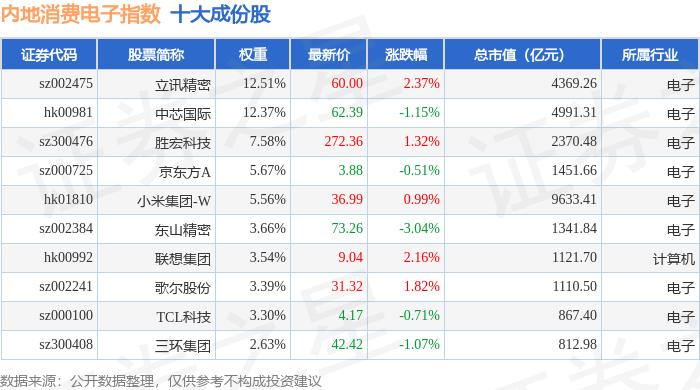
Core Points - The mainland consumer electronics index (983105) closed at 4679.66 points, down 0.04%, with a trading volume of 75.462 billion yuan and a turnover rate of 1.56% [1] - Among the index constituents, 20 stocks rose while 29 fell, with AAC Technologies leading the gainers at 3.95% and Meitu leading the decliners at 6.0% [1] Index Constituents Summary - The top ten constituents of the mainland consumer electronics index are as follows: - Luxshare Precision (sz002475) holds a weight of 12.51%, latest price at 60.00 yuan, with a market cap of 436.926 billion yuan and a rise of 2.37% [1] - SMIC (hk00981) has a weight of 12.37%, latest price at 62.39 yuan, with a market cap of 499.131 billion yuan and a decline of 1.15% [1] - Other notable constituents include BOE Technology (sz000725) with a weight of 5.67% and a market cap of 145.166 billion yuan, and Xiaomi (hk01810) with a weight of 5.56% and a market cap of 963.341 billion yuan [1] Capital Flow Analysis - The net inflow of main funds into the index constituents totaled 775 million yuan, while retail funds saw a net outflow of 347 million yuan [3] - Key stocks with significant fund flows include: - Luxshare Precision with a net inflow of 604 million yuan, accounting for 5.53% of the main funds [3] - Other stocks like GoerTek (sz002241) and Shenghong Technology (300476) also experienced notable fund movements [3]




主力资金流入前20:工业富联流入8.44亿元、立讯精密流入6.19亿元



Jin Rong Jie· 2025-12-02 02:49
Core Insights - The main focus of the article is on the significant inflow of capital into specific stocks as of December 2, with notable amounts recorded for various companies [1] Group 1: Capital Inflows - The top stock receiving capital inflow is Industrial Fulian, with an inflow of 844 million yuan [1] - Luxshare Precision follows with an inflow of 619 million yuan [1] - Pingtan Development and Shenghong Technology also show strong inflows of 546 million yuan and 544 million yuan respectively [1] Group 2: Other Notable Stocks - Other companies with significant capital inflows include: - Tianfu Communication with 358 million yuan [1] - BYD with 319 million yuan [1] - Aerospace Power with 297 million yuan [1] - Additional companies in the top inflow list include: - GoerTek with 287 million yuan [1] - Rongji Software with 276 million yuan [1] - Aerospace Development with 228 million yuan [1]
歌尔股份-Meta Oculus VR 头显出货量与歌尔股价的关联
2025-12-02 02:08
Summary of GoerTek Inc Conference Call Company and Industry Overview - **Company**: GoerTek Inc (002241.SZ) - **Industry**: Greater China Technology Hardware - **Focus**: Analysis of Meta's VR headset shipments and their impact on GoerTek's share price Key Points Meta's VR Headset Shipments - **3Q25 Shipments**: 847K units, representing a **54% increase QoQ** but a **28% decrease YoY** [1] - **Market Share**: Meta's share increased by **6 percentage points QoQ**, reaching **90%** [1] - **Industry Comparison**: Shipments exceeded IDC's estimate of **681K units** for the overall industry [8] GoerTek's Share Price Performance - **Current Share Price**: Rmb30.76 as of December 1, 2025 - **Price Target**: Rmb16.60, indicating a potential downside of **46%** from the current price [5] - **52-Week Range**: Rmb40.68 to Rmb17.11 [5] - **Market Capitalization**: Rmb105,212 million [5] Financial Metrics - **Revenue Projections**: - FY 2025: Rmb100,300 million - FY 2026: Rmb104,999 million - FY 2027: Rmb113,559 million [5] - **EBITDA Projections**: - FY 2025: Rmb8,112 million - FY 2026: Rmb8,427 million - FY 2027: Rmb9,231 million [5] - **Earnings Per Share (EPS)**: - FY 2025: Rmb1.13 - FY 2026: Rmb1.09 - FY 2027: Rmb1.25 [5] Valuation and Risks - **Valuation Methodology**: Based on residual income valuation with a cost of equity of **10%**, medium-term growth rate of **13%**, and terminal growth rate of **5%** [9] - **Risks to Upside**: - Better-than-expected yield ramp-up for AirPods - Share gain within iPhone acoustic business - Higher acoustic pricing [11] - **Risks to Downside**: - Intensified competition in the acoustic market - Potential share loss in iPhone acoustic business and AirPods assembly supply [11] Analyst Ratings - **Stock Rating**: Underweight [5] - **Industry View**: In-Line [5] Additional Insights - The shipment slowdown due to model transitions may continue to limit GoerTek's share price upside in the near term [1] - The analysis indicates a cautious outlook for GoerTek, given the competitive landscape and potential risks associated with its product lines [11]

歌尔股份:累计回购约3450万股
Mei Ri Jing Ji Xin Wen· 2025-12-01 09:27
Group 1 - The core point of the article is that GoerTek Inc. announced a share buyback plan, intending to repurchase approximately 34.5 million shares, which represents 0.97% of the total share capital, with a total expenditure of about 950 million yuan [1] - The share buyback will be conducted using self-owned and self-raised funds through centralized bidding transactions, with the highest transaction price being 34.09 yuan per share and the lowest at 20.35 yuan per share [1] - For the first half of 2025, GoerTek's revenue composition shows that the electronic components manufacturing sector accounts for 96.59% of total revenue, while other businesses contribute 3.41% [1] Group 2 - As of the report, GoerTek's market capitalization stands at 109.1 billion yuan [2]
歌尔股份(002241.SZ):累计回购0.97%股份
Ge Long Hui A P P· 2025-12-01 09:25
格隆汇12月1日丨歌尔股份(002241.SZ)公布,公司于2025年4月11日首次通过回购专用证券账户以集中 竞价交易方式实施本次回购股份。截至2025年11月30日,公司通过回购专用证券账户使用自有资金和自 筹资金以集中竞价交易方式累计回购股份34,497,046股,占公司总股本的比例为0.97%,最高成交价为 34.09元/股,最低成交价为20.35元/股,支付金额为950,080,648.62元(不含交易费用)。 ...
歌尔股份(002241) - 关于回购公司股份的进展公告
2025-12-01 09:16
证券代码:002241 证券简称:歌尔股份 公告编号:2025-125 二、其他说明 公司回购股份的时间、回购股份数量、回购股份价格及集中竞价交易的委托时 间段均符合公司回购股份的方案及《深圳证券交易所上市公司自律监管指引第 9 号 ——回购股份》等相关规定。 歌尔股份有限公司 关于回购公司股份的进展公告 本公司及董事会全体成员保证信息披露的内容真实、准确、完整,没有虚假记 载、误导性陈述或重大遗漏。 歌尔股份有限公司(以下简称"公司")于 2025 年 4 月 10 日召开第六届董事会 第二十四次会议,审议通过了《关于回购公司股份方案的议案》,同意公司以自有资 金和自筹资金通过集中竞价交易的方式回购部分公司发行的人民币普通股(A 股) 用于员工持股计划或股权激励计划。本次回购的资金总额不低于人民币 5 亿元(含) 且不超过人民币 10 亿元(含),回购价格不超过人民币 38.97 元/股(含),具体回 购股份的数量及占公司总股本的比例以实际情况为准。本次回购股份的实施期限为 自 2025 年 4 月 10 日起不超过 12 个月。具体内容详见信息披露媒体巨潮资讯网 http://www.cninfo.com ...
山东潍坊:“五个逻辑”护航民营经济高质量发展
Zhong Guo Fa Zhan Wang· 2025-12-01 06:27
Core Viewpoint - The city of Weifang is actively enhancing its business environment to support the growth and innovation of private enterprises, aiming for high-quality development of the private economy as part of its broader strategy for urban improvement [1][6]. Group 1: Business Environment - Weifang has established a strong business environment, which is seen as a "lifeline" for the high-quality development of the private economy, recognizing the crucial role of private enterprises in driving market economic growth [8][9]. - The city government has implemented various measures to optimize the business environment, including the establishment of a leadership group for business environment optimization and the introduction of the "Weifang City Business Environment Optimization Regulations" [8][9]. Group 2: Economic Contributions - As of September 2023, Weifang has 1.463 million private economic entities, with private investment accounting for 83.9% of total investment, and the private economy contributing 63% to the regional GDP [6][8]. - The private sector is responsible for 60% of the city's GDP, 70% of investment, 80% of tax revenue, and 90% of employment, highlighting its vital role in the local economy [6][8]. Group 3: Policy and Institutional Support - Weifang has introduced a series of policies aimed at enhancing institutional support for private enterprises, including a streamlined approval process that allows businesses to complete necessary permits in as little as one day [10][11]. - The city has established a project reserve library for private economic projects and is actively promoting private capital participation in major projects, thereby expanding the development space for the private economy [22][23]. Group 4: Innovation and Technology - Innovation is identified as a core driver of growth for private enterprises in Weifang, with the city housing 25 national-level manufacturing champions and 178 provincial-level champions [18][20]. - The local government encourages private enterprises to increase R&D investment and collaborate with universities and research institutions to foster technological innovation [18][20]. Group 5: Talent and Human Resources - Weifang is enhancing its talent attraction strategies by implementing favorable policies to draw high-level talent and innovative teams to the city, thereby invigorating the private economy [15][25]. - The establishment of the Weifang Entrepreneurs' International Alliance aims to consolidate the power of entrepreneurs and facilitate their integration into both domestic and international markets [9][15]. Group 6: Future Outlook - The city is committed to building a modern industrial system and aims to create a first-class business environment to support the sustainable development of the private economy [9][21]. - Weifang's private enterprises are expected to play a significant role in the city's modernization efforts, contributing to a robust and dynamic economic landscape [26].
歌尔股份涨2.06%,成交额17.50亿元,主力资金净流入2587.26万元
Xin Lang Cai Jing· 2025-12-01 03:14
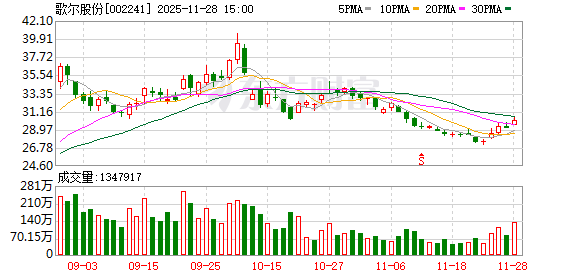
Core Viewpoint - Goer Group's stock price has shown a significant increase this year, with a 20.13% rise, despite recent fluctuations in trading performance [2] Group 1: Stock Performance - As of December 1, Goer Group's stock price rose by 2.06% to 30.65 CNY per share, with a trading volume of 1.75 billion CNY and a turnover rate of 1.86%, resulting in a total market capitalization of 108.67 billion CNY [1] - Year-to-date, Goer Group's stock has increased by 20.13%, with an 11.17% rise in the last five trading days, but has seen a decline of 6.53% over the past 20 days and 16.20% over the last 60 days [2] Group 2: Financial Performance - For the period from January to September 2025, Goer Group reported a revenue of 68.11 billion CNY, a year-on-year decrease of 2.21%, while the net profit attributable to shareholders was 2.59 billion CNY, reflecting a year-on-year growth of 10.33% [3] Group 3: Shareholder and Dividend Information - Goer Group has distributed a total of 5.48 billion CNY in dividends since its A-share listing, with 2.23 billion CNY distributed over the past three years [4] - As of October 31, 2025, the number of shareholders increased to 340,700, a rise of 6.79%, while the average number of tradable shares per person decreased by 6.33% to 9,191 shares [3]
歌尔股份有限公司 第七届董事会第二次会议决议公告
Zhong Guo Zheng Quan Bao - Zhong Zheng Wang· 2025-11-29 00:03
登录新浪财经APP 搜索【信披】查看更多考评等级 证券代码:002241 证券简称:歌尔股份 公告编号:2025-120 歌尔股份有限公司 第七届董事会第二次会议决议公告 本公司及董事会全体成员保证信息披露的内容真实、准确、完整,没有虚假记载、误导性陈述或重大遗 漏。 歌尔股份有限公司(以下简称"公司")第七届董事会第二次会议(以下简称"本次会议")通知于2025年 11月26日以电子邮件方式发出,于2025年11月28日在公司会议室以现场加通讯表决方式召开。公司董事 长姜滨先生主持会议,会议应出席董事9名,实际出席董事9名。本次会议符合有关法律、法规及《歌尔 股份有限公司章程》(以下简称"《公司章程》")的规定,会议合法有效。公司董事会秘书徐大朋先生 列席了本次会议。 一、董事会会议审议情况 经审议,形成如下决议: 1、审议通过《关于补选暨提名第七届董事会独立董事候选人的议案》 为保证公司董事会科学有序决策,规范高效运作,根据《中华人民共和国公司法》《上市公司独立董事 管理办法》等法律、法规、规范性文件和《公司章程》的规定,经公司董事会提名委员会对独立董事候 选人任职资格审查通过,并征求独立董事候选人本人同 ...
歌尔股份:关于补选第七届董事会独立董事的公告
Zheng Quan Ri Bao· 2025-11-28 12:38
Core Viewpoint - The company announced the nomination of Mr. Gao Yonggang as an independent director candidate for the seventh board of directors during the second meeting held on November 28, 2025 [2] Group 1 - The company held its second meeting of the seventh board of directors on November 28, 2025 [2] - The board approved the proposal for the election and nomination of independent director candidates [2] - Mr. Gao Yonggang was nominated as an independent director candidate [2]